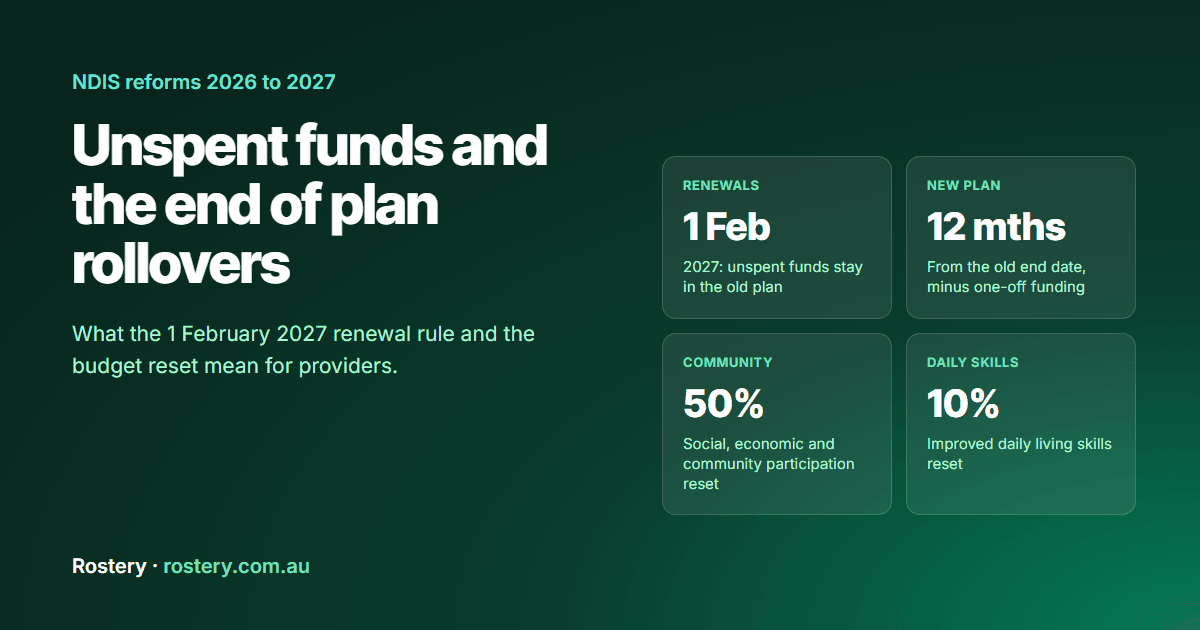
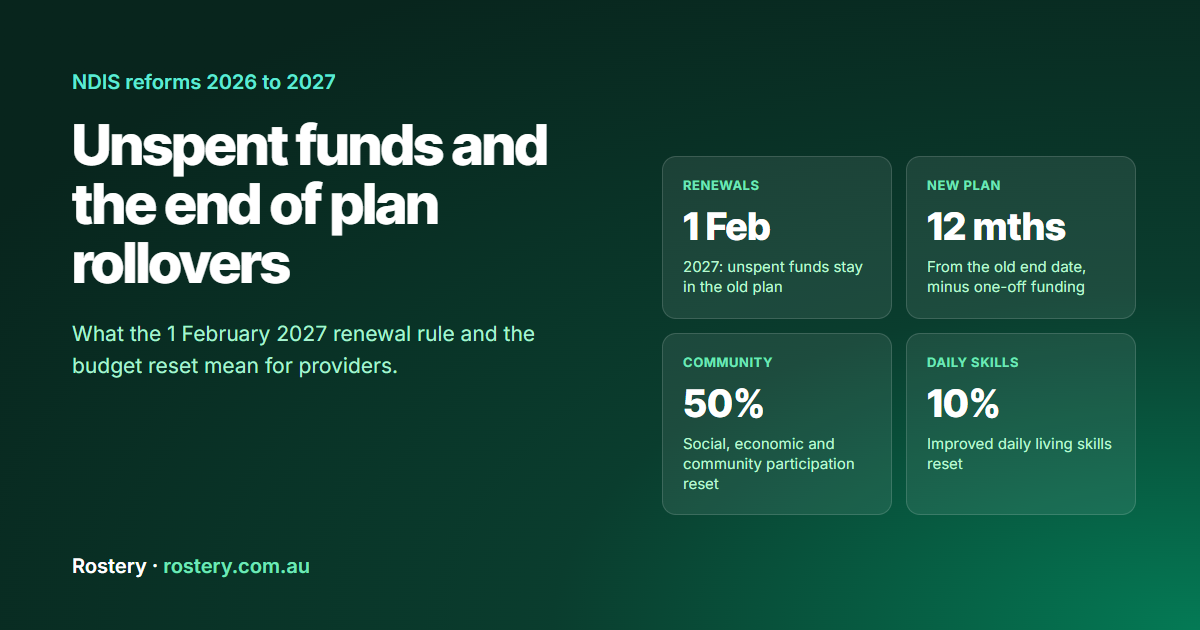
From 1 February 2027, when an NDIS participant's plan reaches its end date it is renewed as a new 12-month plan, and money left unspent in the old plan does not carry over. Until now a plan that passed its reassessment date simply kept going, with whatever was left in it. On top of that, since 1 October 2026 the NDIA has been resetting two budgets as plans are created, reassessed or renewed: funding for social, economic and community participation drops by 50%, and funding for improved daily living skills (formerly capacity building daily activities) drops by 10%. For providers this means checking what each participant has left before you roster, reviewing service agreements whenever a new plan arrives, and claiming promptly at plan end.
In short
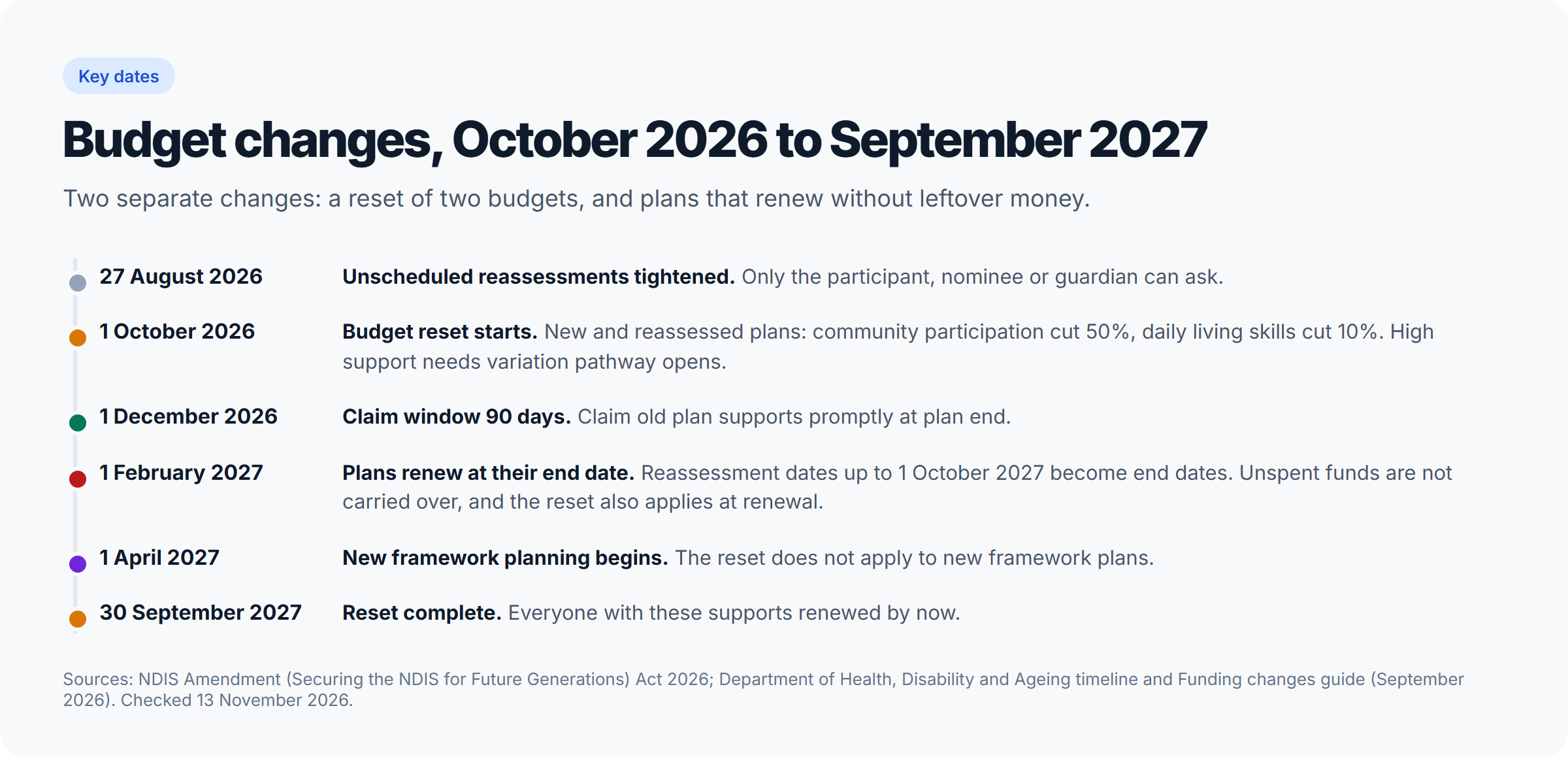
- 1 February 2027: plans have an end date and renew automatically as a new plan with the same supports, minus one-off funding. Unspent money stays behind in the old plan.
- Reassessment dates on or before 1 October 2027 become end dates. Later ones are replaced by a date the Minister sets, which can be earlier.
- 1 October 2026 to 30 September 2027: social, economic and community participation budgets are cut by 50% and improved daily living skills by 10% as each plan is created, reassessed or renewed.
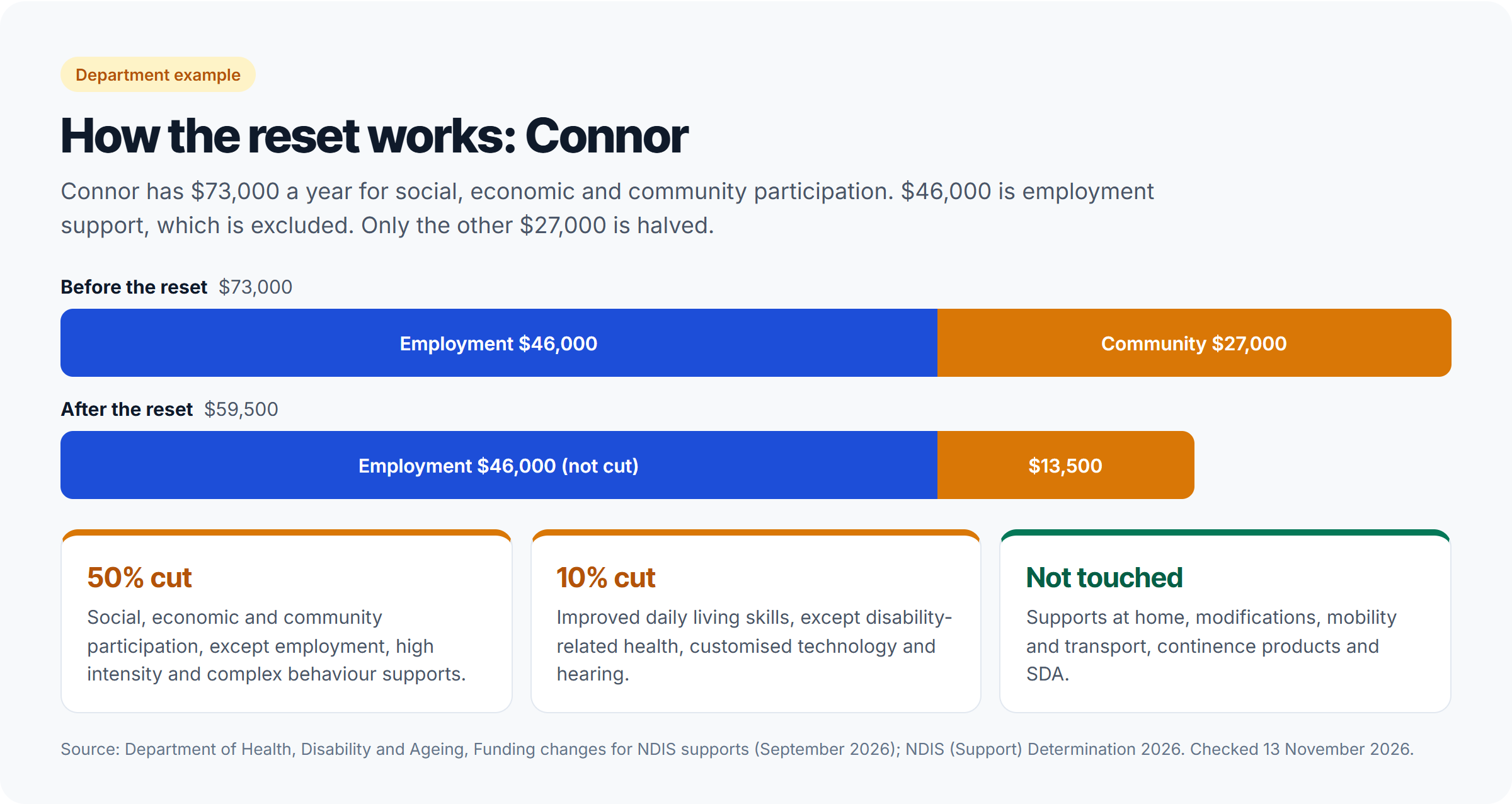
- Employment supports, high intensity supports, complex behaviour supports, disability-related health supports, customised and wearable technology and hearing services are not cut.
- High support needs participants with 24-hour supports can ask for a plan variation within 90 days.
This is the provider's view, built from the Act, the Minister's support determination and the department's guides. For every other reform date, see our NDIS changes 2026 hub.
What changes on 1 February 2027
Schedule 1, Part 5 of the NDIS Amendment (Securing the NDIS for Future Generations) Act 2026 starts on 1 February 2027. It gives every old framework plan an end date and adds a new section 50A to the NDIS Act: when a plan reaches its end date, it is "renewed as a new plan" immediately after.
| Until 31 January 2027 | From 1 February 2027 | |
|---|---|---|
| When the date passes | The reassessment date passes and the plan continues in effect, often until a date the NDIA notifies | The end date passes and the plan is renewed as a new plan the next day |
| Money left in the plan | Stays available while the plan continues | Not carried over to the renewed plan |
| Length of the new plan | Open, until reassessment | 12 months from the old end date |
| Supports in the new plan | Same plan | Same text as the old plan, without one-off funding, plus any changes the Minister sets by instrument |
| New planning meeting? | Reassessment if the NDIA starts one | No. The renewal needs no new statement of supports and is not a reviewable decision |
| Copy of the plan | Within 7 days after it comes into effect | As soon as practicable, which may be more than 7 days after it starts |
The department's timeline says it plainly: "As plans reach their scheduled reassessment dates, a renewed plan will be created and unspent funds from the previous plan will not be carried over." Inside a plan nothing changes. The NDIA's own guidance is that unused funding rolls over from one funding period to the next within the same plan, but unspent money at the end of a plan does not roll into the next one.
The Act also sets the dates. A plan in effect on 1 February 2027 whose reassessment date is on or before 1 October 2027 treats that date as its end date. If the reassessment date is later, the Minister can set a replacement date by instrument, and the Act allows it to be earlier than the date in the plan. If the NDIA has already told a participant their plan will continue until a set date, that date is used.
The budget reset that started on 1 October 2026
The second change is already happening. The Minister made the National Disability Insurance Scheme (Support) Determination 2026 under section 34A of the NDIS Act, and it took effect on 1 October 2026. It cuts the amount available in two groups of supports when a plan is created, reassessed or renewed.
| Group of supports | Formerly called | Reduction | Not reduced (excluded subgroups) |
|---|---|---|---|
| Social, economic and community participation | Social, civic and community participation | 50% | Supports in employment, high intensity supports, intensive and complex behaviour supports |
| Improved daily living skills | Capacity building daily activities | 10% | Disability-related health supports, customised and wearable technology, hearing services |
The department says the change to social, economic and community participation funding "will take average spending levels back to where they were in 2023". Nothing else in the plan changes. Supports at home, home and vehicle modifications, mobility equipment and transport, continence and menstrual consumables and Specialist Disability Accommodation are not affected.
When a participant's plan is reset
| Plan event | Reset applies from | Notice the NDIA gives |
|---|---|---|
| New participant plan | 1 October 2026 | Told the reduction with the new plan |
| Scheduled or NDIA-started reassessment | 1 October 2026 | Contacted 2 to 3 months before the reassessment date |
| Unscheduled reassessment requested by the participant | 1 October 2026 | The NDIA has 90 days to decide whether to reassess |
| Plan renewal | 1 February 2027 | Contacted 60 days before the renewal |
| Anyone with these supports not reset by then | Plan renewed by 30 September 2027 | Renewal brought forward if the date is on or after 1 October 2027 |
| New framework plan | Reset does not apply | New framework planning starts from 1 April 2027 |
Participants cannot ask for a review of the reset itself, and the department says a reduction on its own is not a significant and ongoing change that justifies a reassessment. They can still ask for a variation or unscheduled reassessment when their functional capacity, support needs or circumstances change. Since 27 August 2026 only the participant, their nominee or guardian can make that request.
What it looks like in a plan
The department's own examples show the arithmetic. A participant funded $50,000 a year for social, economic and community participation but spending $30,000 has $25,000 available after the reset, so their actual spending falls by $5,000. Connor has $73,000 in that group, of which $46,000 is employment support; only the other $27,000 is halved, leaving $59,500 in total. Omar's $40,000 becomes $20,000 at renewal, and when a later reassessment sets $35,000 as reasonable and necessary, he has $17,500.
Safeguards for high support needs participants
A separate instrument made a plan variation pathway for high support needs participants. A participant qualifies if, before the reset, their Assistance with Daily Life, Home and Living and social, economic and community participation budgets total $215,030 or more (the department's measure of 24-hour support at a 1:3 ratio), and they receive 24-hour funded supports for needs that arise from their disability.
- The participant or their nominee applies within 90 days of the reset being applied. A support worker or advocate can help, but the NDIA cannot start it.
- The NDIA decides within 21 days whether they are a high support needs participant, then has another 21 days to decide the variation, unless it gives notice it needs more time.
- A variation is only made if the remaining funding cannot keep safe 24-hour supports at the support ratio needed.
- Any increase goes to daily living and home and living supports, never back into the community participation or daily living skills groups, and is no more than the amount cut.
- Both decisions can be reviewed. People in residential aged care are unlikely to qualify.
For SIL providers this matters most. In the department's example, Daniel's community participation funding of $150,000 drops to $75,000, leaving a 2-hour daily gap in his 24-hour support. His nominee applies, and the NDIA adds $25,000 for home and living supports. If you deliver SIL, help residents and nominees track the 90-day window; our SIL provider operations guide covers the rest of SIL operations.
What providers should do
Cash flow
Expect smaller budgets for community participation and some capacity building work across 2026 and 2027, with less leftover money at plan end. Group programs, community access and life skills services are the most exposed. Work out, participant by participant, how much of your forward roster is funded from the two affected groups and when each plan is due to be reset or renewed. The NDIA's notice periods (60 days before renewal, 2 to 3 months before a scheduled reassessment) give you time to plan if participants share their letters with you.
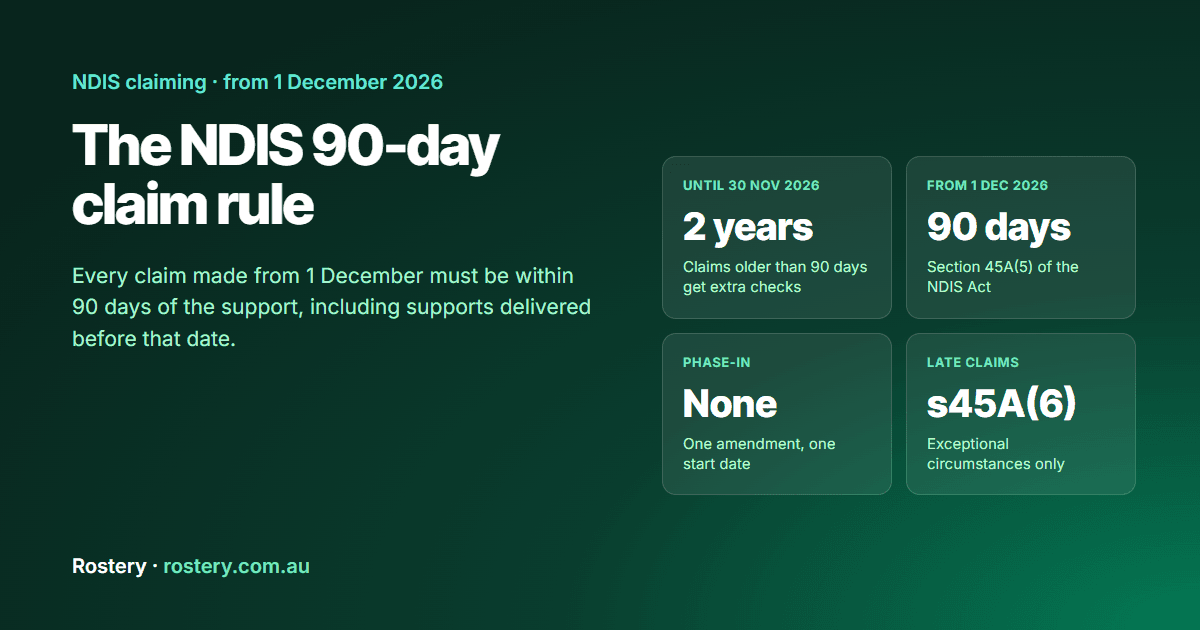
Claim on time. A support delivered before a plan's end date belongs to that plan, and from 1 December 2026 the claim window is 90 days, not 2 years. See our NDIS 90-day claim rule guide and the bulk upload guide.
Service agreement reviews at reassessment and renewal
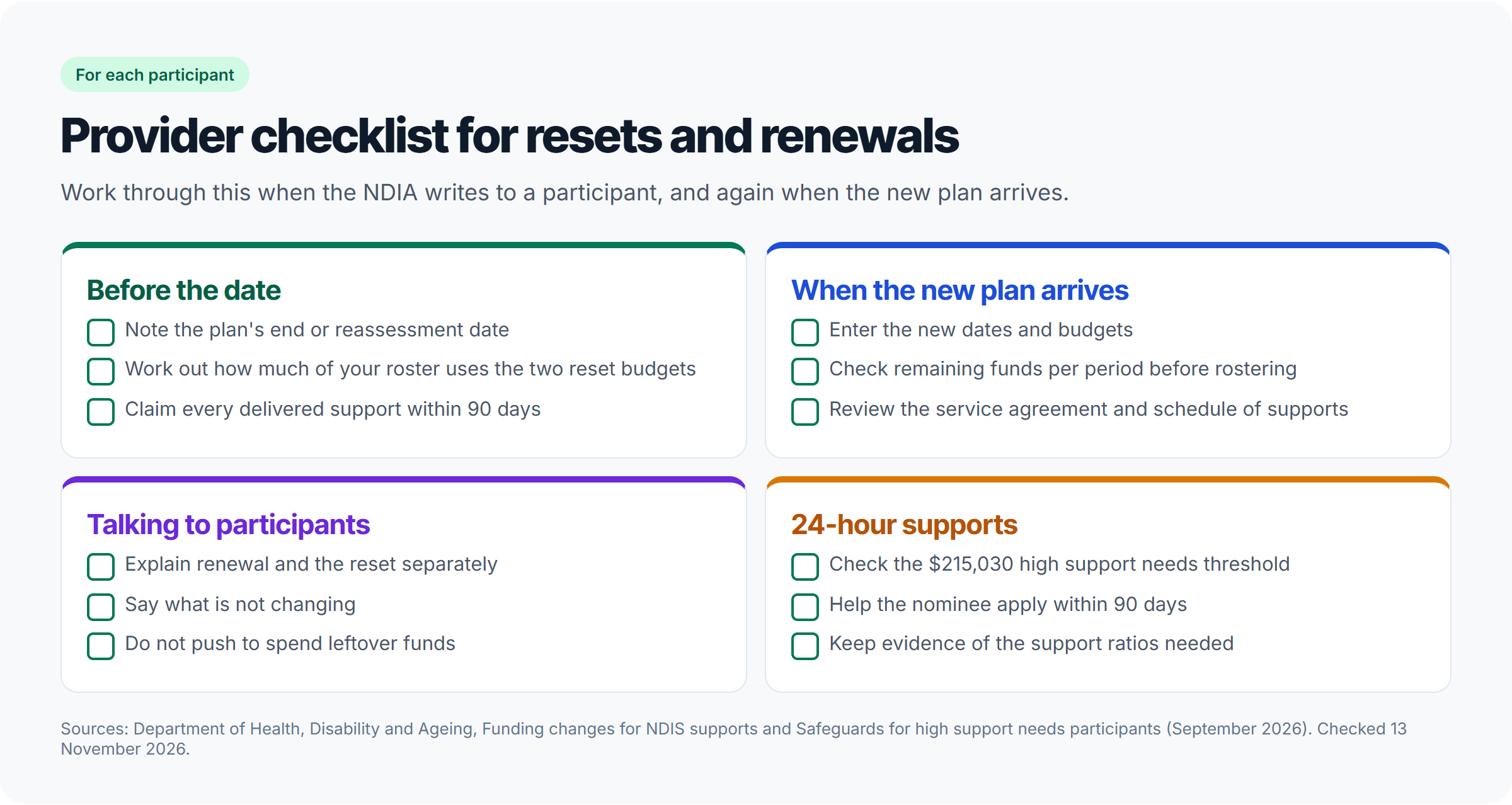
- Ask each participant to tell you when they receive a new or renewed plan, and review the service agreement then.
- Recalculate the schedule of supports against the new amount for each group. A weekly community access booking that fitted last year's budget may now use it up in six months.
- Agree any change in hours with the participant in writing before the old roster runs past what is funded.
- Update end dates. Plans now have end dates, so tie the agreement's end or review date to the plan's end date.
Our NDIS service agreement guide lists what each agreement should cover.
Checking remaining budgets before rostering
Check the remaining funding in the right group, and in the current funding period, before you confirm a recurring shift. Funding periods are usually three months, so a roster can be within the yearly budget and still exceed what has been released so far.
In Rostery, each client has funding plans with service budgets, plan dates and an optional release period. The scheduler holds a shift and labels it on the board when it is outside the funding dates (OUT OF PLAN), when booked shifts would use more than the fund has left (NO BUDGET), or when they exceed the amount released for that period, counting unused money carried forward within the plan (OVER RELEASE). When a renewed plan arrives, enter its dates and new budgets and the board shows which future shifts no longer fit. See rostering in Rostery.
What happens at plan end
| Situation | What to do |
|---|---|
| Support delivered before the end date, not yet claimed | Claim it against the old plan within 90 days of delivery |
| Shifts booked after the end date | They are paid from the renewed plan. Check its amounts before they run |
| Money left in the old plan | It does not move to the renewed plan. Do not bring work forward to use it up |
| Renewed plan copy not yet received | The NDIA may send it more than 7 days after it starts. Ask the participant or plan manager for the new amounts |
| One-off funding in the old plan (for example equipment) | It is not repeated in the renewed plan |
Rushing to spend a participant's leftover funds before the end date is risky in its own right. The NDIS Commission's Code of Conduct guidance treats over-servicing and providing supports contrary to the plan as sharp practices, and from 20 November 2026 offering anything to get a participant to increase their supports is banned. See our guide to the NDIS kickbacks and inducements ban.
How plan managers and support coordinators should talk to participants
Participants will hear about both changes from the NDIA in letters, but the people they ask are usually their plan manager and support coordinator.
- Explain the two changes separately. Renewal is about dates and leftover money; the reset is about how much two budgets hold.
- Say what is not changing: daily living and home supports, consumables, home and vehicle modifications, SDA and the excluded subgroups.
- Be clear that the reset cannot be reviewed on its own, but that a significant and ongoing change in needs or circumstances can still support a variation or reassessment request, which only the participant, nominee or guardian can make.
- For anyone with 24-hour supports, check the $215,030 threshold and the 90-day variation window as soon as the reset is applied.
- Do not encourage spending down leftover funds. Help the participant plan the next 12 months instead.
- Share the new budget figures with the participant's providers, with consent, so rosters are adjusted early.
In Rostery Plan Management, the remaining figure for each plan takes off what was used before you took the participant on, what has been drawn down and what is committed on approved invoices. A provider invoice that the funding cannot fully cover waits at the "Funding available" check instead of being part paid, and you can set per-category budgets and cap how much a provider can bill in a category. Support coordinators can track coordination budgets per category, and a quote that exceeds what is left is flagged. See NDIS plan management and support coordination budgets. Plan managers should also read about the plan management panel from 1 October 2027.
Book a demo to see funding plans, budgets and the scheduler with your own participants.
Frequently asked questions
Do unspent NDIS funds carry over to my next plan?
No. Unused funding rolls from one funding period to the next within the same plan, but not into a new plan. From 1 February 2027, when a plan reaches its end date it is renewed as a new plan and the unspent money in the old one is not carried over.
What is an NDIS plan renewal?
From 1 February 2027, a plan that reaches its end date is renewed automatically under section 50A of the NDIS Act. The new plan has the same supports as the old one, without one-off funding, and runs for 12 months. It does not need a new planning meeting.
How much is NDIS community participation funding being cut?
The Support Determination 2026 reduces the social, economic and community participation group by 50% and the improved daily living skills group by 10%, applied when a plan is created, reassessed or renewed between 1 October 2026 and 30 September 2027. Employment, high intensity and complex behaviour supports are excluded.
Is core funding for daily living affected by the reset?
No. The department says supports in the home, such as help with eating, dressing, toileting, cleaning, nursing care and medication, are not affected, along with home and vehicle modifications, mobility equipment, continence products and SDA.
Can a participant appeal the funding reset?
Not on its own. The reduction is not reviewable and is not by itself a reason for a reassessment. A participant can still ask for a variation or reassessment if their needs or circumstances change significantly, and high support needs participants have a separate variation pathway.
When will a participant's plan be reset?
At the first plan creation, reassessment or renewal on or after 1 October 2026 (renewals from 1 February 2027). Everyone with these supports will have their plan renewed by 30 September 2027 if it has not been reset sooner.
Does the reset apply to new framework plans?
No. The department says it only applies to plans under current arrangements. Once a participant moves to a new framework plan, from 1 April 2027 onwards, the reset no longer applies.
Sources
- NDIS Amendment (Securing the NDIS for Future Generations) Act 2026, Schedule 1, Part 5 (plan renewal)
- National Disability Insurance Scheme (Support) Determination 2026 (F2026L01332)
- Department of Health, Disability and Ageing: Funding changes for NDIS supports (updated 24 September 2026)
- Department of Health, Disability and Ageing: Funding changes for NDIS supports, guide (September 2026)
- Department of Health, Disability and Ageing: Funding changes for NDIS supports, Safeguards for high support needs participants (September 2026)
- Department of Health, Disability and Ageing: Securing the NDIS for future generations timeline (September 2026)
- NDIA: What NDIS funding is (funding periods)
Checked 13 November 2026. The Minister can still make instruments that change renewal dates and what a renewed plan contains, so check the NDIA's letters to each participant. This article explains published rules in general terms and is not financial or legal advice.