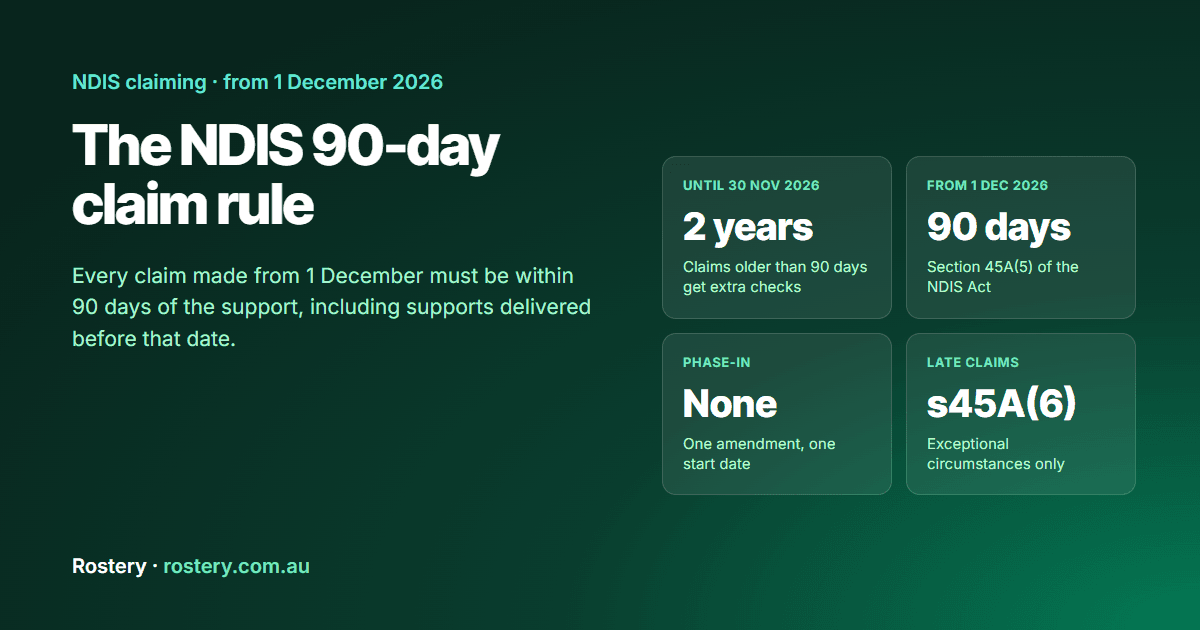
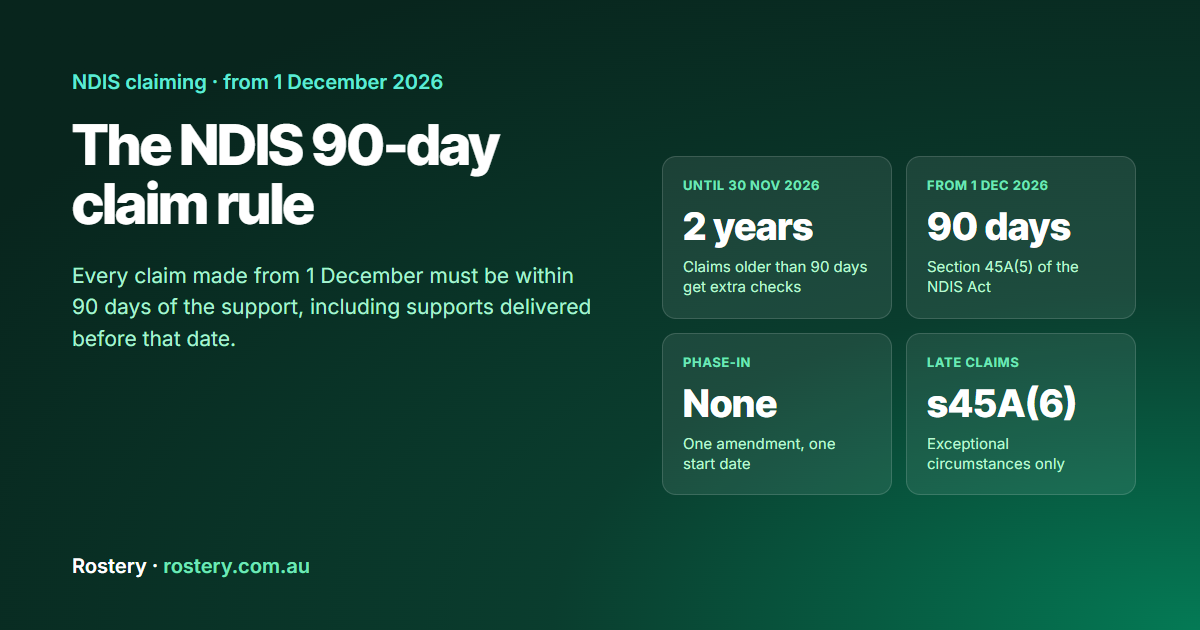
From 1 December 2026, every NDIS claim must be made within 90 days of the day the support was delivered. Until then the limit is 2 years. The change is in the NDIS Act itself (section 45A), it starts on one day with no phase-in, and it applies to every claim made from 1 December, including claims for supports delivered before that date. A support delivered on or before 2 September 2026 that has not been claimed by Monday 30 November 2026 will be out of time. Claims made after the 90 days are not paid unless the NDIA accepts that exceptional circumstances caused the delay.
In short
- The limit in section 45A(5) of the NDIS Act drops from 2 years to 90 days on 1 December 2026.
- The 90 days start on the day the support is provided. Count that day as day 1.
- It covers NDIA-managed, plan-managed and self-managed claims. For plan-managed supports, the plan manager's claim to the NDIA has to be inside the 90 days, so your invoice has to reach them well before that.
- There is no transition for older supports. Claim anything delivered on or before 2 September 2026 by 30 November 2026.
- The only way around it is section 45A(6): exceptional circumstances, and a claim made within a reasonable time after them.
What is the NDIS 90-day claim rule?
Section 45A of the NDIS Act says an NDIS amount is not payable for a support unless a claim for it has been made to the NDIA in the right form and within a set period. Subsection 45A(5) sets that period, counted from the day the support is provided to the participant. Today it is 2 years. The National Disability Insurance Scheme Amendment (Securing the NDIS for Future Generations) Act 2026 changes it with a single amendment, item 89 of Schedule 2: omit "2 years", substitute "90 days".
The amending Act received Royal Assent on 20 August 2026. Most of Schedule 2 started on 27 August, but Part 5, the claim time change, starts on 1 December 2026. The Department's provider FAQs (July 2026) and the NDIA's page on the new laws both give that date.
The NDIS rules can set a shorter period for a particular kind of claim (section 45A(5)(b)), so 90 days is the outer limit.
Why the NDIA is cutting the limit to 90 days
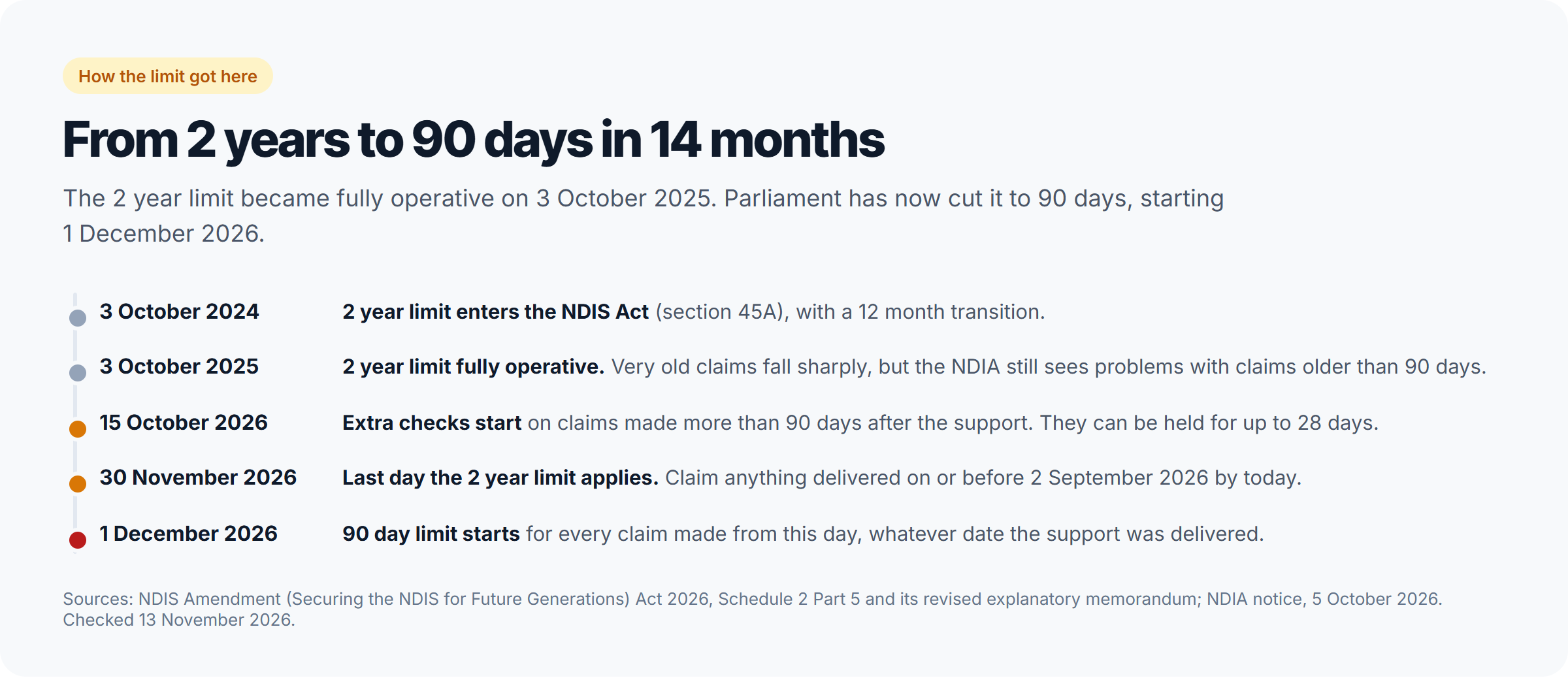
The 2 year limit came into the Act on 3 October 2024 and became operative on 3 October 2025 after a 12 month transition. The revised explanatory memorandum says claims made more than 90 days after the service still have higher rates of claims that are not payable, more cases that cannot be checked with the participant, and more opportunistic claiming.
Does it apply to supports delivered before 1 December 2026?
Yes. Some provider guides say this is still unclear, but the Act answers it. The amendment changes the time limit for making a claim, and it applies to claims made on or after 1 December 2026. Part 5 has no application or transitional provision that keeps the 2 year limit for older supports. Other parts of the same Act do have them (the record keeping changes, for example, apply to claims made on or after their start), which makes the gap here deliberate.
The explanatory memorandum says why the start was pushed back to 1 December: "Delaying commencement until this date is intended to allow sufficient time for claims older than 90 days to be made before the new timeframe takes effect." So a support delivered in August 2026 is already more than 90 days old on 1 December and cannot be claimed under section 45A(5) from that day. Claim it by 30 November.
We found no separate NDIA transition guidance for providers. Its Your plan guideline (1 October 2026) gives no carve-out for older supports either.
Is there a phase-in to 2030?
No. At least one provider blog says the limit will be "gradually introduced over three years to 31 December 2030". Nothing in the Act, the explanatory memorandum, the NDIA's pages or the Department's FAQs supports that: the commencement table gives Part 5 one date, 1 December 2026. In the Government's reform timeline, 31 December 2030 is when the move to new framework planning ends, and December 2030 is also the deadline for expanded mandatory registration.
How to count the 90 days
Section 45A(5) says the claim must be made "before the end of the following period starting on the day the support is provided". Under section 36 of the Acts Interpretation Act 1901, a period that begins on a day includes that day. So the support day is day 1, and day 90 is 89 days after it. A support delivered on Tuesday 1 December 2026 must be claimed by Sunday 28 February 2027.
Section 36(2) of the same Act lets a thing due on a weekend or public holiday be done on the next working day, but the NDIA has not said how its system counts, and it rejects late claims automatically. Treat the last working day before day 90 as your deadline.
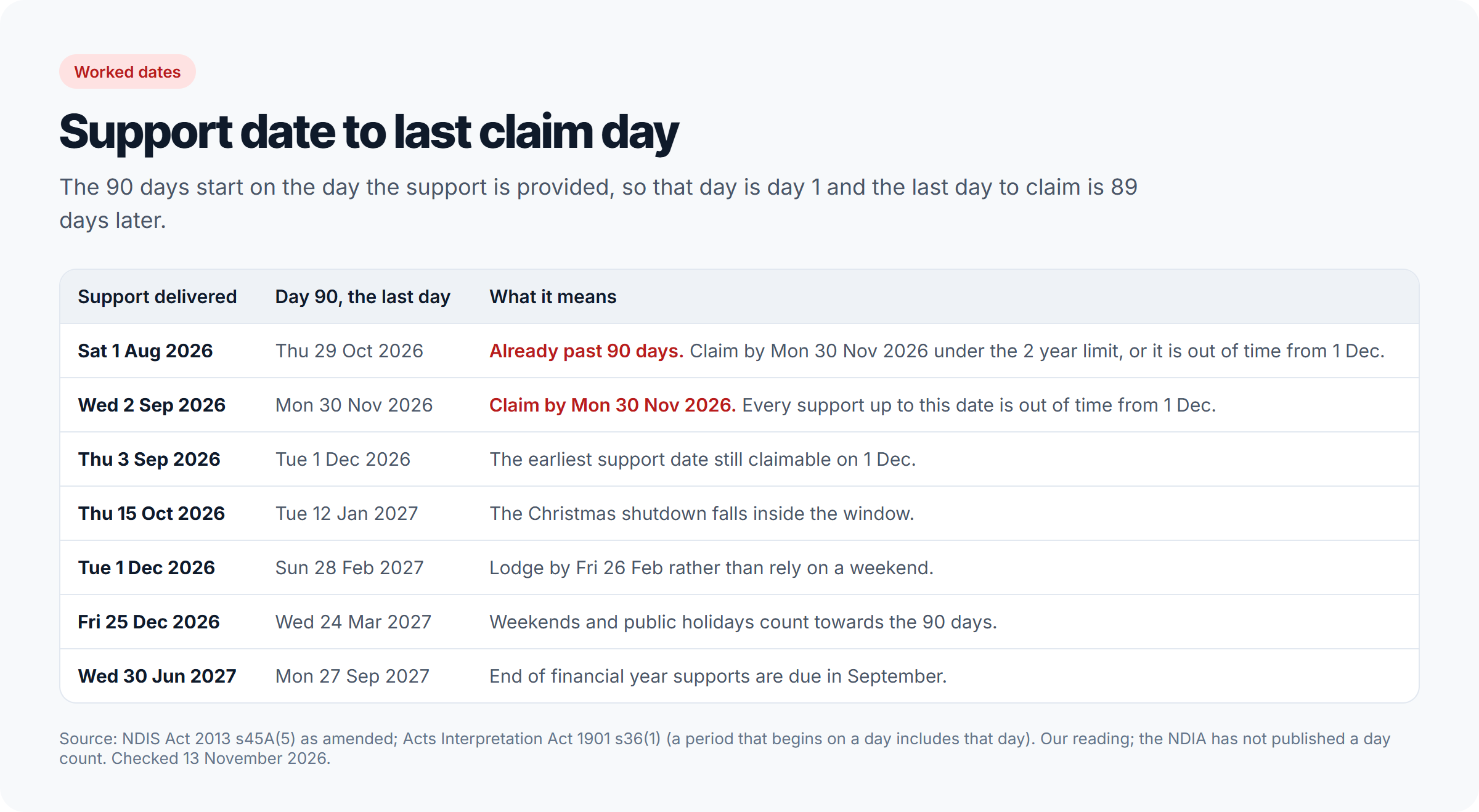
| Support delivered | Day 90 (last day to claim) | Notes |
|---|---|---|
| Sat 1 Aug 2026 | Thu 29 Oct 2026 | Already more than 90 days old. Claim it by Mon 30 Nov 2026 under the 2 year limit; from 1 December it is out of time. |
| Wed 2 Sep 2026 | Mon 30 Nov 2026 | The last support date in that position. Claim by Mon 30 Nov 2026. |
| Thu 3 Sep 2026 | Tue 1 Dec 2026 | The earliest support date still claimable on 1 December, and only on that day. |
| Thu 15 Oct 2026 | Tue 12 Jan 2027 | The Christmas and New Year shutdown sits inside the window. |
| Fri 13 Nov 2026 | Wed 10 Feb 2027 | A support delivered today. |
| Tue 1 Dec 2026 | Sun 28 Feb 2027 | Day 90 is a Sunday. Lodge by Fri 26 Feb. |
| Fri 25 Dec 2026 | Wed 24 Mar 2027 | Public holidays and weekends count towards the 90 days. |
| Fri 1 Jan 2027 | Wed 31 Mar 2027 | |
| Wed 30 Jun 2027 | Mon 27 Sep 2027 | June supports are due in late September. |
For a support that runs over several days, such as a week of SIL, the NDIA's Guide to getting paid asks for claims within 90 days of the support "being delivered in full". The Act counts from "the day the support is provided" and does not say which day of a multi-day support. Until the NDIA says otherwise, count from the first day (the SupportsDeliveredFrom date in a bulk claim file).
Who it applies to: NDIA-managed, plan-managed and self-managed
Section 45A(2) says who may claim: the person who manages the funding under the plan or, where the NDIA manages it, the provider who delivered the support. The 90 days apply to all of them.
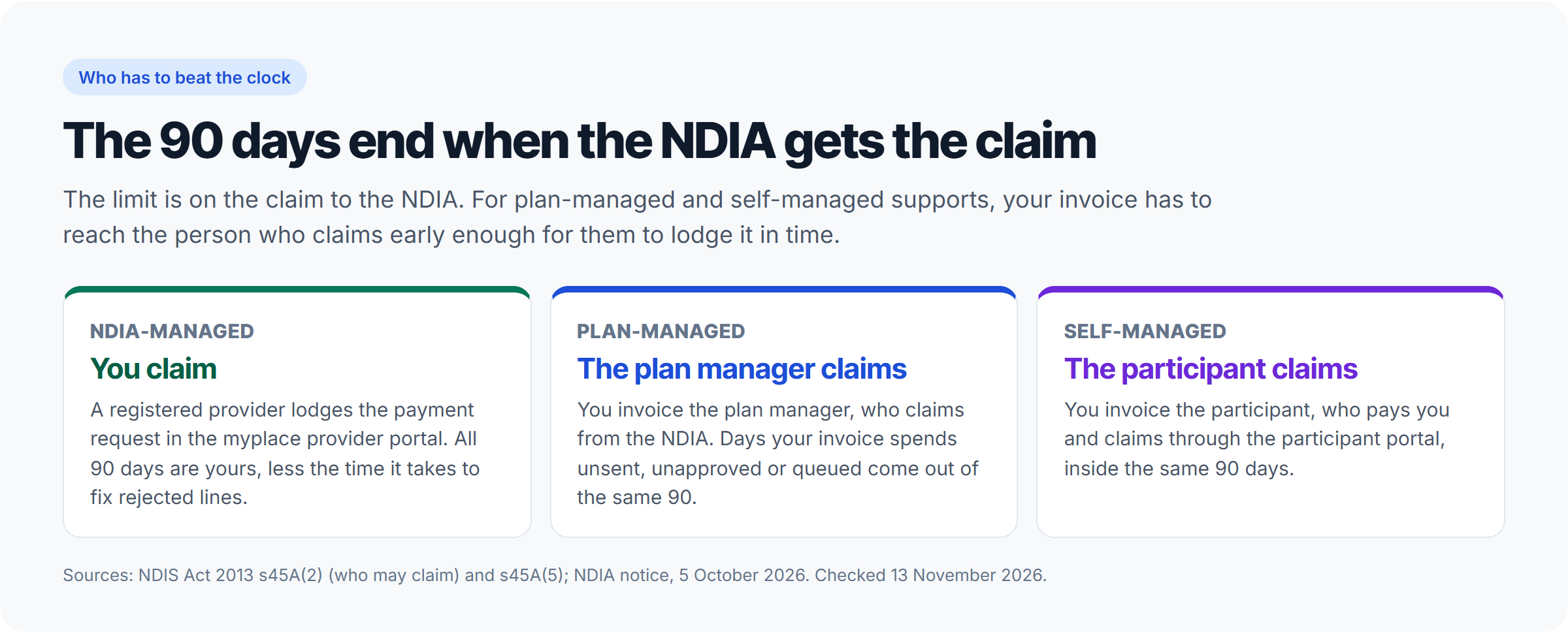
| Funding | Who claims from the NDIA | What the 90 days mean for a provider |
|---|---|---|
| NDIA-managed | The registered provider, in the myplace provider portal | You have all 90 days, less any time spent fixing rejected lines. |
| Plan-managed | The plan manager | Your invoice has to reach the plan manager, be checked and approved, and be claimed inside the same 90 days. |
| Self-managed | The participant (or their nominee) | The participant has to pay and claim inside the 90 days, so invoice them promptly. |
Plan managers paying providers
The Act limits the plan manager's claim to the NDIA. It does not set a deadline for a provider's invoice to a plan manager. In practice the two are the same clock: if your invoice for a 1 December support reaches the plan manager on 20 February, they have about a week to approve and claim it. If the plan manager's claim is late, the NDIA will not pay it, and there is nothing in plan funds to pay you from. Who carries that loss is a matter for your service agreement with the participant, so it is worth adding an invoicing timeframe to your service agreement.
What happens to a claim made after 90 days?
Under section 45A(1), the amount is not payable unless the claim was made in time. The NDIA's Your plan guideline says its claims and payments system will automatically reject a claim that was not submitted within the required time frames. If a claim is rejected, the NDIA's notice says it will tell you why.
Exceptional circumstances and late claims
Section 45A(6) is not changed. The NDIA may treat a late claim as made in time if it is satisfied that there are exceptional circumstances justifying the late claim, and that the claim was made within a reasonable period having regard to those circumstances. The explanatory memorandum says this keeps flexibility "for those with genuine barriers to timely claiming". The NDIA's participant guideline words it as "unless exceptional circumstances prevent you from being able to".
The NDIA has not published what it will accept as exceptional, or a process for asking, so do not plan around it. If you think a claim qualifies, contact the NDIA and keep evidence of what stopped you claiming on time. In our view a backlog or a staff member on leave is unlikely to count.
Rejected claims and resubmission
A rejected payment request cannot be edited; you make a new one, as our NDIS bulk upload guide explains. The new request is a new claim, and on our reading of section 45A it must itself be made within 90 days of the support. A line rejected on day 85 for a wrong NDIS number leaves you five days to fix it.
The extra checks that already apply to claims older than 90 days
The NDIA started treating 90 days as a line before the law changed. Since 15 October 2026, claims submitted more than 90 days after a support is delivered get extra integrity checks and may be held for up to 28 days. The NDIA may ask for more information or evidence before paying. Claims made within 90 days go through the usual process, and in a bulk upload only the claim under review stays open while the rest are paid on the normal terms.
Until 30 November these checks apply to the backlog you are clearing, so some of those payments may take up to four extra weeks.
What providers should change before 1 December
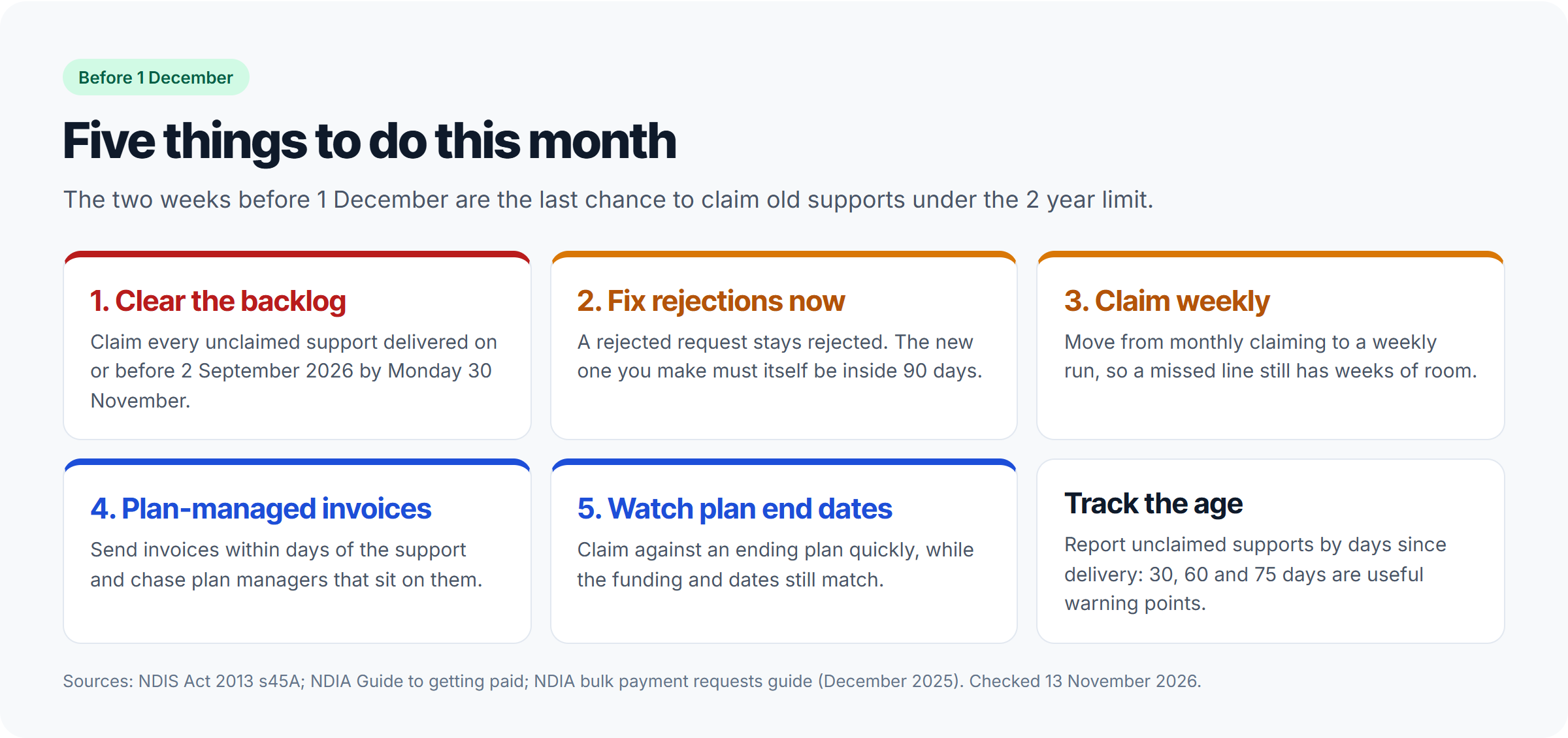
Clear the backlog by 30 November
Report every completed support not yet claimed or invoiced, oldest first. Anything delivered on or before 2 September 2026 has to be claimed by Monday 30 November. Look hardest at cancellations, travel and kilometre lines, NDIA-requested reports and one-off supports.
Claim weekly instead of monthly
A provider that claims monthly, after a two week month-end close, can spend up to 45 days before a support from the start of the month is claimed. A weekly claim run, with timesheets approved within a few days of the shift, leaves weeks of room for a rejected line or a late timesheet. If invoices wait on sign-offs or notes, put a time limit on each step.
Service bookings and my provider records
Old system plans need a valid service booking before you can claim (rejection C01 if it is missing). For new system plans, get recorded as a my provider: the NDIA usually pays valid claims from a my provider within 2 to 3 business days. Sort both out before the support starts.
Plan-managed invoice timing
Send plan-managed invoices within a week of the support, with your ABN, support item numbers, dates and the participant's NDIS number. Ask each plan manager how long they take to approve and claim, and chase anything unpaid after two or three weeks. Invoice self-managed participants just as quickly.
Participant plan end dates
Supports delivered under a plan that is ending still have to be claimed within 90 days, and from 1 February 2027 unspent funds are not carried over into a renewed plan (see unspent funds and plan rollovers). Claim promptly against an ending plan.
SIL weekly claiming
SIL providers who claim monthly or quarterly are the most exposed. Claiming SIL weekly for the week just ended keeps every line far inside the limit, with irregular SIL supports (claim type IRSS) in the same file. See our SIL provider operations guide.
| Process | Typical now | Safer from 1 December |
|---|---|---|
| Claim run | Monthly, after month-end | Weekly, for the week just ended |
| Timesheet approval | Before the monthly invoice run | Within 2 to 3 days of the shift |
| Rejected lines | Fixed at the next claim run | Fixed the day the results come back |
| Plan-managed invoices | Sent monthly | Sent weekly, chased after 2 to 3 weeks |
| Ageing report | Rarely run | Weekly, flagging lines at 30, 60 and 75 days |
Checklist for providers
- List every unclaimed support delivered on or before 2 September 2026 and claim it by Monday 30 November 2026.
- Fix every currently rejected line and resubmit it in a new file.
- Move to a weekly claim run, and set a timesheet approval deadline that supports it.
- Add an invoicing timeframe for plan-managed and self-managed participants to your service agreements.
- Ask each plan manager you work with how long they take to approve and claim.
- Run an ageing report of unclaimed supports every week.
- Keep the records behind every claim for 7 years; see our post on NDIS record keeping.
The 90 day rule is one of several dates in the reform program. Our NDIS changes 2026 hub lists every date from 2026 to 2030, including the ban on kickbacks and inducements from 20 November 2026 and provider enrolment from 1 July 2027.
How Rostery helps with the 90 days
Rostery is our product, so here is plainly what it does today. Completed shifts become invoices, and the Invoices page writes the NDIA bulk claim file for NDIA-managed invoices, checking every line against the portal's format before the file is built, so fewer lines come back rejected. You still upload the file in the myplace provider portal yourself. For SIL, the weekly claim run starts each Monday for the week just ended and builds the NDIA file, and when you upload the NDIA's results each line is marked paid, part paid or rejected.
In Support Coordination, every claim line shows the days since the service. Lines more than 90 days old are held on the fix list and escalated, lines nearing the limit are flagged (from 60 days by default, which each company can change), and users with claiming access get a daily app and email alert about lines near or past 90 days. More on NDIS billing and invoicing and support coordination software. Book a demo to see the claim screens with your own participants.
Frequently asked questions
When does the NDIS 90-day claim rule start?
On 1 December 2026, with no phase-in. Claims made up to and including 30 November 2026 are under the 2 year limit.
Does the 90-day rule apply to supports delivered before 1 December 2026?
Yes, for any claim made on or after 1 December. The amendment has no transitional provision. Claim supports delivered on or before 2 September 2026 by 30 November 2026.
Is the 90-day claim limit being phased in over several years?
No. There is one amendment and one start date. The 31 December 2030 date some articles mention is the end of the move to new framework planning.
Does the 90-day rule apply to plan managers and self-managed participants?
Yes. Section 45A covers every claim for an NDIS amount, whether a provider, a plan manager or a participant makes it. The claim to the NDIA has to be within 90 days of the support.
Can the NDIA accept a claim made after 90 days?
Only if the NDIA is satisfied there were exceptional circumstances and the claim was made within a reasonable period after them (section 45A(6)). It has not published what it will accept.
How do I count the 90 days?
The support day is day 1, so day 90 is 89 days later. A support on 1 December 2026 must be claimed by 28 February 2027. If day 90 falls on a weekend or public holiday, lodge on the working day before.
Why are my claims older than 90 days held for up to 28 days?
Since 15 October 2026 the NDIA does extra checks on claims made more than 90 days after the support and may hold them for up to 28 days while it does.
Sources
- Federal Register of Legislation: National Disability Insurance Scheme Amendment (Securing the NDIS for Future Generations) Act 2026 (No. 66, 2026), commencement table and Schedule 2 Part 5
- Federal Register of Legislation: National Disability Insurance Scheme Act 2013, section 45A (compilation 28, 1 October 2026)
- Department of Health, Disability and Ageing: revised explanatory memorandum to the Bill, Schedule 2 Part 5 (August 2026)
- Federal Register of Legislation: Acts Interpretation Act 1901, section 36
- NDIA: Increasing integrity checks on older claims (5 October 2026)
- NDIA: Guide to getting paid
- NDIA: Securing the NDIS for future generations
- NDIA: Legislation changes timeline for providers
- NDIA: Our Guideline, Your plan (1 October 2026)
- Department of Health, Disability and Ageing: provider FAQs (July 2026)
- Department of Health, Disability and Ageing: About the changes to the NDIS
Checked 13 November 2026. The NDIA's Guide to getting paid still describes the 2 year limit, which is correct until 30 November 2026. The day count and the treatment of resubmitted claims are our reading of the Act; the NDIA has not published guidance on either. This post explains the law and the NDIA's published guidance and is not legal advice.