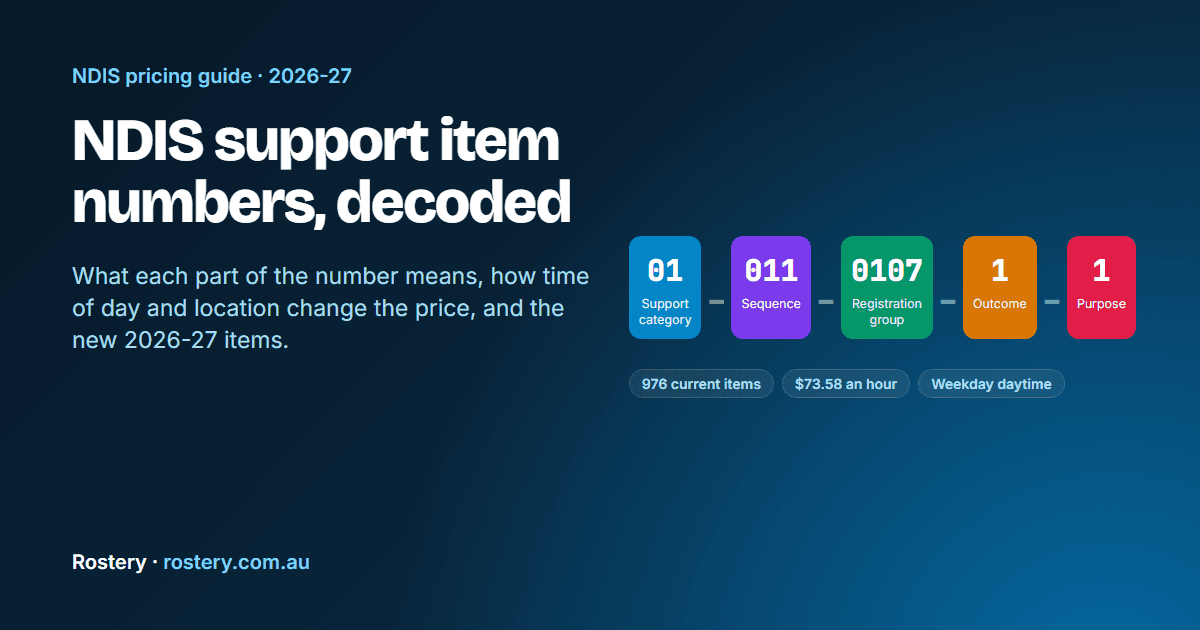
An NDIS support item number, such as 01_011_0107_1_1, is the code the NDIA uses for each support it pays for. It has five parts: the support category, a sequence number, the registration group, the outcome domain and the support purpose. Together they decide which budget pays, who may deliver the support, the unit it is counted in and the most that can be charged. This guide explains each part, how time of day and location change the item, the new therapy item numbers in 2026-27, and how item numbers are used on invoices and claims. Every count below comes from the NDIA's Support Catalogue 2026-27 v1.1, which lists 976 current items.
The five parts of an NDIS support item number
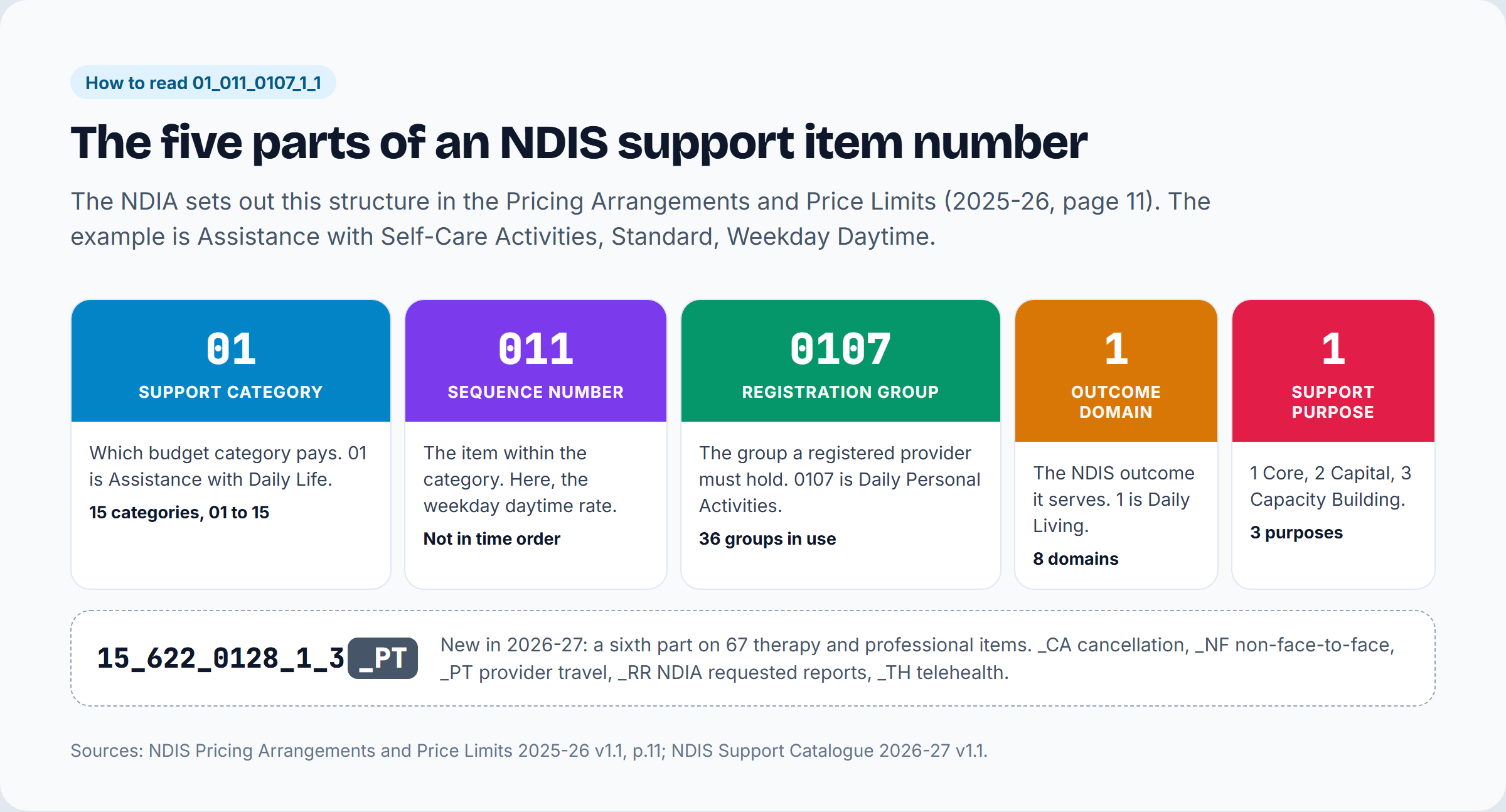
The NDIA explains the structure in its Pricing Arrangements and Price Limits: "Each support item has a unique reference number", made up of the support category, sequence number, registration group, outcome domain and support purpose. Here is 01_011_0107_1_1, Assistance with Self-Care Activities, Standard, Weekday Daytime, taken apart.
| Part | In 01_011_0107_1_1 | What it tells you | Possible values |
|---|---|---|---|
| Support category | 01 | Which budget category pays. 01 is Assistance with Daily Life. | 01 to 15 |
| Sequence number | 011 | The item within the category. Here it is the weekday daytime rate for standard self-care. | Usually 3 digits; 9 for assistive technology and consumables |
| Registration group | 0107 | The registration group a registered provider must hold to deliver it. 0107 is Daily Personal Activities. | 36 groups in use |
| Outcome domain | 1 | The NDIS outcome the support serves. 1 is Daily Living. | 1 to 8 |
| Support purpose | 1 | The budget type: 1 Core, 2 Capital, 3 Capacity Building. | 1 to 3 |
Read left to right, the number says: a Core support from the Assistance with Daily Life budget, delivered under the Daily Personal Activities registration group, for the Daily Living outcome, at the weekday daytime rate. The price limit for it in 2026-27 is $73.58 an hour, or $103.01 in remote areas and $110.37 in very remote areas.
Support purpose: the last digit
Every participant budget is split into three support purposes, and the last digit of the item number says which one pays.
| Digit | Purpose | What it covers | Current items | More |
|---|---|---|---|---|
| 1 | Core | Everyday activities, such as personal care, community access, consumables and transport. Core funding cannot be moved to Capital or Capacity Building. | 243 | Core supports |
| 2 | Capital | Investments such as assistive technology, home and vehicle modifications and Specialist Disability Accommodation. Restricted to the items in the plan. | 238 | Capital supports |
| 3 | Capacity Building | Supports that build independence and skills: therapy, support coordination, plan management, employment support and more. | 494 | Capacity Building |
The counts include the new therapy claim-type items, which is why Capacity Building has the most. One current item has no standard number at all: the plan management bereavement payment, listed simply as "Bereavement", one of three items providers can claim after a participant dies.
Outcome domain: the fourth part
The NDIS outcomes framework has eight domains. Most items serve Daily Living.
| Digit | Outcome domain | Base items |
|---|---|---|
| 1 | Daily Living | 504 |
| 2 | Home | 43 |
| 3 | Health and Wellbeing | 8 |
| 4 | Lifelong Learning | 3 |
| 5 | Work | 24 |
| 6 | Social and Community Participation | 43 |
| 7 | Relationships | 6 |
| 8 | Choice and Control | 9 |
Support category: the first two digits
The first two digits are one of the 15 original support categories. Plans in the NDIA's newer computer system, PACE, use 21 categories, so the category a PACE plan shows can differ from the first two digits. Supported independent living items start with 01 but sit in PACE category 16, Home and Living, and behaviour support items start with 11 but sit in PACE category 20. This is the mapping from the Pricing Arrangements, with the number of 2026-27 items in each original category.
| Purpose | Original category (first two digits) | PACE category | Base items | All current items |
|---|---|---|---|---|
| Core | 01 Assistance with Daily Life | 01 Assistance with Daily Life; 16 Home and Living; 21 YPIRAC cross billing | 157 | 227 |
| Core | 02 Transport | 02 Transport | 2 | 2 |
| Core | 03 Consumables | 03 Consumables | 40 | 40 |
| Core | 04 Assistance with Social, Economic and Community Participation | 04 (same) | 51 | 51 |
| Capital | 05 Assistive Technology | 05 Assistive Technology; 19 AT Maintenance, Repair and Rental | 213 | 213 |
| Capital | 06 Home Modifications and SDA | 06 Home Modifications; 17 Specialist Disability Accommodation | 31 | 31 |
| Recurring | None | 18 Recurring Transport | ||
| Capacity Building | 07 Support Coordination | 07 Support Coordination and Psychosocial Recovery Coaches | 13 | 13 |
| Capacity Building | 08 Improved Living Arrangements | 08 (same) | 3 | 3 |
| Capacity Building | 09 Increased Social and Community Participation | 09 (same) | 8 | 8 |
| Capacity Building | 10 Finding and Keeping a Job | 10 (same) | 18 | 53 |
| Capacity Building | 11 Improved Relationships | 11 Relationships; 20 Behaviour Support | 6 | 16 |
| Capacity Building | 12 Improved Health and Wellbeing | 12 Health and Wellbeing | 6 | 21 |
| Capacity Building | 13 Improved Learning | 13 Lifelong Learning | 3 | 3 |
| Capacity Building | 14 Improved Life Choices | 14 Choice and Control | 2 | 2 |
| Capacity Building | 15 Improved Daily Living Skills | 15 (same) | 88 | 293 |
One quirk catches many people. 84 therapy items start with 01 but end with 3, so they are Capacity Building items inside Assistance with Daily Life. The Pricing Arrangements explain that these supports "have been temporarily duplicated into the Assistance with Daily Life Support Category so that participants can have greater access to these supports if they need them". The same therapy can therefore have two numbers at the same price, such as 01_665_0128_1_3 and 15_622_0128_1_3 for speech pathology at $193.99 an hour. The first two digits tell you which part of the plan pays.
Registration group: the third part
The registration group is the one a registered provider must hold with the NDIS Quality and Safeguards Commission to deliver the item. There are 36 in use in 2026-27. The largest are 0128 Therapeutic Supports (216 items), 0118 Early Intervention Supports for Early Childhood (146), 0103 Assistive Products for Personal Care and Safety (79), 0114 Community Nursing Care (62) and 0105 Personal Mobility Equipment (51). New this year is 0138, Assistance in Supported Independent Living, with 22 items such as 01_801_0138_1_1. Our registration groups glossary entry lists them.
The sequence number and other quirks
- Sequence numbers are not in time order. For standard self-care, 011 is weekday daytime, 015 evening, 002 night, 013 Saturday, 014 Sunday and 012 public holiday.
- The sequence can be longer. 270 assistive technology and consumables items use a 9-digit code, such as 03_040000111_0103_1_1, and 9 AT supplementary charges use 4 digits.
- Some sequence numbers mean the same thing in many categories. 799 is provider travel non-labour costs (01_799_0107_1_1, 04_799_0125_6_1) and 590 is activity based transport.
- The third part matches the registration group for all but two of the 1,017 rows in the catalogue, so you can usually read the group straight from the number.
The new sixth part: therapy claim-type items
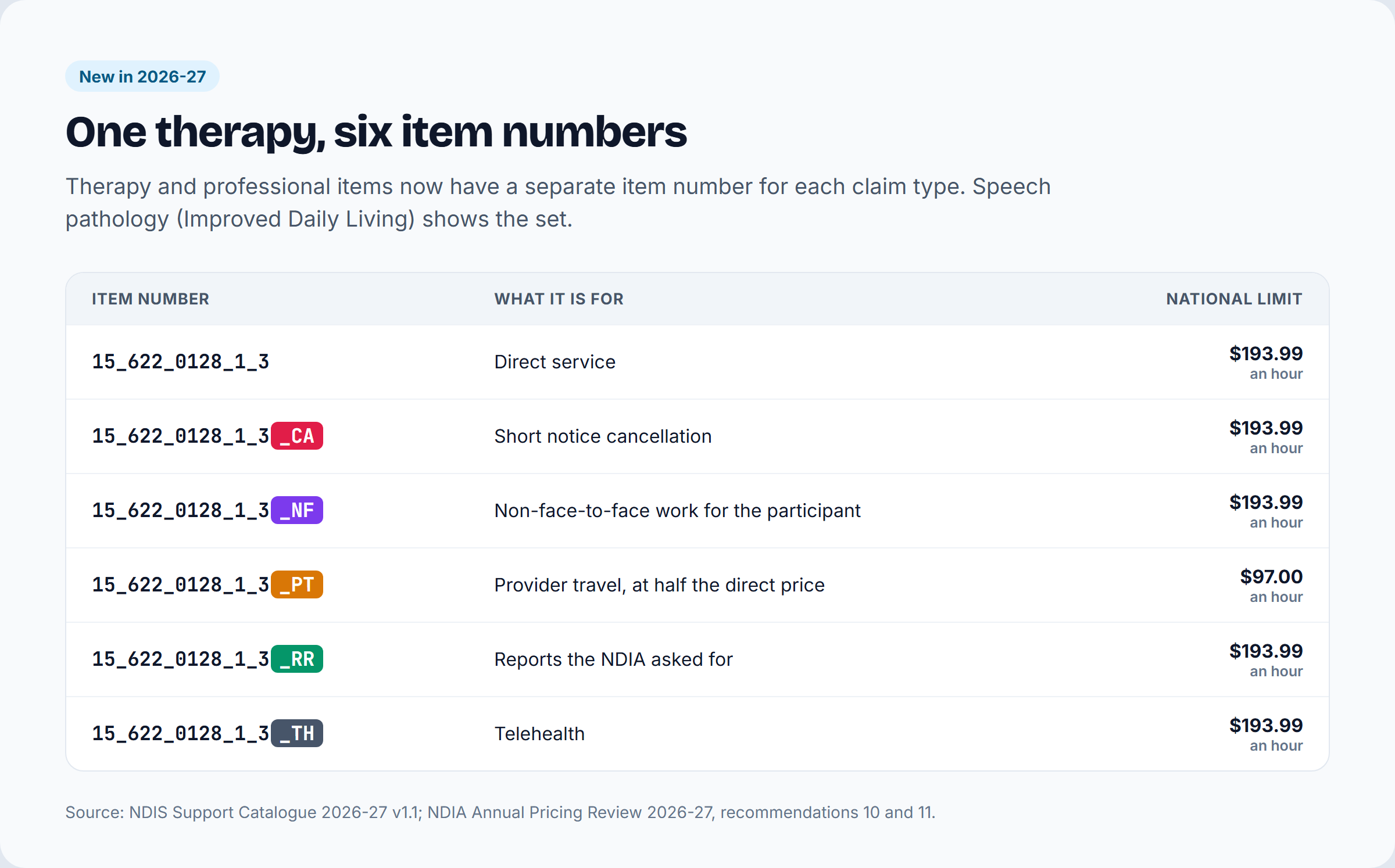
In 2026-27 the NDIA added a sixth part to 67 therapy and professional items. Each now comes as a set: the direct service item, plus _CA for a short notice cancellation, _NF for non-face-to-face work, _PT for provider travel, _RR for reports the NDIA asked for and _TH for telehealth. That added 335 item numbers. Three are numbered differently: _CA2 on an early childhood psychology item and an exercise physiology item, and _NF2 on the same psychology item.
The Annual Pricing Review 2026-27 recommended the change because "in the therapy context, direct service delivery, provider travel and report writing are bundled as non-face-to-face activities". It asked for "a separate line item" for therapy travel and for non-face-to-face work such as "preparation, documentation, and NDIS-requested reporting". In every set the travel item (_PT) is exactly half the direct service price, and the other four match it. Speech pathology travel is 15_622_0128_1_3_PT at $97.00 an hour.
The catalogue now shows the claim-type flags on the base therapy items as not allowed. At the time of writing, the NDIA had not published updated claiming guidance for the new items, so check its latest guidance before claiming them for the first time.
Units: how each item is counted
Every item has a unit of measure, and claims have to use it. The 976 current items break down like this.
| Code | Unit | Current items | Example (national limit) |
|---|---|---|---|
| H | Hour | 602 | 01_011_0107_1_1 Self-care, weekday daytime: $73.58 |
| E | Each | 350 | 01_010_0107_1_1 Night-time sleepover: $311.79 |
| D | Day | 5 | 01_082_0115_1_1 Medium term accommodation: $162.85 |
| WK | Week | 6 | 01_066_0115_1_1 Unplanned onsite shared supports in SDA: $1,616.26 |
| MON | Month | 2 | 14_034_0127_8_3 Plan management monthly fee: $104.45 |
| YR | Year | 11 | 02_051_0108_1_1 Transport: $1.00 notional unit price |
When less than a full hour is delivered, you claim the time actually spent. The NDIA's own example at $193.99 an hour:
| Time delivered | Quantity | Amount |
|---|---|---|
| 10 minutes | 0.17 | $32.33 |
| 30 minutes | 0.50 | $97.00 |
| 50 minutes | 0.83 | $161.66 |
A claim uses either a quantity of units or hours, never both.
How the price limit is set
Since 24 September 2026 the price limits are law. The NDIS (Pricing Arrangements) Determination 2026, made on 16 September and registered on 23 September, adopts the NDIS Pricing Schedule 2026-27 as the maximum amounts. The claiming rules (time of day, travel, cancellations) are still in the Pricing Arrangements and Price Limits 2025-26, and the NDIA says it will "shortly publish updated pricing and claiming guidance documents".
- The limits apply to NDIA-managed and plan-managed participants. Self-managed participants are not bound by them.
- The amounts already include any GST. Most NDIS supports are GST free.
- The Pricing Schedule lists 611 items with a maximum amount. The catalogue lists 976 because it also holds quotable items and items priced at a notional $1, which is why price lists online quote 611, 972 or 976 items.
Remote and very remote
The location of the support decides the zone, "regardless of the participants' usual home address". The Modified Monash Model (MMM) sets it: MM 1 to 5 use the national limit, MM 6 (remote) the remote limit and MM 7 (very remote) the very remote limit. "In general, price limits are 40% higher in Remote areas and 50% higher in Very Remote areas", so $73.58 becomes $103.01 and $110.37. Some towns are reclassified: Broken Hill and Kalgoorlie are treated as MM 6. Where no remote amounts are listed, the item gets no loading. See our Modified Monash Model glossary entry.
Quotable items and items with no price limit
39 current items need a quote: you can only claim them if you quoted the NDIA and the support is a stated item in the participant's plan. 159 items carry a notional unit price of $1.00, used for supports with no fixed limit. The NDIA's example is low cost vision AT bought for $530: claim 530 units at $1.00.
Legacy items
Items being phased out move to a separate Legacy tab of the catalogue first. The NDIA says providers "should not create new service bookings for legacy supports", and claims against them should only continue where the booking already existed.
Time of day and day of week
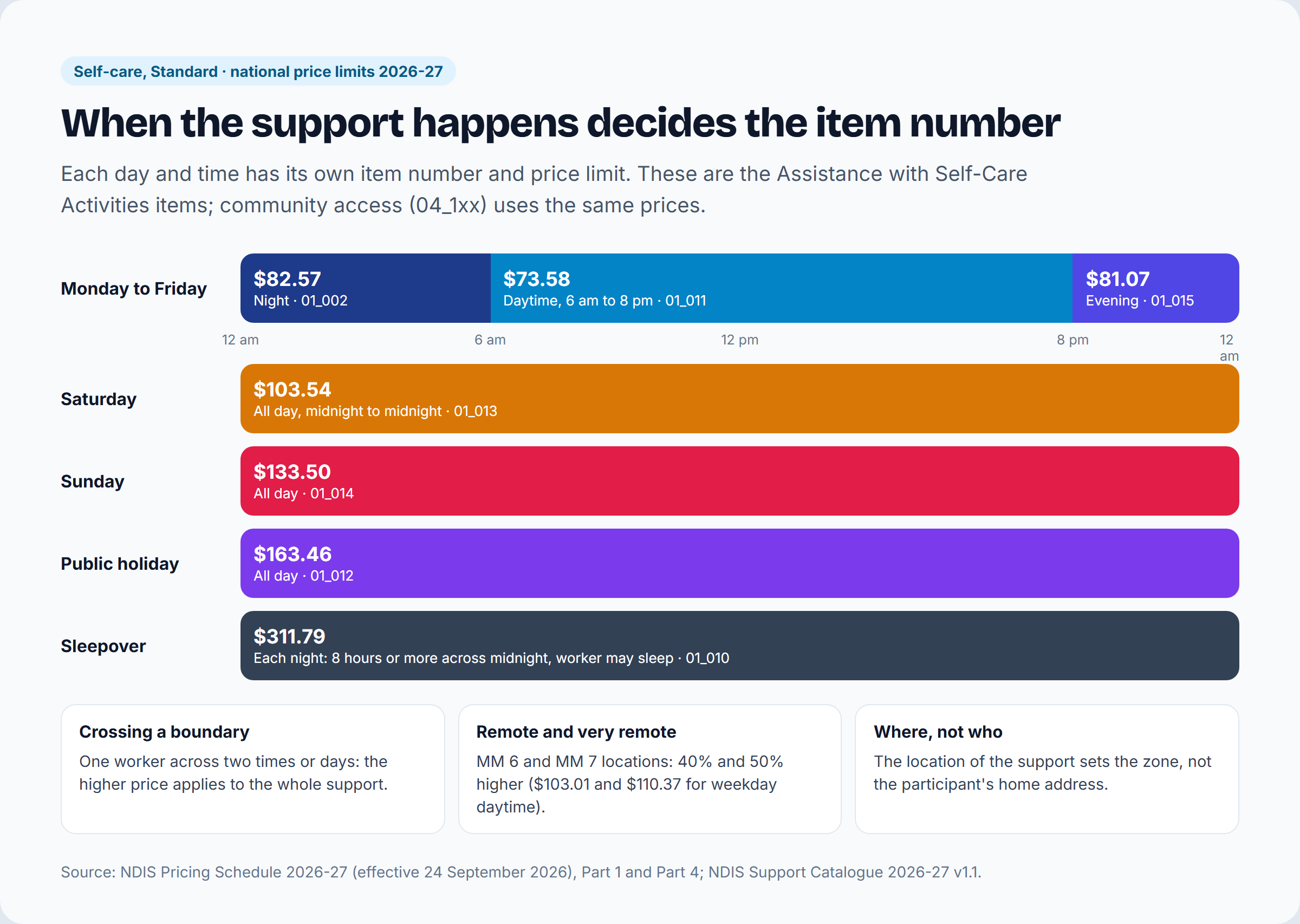
Many supports have a separate item number for each time and day, and it is "when the support is provided to the participant, not the shift of the worker" that counts. The definitions are in Part 4 of the Pricing Schedule:
| Time | Definition |
|---|---|
| Weekday daytime | Starts at or after 6:00 am and ends at or before 8:00 pm on a single weekday. |
| Weekday evening | Starts at or after 8:00 pm and finishes at or before midnight on a single weekday. |
| Weekday night | Starts at or before midnight on a weekday and finishes after midnight on the next weekday, or starts before 6:00 am on a weekday and finishes on that weekday. |
| Saturday, Sunday | Starts at or after midnight on the night before and ends at or before midnight that day (unless it is a public holiday or a sleepover). |
| Public holiday | The same midnight to midnight rule, on a public holiday where the support is delivered. |
| Night-time sleepover | Starts before midnight and finishes after it, lasts 8 hours or more, and the worker is allowed to sleep. After 2 hours of active support, the third and later hours can be claimed at Saturday rates on weekdays, or the rate for the day otherwise. |
When one worker's support crosses from one time or day into another, "the higher of the amounts applies to the whole support". Public holidays are 1 January, 26 January, Good Friday, Easter Monday, 25 April, the King's Birthday, 25 and 26 December, and any other day or part day declared in the state or territory where the support is delivered. Nursing items have their own definitions, and these changed this year: weekday daytime nursing now runs from 6:00 am to 6:00 pm.
Here is the standard self-care family across the year change.
| Item | When | 2025-26 | 2026-27 | Remote | Very remote |
|---|---|---|---|---|---|
| 01_011_0107_1_1 | Weekday daytime | $70.23 | $73.58 | $103.01 | $110.37 |
| 01_015_0107_1_1 | Weekday evening | $77.38 | $81.07 | $113.50 | $121.61 |
| 01_002_0107_1_1 | Weekday night | $78.81 | $82.57 | $115.60 | $123.86 |
| 01_013_0107_1_1 | Saturday | $98.83 | $103.54 | $144.96 | $155.31 |
| 01_014_0107_1_1 | Sunday | $127.43 | $133.50 | $186.90 | $200.25 |
| 01_012_0107_1_1 | Public holiday | $156.03 | $163.46 | $228.84 | $245.19 |
| 01_010_0107_1_1 | Night-time sleepover (each) | $297.60 | $311.79 | $436.51 | $467.69 |
Community access items use the same prices: 04_104_0125_6_1 weekday daytime is $73.58. To price a shift by day and time, use our free NDIS shift price calculator.
Claim types: what else an item can be claimed for
The catalogue shows which claim types each item allows. In a bulk payment request the claim type goes in the ClaimType column, in capitals.
| Claim type | Bulk file code | myplace option | Items that allow it |
|---|---|---|---|
| Direct service | blank | Standard | Every item |
| Non-face-to-face support provision | NF2F | Non-Face-to-Face | 197 |
| Provider travel | TRAN | Provider Travel | 197 |
| Short notice cancellation | CANC | Cancellation | 205 |
| NDIA requested report | REPW | NDIA Report | 73 |
| Irregular SIL support | IRSS | Irregular SIL Support | 35 |
| Telehealth | THLT | Telehealth Services | Not a catalogue column |
- Non-face-to-face work has to be allowed for the item, agreed in the service agreement and part of that participant's support. Admin such as making service bookings or payment claims cannot be billed.
- Provider travel time is capped at 30 minutes per worker in MMM 1 to 3 and 60 minutes in MMM 4 and 5, with no cap in remote and very remote areas. Non-labour travel costs, such as kilometres, are claimed as a direct service on the 799 item. Our provider travel calculator applies the caps, and the travel and kilometre guide explains them.
- A short notice cancellation can be claimed at "up to 100% of the agreed fee", on the same item the support would have used. The notice period is 7 days for support worker items and 2 clear business days for others, and the terms must be in the service agreement. Check one with the cancellation calculator.
What changed in 2026-27
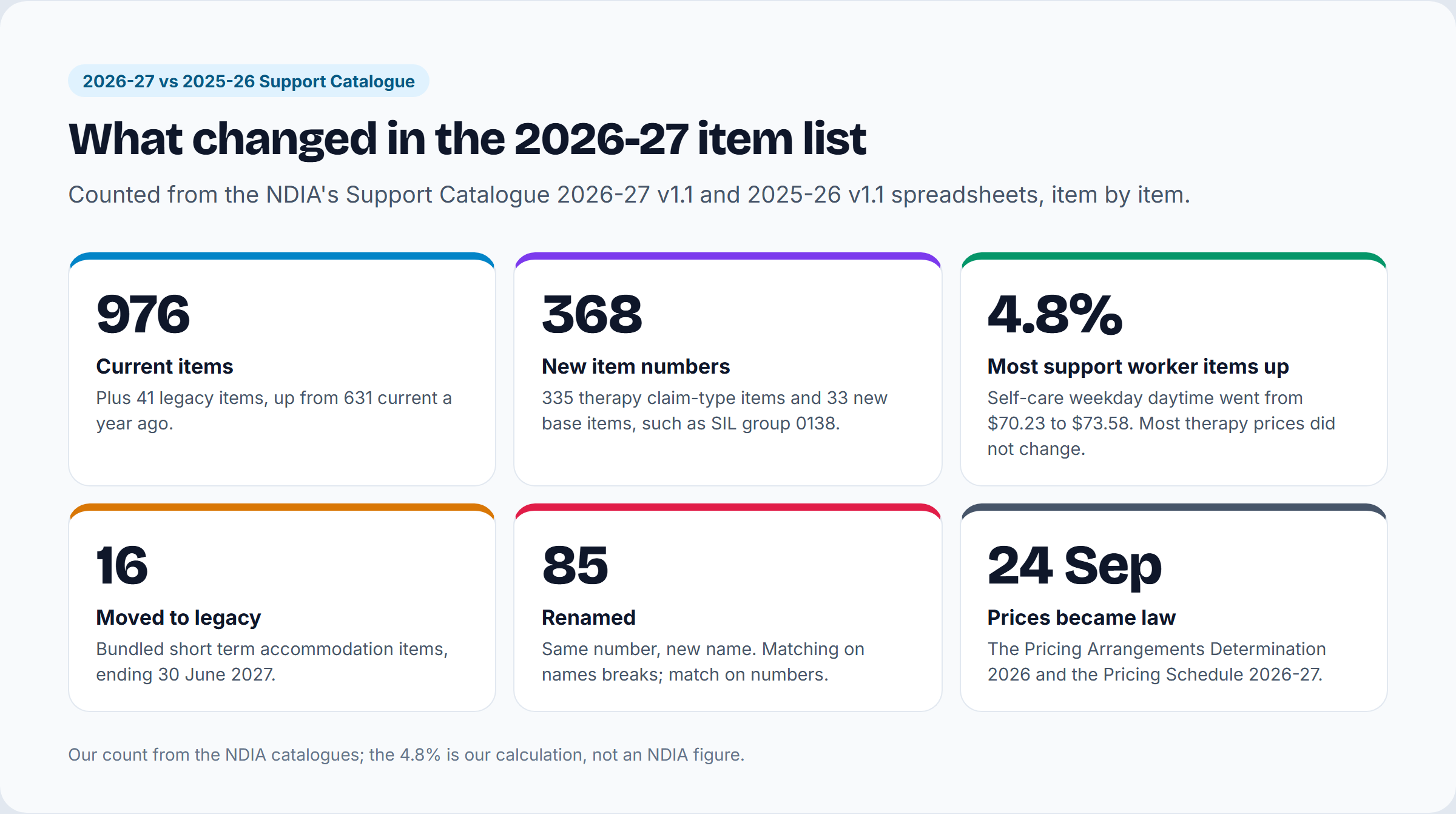
| 2025-26 v1.1 | 2026-27 v1.1 | What it means | |
|---|---|---|---|
| Current items | 631 | 976 | Mostly the new therapy claim-type items |
| Legacy items | 36 | 41 | Includes 16 bundled short term accommodation items, ending 30 June 2027 |
| New item numbers | 368 | 335 therapy claim-type items and 33 new base items | |
| Removed entirely | 7 | Including two Hearing Services Program items and two early childhood AT packages | |
| Renamed, same number | 85 | For example, early childhood therapy items are now "ECI Professional" | |
| Price columns | 8 states plus remote and very remote | National, remote, very remote | No state ever had a different price |
The 33 new base items unbundle short term accommodation (separate items for participant accommodation, worker accommodation, sleepovers and high intensity support), add the new SIL registration group 0138 and add orientation and mobility specialists at $156.16 an hour. Because 85 items kept their numbers but changed their names, any system that matches items by name will break; match on the number.
Prices moved by different amounts. These are the main groups, computed by comparing the two catalogues.
| Group | Change | Example |
|---|---|---|
| Support worker cost model items (self-care, community access, sleepovers) | +4.8% | $70.23 to $73.58 (weekday daytime self-care) |
| Domestic and house and yard items | +3.6% | $59.06 to $61.16 (personal domestic activities) |
| Psychology | +8.6% | $232.99 to $252.99 |
| Occupational therapy, speech pathology, physiotherapy | No change | $193.99, $193.99, $183.99 |
| Dietitian | -5.3% | $188.99 to $178.99 |
| Exercise physiology | -3.0% | $166.99 to $161.99 |
| "Other professional" therapy | -19.5% | $193.99 to $156.16 |
| Support coordination and plan management | No change | $80.06, $100.14, $190.54; $104.45 a month |
The support worker increases follow the Fair Work Commission's Annual Wage Review of 2 June 2026. More change is coming: the government says the Pricing Schedule "will be updated later this year" to reflect the Fair Work Commission's decision on Schedule E of the SCHADS Award, the changes to which take effect on 1 December 2026. It is also consulting on differentiated pricing, which the Annual Pricing Review recommended from 1 January 2027. That is a recommendation, not law yet. Our NDIS price limit history shows how the main limits have moved year by year, and our guide to the 2026-27 price guide changes covers the rest.
How to find the right item number
- Name the support you are delivering, such as personal care, community access or a therapy session.
- Find its family in the catalogue or our free NDIS price guide, which searches all 976 items.
- Pick the item for the day and time the support starts and ends.
- Check the location's MMM zone for the price limit.
- Decide the claim type: direct service, travel, non-face-to-face, cancellation or a report.
- Check the item is active for the date and funded in the participant's plan, and that your registration covers its group.
In the myplace provider portal, the Bulk Upload screen also offers a Support Item Reference List: an Excel file of the items active in service bookings with your participants, with the code to type into a bulk file.
Using item numbers on invoices, agreements and claims
The NDIA's record keeping page lists what an invoice needs. As well as the participant's name and NDIS number, the dates, the quantity or hours and the support, it must show your business name and ABN, the "support item number listed in the NDIS support catalogue", the claim type, the total and the GST. "Each invoice can only be for one participant", though it can include several supports.
The Pricing Arrangements give a worked example of a support with travel, shown as three separate lines and three separate claims: $100.00 for two hours of support on the support item, $41.67 for 50 minutes of travel on the same item with the Provider Travel option, and $46.80 for 60 kilometres on the matching 799 item.
Claim types need to be agreed before they are used. Non-face-to-face work, provider travel, short notice cancellations and NDIA requested reports all depend on terms in the service agreement. In a bulk payment request, the item number goes in the SupportNumber column, which takes up to 60 characters. Our NDIS bulk upload guide walks through every column.
Rejection codes caused by item numbers
These are the NDIA rejections that come from the item number itself. Each links to our NDIA claim rejection codes list.
| Code | What the NDIA says | What it usually means |
|---|---|---|
| M02 | Product selected is incorrect | The item is not in the support category of the service booking. Check the category digits. |
| C06 | The price entered exceeds the price of the product approved in the service booking | Claim at or below the booked price. |
| C15 | Provider is not registered for this support item | Your registration does not cover the item's registration group (the third part). |
| C16 | The support is not available for the dates entered | The item was not active on those dates. Use the item that applied on the day. |
| C18 | Provide product level details | You entered a support category instead of an item number. |
| C21 | Selected product is not relevant for the payment request | Wrong item for the support delivered. |
| C29 | This support item is not allowed for this claim type selection | The claim type is not allowed on that item. |
| V10 | The support item selected can not be claimed | The item is not valid for this claim. |
| V16 | The NDIS support was not funded in the plan when it was delivered | Check the plan on the date of support. |
| V31 | The unit price claimed is above the NDIS price limit | Claim at or below the limit for the location and date. |
Common mistakes
- Claiming a weekday item for a Saturday or Sunday shift, or a daytime item for a shift that ran past 8:00 pm.
- Claiming travel on an item that does not allow it, or on a support that already has travel built in.
- Using a 2025-26 price or item name for a support delivered after 1 July 2026.
- Claiming a legacy item for a new booking.
- Adding a claim type to kilometres, which are claimed as a direct service on the 799 item.
- Putting both a quantity and hours on one claim.
How Rostery handles item numbers
Rostery is our product, so here is what it does. The NDIS price guide is built in, loaded from each new Support Catalogue as a version with its own start date, so every visit is priced at the version in force on the day it happened. A shift is billed at the item for the day and time it ran (weekday daytime, evening or night, Saturday, Sunday or public holiday), and sleepovers are their own item. The price guide holds the national, remote and very remote limit for every item. Rostery warns when a rate in your price list is above the limit, and it checks every line of a claim file against the NDIA rules before the file is written. See NDIS billing and invoicing in Rostery.
Frequently asked questions
What does an NDIS support item number mean?
It identifies one support the NDIA pays for, in five parts: support category, sequence number, registration group, outcome domain and support purpose. In 01_011_0107_1_1, 01 is Assistance with Daily Life, 011 is the weekday daytime rate, 0107 is the Daily Personal Activities registration group, the first 1 is the Daily Living outcome and the last 1 means Core.
How many NDIS support items are there in 2026-27?
The Support Catalogue 2026-27 v1.1 has 976 current items and 41 legacy items. 335 of the current items are the new therapy claim-type items, leaving 641 base items. The Pricing Schedule, which is law, lists the 611 items that have a maximum price.
What is the NDIS price limit for 01_011_0107_1_1 in 2026-27?
$73.58 an hour nationally, $103.01 in remote areas (MM 6) and $110.37 in very remote areas (MM 7). It was $70.23 in 2025-26.
What do _PT, _NF, _CA, _RR and _TH mean on NDIS item numbers?
They are the new 2026-27 therapy claim-type items: provider travel, non-face-to-face, short notice cancellation, NDIA requested reports and telehealth. The travel item is half the direct service price; the others are the same as the direct service price.
Where do I find NDIS support item numbers?
In the NDIA's Support Catalogue spreadsheet, the Pricing Schedule 2026-27, the Support Item Reference List in the myplace portal, or our free NDIS price guide, which has a page for every item.
Can I charge more than the price limit?
Not for NDIA-managed or plan-managed participants. The NDIA cannot pay above the limit, and providers cannot charge more than it. A bulk claim priced above the limit is either rejected (V31) or, in a bulk upload, paid only up to the limit. Self-managed participants are not bound by the limits.
Does the price depend on when the support was delivered?
Yes. Each item has a start and end date, and claims for dates outside them are rejected (C16). A support delivered before 1 July 2026 is claimed against the item and price that applied then.
Sources
- NDIA: NDIS Pricing Arrangements and Price Limits 2025-26, version 1.1 (pages 7, 11 to 18, 20 to 31, 61)
- NDIA: NDIS Support Catalogue 2026-27, version 1.1 (spreadsheet)
- NDIA: NDIS Pricing Schedule 2026-27, effective 24 September 2026
- National Disability Insurance Scheme (Pricing Arrangements) Determination 2026 (F2026L01268)
- NDIA: Pricing arrangements
- NDIA: Annual Pricing Review 2026-27 (June 2026)
- NDIA: Bulk payment requests self-help guide (December 2025)
- NDIA: What are the record keeping requirements
- Department of Health, Disability and Ageing: New price limits set for NDIS supports (24 September 2026)
Checked 21 October 2026. Counts and percentage changes are our own, computed from the NDIA's catalogue spreadsheets. This guide explains the NDIA's published pricing and is not financial or legal advice.