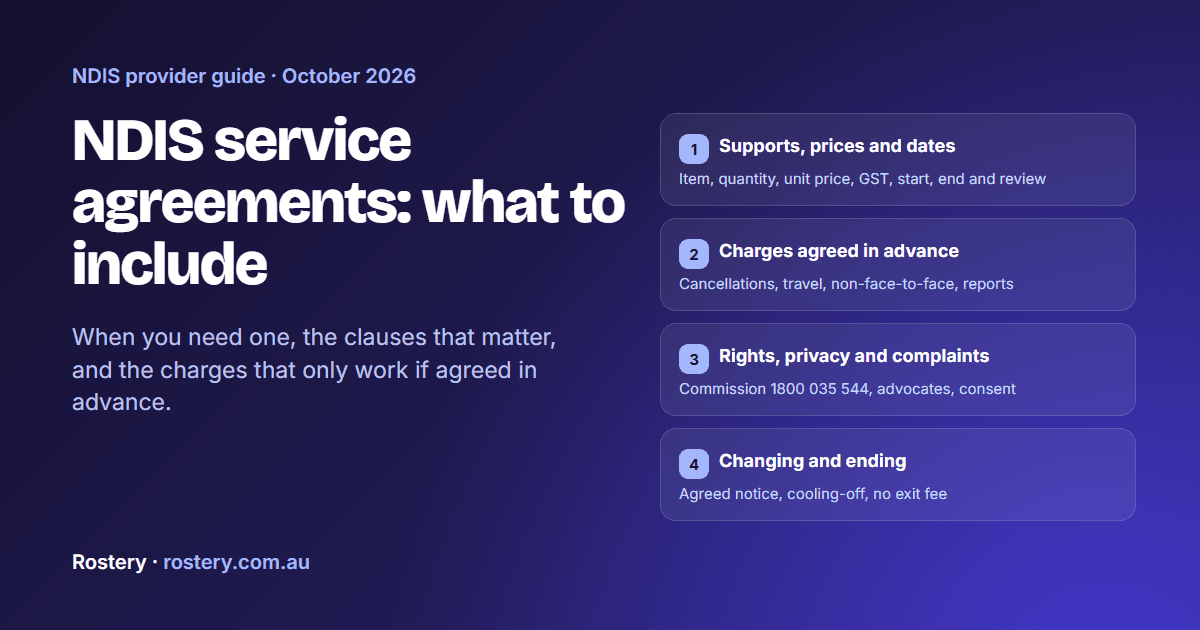
An NDIS service agreement is the agreement between a participant and a provider about which supports will be delivered, how and when, what they cost, and the terms around them: cancellations, changes, complaints and ending the arrangement. It protects both sides. The participant knows what they are getting and what they will pay, and the provider has the advance agreement that several NDIS charges depend on.
Several things changed in 2026. Since 24 September 2026, NDIS price limits are set in law, and charging more than the limit for NDIA-managed or plan-managed supports is prohibited by the NDIS Act. In October 2026 the NDIA and the NDIS Quality and Safeguards Commission published a new service agreement template. Supported independent living (SIL) providers have had new registration and Practice Standards since 1 July 2026. This guide explains when you need an agreement, what to put in it clause by clause, which charges only work if they were agreed in advance, and what to leave out. It is written for owners, coordinators and intake staff at registered and unregistered providers, and was checked on 13 October 2026 against the sources at the end.
Is an NDIS service agreement mandatory?
Only one support needs a written service agreement by law: specialist disability accommodation (SDA). For most other supports an agreement is expected or recommended, and in practice you need one, because some charges can only be claimed when the participant agreed to them beforehand.
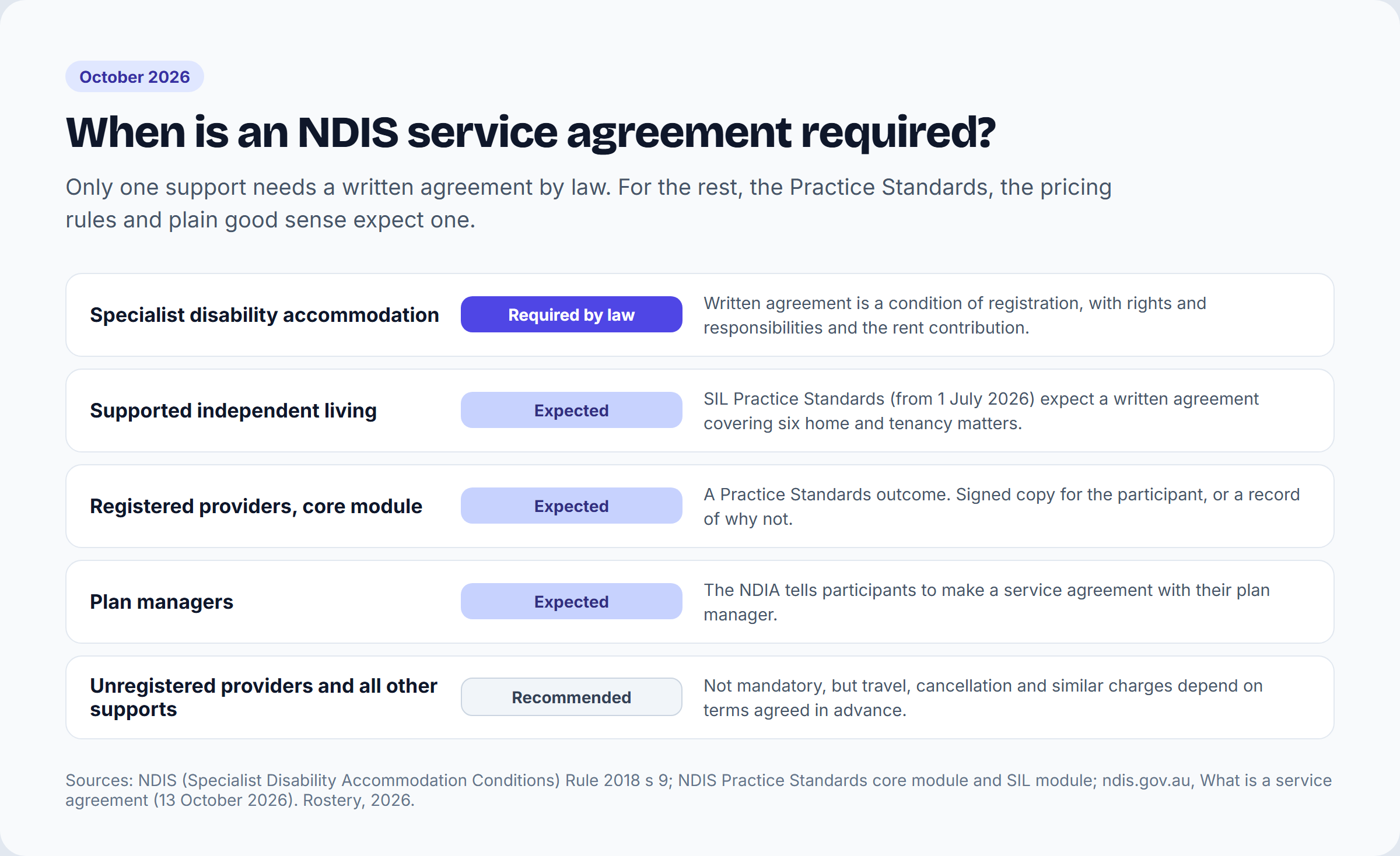
| Situation | Is a service agreement needed? | Why |
|---|---|---|
| Specialist disability accommodation | Yes, in writing | A condition of registration under section 9 of the NDIS (Specialist Disability Accommodation Conditions) Rule 2018. It must set out both parties' rights and responsibilities, and the NDIA says it should include the participant's rent contribution. |
| Supported independent living | Expected | The NDIA says agreements are "encouraged". The SIL Practice Standards that started on 1 July 2026 expect each participant to be supported to have a written service agreement. |
| Registered providers audited against the core module | Expected | Service agreements are an outcome in the core module of the NDIS Practice Standards. |
| Plan managers | Expected | The NDIA tells plan-managed participants to make a service agreement with their plan manager. |
| Unregistered providers, and all other supports | Recommended | We found no rule that makes it mandatory, but the NDIA recommends one whenever a participant starts with a new provider or their needs change. |
Registered providers who are only audited against the verification module, for lower-risk supports, don't have a service agreement outcome in that module. Neither the NDIA nor the NDIS Commission is a party to service agreements, keeps copies of them or enforces them. Every provider, registered or not, must follow the NDIS Code of Conduct, and an agreement can't be used to contract out of the Code or the Australian Consumer Law.
Does it have to be written and signed?
The Practice Standards define a service agreement as "a written agreement between the provider and the participant". Their indicator says that where the agreement is in writing, the participant receives a copy signed by both the participant and the provider. If that isn't practicable, or the participant chooses not to have an agreement, the provider records why the participant didn't receive a copy.
The ACCC notes that for many NDIS supports an agreement can be based on conversations or electronic messages, although agreements for SDA and certain behavioural therapies must be in writing. Our advice is to put every agreement in writing and keep the signed copy. If a participant won't sign, write down the circumstances and what was agreed.
What to include in an NDIS service agreement
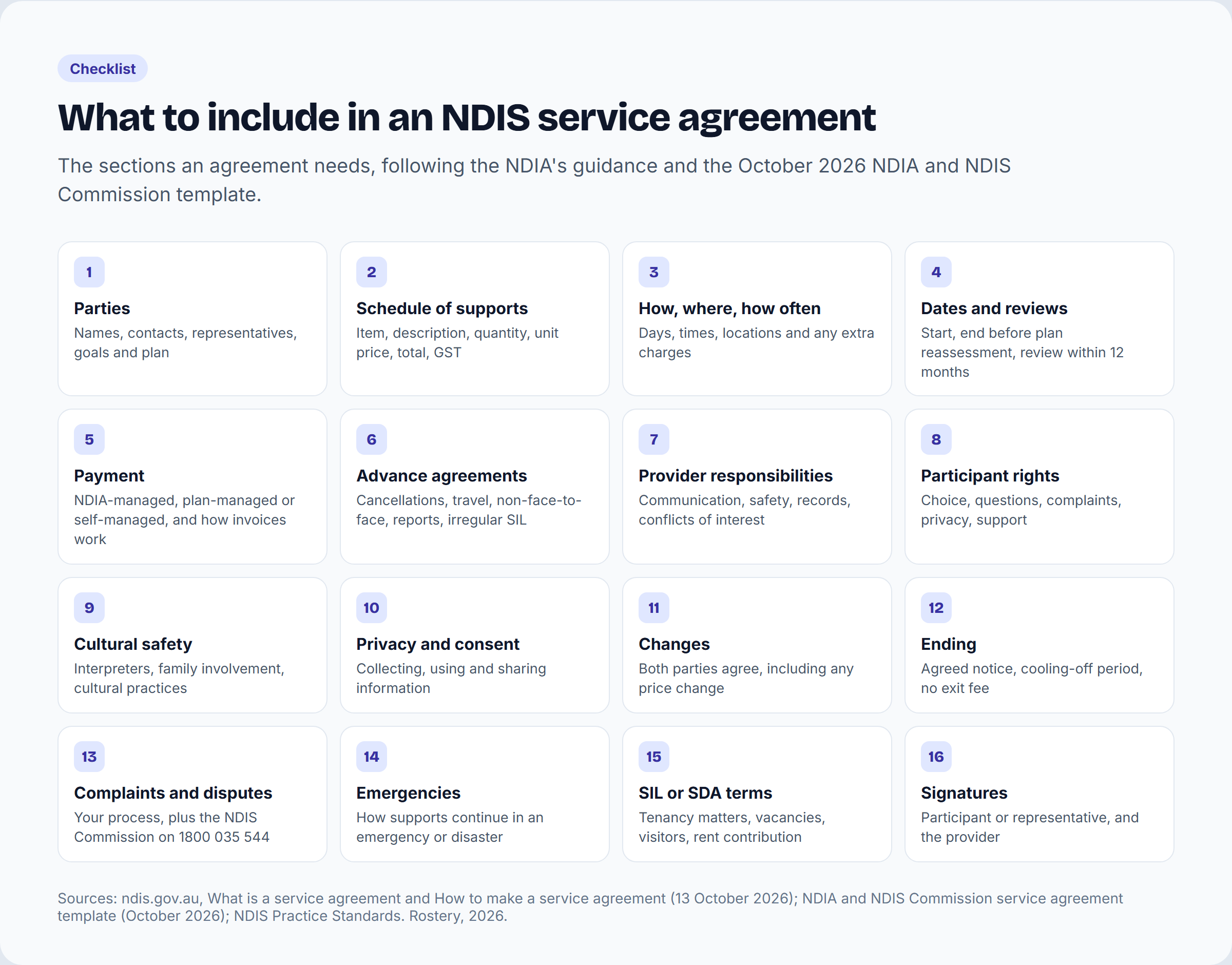
The NDIA says a good service agreement covers eight things: who it is for, which supports are provided, how they are provided, how much they cost, how the provider gets paid, important dates and reviews, both parties' rights and responsibilities, and what to do when you disagree or something goes wrong. The new template expands that into sections, and the pricing rules add the charges that need advance agreement.
The parties
Names and contact details for the participant and the provider, any representative such as a guardian, nominee or child representative, and the participant's goals and NDIS plan. Note the participant's NDIS number, because the provider needs it for claims and invoices.
The schedule of supports
List each support with its category, support item name or number, a description, the quantity or hours, the unit price, the total cost and any GST. Say how, where and how often each support will be delivered, and list any extra charges such as travel. The template puts this in an attachment, the Schedule of Supports, with columns for category, support item, description, when, where, unit price, additional charges and total cost. It also says additional charges must not exceed the current NDIS Pricing Schedule and must be agreed before supports are delivered.
Here is an example of how a schedule of supports might look, using NDIS Pricing Schedule 2026-27 items. The prices are the national maximums, so your agreed price can be lower.
| Support item | Description | When and where | Unit price (limit) | Example quantity |
|---|---|---|---|---|
| 01_011_0107_1_1 | Assistance With Self-Care Activities, Standard, Weekday Daytime | Monday, Wednesday and Friday mornings, at home | $73.58 an hour | 3 hours a week |
| 04_104_0125_6_1 | Access Community Social and Rec Activities, Standard, Weekday Daytime | Tuesday afternoons, in the community | $73.58 an hour | 4 hours a week |
| Provider travel | Travel time to the participant, claimed against the support item | Each visit | As agreed, within the travel caps | Up to 30 minutes each way (MMM 1 to 3) |
| 01_049_0107_1_1 | Establishment Fee For Personal Care/Participation | Once, at the start | $735.80 | 1 (only if at least 20 hours a month for 3 or more months) |
Check each item's current price limit and claiming rules in our NDIS price guide before you fill in the schedule.
Dates and reviews
Give a start date, an end date and a review date. The NDIA says the end date shouldn't be later than the participant's plan reassessment date, and the template says the review date should be no more than 12 months after the start date.
Prices and the price limits
Each provider agrees its price for each support with each participant, up to the price limit. Since 24 September 2026, the limits come from the NDIS (Pricing Arrangements) Determination 2026, which makes the NDIS Pricing Schedule 2026-27 legally binding, and section 45C(7) of the NDIS Act prohibits a provider from charging more than the limit. The limits apply to NDIA-managed and plan-managed funding, whether the provider is registered or not. Self-managed participants can negotiate prices above or below them. Every limit already includes GST, and many NDIS supports are GST-free.
The maximum is a ceiling, and providers and participants can agree a lower amount. If a claim goes over the limit, the NDIA can refuse it or pay only the maximum. Providers also shouldn't tell participants that the NDIA sets their prices.
How you get paid
Write down how the participant's supports are funded, because it decides who you invoice and whether the price limits apply.
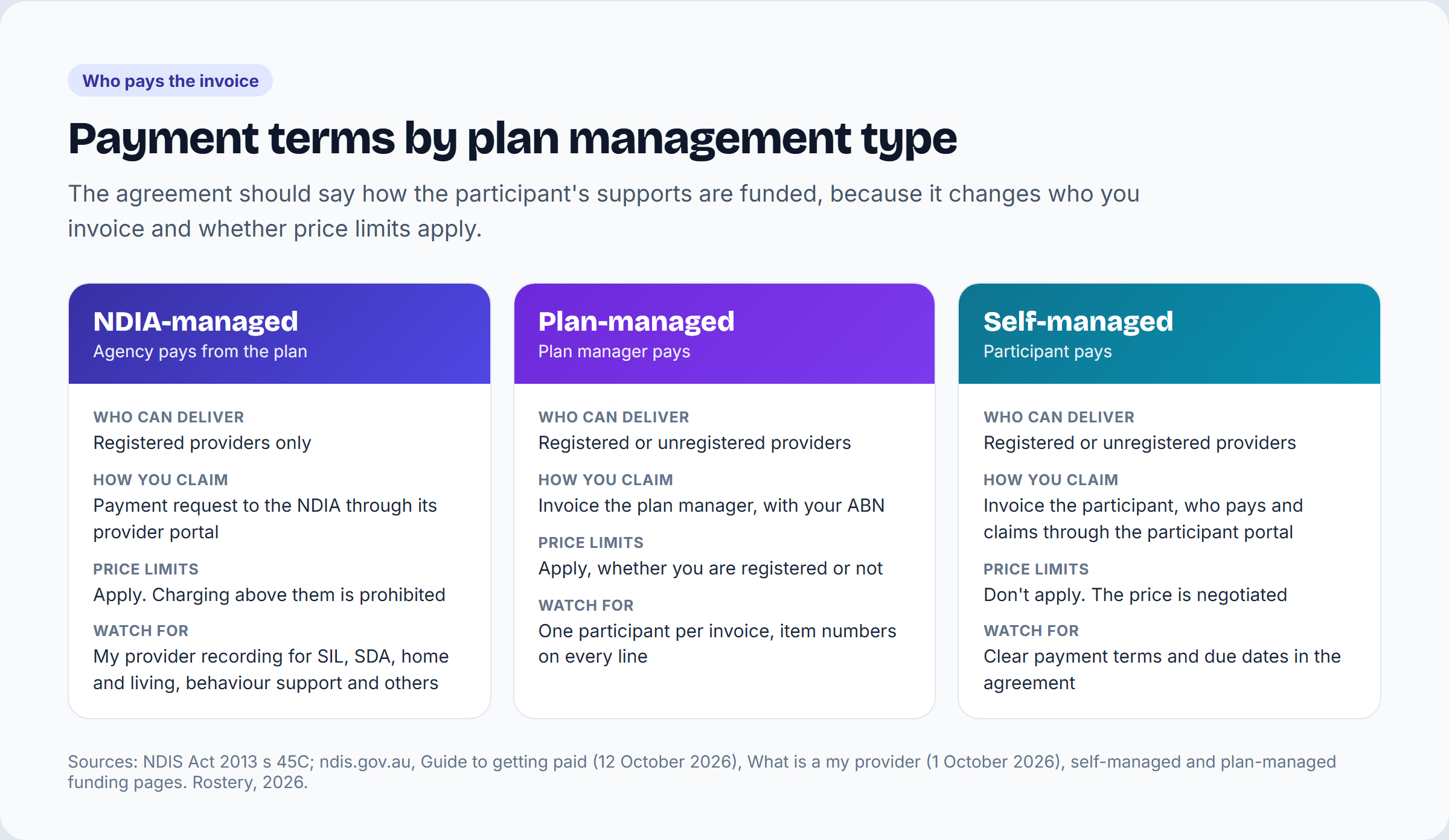
| Funding | Who can deliver | Who you invoice | Price limits |
|---|---|---|---|
| NDIA-managed | Registered providers only | The NDIA, by payment request through its provider portal | Apply |
| Plan-managed | Registered or unregistered providers | The plan manager, with an invoice showing your ABN | Apply |
| Self-managed | Registered or unregistered providers | The participant, who pays through the participant portal | Don't apply |
Plans built in the NDIA's PACE system don't use service bookings. Instead, participants record the providers they work with regularly as "my providers". A participant must record a my provider for specialist disability accommodation, supported independent living, home and living supports, behaviour supports, and a plan manager, support coordinator or recovery coach. Claims for those supports from a provider who isn't recorded are rejected automatically. Valid claims from my providers are usually paid within 2 to 3 business days, compared with about 10 business days otherwise. Plans still on the old system use service bookings, which must be in place before you deliver supports.
At the moment you have up to 2 years after delivering a support to claim for it. From December 2026, claims must be lodged within 90 days of delivery.
Charges that need advance agreement
Several charges depend on what the participant agreed to before the support was delivered. If your agreement doesn't mention them, you may not be able to claim them. The NDIS Pricing Schedule 2026-27 sets the maximum prices only. The NDIA says it will publish updated claiming guidance shortly, so the rules below come from the latest published version, the Pricing Arrangements and Price Limits 2025-26 (version 1.1).
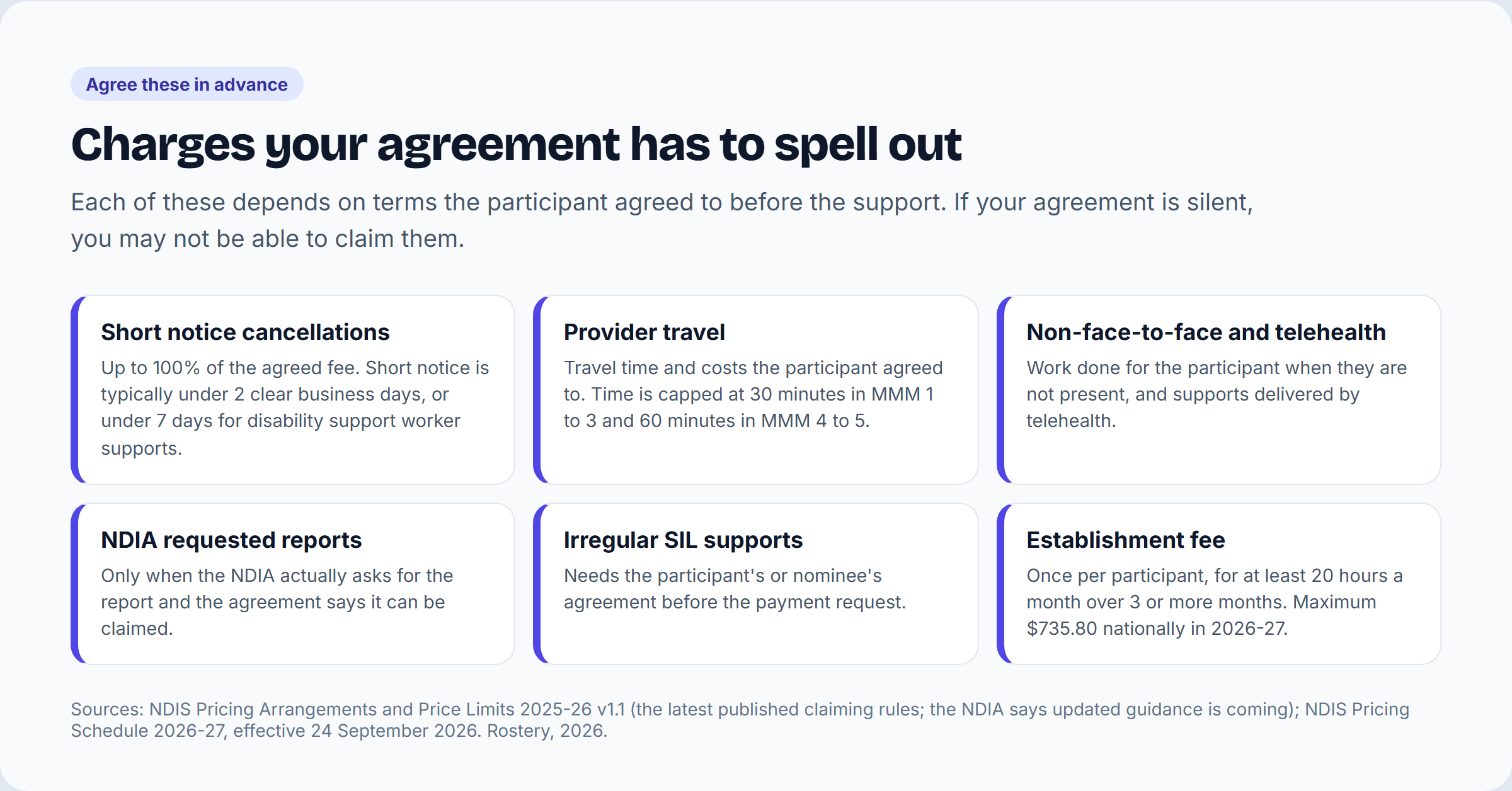
| Charge | What the agreement needs to say |
|---|---|
| Short notice cancellations and no-shows | Your cancellation terms, including the notice period and how much you charge |
| Provider travel | The travel costs that can be claimed, and how shared travel is split between participants |
| Non-face-to-face supports | That non-face-to-face work can be claimed |
| Telehealth | That supports delivered by telehealth can be claimed |
| NDIA requested reports | That reports can be claimed when the NDIA asks for one |
| Irregular SIL supports | That irregular SIL supports can be claimed when required |
| Establishment fee | An agreement to supply at least 20 hours a month for 3 or more months |
| Prepayments for assistive technology or home modifications | Any deposit or milestone payments |
Provider travel time is capped at 30 minutes each way in Modified Monash areas 1 to 3 and 60 minutes in areas 4 to 5, and travel for therapy supports is capped at 50% of the therapy price limit. For non-labour travel costs, such as running a car, providers can negotiate a reasonable contribution with the participant. The 2025-26 rules treated up to $0.99 a kilometre as reasonable for a vehicle owned by the provider or the worker. Our NDIS provider travel calculator applies the caps for you. An establishment fee can be claimed only once per participant, across all their plans, and its 2026-27 maximum is $735.80 nationally.
Your cancellation policy
Under the latest published rules, a provider can claim up to 100% of the agreed fee for a short notice cancellation or no-show, subject to the pricing rules and the service agreement. A cancellation is typically short notice when the participant gives:
- less than 2 clear business days' notice, for supports that aren't disability support worker supports
- less than 7 days' notice, for disability support worker supports
The provider can only claim if it couldn't find other billable work for the worker and still had to pay them. There is no hard limit on how many short notice cancellations can be claimed for a participant, although the NDIA monitors them. Providers can waive the fee or offer more generous notice terms. The new template goes further than the pricing rules: it says the provider will only charge for a short notice cancellation or no-show when there has been an actual loss, and won't charge where it would be unfair under the Australian Consumer Law.
The cancellation section should also say what happens when you cancel, pause or replace a support yourself. Our NDIS cancellation calculator works out whether a cancellation can be charged and how much, and the glossary entry on short notice cancellation has the definitions.
Provider responsibilities
The NDIA suggests the provider commits to treating the participant with respect, communicating clearly and on time, providing suitable supports, and explaining complaints, changes, privacy, records, safety rules and conflicts of interest. The template adds arranging an interpreter if needed, giving the participant the final agreement in their preferred format, and keeping accurate records for at least seven years.
Participant rights and responsibilities
Participants have the right to choice, to ask questions, to make complaints, to get support and to have their privacy protected. Their responsibilities include paying invoices on time and telling the provider when their needs or their NDIS plan change.
Cultural safety
The NDIA now lists cultural safety as part of an agreement: information that works for the participant, an interpreter when needed, the choice to involve family, and a provider that understands and respects the cultural practices and beliefs that matter to the participant.
Privacy and consent
Explain how you collect, use, store and share the participant's information, get their consent to do so, and tell them how to access or correct it and how to withdraw or change their consent. The template's privacy statement also tells participants they can complain to the Office of the Australian Information Commissioner or the NDIS Commission.
Changing the agreement
Any change has to be agreed by both parties, including a change of price. The template adds that if the provider proposes a price change and the participant doesn't agree, the participant can end the agreement straight away. The NDIA suggests small changes can be made as a variation, and a new agreement is better for big changes such as new supports or a new plan.
Ending the agreement
No law sets a fixed notice period for ending a service agreement, so the notice period is whatever the agreement says. The template leaves it for you to fill in, giving 14 days as an example. It also includes a cooling-off period, with 7 days as its example, and says the participant won't be charged an exit fee. The NDIA tells participants they may be charged a fee if they end an agreement without giving the agreed notice, under the conditions in the pricing rules.
Complaints and disputes
The agreement should have a clear complaints process. Registered providers must run a complaints system that tells people they can take a complaint to the NDIS Commission and protects them from any adverse effect for complaining. Unregistered providers are expected to act fairly and in line with the Code of Conduct. Include the Commission's contact details: 1800 035 544, or TTY 133 677, with interpreters available. Registered providers must also cooperate with advocates who represent participants.
Emergencies and disasters
The Practice Standards say service agreements set out how supports will be provided in an emergency or disaster. Say how you will contact the participant and keep essential supports going.
SIL and SDA terms
For SIL, the SIL Practice Standards expect the written agreement to cover how concerns about the home are raised and dealt with, how conflicts with co-tenants are managed, how changes in circumstances or support needs are agreed, how vacancies are filled, how behaviours of concern that put a tenancy at risk are managed, and how the participant can have visitors. A provider that delivers both SIL and tenancy to the same participant must use separate service and tenancy agreements. For SDA, include the rights and responsibilities of both parties and the participant's rent contribution. Our SIL provider operations guide covers the rest of running a SIL house.
Signatures
The participant, or their authorised representative, signs, and so does someone authorised to sign for the provider. For a participant under 18, things the NDIS Act requires or permits are done by the person or people with parental responsibility. Nominees act for participants aged 18 and over. The template's signing page asks a representative to state their authority to sign, for example as a guardian. See our glossary entry on the plan nominee for what a nominee can do.
Clauses to leave out
Since 9 November 2023, proposing, using or relying on unfair terms in standard form contracts has been banned under the Australian Consumer Law, and penalties apply. A term can be unfair if it causes a significant imbalance between the parties, isn't reasonably necessary to protect the business, and would cause the other party harm if enforced. A contract is presumed to be a standard form contract, and the business that wrote it has to prove otherwise. The NDIA says the Australian Consumer Law applies to service agreements.
The ACCC's examples of terms that may be unfair include terms that let only one party end the contract, penalise only one party for breaching or ending it, or let only one party change it. In 2025 the support platform Mable admitted to using unfair contract terms, including a minimum $5,000 penalty fee and a term that treated service logs as approved after 24 hours.
The pricing rules also limit what you can add. Registered providers must not add credit card surcharges, gap fees, late payment fees or cancellation fees unless the pricing rules allow them, and participants are generally not required to pay exit fees. Developing and agreeing a service agreement is an administrative activity covered by your prices, so you can't bill the participant for it. The unfair terms law doesn't cover the upfront price itself. The Code of Conduct does, through its fair pricing rule: without a reasonable justification, you must not charge a participant more than you would charge someone else for the same thing.
Making the agreement easy to understand
Participants can ask for the agreement in the format they prefer, in words they understand, and with an interpreter. The NDIA publishes Easy Read guides: What is a service agreement (Easy Read PDF) and Making a service agreement (Easy Read PDF). Give the participant time to read the agreement and to ask someone they trust about it. They can say no or ask for changes, and they don't have to sign.
Keeping service agreement records
The NDIA lists service agreements among the records providers keep, alongside invoices, support logs, rosters and case notes. The amended NDIS Act sets a 7-year retention period for provider records that support claims, counted from the day of the claim. The NDIA describes the new retention periods as coming soon and says it will explain which records they cover. Complaint records already have to be kept for 7 years, and the template commits providers to keeping records for at least seven years, so 7 years is the safe default for signed agreements.
NDIS service agreement checklist
Before a participant signs, check that the agreement:
- names the participant, any representative and the provider, with contact details
- lists every support with its item number, quantity, unit price, GST and total
- keeps every price within the limit for NDIA-managed and plan-managed funding
- says how, where and how often each support is delivered
- has start, end and review dates, with the end no later than plan reassessment
- states how the provider is paid for each funding type
- spells out cancellations, travel, non-face-to-face, telehealth, reports and irregular SIL, if you will charge for them
- includes provider responsibilities, participant rights and cultural safety
- explains privacy and consent
- sets out how changes are agreed, including price changes
- gives the notice period, a cooling-off period and no exit fee
- has a complaints process with the NDIS Commission's contact details
- covers emergencies and disasters
- includes the SIL or SDA terms, where they apply
- contains no one-sided termination, penalty or change terms
- is signed, with a copy given to the participant in their preferred format.
To start from a draft that already covers this checklist, download our free NDIS service agreement template in Word or PDF. There is a sole trader version too.
The NDIA and NDIS Commission service agreement template (Word document) is a good starting point. It is optional, and the NDIA says it is a guide, not legal advice.
2026 changes to check against your template
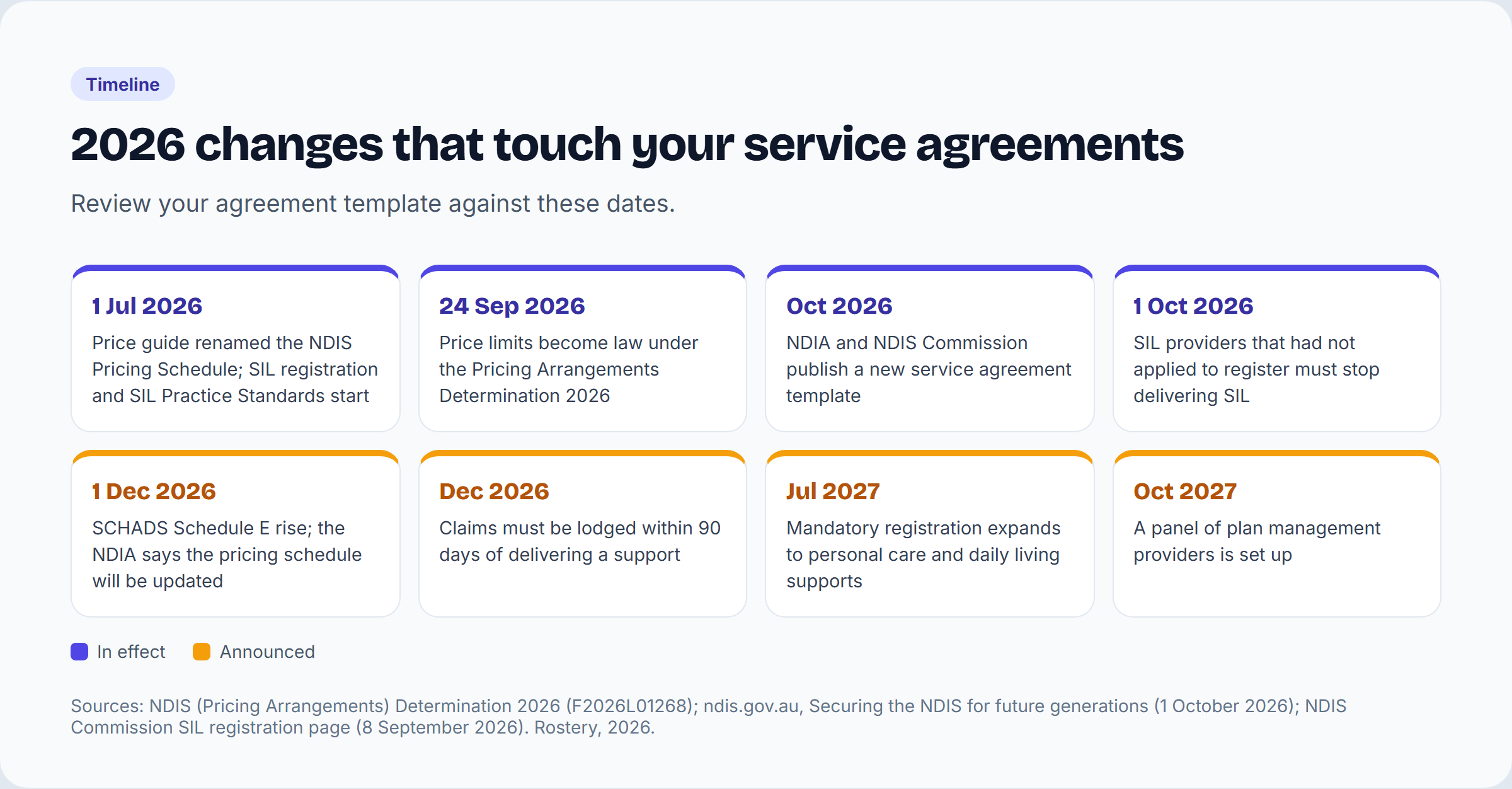
| Date | Change | What to update |
|---|---|---|
| 1 July 2026 | The Pricing Arrangements and Price Limits became the NDIS Pricing Schedule; SIL registration and the SIL Practice Standards started | References to the price guide; the SIL clauses |
| 24 September 2026 | Price limits became law under the NDIS (Pricing Arrangements) Determination 2026 | Prices in every schedule of supports |
| October 2026 | The NDIA and NDIS Commission published a new service agreement template | Compare your clauses, especially cancellations, cooling-off and exit fees |
| 1 December 2026 | SCHADS Award Schedule E increase; the NDIA says the 2026-27 pricing schedule will be updated | Check the prices you agreed against the updated limits |
| December 2026 | Claims must be lodged within 90 days of delivery | Your claiming and invoicing timeline |
| From July 2027 | Mandatory registration expands to some personal care, daily living and closed-setting supports | Registration status and the agreement wording that refers to it |
Before you raise prices under existing agreements, remember the rule that applies whenever limits change: you have to discuss the change with each participant, and they have to agree to it. Our summary of the 2026-27 NDIS pricing changes lists what moved.
How Rostery helps
Rostery has a ready-made Service Agreement form that covers the services, prices, cancellations, rights and responsibilities, and captures the participant's and the provider's signatures on screen. Each agreement is then kept in the participant's service agreements register with its supports, agreed rates and dates, alongside their roster and NDIS invoices. Check each item's current price limit in our NDIS price guide before you agree a price. Book a demo to see it with your own participants.
Frequently asked questions
Is a service agreement mandatory under the NDIS?
Only for specialist disability accommodation, where a written agreement is a condition of registration. It is expected for SIL, for registered providers audited against the core module and for plan managers, and recommended for everything else.
Is there an official NDIS service agreement template?
Yes. The NDIA and the NDIS Commission published one in October 2026. It is optional, and the NDIA says it is a guide, not legal advice. Our free NDIS service agreement template follows the same structure and adds the clauses the pricing rules need before you can charge for travel, cancellations or reports.
Can a provider charge for writing a service agreement?
No. Developing and agreeing a service agreement is an administrative activity, and the pricing rules say administration is covered by the price of the supports.
What is the short notice cancellation rule?
Under the latest published rules, a cancellation is typically short notice when the participant gives less than 2 clear business days' notice, or less than 7 days for disability support worker supports. The provider can claim up to 100% of the agreed fee if its service agreement allows it.
Can I charge more than the NDIS price limit?
Not for NDIA-managed or plan-managed supports. Since 24 September 2026 the NDIS Act prohibits it. Self-managed participants can agree prices above or below the limits.
Can an NDIS service agreement be verbal?
The ACCC says many can be, but SDA agreements and certain behavioural therapy agreements must be in writing, and the Practice Standards define a service agreement as written. Put it in writing and record the circumstances if a participant won't sign.
How much notice is needed to end a service agreement?
Whatever the agreement says. No law sets a fixed period. The NDIA template uses 14 days as an example.
Who signs a service agreement for a child?
For a participant under 18, the person or people with parental responsibility act for them under the NDIS Act.
Sources
- NDIS: What is a service agreement and How to make a service agreement (13 October 2026)
- NDIA and NDIS Commission service agreement template (October 2026)
- NDIS pricing arrangements page and NDIS Pricing Schedule 2026-27 (effective 24 September 2026)
- NDIS Pricing Arrangements and Price Limits 2025-26, version 1.1
- NDIS (Pricing Arrangements) Determination 2026 (F2026L01268)
- National Disability Insurance Scheme Act 2013, sections 45B, 45C, 74 and 78
- NDIS (Specialist Disability Accommodation Conditions) Rule 2018, section 9
- NDIS Practice Standards core module: provision of supports
- SIL Practice Standards: tenancy and housing
- NDIS Code of Conduct and fair pricing
- NDIS Commission: make a complaint
- NDIS: What is a my provider
- NDIS: Guide to getting paid
- NDIS: Record keeping requirements
- NDIS: Securing the NDIS for future generations
- ACCC: Provider obligations under the NDIS and unfair contract terms
Checked 13 October 2026. This guide is general information, not legal advice. The NDIA has said it will publish updated claiming guidance for 2026-27, so check the claiming rules before relying on the cancellation and travel details above. For the short definition, see our glossary entry on the NDIS service agreement.