
Free NDIS service agreement template (Word and PDF)
A free NDIS service agreement template you can edit in Word or fill in as a PDF. It follows the NDIA’s October 2026 template, then adds what it leaves out: the clauses the pricing rules need before you can charge travel, cancellations and reports, an emergency clause and a sole trader version. General information, not legal advice.
- Updated 23 Oct 2026
- Follows the NDIA template (Oct 2026)
- 2026-27 Pricing Schedule
- Free, no email
Version 2026-10
Download the template
Organisation version
ndis-service-agreement-template-2026-10.docx · Word (.docx) · 17 pages · 57 KB
For registered and unregistered providers with staff: 25 clauses, the Schedule of Supports, a SIL addendum and a variation form.
Sole trader version
ndis-service-agreement-template-sole-trader-2026-10.docx · Word (.docx) · 13 pages · 53 KB
For independent support workers and other one-person businesses, written in “I” and “my”.
PDF to fill in or print
ndis-service-agreement-template-2026-10.pdf · PDF · 17 pages · 305 fields · 631 KB
The organisation version with fields you can type into and tick boxes you can click, or print it and write on it.
Checked 23 October 2026. The Word files open in Google Docs too. General information, not legal advice: get independent legal advice before you rely on it. Not endorsed by the NDIA or the NDIS Commission.
What’s in the template
Every clause, and the rule behind it
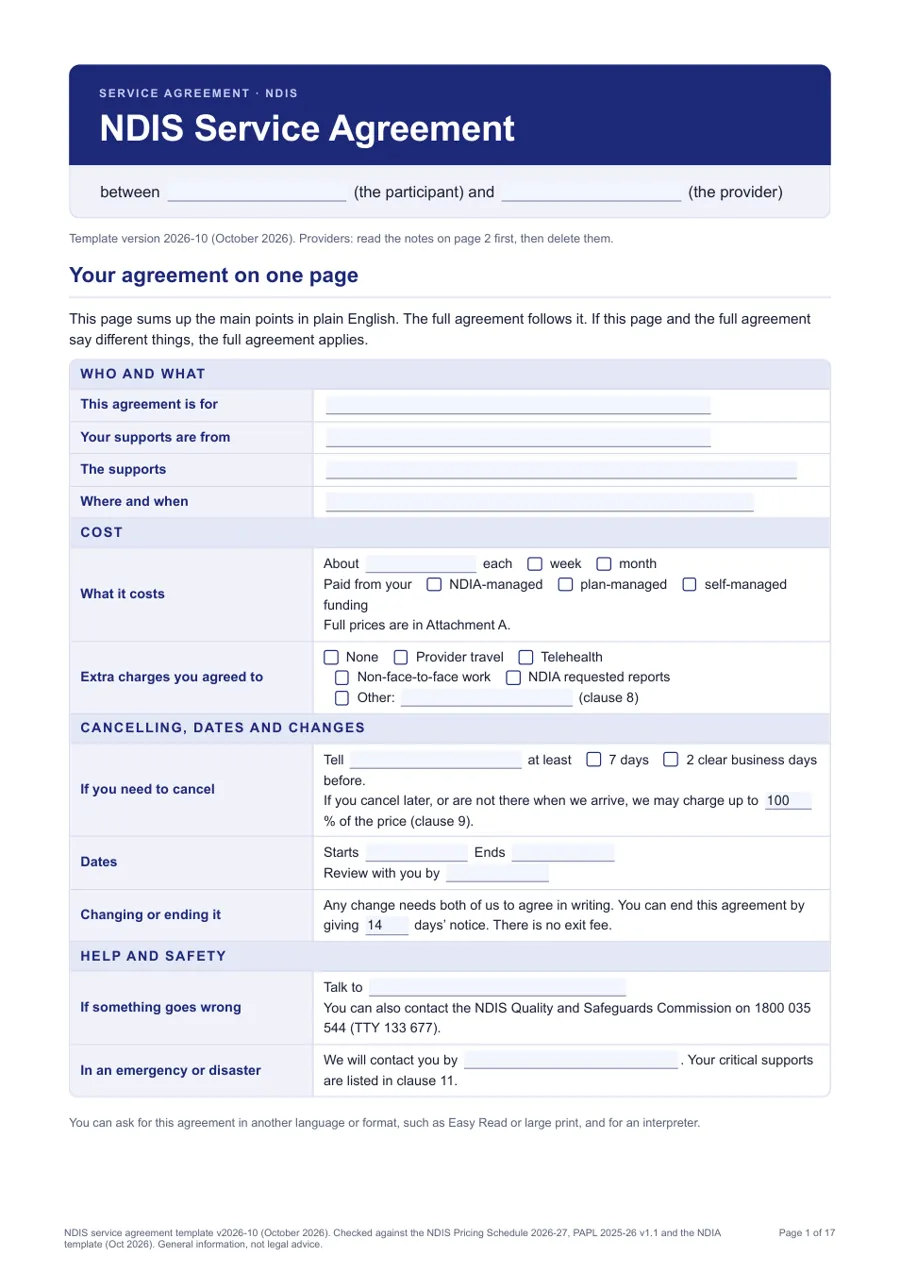
A service agreement is required for SDA, encouraged for SIL and recommended for every other support. The organisation version has 25 clauses and three attachments, in the same order as the NDIA template. This is what each one is for.
| Clause | Why it is there | Source |
|---|---|---|
| Page 1: summary | The key terms on one page, in plain English | Practice Standards core module: language the participant is most likely to understand |
| Before you sign | Time to read, a support person, an interpreter, independent advice | NDIA how-to guide; NDIA template |
| 1 About this agreement | Who it is between, the Code of Conduct, rights that cannot be signed away, the NDIA is not a party | NDIA what-is page; NDIA news, 13 Oct 2026 |
| 2 Words used | Defines the Pricing Schedule and the claiming rules so later clauses stay current | NDIA pricing arrangements page |
| 3 Parties | Participant, representative, plan manager, support coordinator, provider and registration | NDIA how-to guide; ACCC minimum inclusions |
| 4 Dates and reviews | Ends no later than the plan reassessment date; review within 12 months | NDIA how-to guide; NDIA template |
| 5 Goals | The plan goals the supports work towards | NDIA how-to guide |
| 6 Supports | Points to Attachment A and says what is not included | NDIA template; ACCC |
| 7 Prices | Never above the price limit for NDIA-managed and plan-managed supports; how prices change | Pricing Schedule 2026-27; PAPL p16 |
| 8a to 8j Extra charges | Travel, community transport, non-face-to-face, telehealth, NDIA reports, establishment fee, irregular SIL, AT deposits, programs of support. Each applies only if ticked | PAPL p20 to 23, 27, 28, 32, 34, 36, 38 |
| 9 Cancellations by the participant | 7 days or 2 clear business days, no-shows, up to 100%, and when a fee cannot be charged | PAPL p26 to 27 |
| 10 Cancellations by the provider | Back-up workers, pausing supports, keeping supports going | NDIA how-to guide; Practice Standards (continuity) |
| 11 Emergencies and disasters | Critical supports, a back-up way to make contact, who to tell | Practice Standards core module. Not in the NDIA template |
| 12 Paying for supports | Funding type, invoices, no surcharges, gap or late fees | NDIA template; PAPL p40 |
| 13 GST | Many supports are GST-free, but not all | PAPL p40 |
| 14, 15 Responsibilities and rights | What each side agrees to do, including records kept for 7 years | NDIA template; NDIA how-to guide |
| 16 Culture, identity and diversity | Preferences, family and community, interpreters | NDIA how-to guide |
| 17 Privacy and consent | What is collected and shared; consent that can be withdrawn | NDIA template |
| 18 Contacts | Who to call, and how the participant wants to be contacted | NDIA how-to guide |
| 19 Changing the agreement | Small changes on a variation form, big changes in a new agreement | NDIA how-to guide |
| 20 Ending the agreement | Notice, fixing a breach, optional cooling-off, no exit fee | NDIA template; PAPL p40; ACCC |
| 21, 22 Complaints and disagreements | Three steps, NDIS Commission contacts, no debt collector until a debt is confirmed | NDIA template |
| 23 Liability | Does not limit Australian Consumer Law rights | NDIA what-is page |
| 24 Signing and copies | Electronic signing by agreement; a signed copy for the participant | Practice Standards core module; Electronic Transactions Act 1999 |
| 25 Signatures | Participant, representative with their authority, provider, optional witness | NDIA template |
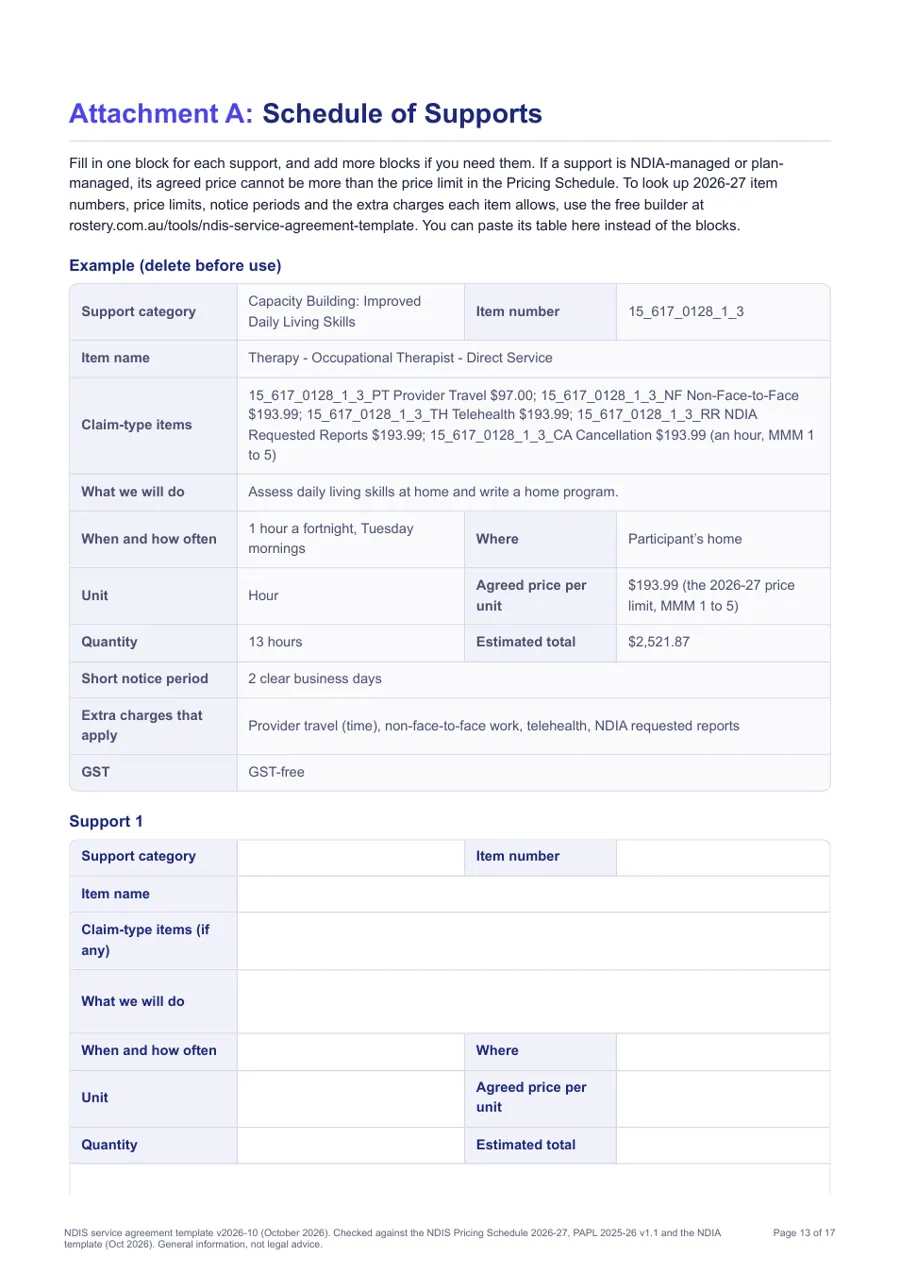
| Attachment A Schedule of Supports | Item numbers, claim-type items, prices, notice periods and extra charges for each support | NDIA template; Pricing Schedule 2026-27 |
| Attachment B SIL addendum | The five SIL matters, weekly SIL claiming, unplanned exits | Practice Standards; PAPL p36, 49, 51 |
| Attachment C Variation form | Records a small change, signed by both | NDIA how-to guide |
PAPL means the NDIS Pricing Arrangements and Price Limits 2025-26, version 1.1. The sole trader version has the same clauses without irregular SIL, assistive technology deposits, programs of support and the SIL addendum, so its numbers run 1 to 23.
Attachment A
Build your Schedule of Supports
Pick the participant’s supports from the NDIS Support Catalogue 2026-27 (v1.1). For each one you see the unit, the price limit for the area, the short notice period and the extra charges the item allows, and the matching clauses are ticked for you. Therapy, early childhood and behaviour support items also show their 2026-27 claim-type items, each with its own price limit: 15_617_0128_1_3_PT Provider Travel is $97.00 an hour, against $193.99 for the direct service. Copy the finished table into Attachment A. Prices come from the 2026-27 NDIS price guide.
Assistance With Self-Care Activities - Standard - Weekday Daytime
01_011_0107_1_1 · Daily Life · per hour
limit $73.58$hrsNotice: 7 daysProvider travelNon-face-to-face$38,261.60Therapy - Occupational Therapist - Direct Service
15_617_0128_1_3 · Daily Living Skills · per hour
limit $193.99$hrsNotice: 2 clear business daysProvider travelNon-face-to-faceTelehealthNDIA reports$4,655.76Claim-type items, 2026-27
- 15_617_0128_1_3_PTProvider travel$97.00
- 15_617_0128_1_3_NFNon-face-to-face$193.99
- 15_617_0128_1_3_THTelehealth$193.99
- 15_617_0128_1_3_RRNDIA requested reports$193.99
- 15_617_0128_1_3_CACancellation$193.99
Estimated total
over 52 weeks, about $825.33 a week
Tick these in the agreement
- 8a Provider travel: time2 of your supports
- 8b Provider travel: other costs2 of your supports
- 8c Transport during community participation
- 8d Non-face-to-face work2 of your supports
- 8e Telehealth1 of your supports
- 8f NDIA requested reports1 of your supports
- 8g Establishment fee
- 8h Irregular SIL supports
- 9 Short notice cancellations2 of your supports
- B Attachment B: SIL addendum
Clause numbers are the organisation version’s. A ticked line means at least one support allows the charge; tick it in the agreement only if you will claim it. Nothing you type is stored or sent anywhere.
Your Schedule of Supports
Copy it straight into Attachment A in Word, or download it as CSV.
Attachment A
Schedule of Supports
Funding: Plan-managed. Price limits for National (MMM 1 to 5), NDIS Pricing Schedule 2026-27. Agreement length 52 weeks.
| Item number | Support item | Unit | Price limit (National (MMM 1 to 5)) | Agreed price | Quantity | Estimated total | Short notice period | Extra charges allowed |
|---|---|---|---|---|---|---|---|---|
| 01_011_0107_1_1 | Assistance With Self-Care Activities - Standard - Weekday Daytime | hour | $73.58 | $73.58 | 10 a week | $38,261.60 | 7 days | Provider travel, Non-face-to-face |
| 15_617_0128_1_3 | Therapy - Occupational Therapist - Direct ServiceClaim-type items: 15_617_0128_1_3_PT Provider travel $97.00; 15_617_0128_1_3_NF Non-face-to-face $193.99; 15_617_0128_1_3_TH Telehealth $193.99; 15_617_0128_1_3_RR NDIA requested reports $193.99; 15_617_0128_1_3_CA Cancellation $193.99 | hour | $193.99 | $193.99 | 2 a month | $4,655.76 | 2 clear business days | Provider travel, Non-face-to-face, Telehealth, NDIA reports |
| Estimated total for 52 weeks | $42,917.36 | |||||||
Item numbers and price limits: NDIS Support Catalogue 2026-27 v1.1 and Pricing Schedule 2026-27. Notice periods: NDIS Pricing Arrangements and Price Limits 2025-26 v1.1. Built with the free template at rostery.com.au/tools/ndis-service-agreement-template.
Support at Home (aged care) uses a different agreement under different law. This template is for NDIS supports only.
How to fill in the template, step by step
- 1. Check the plan. Confirm each support is in the participant’s plan, and whether it is NDIA-managed, plan-managed or self-managed.
- 2. Fill in the parties. Add any guardian, nominee or child representative and what they are allowed to sign, plus the plan manager’s email for invoices.
- 3. Set the dates. The end date should be no later than the plan reassessment date, and the review no more than 12 months from the start.
- 4. Write the goals. Copy them from the plan, in the plan’s own words.
- 5. Build the Schedule of Supports. Use the builder above for item numbers, units and price limits, then paste the table into Attachment A.
- 6. Tick only the extra charges you will claim. An unticked box means you will not charge it. If you never charge travel, leave 8a and 8b unticked.
- 7. Set the cancellation terms. Put the notice period against each support and the percentage you will charge, up to 100%.
- 8. Fill in the emergency clause. List the critical supports and a back-up way to make contact when phones are down.
- 9. Fill in page 1 last, so the summary matches the agreement. Delete the provider notes box on page 2.
- 10. Explain it and give time. Offer an interpreter, Easy Read or another format, and time to get advice. The NDIA’s How to make a service agreement page has Easy Read guides for participants.
- 11. Sign and give a copy. Both of you sign, and the participant gets a signed copy in the format they prefer.
- 12. Diarise the review, and use the variation form for small changes in between.
Charges that only work if the agreement says so
The NDIS Pricing Schedule 2026-27 sets maximum prices. The rules for claiming extra charges are still in the NDIS Pricing Arrangements and Price Limits 2025-26 (version 1.1), the latest claiming guidance the NDIA has published. Its pricing page says updated guidance is coming, so check it before you rely on these. Under the current rules, each of these depends on the service agreement (page numbers are the PAPL’s):
| Charge | What the agreement needs | Page |
|---|---|---|
| Telehealth | Says telehealth supports can be claimed | 20 |
| Non-face-to-face | Says non-face-to-face supports can be claimed; it can pre-authorise activities. Writing the agreement is not billable | 20-21 |
| Provider travel time | Agreed in advance, including how shared trips are split. Up to 30 minutes in MMM 1 to 3 and 60 minutes in MMM 4 to 5 | 22 |
| Travel costs | Negotiated with the participant: up to $0.99 a kilometre, plus tolls, parking and fares. Flights and accommodation in remote areas need prior agreement | 23 |
| Short notice cancellations | Up to 100% of the agreed fee, subject to the agreement’s terms. Less than 7 days for support worker supports, less than 2 clear business days for others | 26-27 |
| NDIA requested reports | Says these reports can be claimed | 27 |
| Establishment fee | An agreement for at least 20 hours a month for 3 or more months in a row; once per participant; $735.80 limit in 2026-27 | 34 |
| Irregular SIL | Says irregular SIL supports can be claimed when required | 36 |
| AT and home modification deposits | Sets out the deposit or milestone payments | 38 |
Check a single cancellation with the NDIS cancellation calculator, and travel time and kilometres with the NDIS provider travel calculator.
Sole trader and independent support worker version
The sole trader version is 13 pages, against 17 for the organisation version. What is different:
- “I” and “my” instead of “we” and “our”, and a clause saying you deliver the supports yourself unless the participant agrees to someone else.
- Sick days and leave: how you will tell the participant, the notice you give for planned leave, and whether supports pause or someone else steps in.
- Cancellations: it leaves out the condition about having to pay a worker, which the claiming rules apply only to providers that are not a sole trader or partnership. You still cannot charge if you found other billable work for that time.
- Funding: unregistered providers cannot be paid for NDIA-managed supports, so it is set up for plan-managed and self-managed participants. Tick NDIA-managed only if you are registered.
- About me (optional): insurance, worker screening and how you stay safe working alone. These are our suggestions, not NDIS rules.
It leaves out what a sole trader rarely needs: irregular SIL, assistive technology deposits, programs of support and the SIL addendum.
SIL, SDA and support coordination
SIL. The NDIS Commission’s SIL standard expects each participant to be supported to have a written service agreement. For SIL in SDA homes, the Practice Standards list five things to set out: concerns about the home, conflicts between residents, changes in circumstances or support needs, filling vacancies, and behaviours of concern that could put a tenancy at risk. Attachment B covers them, plus weekly SIL claiming against the typical schedule of supports (PAPL p49) and the notice period for an unplanned exit (p51). Keep the tenancy agreement separate, and build the roster of care with the SIL roster of care calculator.
SDA. The NDIA says participants must have a service agreement with their SDA provider. This template does not cover SDA, so use an agreement written for it.
Support coordination. The template works as it is. Add the support coordination items in the builder and it shows the extra charges they allow, such as non-face-to-face work and NDIA requested reports.
How it differs from the NDIA template
The NDIA and NDIS Commission template is free, optional and the reference point. If you only want the official wording, download it from the NDIA. Ours keeps its order and fills the gaps:
| Part | NDIA template | This template |
|---|---|---|
| Section order | Background to Attachment A | The same order |
| Plain-English summary | No | Page 1 |
| Claim clauses | Travel and reports only as examples in Attachment A | Opt-in clauses 8a to 8j |
| Cancellation notice and fee | Left blank | 7 days or 2 clear business days, up to 100%, with the conditions |
| Emergencies and disasters | No clause | Clause 11 |
| 2026-27 items and claim-type items | No | Attachment A and the builder |
| SIL | No SIL terms | Attachment B |
| Electronic signing | Not covered | Clause 24 |
| Sole trader version | No | Yes |
| Formats | Word | Word and a fillable PDF |
Signing on paper, PDF or electronically
Any of the three works. The Attorney-General’s Department says the Electronic Transactions Act 1999 does not require a particular way of signing electronically, as long as the method identifies the person and shows they intended to sign. Clause 24 records that you both agree to sign and receive the agreement electronically. Whichever way you sign:
- Give the participant a copy signed by both of you. The Practice Standards say that where an agreement is in writing, the participant gets a signed copy; if that is not practicable, or they choose not to have one, record why.
- If a representative signs, write down their authority, such as a guardianship order or plan nominee, and the date it started.
- A witness is optional.
Keep your agreements in Rostery
Record each agreement against the participant with its supports and agreed rates, see which are unsigned or expiring, download a PDF copy, and capture participant and provider signatures on screen with the built-in Service Agreement form. See service agreements in Rostery.
What this tool follows
- NDIA and NDIS Commission: Service agreement template (Word, October 2026): the section order this template follows; optional, and a guide rather than legal advice
- NDIS: What is a service agreement?: when one is needed, what a good agreement covers, and that it cannot contract out of the Code of Conduct or Australian Consumer Law
- NDIS: How to make a service agreement: details, supports and costs, dates, cancellations, changes and complaints
- NDIA news: New service agreement resources available (13 October 2026): the NDIA is not a party to service agreements and does not need a copy
- NDIS Pricing Arrangements and Price Limits 2025-26, version 1.1 (PDF): pages 14, 16, 20 to 23, 26 to 28, 32, 34, 36, 38 to 40, 49 and 51: what a service agreement needs before each charge can be claimed
- NDIS Pricing Schedule 2026-27 (PDF): price limits from 24 September 2026, including the claim-type items
- NDIS Support Catalogue 2026-27 v1.1: item numbers, units, price limits and claim flags in the builder
- NDIS: Pricing arrangements: updated 2026-27 pricing and claiming guidance to be published
- NDIS Commission: Core module, provision of supports: service agreement indicators, including emergency and disaster arrangements and signed copies
- NDIS Commission: Core module, governance and operational management: supports provided without interruption for the term of the agreement
- NDIS Commission: SIL tenancy and housing: each participant supported to have a written service agreement
- ACCC: Provider obligations under the NDIS: minimum inclusions for service agreements
- ACCC: Telemarketing and door-to-door sales: cooling-off periods apply to unsolicited agreements
- Attorney-General’s Department: Electronic signatures: Electronic Transactions Act 1999
- NDIS: What is NDIA-managed funding?: NDIA-managed supports must come from registered providers
- Department of Health, Disability and Ageing: Service agreements for Support at Home: aged care uses a different agreement
General information only, not financial, legal or claiming advice. Always check a claim against the current official documents.
Questions people ask
Is this NDIS service agreement template really free? Do I need to give my email?
Yes, it is free, and there is no form. The two Word files and the PDF download straight from this page, and you can use them for your own participants.
Can I just use the NDIA’s official template?
Yes. The template the NDIA and the NDIS Commission released in October 2026 is free and optional, and the NDIA calls it a guide, not legal advice. Ours keeps its section order and adds the opt-in claim clauses, an emergency and disaster clause, 2026-27 claim-type items, a SIL addendum, an e-signing clause and a one-page summary.
Is there a PDF or Google Docs version?
Yes. The PDF is the organisation version with fields you can type into and tick boxes you can click, or you can print it and write on it. For Google Docs, upload the Word file to Google Drive and open it there.
Is there a simple NDIS service agreement template?
Page 1 of both versions is a plain-English summary: who it is for, the supports, the cost, how to cancel, the dates and who to call. The full agreement behind it is still what lets you claim the extra charges.
Does it work for sole traders and unregistered providers?
Yes. Download the sole trader version. It is shorter, says “I” instead of “we”, and leaves out the cancellation condition about paying a worker, which the claiming rules do not apply to sole traders. Unregistered providers cannot be paid for NDIA-managed supports, so it is set up for plan-managed and self-managed participants.
Can the agreement be signed electronically?
Yes, if you both agree; clause 24 has a tick box for it. The Attorney-General’s Department says the Electronic Transactions Act 1999 does not require a particular method, as long as it identifies the person and shows they intended to sign.
Does it cover plan-managed and self-managed participants?
Yes. Clause 12 has a tick box for each way of managing funding. Price limits apply to NDIA-managed and plan-managed supports, so the agreed price cannot be higher than the limit. Self-managed participants can agree other prices.
Do I have to send the service agreement to the NDIA?
No. The NDIA says it is not a party to service agreements, does not record or enforce them, and does not need a copy.
Does this template work for Support at Home?
No. Support at Home is aged care, with its own service agreement rules and a template from the Department of Health, Disability and Ageing. This template is for NDIS supports only.
More free tools
See all tools →Rostery does this for you
Stop working it out by hand
Rostery applies the right price, award rate and rule to every shift, invoice and claim automatically. Book a demo and we’ll show you on your own roster.