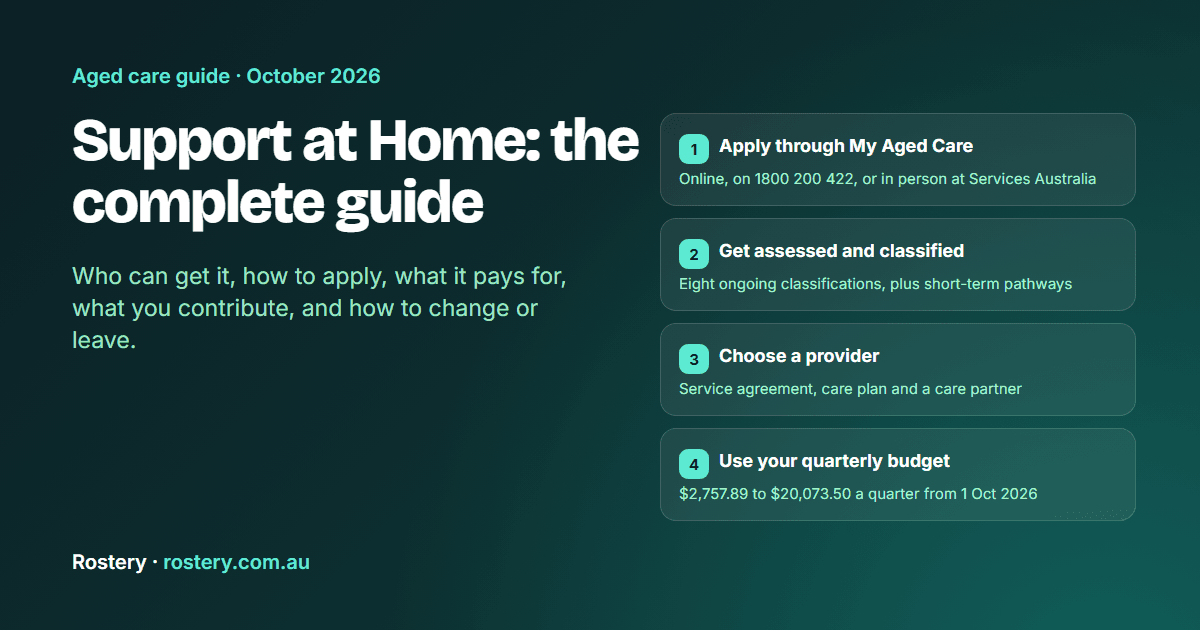
Support at Home is the Australian Government program that pays for care and practical help at home for older people. It started on 1 November 2025, when it replaced the Home Care Packages Program and the Short-Term Restorative Care Programme. The Department of Health, Disability and Ageing runs it, Services Australia holds each person's budget and pays providers, and the Aged Care Quality and Safety Commission registers and regulates the providers who deliver the services.
This guide puts the whole program in one place: who can get it, how to apply, the kinds of funding, what it pays for, what you contribute, how to choose a provider, and what happens when your needs or plans change. It is written for older people and their families, and for the provider staff who explain the program every day. The amounts are the ones in effect from 1 October 2026, checked against the government sources listed at the end.
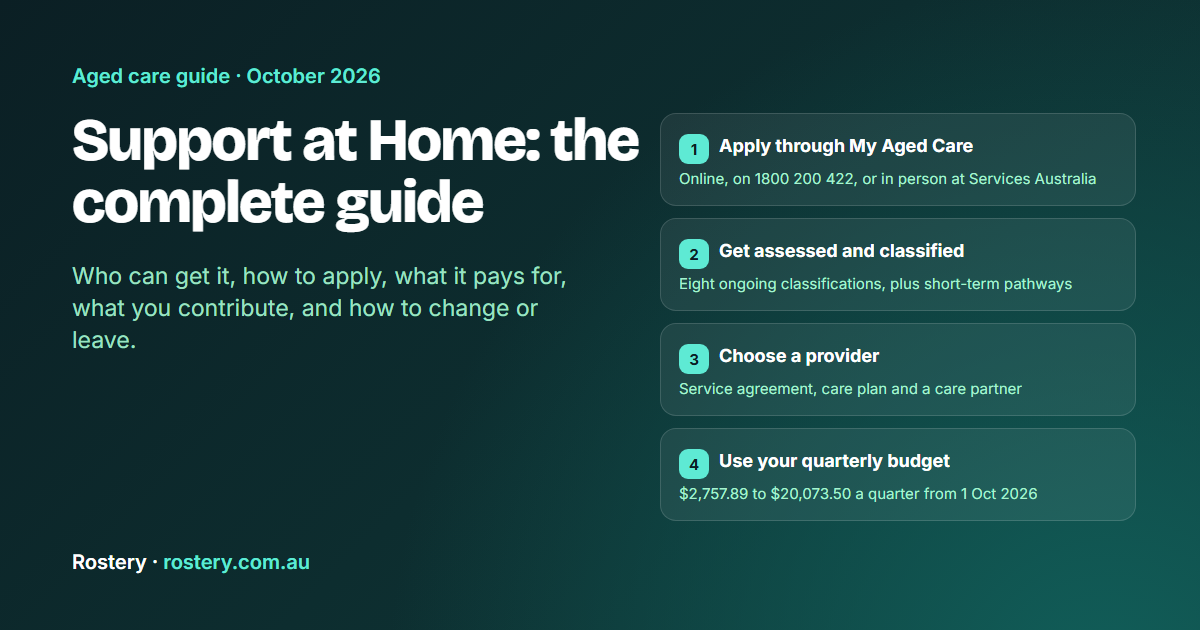
Support at Home at a glance
| Question | Answer |
|---|---|
| When did it start? | 1 November 2025 |
| What did it replace? | Home Care Packages and the Short-Term Restorative Care Programme |
| Who can apply? | People aged 65 or over, or 50 or over for Aboriginal and Torres Strait Islander people and for people who are homeless or at risk of homelessness |
| How do I apply? | Through My Aged Care: online, on 1800 200 422, or in person at a Services Australia office |
| How much is ongoing funding? | Eight classifications, from $2,757.89 to $20,073.50 a quarter |
| Is there short-term funding? | Yes: the Restorative Care Pathway, the End-of-Life Pathway, and assistive technology and home modifications (AT-HM) |
| What do I pay? | Nothing for clinical supports, and a share of the price for independence and everyday living services, based on your means |
| Who holds the money? | Services Australia, on your behalf |
| How do I track it? | Your provider sends you a statement every month |
| What is separate? | The Commonwealth Home Support Programme (CHSP) and residential aged care |
What Support at Home replaced
Before November 2025, government-funded help at home for older people with higher needs came through Home Care Packages, which had four funding levels. Short bursts of therapy to help someone recover came through a separate program, Short-Term Restorative Care. Support at Home brought both into one program with eight ongoing classifications and three kinds of short-term funding.
People who had a Home Care Package moved across automatically when the program started. What that means for them is covered in the section on people who had a Home Care Package, further down. Providers who want the operational side of the change can read our summary of Support at Home vs Home Care Packages for providers.
The Commonwealth Home Support Programme, which funds entry-level help at home, did not join. In August 2026 the Government extended CHSP grant funding to 30 June 2029 and said it believes CHSP should remain a standalone program. Residential aged care is also a separate program.
Who can get Support at Home
Under section 58 of the Aged Care Act 2024, you can be assessed for Support at Home if you have care needs and you are:
- aged 65 or over
- aged 50 or over and an Aboriginal or Torres Strait Islander person
- aged 50 or over and homeless or at risk of homelessness.
If you are under 65, you have to choose aged care in writing, and you must be told about other services that may be available to you. Meeting the age rule only means you can be assessed. The assessment decides whether you are approved, at what classification, and for which services.
How to apply for Support at Home, step by step
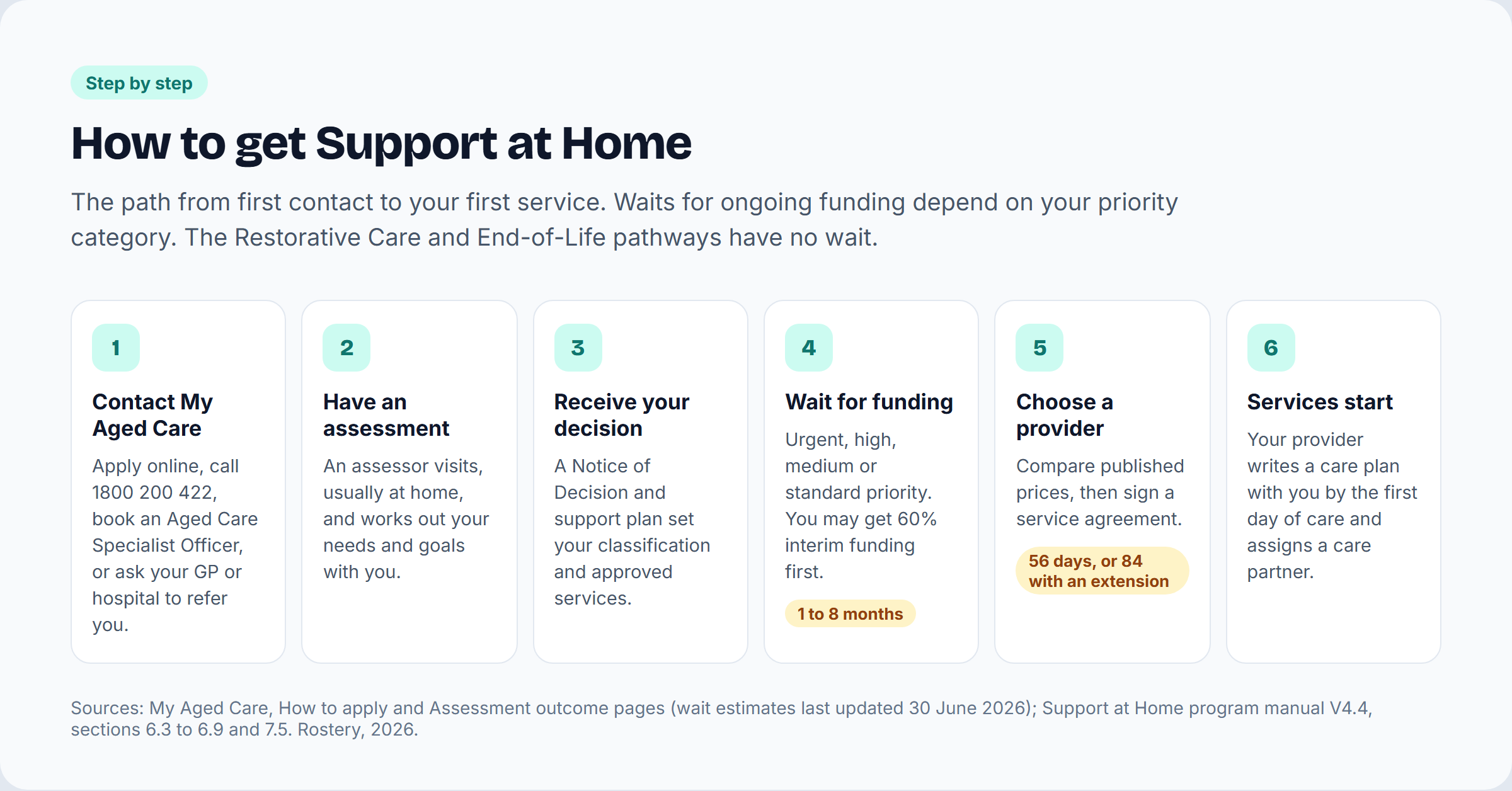
1. Contact My Aged Care
There are three ways to start:
- Online at myagedcare.gov.au. You need your Medicare card, and the form takes about 15 to 20 minutes.
- By phone on 1800 200 422, Monday to Friday from 8am to 8pm and Saturday from 10am to 2pm.
- In person with an Aged Care Specialist Officer at a Services Australia office. Book a time on 1800 227 475.
Your GP, another health professional or a hospital can also refer you, and a family member or friend can apply with you. If you have no one to help, a care finder can support you through the process. Elder Care Support helps Aboriginal and Torres Strait Islander people.
2. Have an assessment
If you are eligible, an aged care needs assessor contacts you to arrange an assessment. Assessments are part of the Single Assessment System, which started on 1 July 2024, and the assessor uses the Integrated Assessment Tool to understand your needs, your goals and the help you already have.
3. Receive your Notice of Decision and support plan
After the assessment you receive two documents. The Notice of Decision says what you are approved for: your ongoing classification, any short-term pathway or AT-HM tier, the reasons and evidence for the decision, and your right to ask for a review. The support plan describes your needs and goals and the services you are approved to use. Any provider you choose works from these two documents.
4. Wait for funding in the Priority System
Restorative Care and End-of-Life funding is available straight away, with no waitlist. AT-HM funding has its own priority systems, and each approved item is funded separately. Ongoing funding comes through the Support at Home Priority System, which has four categories. People are funded in category order, and then by the date they were approved.
| Priority category | Estimated wait for ongoing funding |
|---|---|
| Urgent | Within 1 month |
| High | 1 month |
| Medium | 5 to 6 months |
| Standard | 7 to 8 months |
These are My Aged Care's estimates, last updated on 30 June 2026. At that date 106,977 people were waiting for an ongoing place, and 131,017 places had been released between April and June 2026. In August 2026 the minister said the aim was to bring waits down to about three months by the middle of 2027.
When funding is tight, you may be given interim funding first. Interim funding is 60% of your classification, and the rest is added when it becomes available. The extra amount is not backdated. People in the urgent category, and people on the Restorative Care or End-of-Life pathways, always receive full funding.
5. Choose a provider within 56 days
Once your funding is allocated, you have 56 calendar days to sign a service agreement with a provider and start services. If you need more time, call My Aged Care and ask for a 28-day extension, which gives you 84 days in total. If services haven't started by then, the funding is withdrawn. Choosing a provider is covered in its own section below.
6. Start services
Your provider writes a care plan with you before or on the first day of care, gives you an individualised budget as soon as practical, and allocates you a care partner.
The kinds of Support at Home funding
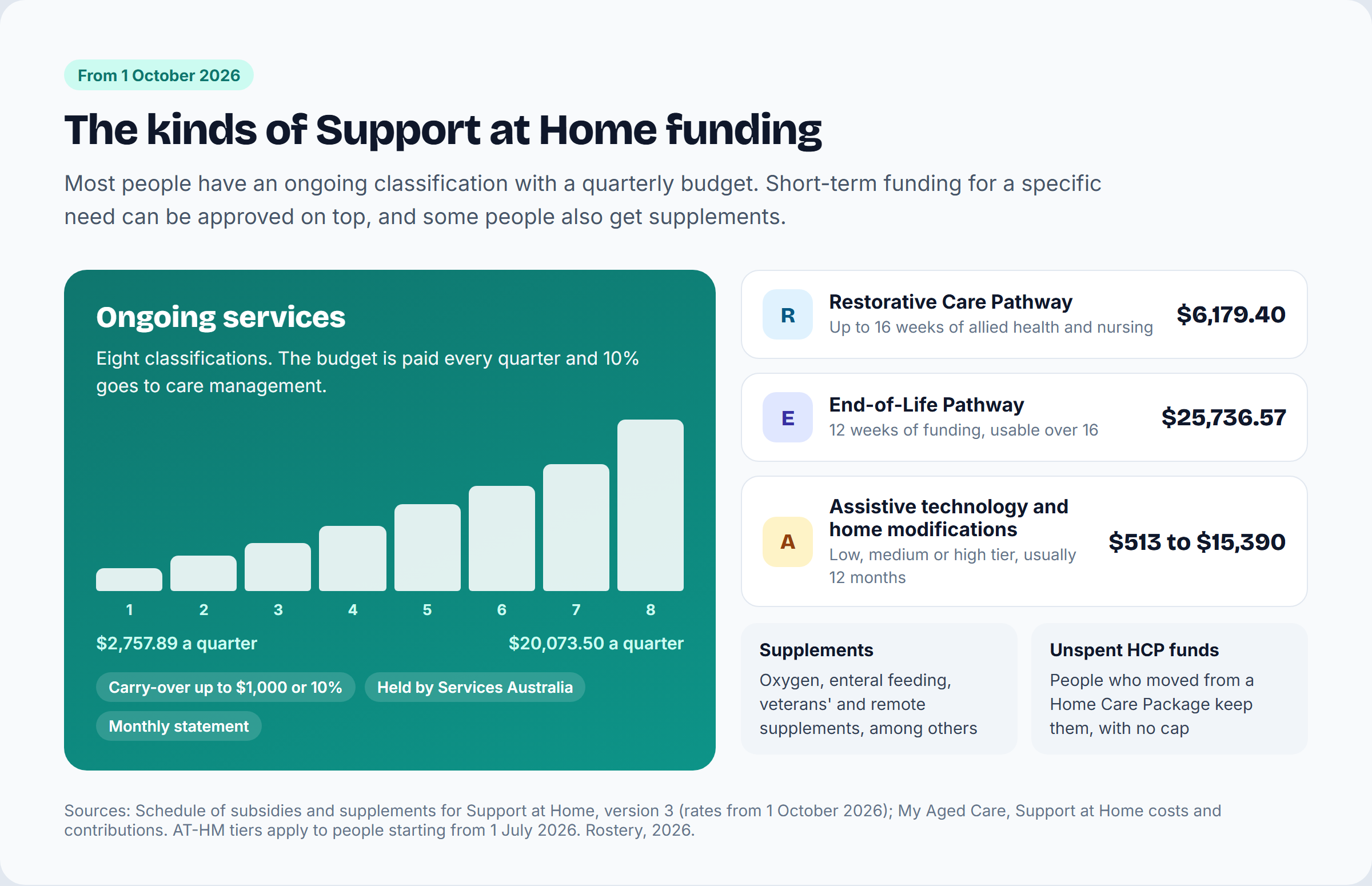
Ongoing services: eight classifications
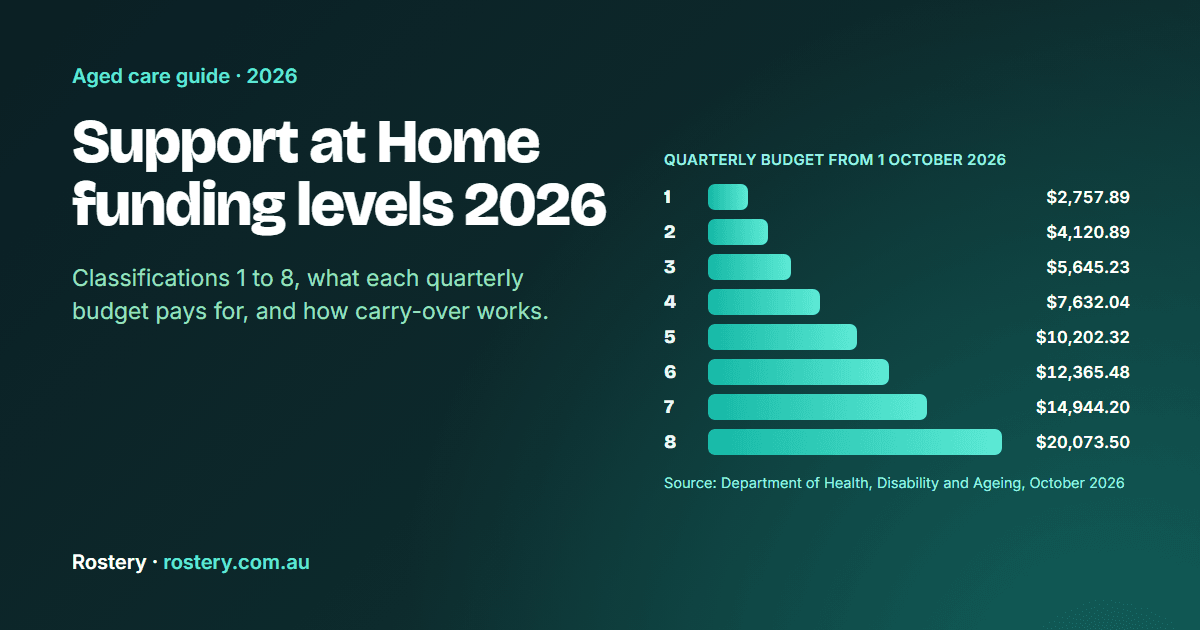
Most people are approved for ongoing services. Your classification sets a budget that is paid every quarter. From 1 October 2026 the amounts are:
| Classification | Each quarter | Each year |
|---|---|---|
| Classification 1 | $2,757.89 | $11,031.56 |
| Classification 2 | $4,120.89 | $16,483.55 |
| Classification 3 | $5,645.23 | $22,580.93 |
| Classification 4 | $7,632.04 | $30,528.15 |
| Classification 5 | $10,202.32 | $40,809.27 |
| Classification 6 | $12,365.48 | $49,461.91 |
| Classification 7 | $14,944.20 | $59,776.80 |
| Classification 8 | $20,073.50 | $80,294.00 |
These amounts include the 10% that goes to care management. Budgets are normally indexed every 1 July. The increase on 1 October 2026 was an extra, one-off rise to fund the August 2026 award wage increase for aged care nurses. For what each classification is worth week by week, how the budget is drawn down and how carry-over works, see our guide to Support at Home funding levels, or explore each level with the Support at Home classifications tool.
Restorative Care Pathway
The Restorative Care Pathway pays for an intensive, short period of care from a team of allied health professionals and nurses, to help you regain or keep your independence and stay at home for longer. One unit of funding is $6,179.40 for people starting from 1 October 2026, and it covers up to 16 weeks. You can be approved for up to two units in a 12-month period. A second episode can start no sooner than three months after the 16 weeks of the first one end.
End-of-Life Pathway
The End-of-Life Pathway is for people who want to stay at home in their last months. A doctor or nurse practitioner must estimate that you have three months or less to live, and your score on the Australian-modified Karnofsky Performance Status (AKPS) must be 40 or less. For people starting from 1 October 2026 it provides $25,736.57 over 12 weeks, and the funding can be used over up to 16 weeks without a new review. Each person can have one episode. My Aged Care says the pathway replaces any other funding you have through My Aged Care, and your ongoing classification is set aside while you are on it. The Government has announced a second round of funding, from early 2027, for people who live beyond the first 12 weeks.
Assistive technology and home modifications (AT-HM)
The AT-HM scheme pays for equipment and changes to your home, separately from your quarterly budget. For people starting from 1 July 2026 the tiers are:
| Tier | Amount | Time to spend it |
|---|---|---|
| Low | $513 | 12 months |
| Medium | $2,052 | 12 months |
| High | $15,390 | 12 months, or up to 24 months for complex home modifications |
Assistive technology that costs more than $15,390 can be funded with evidence of need, such as a valid prescription. The money has to be spent within the period, and any amount left at the end can't be carried over.
Supplements
Some people receive extra funding on top of their budget for a specific need. The rates from 1 October 2026 are:
- The oxygen supplement is $15.06 a day.
- The enteral feeding supplement is $23.90 a day for bolus feeding and $26.84 a day for non-bolus feeding.
- The veterans' supplement adds 11.5% of the classification's daily funding.
- The remote supplement adds 50% of the AT or HM tier for people living in Modified Monash areas 6 and 7.
- The dementia and cognition supplement and the EACH-D top-up continue only for some people who moved across from a Home Care Package.
Providers also receive a care management supplement of $4.06 a day for some participants, including Aboriginal and Torres Strait Islander people, people who are homeless or at risk, care leavers, veterans who receive the veterans' supplement, and people referred by a care finder. It pays for about 12 extra hours of care management a year. If you can't afford your contributions, you can apply for the fee reduction supplement on form SA462. While your application is being assessed, your provider can't invoice you for contributions. The Modified Monash Model entry in our glossary explains the remoteness areas.
What Support at Home pays for
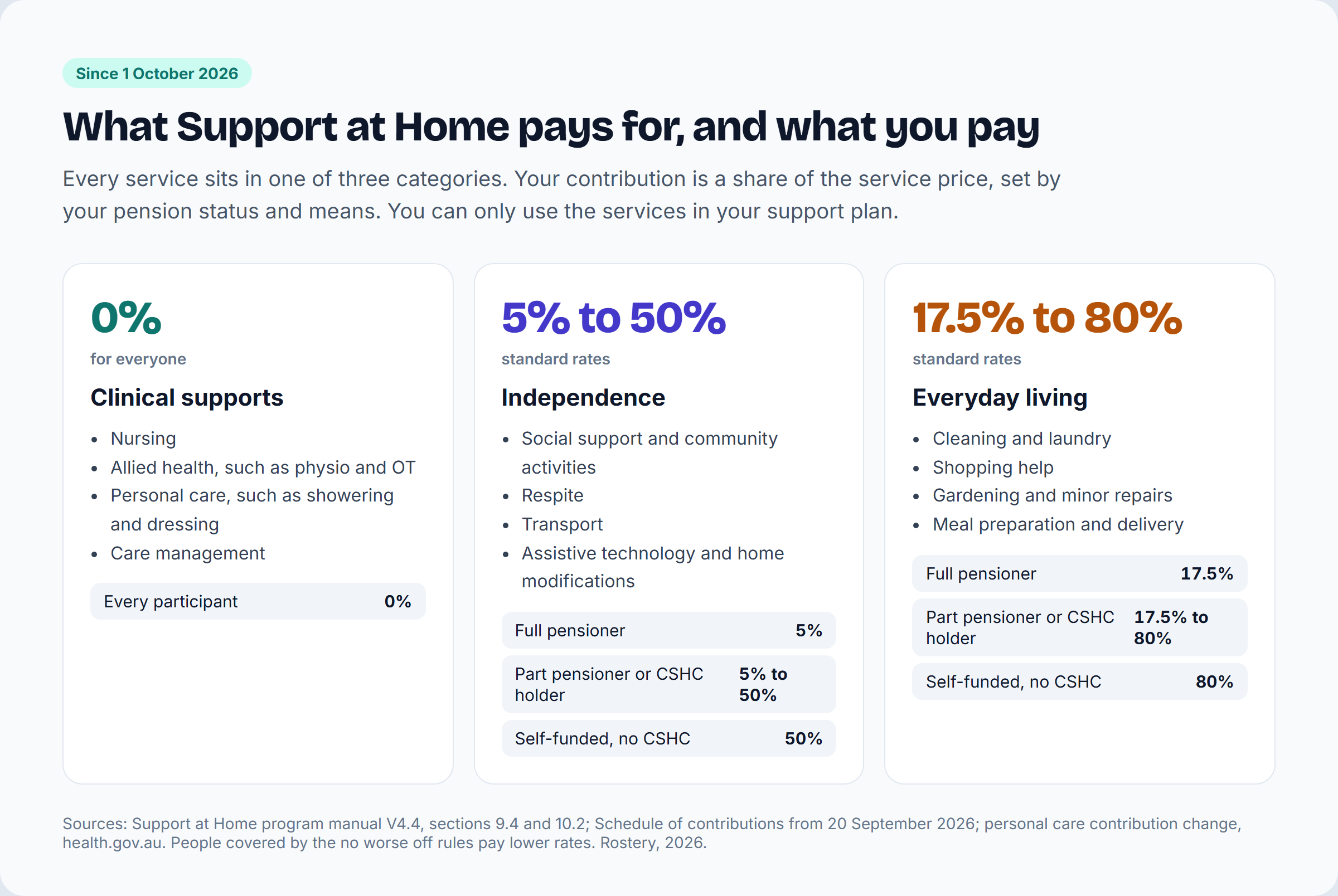
Every service on the Support at Home service list belongs to one of three categories, and the category decides what you contribute. You can only use the services your assessment approved in your support plan. Aboriginal and Torres Strait Islander people are eligible for every service on the list.
| Category | Examples of services | Your contribution |
|---|---|---|
| Clinical supports | Nursing; allied health such as physiotherapy, occupational therapy, podiatry and dietetics; personal care such as showering, dressing, eating, continence help and help with medicines; care management | None |
| Independence | Social support and community activities; respite; transport; therapeutic services such as remedial massage; assistive technology and home modifications | 5% to 50% at standard rates |
| Everyday living | Cleaning and laundry; shopping help; gardening and minor home repairs; meal preparation and delivery | 17.5% to 80% at standard rates |
Personal care moved from the independence category to clinical supports on 1 October 2026, so it no longer attracts a contribution. The change goes by the date the service was delivered. Personal care delivered before 1 October still carries a contribution, even if the provider claims it later. Personal care is still paid for from your budget, and you need to be approved for it.
What Support at Home won't pay for
The service list sets out what each service excludes. The main exclusions are:
- anything the health system pays for, such as hospital and ambulance costs, medical treatment, medicines, psychiatry and dental care
- the cost of food ingredients, takeaway delivery, and meals for other people in your household
- buying or running your own car, licences, public transport fares, flights and travel for holidays
- pest control, carpet cleaning, dry cleaning, pet care and groceries
- tree removal, landscaping, gardening that is only for looks, and repairs a landlord, housing authority or insurer is responsible for
- tickets, accommodation, memberships and smart devices for social activities
- massage for relaxation, and hairdressing
- residential respite and cottage respite, which are funded through other programs.
If you want more help than your budget covers, you can buy extra services from your provider under a separate private agreement. The government does not fund those services.
What you pay: contributions
Clinical supports cost you nothing. For independence and everyday living services you pay a percentage of each service's price, and the government pays the rest. Your rate depends on your pension status and, for part pensioners and card holders, on your income and assets.
| Your situation | Clinical supports | Independence | Everyday living |
|---|---|---|---|
| Full Age Pension | 0% | 5% | 17.5% |
| Part pension, or self-funded with a Commonwealth Seniors Health Card | 0% | 5% to 50% | 17.5% to 80% |
| Self-funded without a Commonwealth Seniors Health Card, or means not disclosed | 0% | 50% | 80% |
Part pensioners and card holders are on a sliding scale, so their rate rises with income and assets. If you don't share your means information, you pay the highest rates. To estimate what you would pay, try our Support at Home budget and contribution calculator.
The lifetime cap
There is a limit on what you pay over your lifetime. From 20 September 2026 it is $140,652.80, and it counts your Support at Home contributions together with the non-clinical part of any contribution you pay in residential care later. For people under the no worse off rules the cap is $88,934.57. Both caps are indexed every 20 March and 20 September.
The no worse off rules
If on 12 September 2024 you were receiving a Home Care Package, were on the National Priority System, or had been approved for a package, you pay lower rates:
| Your situation | Clinical supports | Independence | Everyday living |
|---|---|---|---|
| Full pensioner | 0% | 0% | 0% |
| Part pensioner or Commonwealth Seniors Health Card holder | 0% | 0% to 25% | 0% to 25% |
| Self-funded retiree | 0% | 25% | 25% |
If you paid no income-tested care fee under your Home Care Package, you still pay no contributions. For everyone else under these rules, the rate is based on income only, and a fortnightly cap limits the total.
Fees a provider can't charge
Providers have to build their costs into the price of each service. They can't charge separate administration, package management or travel fees, and they can't charge you to start or to leave. In May 2026 the Government paused its plan to cap Support at Home prices. Instead, it gave the Aged Care Quality and Safety Commission power to order refunds when providers overcharge, and it now publishes a National Summary of Support at Home Prices every quarter. It also asked providers to raise their prices no more than twice a year.
Care management and your care partner
Before your quarterly budget is spent on services, 10% is set aside for care management. That share goes into your provider's care management account, where it is pooled with the same share from the provider's other participants at the same service delivery branch. The pool doesn't apply to Restorative Care or End-of-Life funding. For those pathways, care management is paid from the pathway budget.
A staff member called a care partner delivers your care management. Your care partner helps set up your service agreement and care plan, reviews your budget, checks that your services are working, connects you with other help, and asks for a Support Plan Review when your needs change. They must have at least one direct care management contact with you every month, lasting at least 15 minutes. Care management carries no contribution.
There is no required qualification for a care partner. Where a provider uses a clinically qualified care partner, that person must hold a university degree in a relevant health field. To see how much care management a budget pays for, use the care management calculator.
Choosing a Support at Home provider
One registered provider delivers and claims for all of your Support at Home services, through one of its service delivery branches. It can use subcontractors, but it stays responsible for their work. To deliver Support at Home, a provider must be registered with the Aged Care Quality and Safety Commission in at least Category 4, and also in Category 5 if it delivers nursing.
Providers must report their usual price for each service type on My Aged Care and publish their full price list on their own website. You can compare providers with the Find a provider tool on myagedcare.gov.au. Before you sign, it helps to ask:
- What is your price for each service I'm approved for, and is it the same as your published price?
- Who will my care partner be, and how often will we talk?
- Will your own staff deliver my services, or do you use subcontractors?
- How much notice do you need if I cancel or change a visit?
- Will I get my monthly statement by email or by post?
- How do I raise a concern or make a complaint?
Your service agreement
A provider must have a service agreement with every participant, and you sign it before services start. It lists each service with its price. If a price in your agreement is higher than the provider's published price, the agreement has to say so and explain why. The provider can't charge you to join or to leave.
Your care plan and individualised budget
The provider develops your care plan with you before or on the day care starts. It then gives you an individualised budget as soon as practical, showing how your quarterly funding will be used across your services.
Your quarterly budget and monthly statement
Services Australia holds your budget in an account on your behalf. Your provider is paid after it delivers services, by claiming from that account. Unspent money in your ongoing budget carries over to the next quarter, up to $1,000 or 10% of your quarterly budget after care management, whichever is higher. Short-term pathway and AT-HM funding can't be carried over.
Your provider must send you a statement every month, including months with no services, by the last day of the following month. For example, the statement for August is due by 30 September. It shows the services you received and their prices, what the government paid, what you contributed, and how much of your budget is left.
When your needs or plans change
Your needs increase
Ask My Aged Care for a Support Plan Review, or ask your care partner to request one. A review can lead to new services or a higher classification.
You need a break from services
Support at Home has no leave arrangements. If you stop services for a while, you keep receiving your quarterly budget, but the carry-over limit still applies to anything you don't use. If no services are delivered for four quarters in a row, your funding is reduced to zero and given to someone else. Short-term pathways can't be paused, because their funding only lasts for a set time.
Your provider stops your services
A provider that decides to stop delivering your services must tell you in writing at least 14 days beforehand, and it must keep providing services during that notice period.
Changing providers or leaving Support at Home
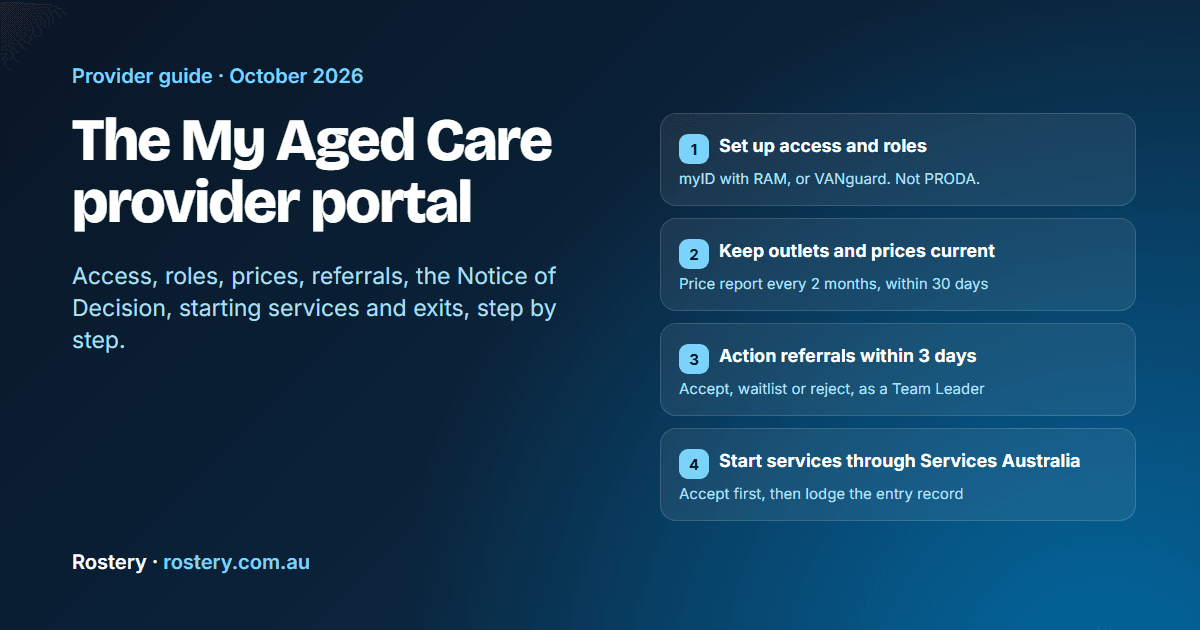
You can change provider for any reason, and your funding moves with you, including unspent money for ongoing services. You reactivate your referral code with My Aged Care and give it to the new provider. Your old provider must tell Services Australia within 28 days of your exit date, finalise its claims within 60 days, and give you a final statement. It can't charge an exit fee. You then have up to four quarters in a row to sign with a new provider before your ongoing funding is withdrawn. Providers can read how the referral and start steps work in our guide to the My Aged Care provider portal.
You leave the program when you move into permanent residential care, when you no longer want or need services, or when you die. If you move into residential care, your exit date is usually the day you enter it. After a death, the exit date is the date of death.
If you had a Home Care Package
Everyone with a Home Care Package was approved for Support at Home automatically when the program started. They moved to a transitioned classification with the same funding level as their package. From 1 October 2026 the quarterly budgets are:
| Former package level | Each quarter |
|---|---|
| Level 1 | $2,823.55 |
| Level 2 | $4,965.14 |
| Level 3 | $10,808.30 |
| Level 4 | $16,385.99 |
You keep any unspent Home Care Package funds. You can use them for AT-HM, or for services once your quarterly budget runs out, and there is no cap on how much of them you use. Anything paid for entirely from the Commonwealth portion of those funds attracts no contribution. Any participant portion your provider holds goes towards your contributions and is refunded when you leave the program. If you joined Home Care Packages after 1 September 2021, your provider holds no Commonwealth portion.
The income-tested care fee no longer exists, and the no worse off rules described above set your contribution rates. If you are reassessed and accept a new Support at Home classification, some supplements that came across from your package, such as the dementia and cognition supplement, stop. Our Home Care Package to Support at Home tool shows what each package level became.
Support at Home and CHSP
The Commonwealth Home Support Programme is a separate, grant-funded program for entry-level help at home. In August 2026 the Government extended it to 30 June 2029 and said CHSP should remain a standalone program, rather than being rolled into Support at Home, which had been the earlier plan. Consultation on its long-term future starts in 2026. If you receive CHSP services and need more help, ask My Aged Care about an assessment for Support at Home.
Support at Home key dates
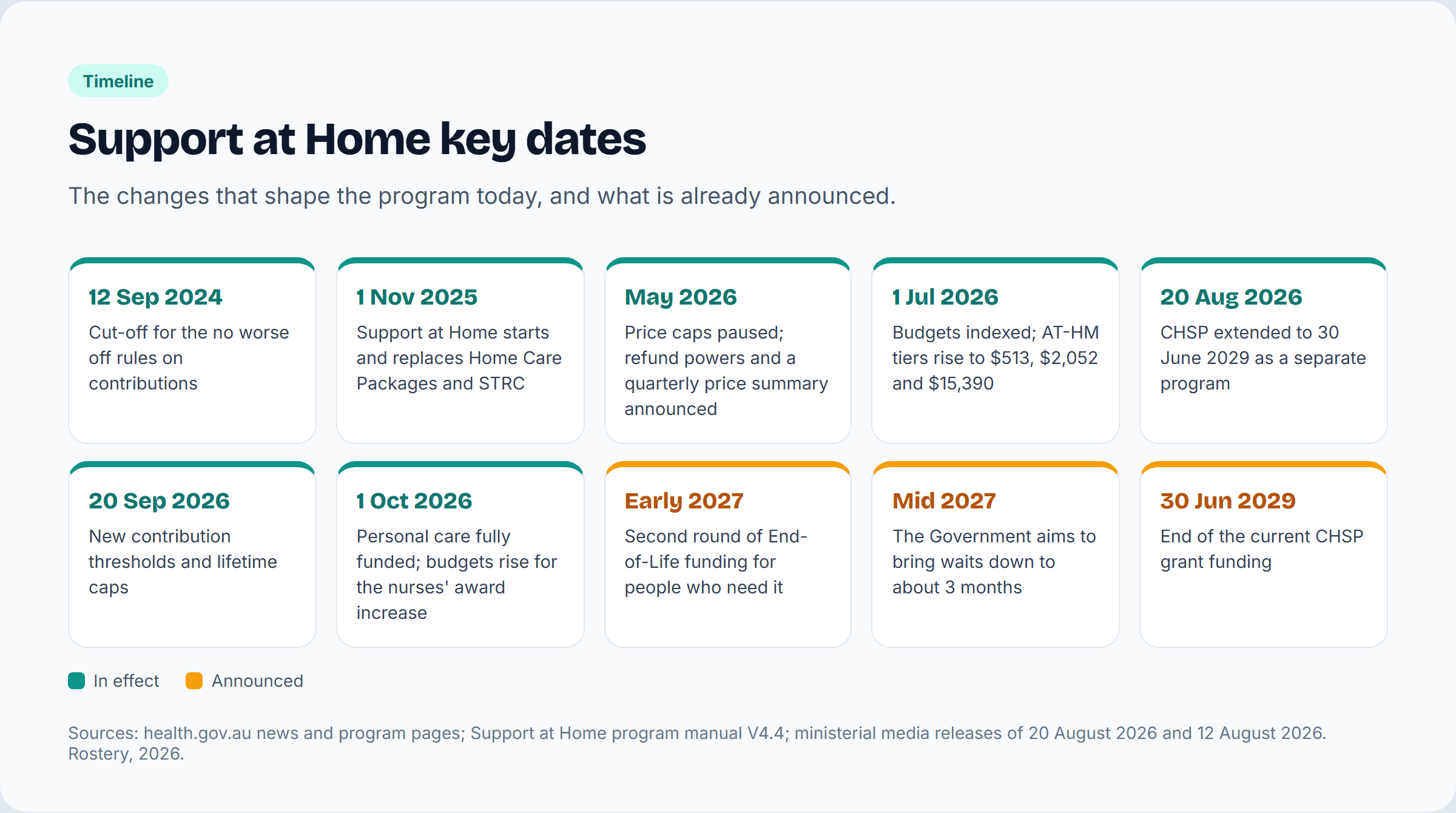
| Date | What happened |
|---|---|
| 1 July 2024 | The Single Assessment System started |
| 12 September 2024 | Cut-off date for the no worse off contribution rules |
| 1 November 2025 | Support at Home started, replacing Home Care Packages and Short-Term Restorative Care |
| May 2026 | Price caps paused; refund powers and a quarterly National Summary of prices announced |
| 1 July 2026 | Budgets indexed; AT-HM tiers rose to $513, $2,052 and $15,390 |
| August 2026 | CHSP extended to 30 June 2029 as a standalone program |
| 20 September 2026 | New contribution thresholds and lifetime caps |
| 1 October 2026 | Personal care fully funded; budgets and pathway amounts rose to fund the nurses' award increase |
| Early 2027 | Second round of End-of-Life funding to start |
| 30 June 2029 | Current CHSP grant funding ends |
What Support at Home means for providers
Providers carry most of the program's day-to-day obligations. The main ones are:
- be registered in Category 4, and in Category 5 to deliver nursing
- report your common prices on My Aged Care and publish your full price list on your website
- accept, reject or waitlist electronic referrals in the My Aged Care Service and Support Portal within 3 calendar days
- have a signed service agreement, and a care plan by the first day of care
- notify Services Australia that services have started, then claim each service in arrears at the agreed price
- deliver at least 15 minutes of direct care management to each participant every month
- charge contributions according to the date each service was delivered
- send every participant a statement each month, by the last day of the following month
- notify an exit within 28 days and finalise its claims within 60 days.
Rostery's Support at Home software runs these steps from one participant record. Referrals are imported from My Aged Care, visits are rostered and drawn from the right budget, contributions follow the date of service, care management is tracked against the pool, and claims and monthly statements are built from the same visits. If you also deliver CHSP, DEX reporting works from the same roster. Book a demo to see it with your own participants.
Frequently asked questions
What is the Support at Home program?
It is the Australian Government's program for care and practical help at home for older people. It started on 1 November 2025 and replaced Home Care Packages and Short-Term Restorative Care.
Who is eligible for Support at Home?
People with care needs who are 65 or over, or 50 or over if they are Aboriginal or Torres Strait Islander or are homeless or at risk of homelessness. An assessment decides what you are approved for.
How do I apply for Support at Home?
Through My Aged Care: online at myagedcare.gov.au, by phone on 1800 200 422, or in person with an Aged Care Specialist Officer at Services Australia. Your GP or hospital can also refer you.
How long is the wait for Support at Home?
For ongoing funding, My Aged Care's estimates at 30 June 2026 were within 1 month for urgent and high priority, 5 to 6 months for medium and 7 to 8 months for standard. Restorative Care and End-of-Life funding has no wait.
How much does Support at Home cost me?
Clinical supports, including personal care since 1 October 2026, are free. A full pensioner pays 5% of the price of independence services and 17.5% of everyday living services. Other people pay more, up to 50% and 80%, depending on their means, with a lifetime cap of $140,652.80.
Is CHSP part of Support at Home?
No. CHSP is a separate program, extended to 30 June 2029, and the Government has said it should remain standalone.
Can I change my Support at Home provider?
Yes, for any reason. Your funding, including unspent ongoing funds, moves with you, and your old provider can't charge an exit fee.
What happens if I don't use my budget?
Up to $1,000 or 10% of your quarterly budget, whichever is higher, carries over to the next quarter. If no services are delivered for four quarters in a row, your funding is withdrawn.
Sources
- Department of Health, Disability and Ageing: Support at Home program
- Support at Home program manual: a guide for registered providers, V4.4 (September 2026)
- Schedule of subsidies and supplements for Support at Home, version 3 (rates from 1 October 2026)
- Support at Home program: classifications and budgets (October 2026)
- Schedule of contributions for Support at Home services from 20 September 2026
- Support at Home service list (24 September 2026)
- My Aged Care: Support at Home costs and contributions
- My Aged Care: assessment outcome and wait times for Support at Home
- My Aged Care: how to apply for an assessment
- Support at Home personal care contribution change
- New consumer protections for Support at Home services
- Support at Home supplements and grants
- Changing Support at Home providers
- Exiting the Support at Home program
- Ceasing Support at Home services
- Temporarily stopping Support at Home services
- Commonwealth Home Support Program (CHSP) extended to 30 June 2029
- Aged Care Act 2024, section 58
Checked 13 October 2026. Government amounts and wait times change, so confirm the current figures with My Aged Care or your provider before making a decision. For short definitions, see our glossary entries on Support at Home, My Aged Care and the Notice of Decision.