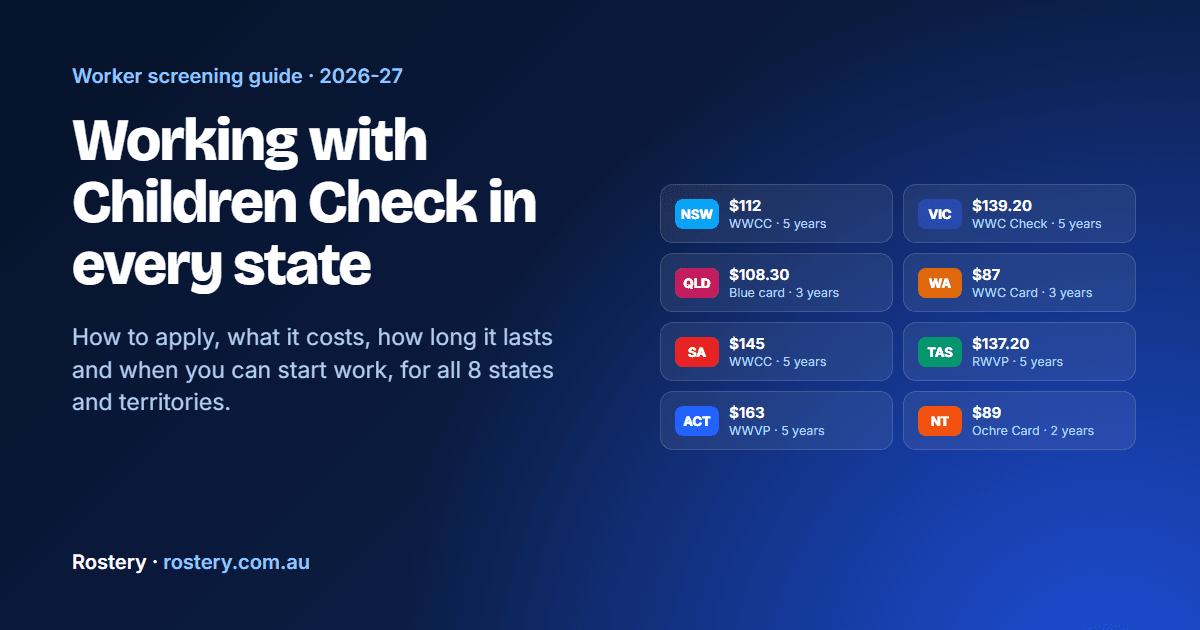
A Working with Children Check is a screening check, run separately by each state and territory, that you need before doing paid or volunteer work involving children under 18. Each of the eight has its own check, its own name and its own fees, and a check from one state does not cover work in another. In 2026-27 the fee for paid work ranges from $87 in Western Australia to $163 in the ACT; volunteers pay nothing except in WA ($11) and the Northern Territory ($8). A check lasts 5 years in most places, 3 years in Queensland and WA and 2 years in the NT. This guide gives the step-by-step application for each state, the current fees, whether you can start work before you are cleared, how to renew, what employers must record, and how the check fits alongside the NDIS Worker Screening Check.
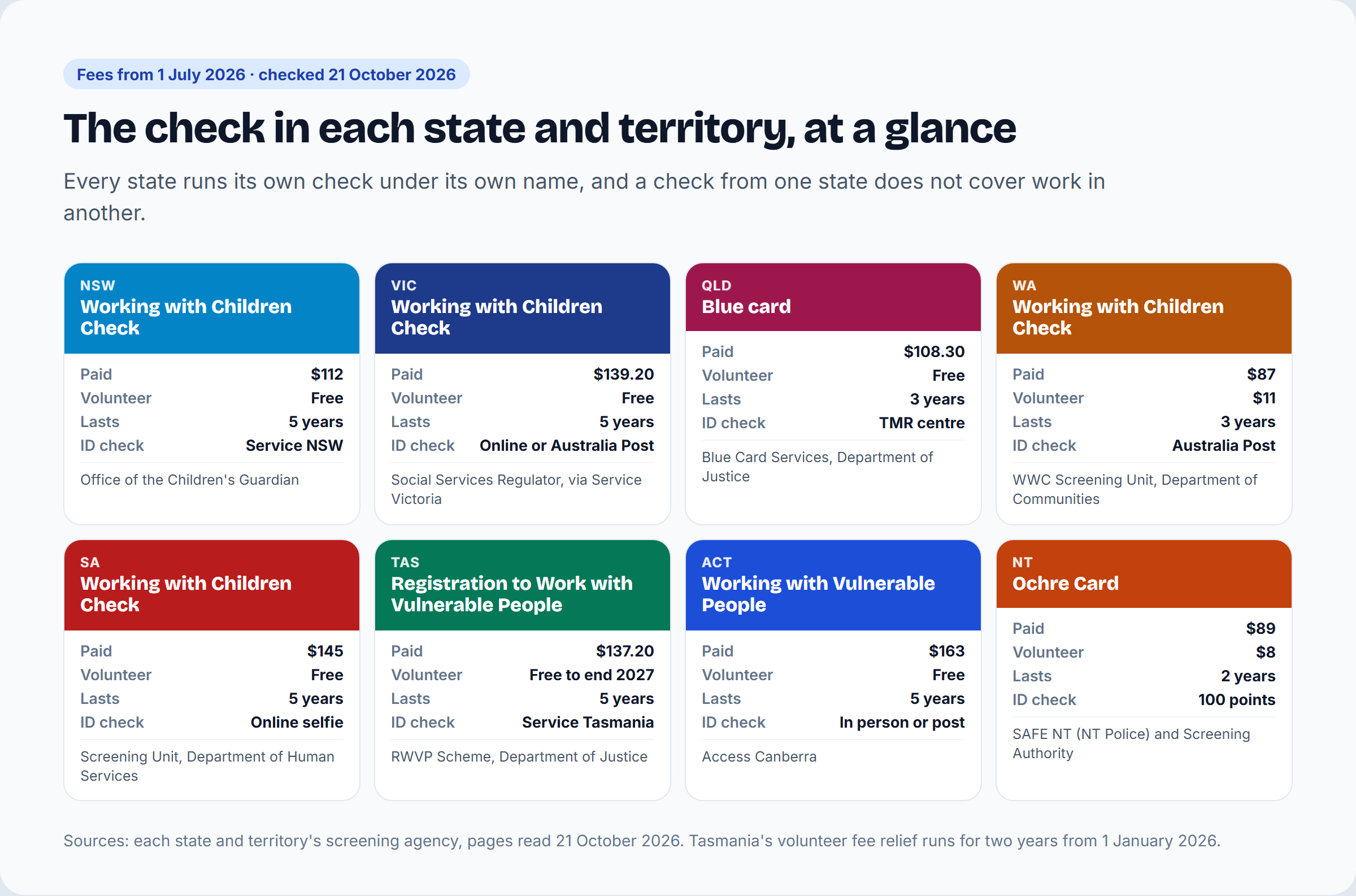
The check in every state at a glance
| State or territory | Name | Paid work | Volunteer | Lasts | Where to apply | Start before clearance? |
|---|---|---|---|---|---|---|
| NSW | Working with Children Check | $112 | Free | 5 years | Online, then Service NSW | Yes, with an application number |
| Victoria | Working with Children Check | $139.20 | Free | 5 years | Service Victoria, with training | Mostly, once you have applied |
| Queensland | Blue card | $108.30 | Free | 3 years | TMR centre, then online | No, not until approved |
| Western Australia | Working with Children Check | $87 | $11 | 3 years | Australia Post | Mostly, on the receipt |
| South Australia | Working with Children Check | $145 | Free | 5 years | Screening SA, online | No, for new workers |
| Tasmania | Registration to Work with Vulnerable People | $137.20 | Free (to end 2027) | 5 years | Online, then Service Tasmania | Only if supervised |
| ACT | Working with Vulnerable People | $163 | Free | 5 years | Online, then ID in person or by post | Only if supervised |
| Northern Territory | Ochre Card | $89 | $8 | 2 years | Online, in person or by mail | Only with an employer exemption |
Fees are for a new check for paid work from 1 July 2026. Volunteer checks cannot be used for paid work in any state: you upgrade, usually for a fee, when your volunteering becomes a paid job.
Do you need a Working with Children Check?
You need one if your work or volunteering involves contact with children under 18 that is a normal part of the role, not incidental to it, in one of the settings your state lists: schools, childcare, coaching, clubs, religious organisations, transport, health and support services, out-of-home care and more. Self-employed people need one too. The age you must be to apply varies, from 14 in South Australia to 18 in NSW.
Disability support for children counts. NSW names working with or helping children with disability without other adults supervising; South Australia lists disability services for children and any close personal contact with a child with a disability; Queensland names disability services and NDIS supports to a child; Tasmania and the ACT treat NDIS work itself as a regulated activity. Parents volunteering in their own child's activity are usually exempt, but NSW and Queensland exclude personal care of a child with disability from that exemption, and in SA close personal contact with a child with a disability always needs a check.
NDIS workers: you usually need both checks
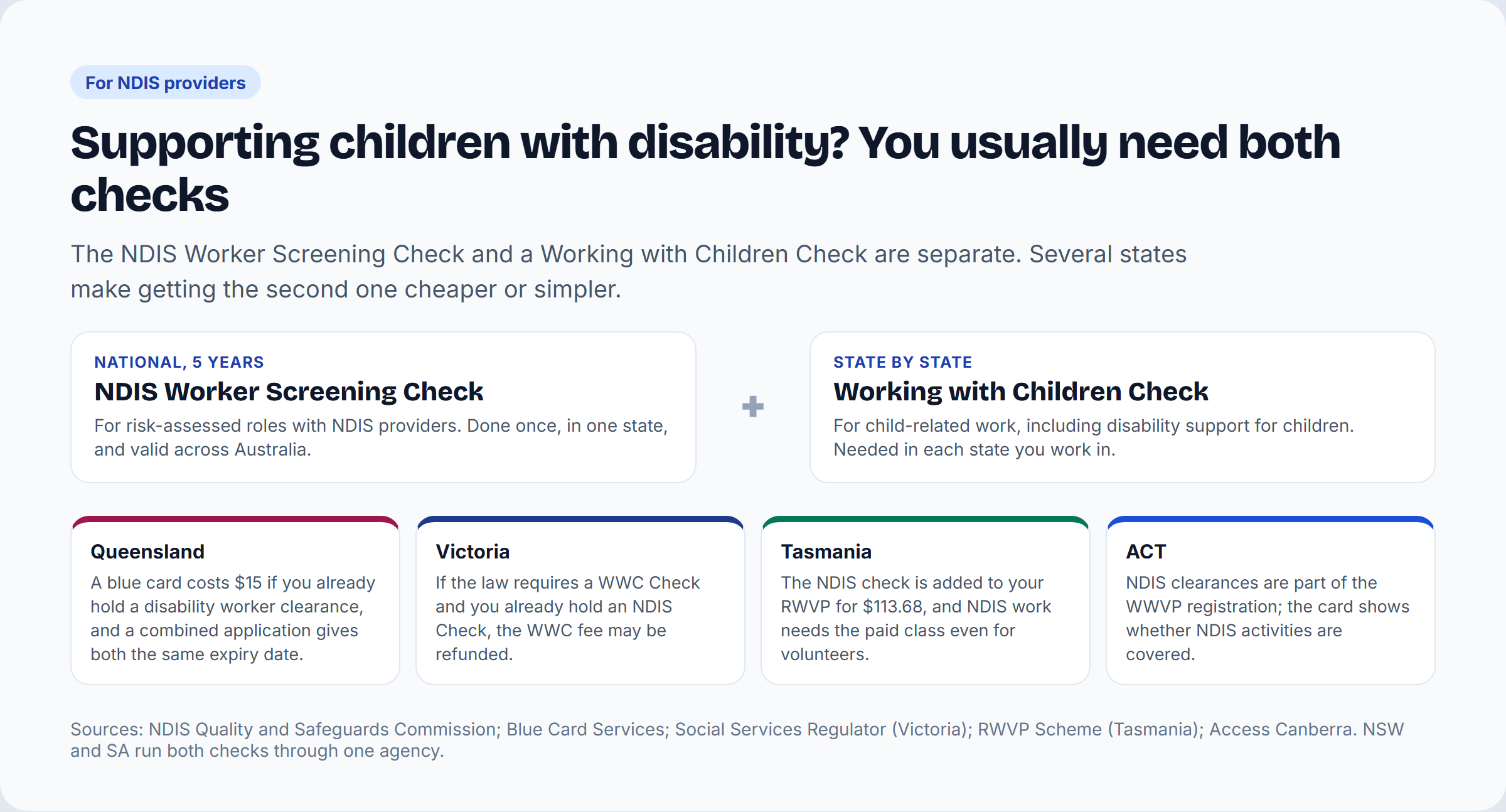
The NDIS Worker Screening Check and a Working with Children Check are different checks under different laws. The NDIS check is national: you apply once, in one state, it lasts 5 years and it is valid across Australia. A Working with Children Check is state-based. A support worker who works with participants under 18 usually needs both: the NDIS check for the NDIS role and the state check for the child-related work.
| State or territory | How the two checks relate |
|---|---|
| NSW | Office of the Children's Guardian runs both, as separate applications. |
| Victoria | The Social Services Regulator runs both. If the law requires a WWC Check and you already hold an NDIS Check, the WWC fee may be refunded. |
| Queensland | Blue card plus a yellow card (NDIS worker screening). A combined application gives both the same expiry; a blue card costs $15 if you already hold a disability worker clearance. |
| Western Australia | Separate checks. |
| South Australia | One Screening Unit handles both, as separate applications. |
| Tasmania | The NDIS check is added to your RWVP for $113.68, and NDIS work needs the Employment/Volunteer class even if you volunteer. |
| ACT | NDIS clearances are part of the WWVP registration; the card shows whether NDIS activities are covered. |
| Northern Territory | Separate checks. |
Our guide to the NDIS Worker Screening Check in every state covers the NDIS check in the same detail, and our sister compliance platform AuditCore explains when NDIS workers need a Working with Children Check.
How to get a Working with Children Check, state by state
Jump to: New South Wales · Victoria · Queensland · Western Australia · South Australia · Tasmania · Australian Capital Territory · Northern Territory
New South Wales: Working with Children Check (WWCC)
Issued by Office of the Children's Guardian (OCG), with ID checks at Service NSW. Official site.
Anyone 18 or over doing child-related work in NSW: work that involves face-to-face contact with children under 18 that is more than incidental. Disability support counts: the OCG names working with or helping children with disability without other adults supervising as a role that needs a check. Parents and close relatives volunteering at their child's usual school or activity are exempt, except for personal care of a child with disability, formal mentoring and overnight camps. Visitors from interstate working with children for fewer than 30 days do not need one.
How to apply in New South Wales
- Fill in the online application on the OCG website. Have 4 original identity documents ready, your full name including every previous name, your address, an email address and a phone number. You get an application (APP) number by email.
- Within 28 days, take the APP number, your original ID and the $112 fee (paid workers only) to a Service NSW centre. Four documents are needed: one commencement of identity document, one primary and two secondary documents, and at least one must show your photo and signature. A digital NSW driver licence is accepted; laminated documents and photocopies are not.
- The OCG checks your national criminal history and workplace misconduct records. Your clearance arrives by email as a WWC number. There is no card; you can add it to the Service NSW app.
- Give your employer your APP number, then your WWC number, full name and date of birth, so they can verify you online.
| Fee (2026-27) | Amount |
|---|---|
| Paid worker, new or renewal | $112 |
| Volunteer, student over 18 on placement, carer | Free |
| Internal review of a decision | $224 |
Waiting for your check
The OCG says it can take up to 4 weeks to receive police results. Under the law you can start child-related work once you have an APP number, but some employers insist on a clearance first, including NSW Health, early childhood education and care services and the Department of Education. An interim bar means you must stop child-related work straight away.
How long it lasts
5 years, with continuous monitoring. You can renew up to 3 months before expiry, online with face verification or at Service NSW, and you can keep working while a renewal is in progress. A volunteer moving into paid work has 30 days to upgrade.
What employers in New South Wales must do
Register as a child-related employer, verify each worker online (APP number, then WWC number), and record full name, date of birth, WWC number, verification date, outcome, expiry date and whether the work is paid or volunteer. Employers cannot verify themselves. NSW issued more than 100 fines and warnings in 2026 under Operation Sentinel, over $99,500 in total, and failing to verify online was a common breach.
Victoria: Working with Children (WWC) Check, giving a WWC Clearance
Issued by Social Services Regulator (SSR), applications through Service Victoria. Official site.
Adults doing paid, self-employed or volunteer work in a listed child-related field (camps, child care, clubs, coaching, counselling and support services for children, schools, out-of-home care, transport for children and others) where the work usually involves direct contact with children. Parents volunteering in their own child's activity, close relatives, VIT-registered teachers and police are exempt. Visitors who hold an equivalent check from their home state can work up to 30 days in a calendar year without one.
How to apply in Victoria
- From 19 October 2026, complete the free WWC Child Safety Training first: an online course of about 45 minutes in six modules. You then have 30 days to lodge the application.
- Apply online at Service Victoria and verify your identity with one Group A document (Australian driver licence, learner permit or Medicare card) and one Group B document (Australian passport, birth certificate, foreign passport with visa, ImmiCard or citizenship certificate). Without both, verify in person at Australia Post.
- Pay the fee if you are an employee. Respond within 28 days to any request for information, or the application is withdrawn.
- Your WWC Clearance card shows your photo, number, type (E for employee, V for volunteer) and expiry, and can be kept in the Service Vic app.
| Fee (2026-27) | Amount |
|---|---|
| Employee Clearance | $139.20 |
| Renewal of employee Clearance | $105.30 |
| Volunteer to employee | $139.20 |
| Volunteer Clearance and renewal | Free |
| Replacement employee card | $8.60 |
| Internal review | $345.40 |
Waiting for your check
A clean record may be processed within days; applications with history generally take 3 to 12 weeks, and the SSR warns some assessments are taking longer than six months. Most people may start child-related work while their application is assessed, but not in services regulated by the Children's Services Regulations 2020 or the Education and Care Services National Law, and it is illegal to start before you have applied.
How long it lasts
5 years. You can renew online up to six months before it expires and up to three months after. It is illegal to do child-related work after expiry unless you have lodged your renewal.
What employers in Victoria must do
From 19 October 2026, every employer must use WWC Connect: check the worker's status, connect them to your organisation, record their details and notify the SSR within 7 days when a worker starts or stops (21 days for volunteers). Keep name, address, email, phone, start and stop dates and evidence of verification for at least seven years. Knowingly engaging someone without a Clearance carries up to 2 years in prison or a fine of up to $50,184 (2026-27), or $250,920 for a company.
Queensland: Blue card (exemption card for teachers and police)
Issued by Blue Card Services, Department of Justice. Official site.
People in 18 categories of regulated employment and 15 categories of regulated business. Disability work is named: you need a blue card if you provide disability services or NDIS supports to a child with disability, or work for an NDIS provider and have contact with children, and you also need a yellow card (NDIS worker screening). Work with children for no more than 7 days in a calendar year is exempt, except overnight camps. Queensland does not recognise checks from other states.
How to apply in Queensland
- Get a Customer Reference Number (CRN) and photo from the Department of Transport and Main Roads at a customer service centre, which checks your identity. It is free. Interstate, overseas and remote applicants have a remote option.
- Register an online account and apply through the applicant portal, using the same email, mobile and date of birth as your TMR record. Volunteers and students give their account number to the organisation, which links them so the application is free.
- Pay $108.30 if the work is paid, or have your employer pay it. If you also need a yellow card, one combined application goes through Disability Worker Screening and both expire on the same date.
- Start work once you receive the approval notice. The card is posted and can take up to 21 days to arrive.
| Fee (2026-27) | Amount |
|---|---|
| Paid work or business, new or renewal | $108.30 |
| Volunteer, student or exemption card | Free |
| Already hold a disability worker screening clearance | $15.00 |
| Replacement card | $16.35 |
Waiting for your check
Most applications with no criminal history are approved within 5 business days, and most risk assessments within 21 business days. The rule is "No Card. No Link. No Start": you cannot start regulated work until you have been approved, with a maximum penalty of $86,350 or 5 years in prison. A volunteer moving into paid work can start after submitting the application and paying.
How long it lasts
3 years. Blue Card Services sends a reminder 10 weeks before expiry and you can renew up to 16 weeks early; if you renew on time you can keep working. Changes to your name or contact details must be reported within 7 days.
What employers in Queensland must do
Check the person holds a valid card before they start, check their identity, link them to your organisation in the Organisation Portal, delink them when they leave and keep an employee register (name, date of birth, whether a card is needed, card number and expiry, or the exemption). Employing someone without a current, linked card carries up to $34,540 or 2 years in prison.
Western Australia: Working with Children (WWC) Check, giving a WWC Card
Issued by WWC Screening Unit, Department of Communities. Official site.
Anyone whose usual duties involve contact with a child in one of 18 categories of child-related work, such as child care, education, coaching, accommodation or care of children, counselling and other support services, clubs, babysitting, overnight camps and transport. Short-term visitors are exempt for two weeks after they arrive, up to two weeks in 12 months. If your work is exempt, you cannot apply.
How to apply in Western Australia
- Get the application form at an authorised Australia Post outlet. Your organisation completes its part to confirm the work is child-related (self-employed people do not need this).
- Lodge it in person at Australia Post with your identity documents and the fee.
- Keep the application receipt: it is your proof of a pending application and in most cases lets you start or continue child-related work.
- Your WWC Card is emailed and posted, and the number can be checked online before it arrives.
| Fee (2026-27) | Amount |
|---|---|
| Paid employee or self-employed | $87.00 |
| Volunteer, unpaid or student on unpaid placement | $11.00 |
| Replacement card | $11.00 |
Waiting for your check
WA does not publish a processing time. The application receipt lets most people start child-related work while they wait, except anyone with a negative notice, an interim negative notice, or a pending charge or conviction for a Class 1 offence. WA is the only jurisdiction that charges volunteers.
How long it lasts
3 years. Renew up to three months before expiry, at Australia Post or online through your WWC Account. Working with an expired card and no pending application is an offence.
What employers in Western Australia must do
Do not engage anyone in child-related work without a current WWC Card or a pending application, validate cards online, and tell the Screening Unit when existing card holders start or stop working for you. Since September 2026, a check refused or cancelled in any state stops a person holding one in WA ("banned in one, banned in all").
South Australia: Working with Children Check (WWCC)
Issued by Screening Unit, Department of Human Services, through the Screening SA portal. Official site.
People aged 14 or over doing child-related work for more than 7 days a year, any child-related work with overnight stays, or close personal contact with a child with a disability. "Disability services for children" is on the list. Visitors holding an equivalent check from home can work at an organised event of up to 10 consecutive days without one.
How to apply in South Australia
- Create a Screening SA account with your own email address, or sign in with an Australian Government Digital ID. An employer can start the application for you, and you then have 28 days to finish it.
- Verify your identity online with a selfie and your documents: photo ID (Australian passport, foreign passport with visa, ImmiCard or Australian driver licence) and a second document (birth certificate, citizenship certificate or Medicare card). You need a smartphone.
- Pay online by credit card. Fees are not refunded, and an incomplete application is cancelled after 28 days.
- There is no card. Your outcome arrives by email with your check number, but your employer must verify it through its own portal.
| Fee (2026-27) | Amount |
|---|---|
| Employee | $145.00 |
| Tertiary student | $73.50 |
| Volunteer, foster carer, secondary student on work experience | Free |
| Volunteer upgrading to paid | $29 to $145, by time left on the check |
Waiting for your check
Most applications are completed within 4 weeks, though SA warns some police checks take up to a month longer. New workers cannot start in a prescribed position until the employer has verified a check from the last 5 years. A renewal lodged before expiry lets you keep working if your employer agrees.
How long it lasts
5 years. Apply for a new check if yours expires within 6 months: it is a new 5-year check from the date it is finalised, not an extension. Failing to notify a change of name, address or contact details can cost up to $50,000.
What employers in South Australia must do
Identify and record prescribed positions, register the organisation and its portal, verify each worker by generating a Certificate of Interrogation (an outcome email is not enough), register an interest in each worker so you are notified of changes, confirm renewal every 5 years and remove expired or prohibited workers immediately.
Tasmania: Registration to Work with Vulnerable People (RWVP)
Issued by RWVP Scheme, Department of Justice, with ID checks at Service Tasmania. Official site.
Anyone who works or volunteers in a regulated activity with children and has regular contact with them, and anyone providing NDIS supports to a person with disability in Tasmania. People under 16 are exempt. Regulated activities include education, childcare, child and youth services, NDIS disability services, transport, clubs, coaching and religious organisations. Tasmania removed its 7-day exemption on 1 April 2025, so short-term work now needs a registration too. Overnight camps are never exempt.
How to apply in Tasmania
- Fill in the online application. Have 5 years of addresses, any offence history, family violence or child protection orders, and each employer's details ready. You get an emailed receipt with an application number.
- Within 21 days, go to a Service Tasmania centre with three current identity documents (one commencement, one primary and one secondary), have your photo taken and pay if you did not pay online. Interstate and overseas applicants can send certified copies and a certified photo.
- Choose the right class: Employment/Volunteer for paid work, or Volunteer for unpaid work only. NDIS work needs Employment/Volunteer with an NDIS Worker Screening Check, even if you volunteer.
- Your card and confirmation letter are posted once you are registered.
| Fee (2026-27) | Amount |
|---|---|
| Employment/Volunteer | $137.20 |
| Volunteer | Free (fee relief for two years from 1 January 2026) |
| Change from Volunteer to Employment/Volunteer | $113.68 |
| Add an NDIS Worker Screening Check | $113.68 |
| Replacement card | $49.00 |
Waiting for your check
Allow up to 6 weeks. You can start while your application is pending only if your employer has agreed to engage you, you named the employer, you are supervised at all times by an RWVP holder and the employer has a risk management plan. That is not available if a previous registration was refused, suspended or cancelled, and overnight stays with children must wait for approval.
How long it lasts
5 years. You can renew up to 3 months before expiry without losing time on your current registration. Tell the Registrar about changes to your name, address, employer or any new charges within 10 working days.
What employers in Tasmania must do
Check each worker holds a current RWVP before they start, make sure your organisation is listed on their registration within 10 working days, and remove it within 10 working days when they leave, using the Employer Portal.
Australian Capital Territory: Working with Vulnerable People (WWVP) registration
Issued by Access Canberra. Official site.
People with regular contact with children or vulnerable adults in a regulated activity, which in the ACT includes NDIS activity, disability services, education and care, accommodation, transport, coaching and religious activities. Incidental contact of no more than 3 days in 4 weeks and 7 days in 12 months is exempt, as is someone holding another state's check who works in the ACT for no more than 28 days in 12 months. The ACT warns employers not to ask for a registration where the law does not require one.
How to apply in Australian Capital Territory
- Sign in to an ACT Government Digital Account, link the WWVP service and complete the online application.
- Pay online or at an Access Canberra Service Centre: $163 for paid work, or free for volunteering only.
- Verify your identity with 4 documents, including photo ID (one commencement, one primary and two secondary): in person at a Service Centre, where your photo is taken, or by post with certified copies, two passport photos and a photo of you holding your ID.
- Your card is posted. It shows whether the registration is unrestricted or restricted and whether it covers NDIS activities.
| Fee (2026-27) | Amount |
|---|---|
| Worker, new or renewal | $163.00 |
| Volunteer only | Free |
| Duplicate card | $23.55 |
Waiting for your check
The average is 8 weeks, and a risk assessment can take more than 60 working days. You can work while your application is pending only for the employer named in it, with its agreement, and only if you are supervised at all times by a WWVP holder and have never had an interim bar, negative notice, suspension or cancellation.
How long it lasts
5 years. Older 3-year registrations were extended to 5 years. A reminder comes about 12 weeks before expiry, and a renewal lodged before expiry keeps your registration valid until it is decided. Report new charges or convictions within 10 days.
What employers in Australian Capital Territory must do
Confirm each worker's registration is current by emailing Access Canberra with their full name, date of birth, registration number and expiry, check its type and conditions suit the role, keep records and monitor expiry dates. Working without a registration can bring fines of up to $7,000 and up to 2 years in prison.
Northern Territory: Working with Children Clearance (Ochre Card)
Issued by SAFE NT (NT Police) and the NT Screening Authority. Official site.
Anyone over 15 working or volunteering with people under 18. Visitors volunteering with children for less than 30 days a year in total are exempt, as are short-term parent volunteers who meet all four conditions (no overnight stay, a parent of one of the children, supervised by a clearance holder, and the employer does not require one).
How to apply in Northern Territory
- Apply online through Territory Services in one sitting, in person at SAFE NT, a Territory Business Centre or an NT Police station, or by mail. Paper forms changed on 1 September 2026, with new consent and self-disclosure questions, and old forms are returned.
- Provide 100 points of identity, including at least one Category A document (for example a passport is 70 points, an Australian driver licence 40, a birth certificate 70 and a Medicare card 25). Photos are taken free at SAFE NT in Darwin; otherwise supply a passport-style photo.
- Pay $89 for paid work (including student placements) or $8 for volunteering, with a declaration from the volunteering organisation.
- Your Ochre Card is issued once the Screening Authority clears you.
| Fee (2026-27) | Amount |
|---|---|
| Paid employment, including student placement | $89 |
| Volunteer | $8 |
| Replacement paid card | $35 |
| Replacement volunteer card | $8 |
Waiting for your check
The NT does not publish a processing time. You cannot start until you are cleared unless your employer applies for a limited exemption for you. You and your employer can each be fined up to $97,000 for working with children without a valid clearance.
How long it lasts
2 years, the shortest in Australia. Renewing involves new police and employment checks and can take as long as a new application, so renew early. A volunteer card can be used for paid work if you start within its 2-year term.
What employers in Northern Territory must do
Make sure every relevant employee and volunteer holds a valid clearance, check it online with their full name and date of birth, and keep a record of expiry dates.
Fees compared
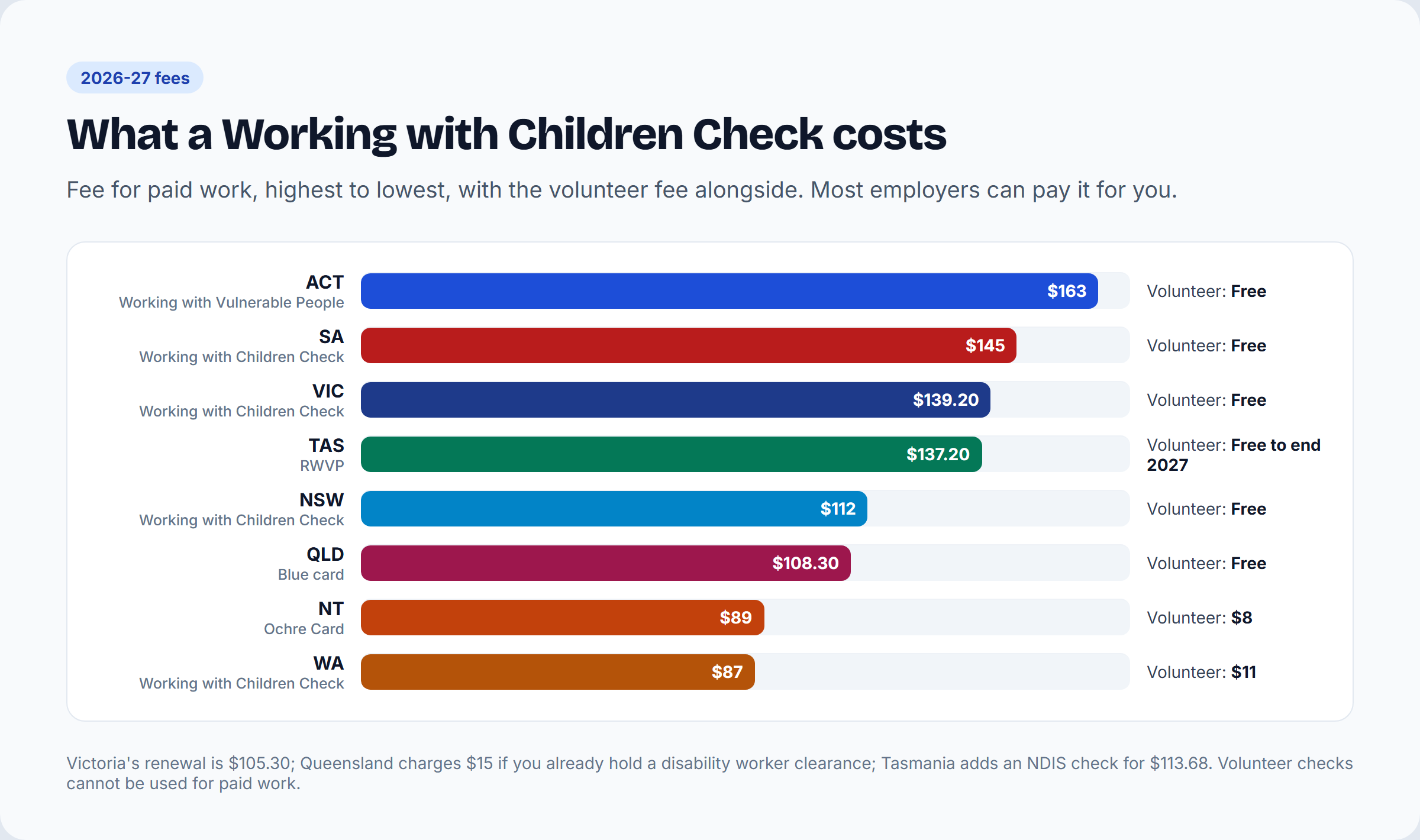
Most states let an employer pay the fee for you. Fees are not refunded if you apply twice, apply as paid by mistake or withdraw. Several states charge again to upgrade a volunteer check to paid work: $139.20 in Victoria, $108.30 in Queensland, $113.68 in Tasmania, and in SA a share of $145 based on the time left on your check.
How long a check lasts, and renewing
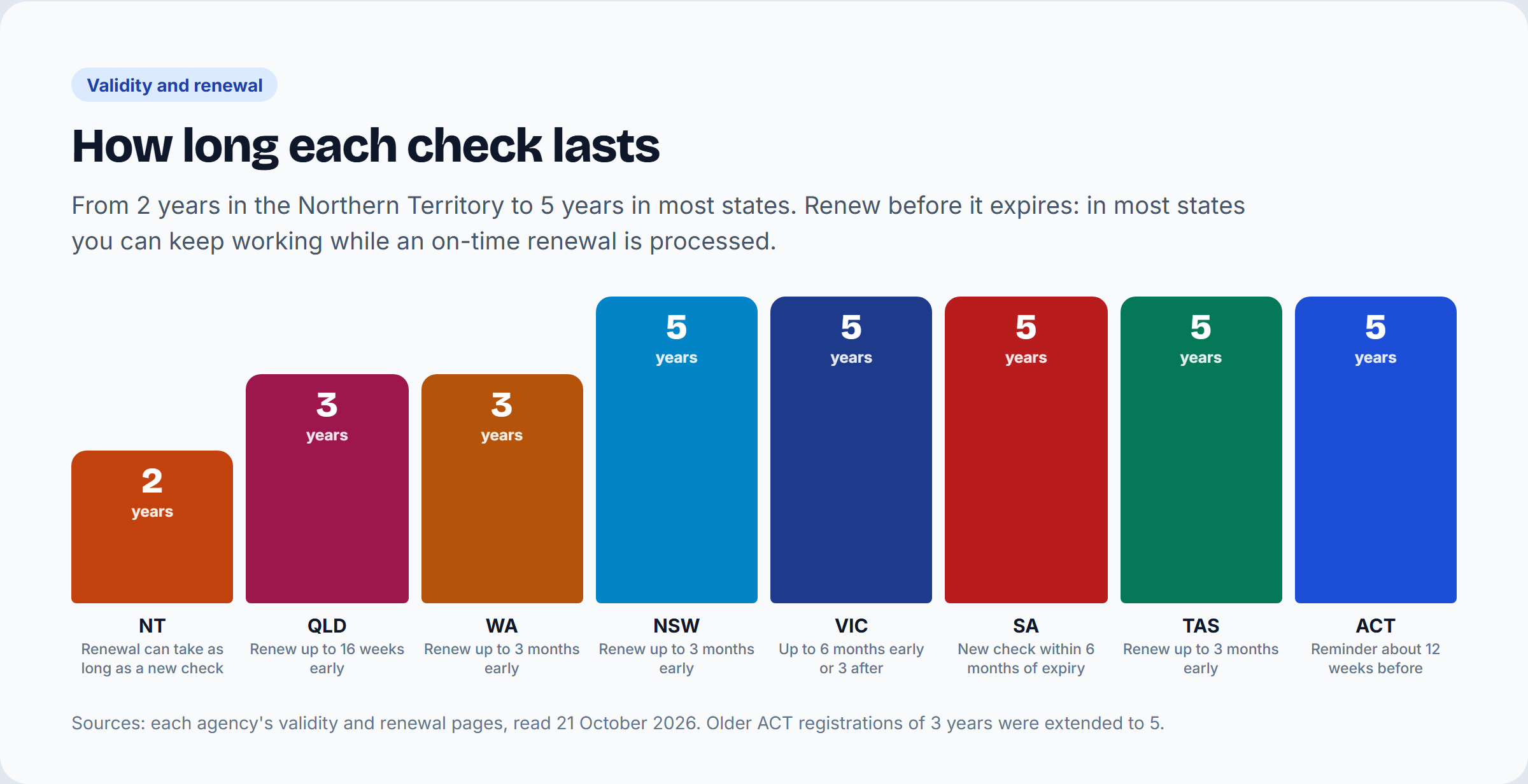
Renew before your check expires. In NSW, Victoria, Queensland and the ACT, an on-time renewal lets you keep working while it is processed (in SA, if your employer agrees); once a check has lapsed, you generally cannot do child-related work until you are cleared again. The NT's Ochre Card lasts only 2 years and a renewal can take as long as a first application, so start early.
Can you start work before your check comes through?
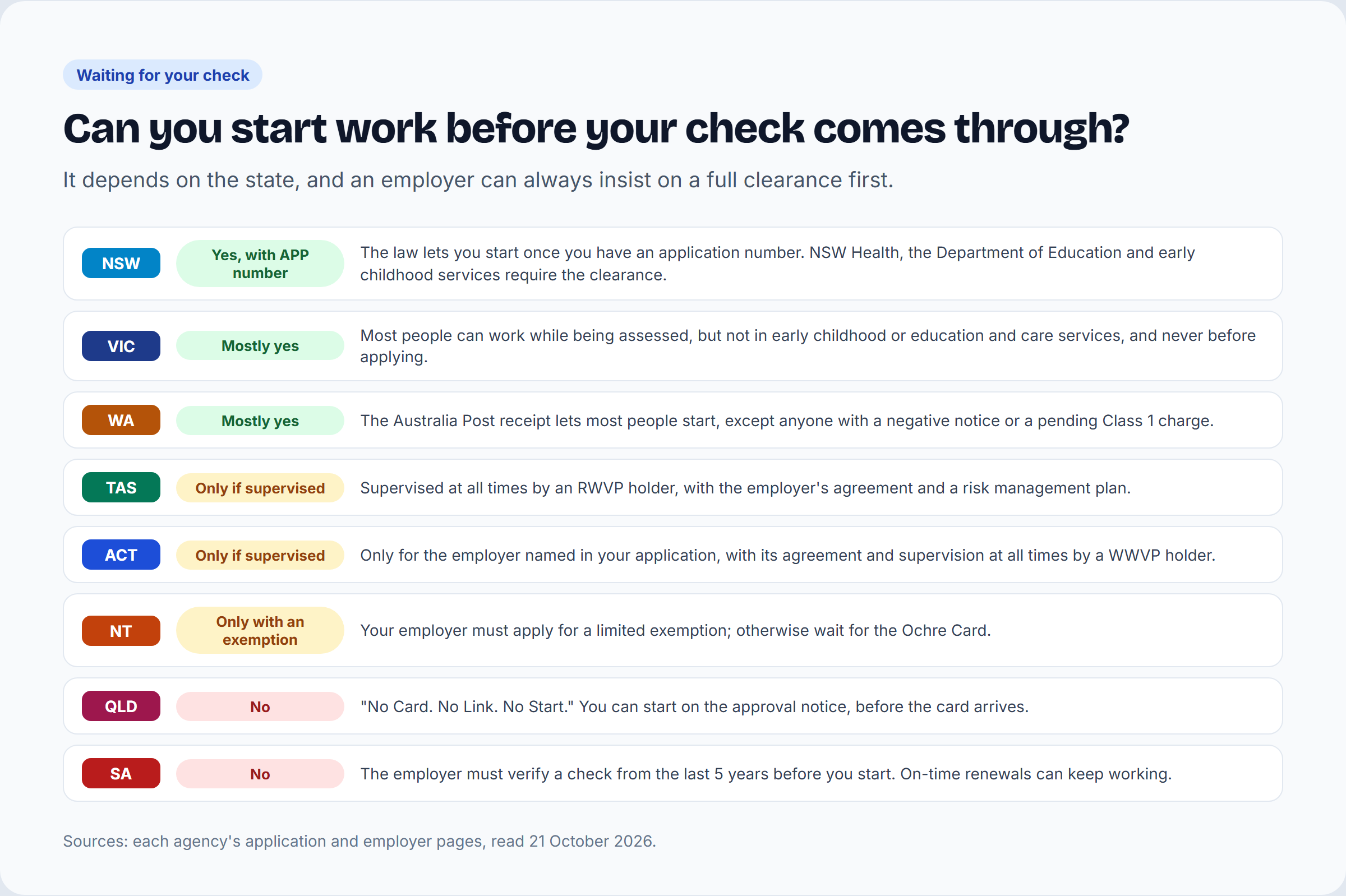
Even where the law allows it, an employer can insist on a full clearance first, and many do: NSW Health, the NSW Department of Education and early childhood services among them.
What changed in 2026
| Date | Where | Change | Status |
|---|---|---|---|
| September 2025 | NSW | Tribunal (NCAT) reviews replaced by an internal review by the Office of the Children's Guardian, with a $224 fee. | In force |
| 20 September 2025 | Queensland | New suspension powers and more roles that need a blue card (businesses had until 20 March 2026). | In force |
| 1 December 2025 | NSW | A bar in another state stops you holding a NSW check ("banned in one, banned in all"). | In force |
| 16 December 2025 | ACT | Someone barred from working with children elsewhere cannot hold a WWVP registration for work with children. | In force |
| 1 January 2026 | Tasmania | Volunteer registrations free for two years. | In force |
| February 2026 | Victoria | The new Social Services Regulator took over the WWC Check and the NDIS Check. | In force |
| 28 July 2026 | Victoria | Child safety information that never led to a charge can now be considered; interim bars introduced; internal review replaces VCAT. | In force |
| September 2026 | Western Australia | Banned in one, banned in all, after the amendment passed on 19 August 2026. | In force |
| 1 September 2026 | Northern Territory | New application forms with consent and self-disclosure questions. | In force |
| 19 October 2026 | Victoria | Mandatory 45-minute child safety training for new applicants and renewals; employers must use WWC Connect. | In force |
| 1 February 2027 | Queensland | A Queensland Protection Commission would merge the blue card, yellow card and Reportable Conduct schemes. | Proposed (Bill) |
| Not yet set | National | One check recognised in every state. Ministers have agreed the steps towards it, but it is not law. | Proposed |
The biggest change is in Victoria. Since 19 October 2026 every new applicant, every renewal and every volunteer moving to paid work must first complete free, self-paced child safety training of about 45 minutes, and every employer must use the WWC Connect system to check and connect its workers. Nationally, "banned in one, banned in all" is now law in most jurisdictions, but a single check recognised everywhere is still a goal, not law.
Working or moving interstate
A check is only valid in the state that issued it. If you work across a border, you generally need a check in each state, apart from these short visits:
| State or territory | You can work without its check for |
|---|---|
| NSW | Visiting from interstate and working with children for fewer than 30 days |
| Victoria | Up to 30 days in a calendar year if you hold an equivalent check from your home state |
| Queensland | No more than 7 days in a calendar year across all organisations (not overnight camps). Interstate checks are not recognised. |
| Western Australia | The two weeks after you first arrive, up to two weeks in any 12 months |
| South Australia | An organised event of no more than 10 consecutive days, if you hold an equivalent home-state check |
| Tasmania | Short-term visitors with an equivalent check; new residents can use an interstate check until it expires |
| ACT | Up to 28 days in 12 months if you hold another state's check |
| Northern Territory | Volunteering with children for less than 30 days in a year in total |
Tasmania is the most generous: someone who moves there can keep using a check from another state until it expires.
A checklist for employers
- Work out which roles are child-related under your state's law, and do not ask for checks the law does not require (the ACT and WA both warn against over-capturing).
- Register as an employer or organisation with the state agency where that is required (NSW, Victoria's WWC Connect, Queensland, SA, Tasmania).
- Verify each worker's check online before they start, and again on renewal. Sighting an email or a card is not enough in NSW or SA.
- Link or connect the worker to your organisation where the state requires it, and delink them when they leave.
- Record each worker's name, date of birth, check number, type (paid or volunteer), expiry date and the date you verified it. Victoria requires records to be kept for at least seven years after the worker leaves.
- Track expiry dates and remind staff to renew in time, especially Queensland and WA (3 years) and the NT (2 years).
- For NDIS workers with child participants, track both the NDIS Worker Screening Check and the state check.
How Rostery helps
Rostery is our product, so here is plainly what it does. Staff upload their Working with Children Check, blue card or Ochre Card to their profile, and Rostery reads the document and records the type, number, issuer and expiry date. Where a card prints only an issue date, Rostery works out the expiry from that state's validity: 2 years for an NT Ochre Card, 3 for a Queensland blue card or WA card, and 5 elsewhere. Expiry dates raise alerts before they lapse.
When you match staff to a participant's support needs, Rostery only suggests workers whose checks are current. Aged care providers can also set the checks each role must hold and switch on a rule that stops a worker with a missing or expired check from being rostered, from the roster, the job board or a bulk change, unless an admin overrides it, and the override is recorded. See document expiry tracking in Rostery.
Frequently asked questions
How much does a Working with Children Check cost in 2026?
For paid work: NSW $112, Victoria $139.20, Queensland $108.30, WA $87, SA $145, Tasmania $137.20, ACT $163 and NT $89. Volunteer checks are free everywhere except WA ($11) and the NT ($8).
How long does a Working with Children Check take?
Most straightforward applications take days to a few weeks: Queensland approves most within 5 business days, SA completes most within 4 weeks, NSW can take up to 4 weeks for police results, Tasmania asks you to allow 6 weeks and the ACT averages 8 weeks. Applications with a criminal or other history take longer.
Can I use my Working with Children Check in another state?
No. Each check is valid only in the state that issued it, apart from short visits (for example up to 30 days in NSW) and Tasmania, which lets new residents use an interstate check until it expires. You need a new check if you move or work regularly across a border.
How long does a Working with Children Check last?
5 years in NSW, Victoria, SA, Tasmania and the ACT, 3 years in Queensland and WA, and 2 years in the Northern Territory.
Can I start working before my check is approved?
In NSW, Victoria and WA most people can once they have applied; in Tasmania and the ACT only with constant supervision; in the NT only with an employer exemption; and in Queensland and SA not until cleared. Your employer can always require a clearance first.
Do NDIS workers need a Working with Children Check?
If they work with participants under 18, usually yes, as well as the NDIS Worker Screening Check. The two are separate checks, though some states, such as Queensland and Tasmania, make getting the second one cheaper.
Is a volunteer check enough for paid work?
No. In every state a volunteer check covers volunteering only, and you must upgrade, usually for a fee, before or soon after starting paid work (within 30 days in NSW and 28 days in SA).
Sources
- Office of the Children's Guardian (NSW): Working with Children Check
- Victorian Government: Working with Children Check, including the changes from 19 October 2026
- Queensland Government: Blue card services
- Department of Communities (WA): Working with Children Check
- SA Department of Human Services: Working with Children Check
- Department of Justice (Tasmania): Registration to Work with Vulnerable People
- Access Canberra: Working with Vulnerable People registration
- ACT Working with Vulnerable People Background Checking (Fees) Determination 2026
- NT Government: Working with Children Clearance (Ochre Card)
- National Office for Child Safety: Working with Children Check reform
- NDIS Quality and Safeguards Commission: Worker screening
Checked 21 October 2026, with every fee the 2026-27 figure. Fees change every 1 July and rules change often, so confirm with the agency before you apply. This guide is general information, not legal advice.