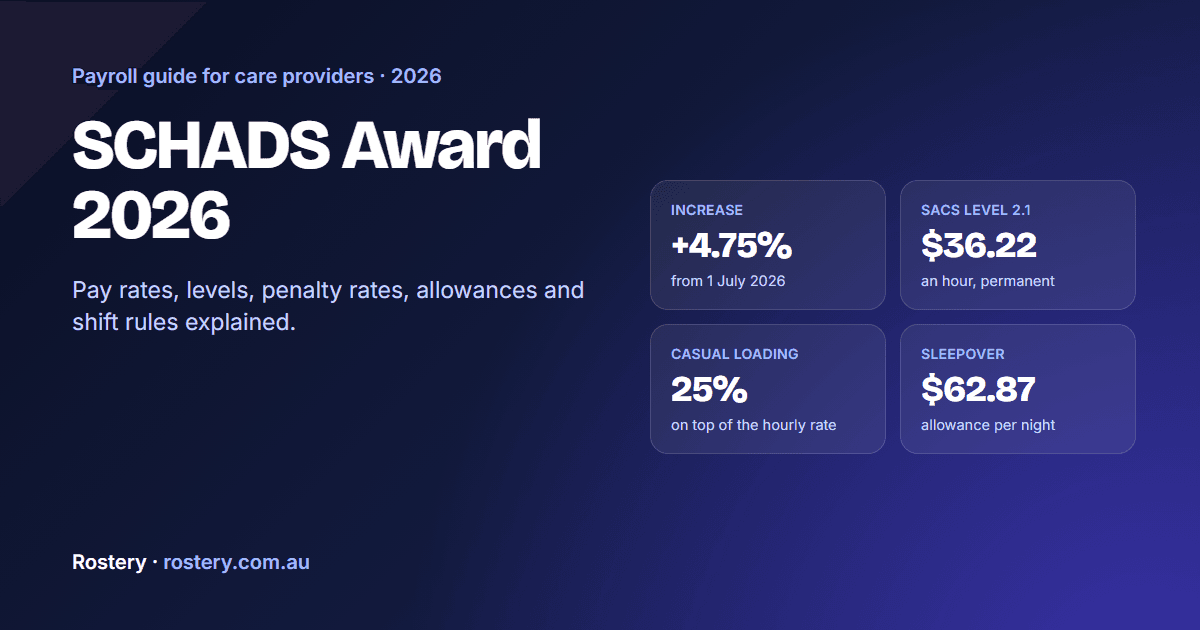
The SCHADS Award sets the minimum pay and conditions for most people who work in disability support, home care, community services and family day care in Australia. Its full name is the Social, Community, Home Care and Disability Services Industry Award 2010, and its code is MA000100. Its pay rates went up by 4.75% from the first full pay period starting on or after 1 July 2026, after the Fair Work Commission's Annual Wage Review.
This guide explains the 2026 rates for every level, how classifications and pay points work, casual loading, penalty rates, overtime, allowances, the rules for broken shifts, sleepovers and cancellations, and leave. Every rate comes from the Fair Work Ombudsman's pay guide for 1 July 2026. To look up a single rate, use our SCHADS Award pay rates table. To work out what a whole shift costs, use the SCHADS pay calculator.
SCHADS Award 2026 at a glance
| What | From 1 July 2026 |
|---|---|
| Pay increase | 4.75%, from the first full pay period starting on or after 1 July 2026 |
| SACS Level 2, pay point 1 | $36.22 an hour ($1,376.49 a week); casual $45.28 an hour |
| Casual loading | 25%, added on top of weekend, public holiday and shift rates |
| Saturday, Sunday, public holiday | 150%, 200%, 250% (casual 175%, 225%, 275%) |
| Sleepover allowance | $62.87 a night |
| Broken shift allowance | $21.81 with one unpaid break, $28.87 with two |
| Minimum engagement | 2 hours for disability and home care work, 3 hours for other SACS work |
| Vehicle allowance | $1.05 a km from 1 September 2026 to 28 February 2027 ($1.01 otherwise) |
Who the SCHADS Award covers
The award covers employers throughout Australia in four sectors, and their employees in the classifications the award lists:
- crisis assistance and supported housing
- social and community services, which includes disability services
- home care
- family day care schemes
It does not cover employers and employees covered by the Aged Care Award, the Health Professionals and Support Services Award, the Nurses Award, the Fitness Industry Award, or the Amusement, Events and Recreation Award. Residential aged care is under the Aged Care Award. Home care for older people is under SCHADS.
Inside SCHADS, each employee belongs to a stream, and each stream has its own classification schedule and its own pay table:
| Stream | Who it is for | Levels |
|---|---|---|
| Social and community services (SACS) | Social and community services work, including disability services work | Levels 1 to 8, each with pay points (Schedule B) |
| Crisis accommodation | Employees in crisis accommodation and supported housing | Schedule C |
| Family day care | Employees of family day care schemes | Levels 1 to 5 (Schedule D) |
| Home care, disability | Home care for people with disability | Levels 1 to 5 (Schedule E) |
| Home care, aged care | Home care for older people | Levels 1 to 6 (Schedule F, since 1 January 2025) |
The award says an employee is not kept out of the SACS stream just because they work in a private home or in outreach. Which stream applies depends on the work the person mainly does, so check the classification definitions before you set anyone up in payroll.
SCHADS Award pay rates 2026: social and community services
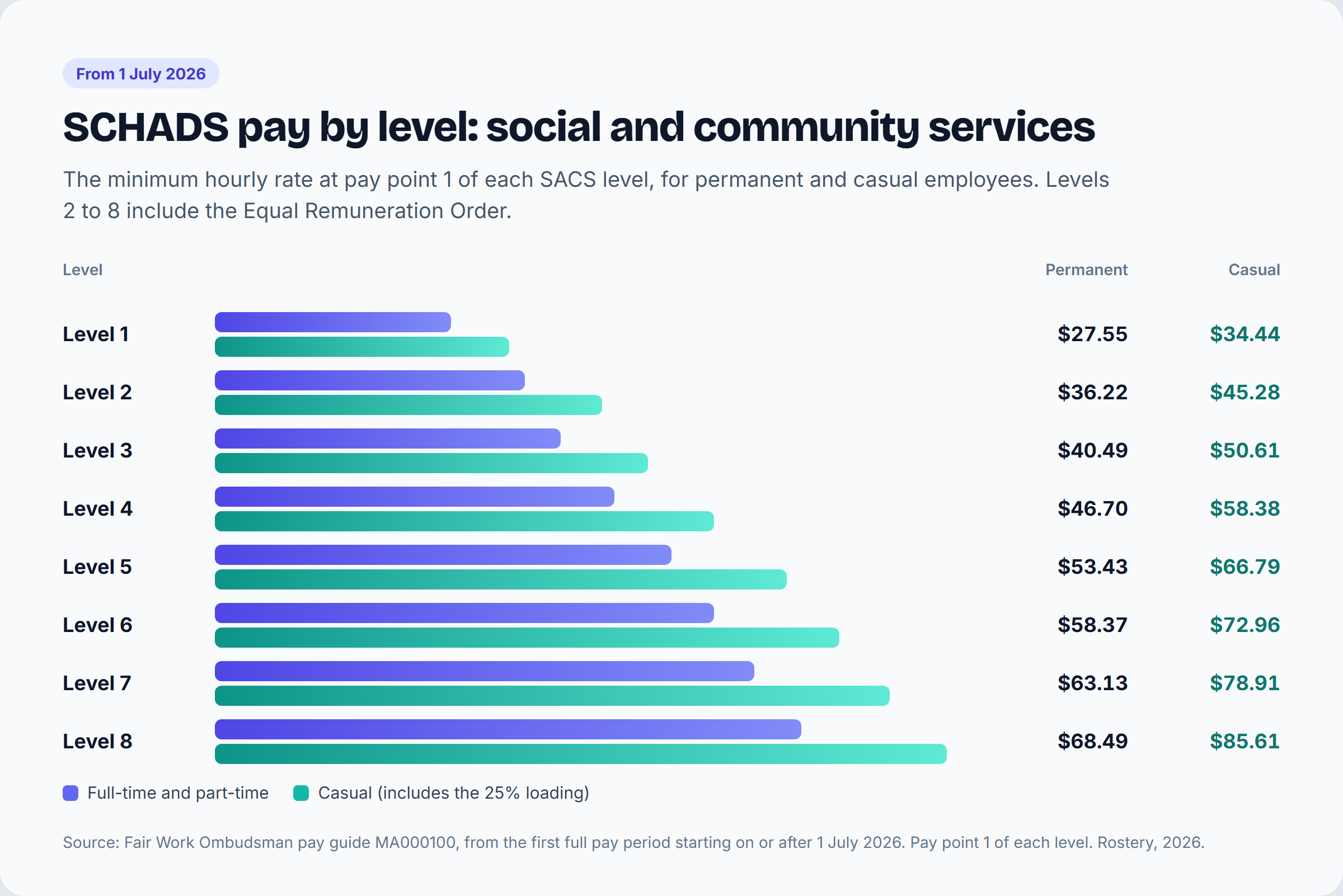
These are the minimum rates for SACS employees from 1 July 2026. Levels 2 to 8 include the Equal Remuneration Order, which the award says forms part of the ordinary rate of pay for all purposes. Level 1 has no ERO.
| Level and pay point | Weekly (full-time) | Hourly | Casual hourly |
|---|---|---|---|
| Level 1, pay point 1 | $1,046.90 | $27.55 | $34.44 |
| Level 1, pay point 2 | $1,080.60 | $28.44 | $35.55 |
| Level 1, pay point 3 | $1,119.10 | $29.45 | $36.81 |
| Level 2, pay point 1 | $1,376.49 | $36.22 | $45.28 |
| Level 2, pay point 2 | $1,419.79 | $37.36 | $46.70 |
| Level 2, pay point 3 | $1,462.96 | $38.50 | $48.13 |
| Level 2, pay point 4 | $1,501.95 | $39.53 | $49.41 |
| Level 3, pay point 1 | $1,538.59 | $40.49 | $50.61 |
| Level 3, pay point 2 | $1,582.94 | $41.66 | $52.08 |
| Level 3, pay point 3 | $1,616.71 | $42.55 | $53.19 |
| Level 3, pay point 4 | $1,649.97 | $43.42 | $54.28 |
| Level 4, pay point 1 | $1,774.74 | $46.70 | $58.38 |
| Level 4, pay point 2 | $1,821.07 | $47.92 | $59.90 |
| Level 4, pay point 3 | $1,867.93 | $49.16 | $61.45 |
| Level 4, pay point 4 | $1,909.51 | $50.25 | $62.81 |
| Level 5, pay point 1 | $2,030.20 | $53.43 | $66.79 |
| Level 5, pay point 2 | $2,073.91 | $54.58 | $68.23 |
| Level 5, pay point 3 | $2,122.13 | $55.85 | $69.81 |
| Level 6, pay point 1 | $2,218.02 | $58.37 | $72.96 |
| Level 6, pay point 2 | $2,267.02 | $59.66 | $74.58 |
| Level 6, pay point 3 | $2,316.16 | $60.95 | $76.19 |
| Level 7, pay point 1 | $2,398.95 | $63.13 | $78.91 |
| Level 7, pay point 2 | $2,449.36 | $64.46 | $80.58 |
| Level 7, pay point 3 | $2,499.20 | $65.77 | $82.21 |
| Level 8, pay point 1 | $2,602.75 | $68.49 | $85.61 |
| Level 8, pay point 2 | $2,653.94 | $69.84 | $87.30 |
| Level 8, pay point 3 | $2,705.27 | $71.19 | $88.99 |
The hourly rate is the weekly rate divided by 38. Casual rates include the 25% casual loading. Some Queensland employers that are not constitutional corporations have transitional ERO arrangements that are not in the pay guide.
SCHADS Award pay rates 2026: home care
Home care has two tables: one for disability care and one for aged care. The aged care rates are higher because they were set separately, with new classifications from 1 January 2025.
| Home care level | Weekly (full-time) | Hourly | Casual hourly |
|---|---|---|---|
| Disability care, Level 1, pay point 1 | $1,036.80 | $27.28 | $34.10 |
| Disability care, Level 2, pay point 1 | $1,096.60 | $28.86 | $36.08 |
| Disability care, Level 2, pay point 2 | $1,104.10 | $29.06 | $36.33 |
| Disability care, Level 3, pay point 1 | $1,119.10 | $29.45 | $36.81 |
| Disability care, Level 3, pay point 2 | $1,153.70 | $30.36 | $37.95 |
| Disability care, Level 4, pay point 1 | $1,221.00 | $32.13 | $40.16 |
| Disability care, Level 4, pay point 2 | $1,245.40 | $32.77 | $40.96 |
| Disability care, Level 5, pay point 1 | $1,309.20 | $34.45 | $43.06 |
| Disability care, Level 5, pay point 2 | $1,360.80 | $35.81 | $44.76 |
| Aged care, Level 1, Introductory | $1,239.00 | $32.61 | $40.76 |
| Aged care, Level 2, Home carer | $1,307.80 | $34.42 | $43.03 |
| Aged care, Level 3, Qualified | $1,376.70 | $36.23 | $45.29 |
| Aged care, Level 4, Senior | $1,431.70 | $37.68 | $47.10 |
| Aged care, Level 5, Specialist | $1,486.80 | $39.13 | $48.91 |
| Aged care, Level 6, Team leader | $1,541.90 | $40.58 | $50.73 |
The aged care levels are defined by experience and qualifications. Level 1 is a carer with less than 3 months' aged care experience, and Level 2 is one with 3 months or more. Level 3 needs a Certificate III in Individual Support (Ageing) or equivalent, and Level 4 needs that plus 4 years at Level 3 after 1 January 2025. Levels 5 and 6 are for carers whose employer requires a Certificate IV in Ageing Support, with Level 6 also supervising and training other home care employees.
SCHADS levels and pay points explained
Your level depends on the work you do and the skills it needs. Your pay point is your step within that level. In the SACS stream, the award describes each level like this:
- Level 1 is for entry-level work under direct supervision, with substantial on-the-job training.
- Level 2 works under regular supervision. The position needs an appropriate certificate, relevant experience, or on-the-job training and experience, and it is the entry point for someone with a diploma and no experience.
- Level 3 works under general direction and solves problems of limited difficulty. It is the entry level for graduates with a relevant three-year degree (pay point 3) or four-year degree (pay point 4).
- Level 4 needs, for example, a relevant four-year degree and one year's experience, a three-year degree and two years' experience, or lesser qualifications with substantial experience.
- Level 5 needs a relevant degree with experience, an associate diploma with substantial experience, or equivalent expertise.
- Levels 6 to 8 cover more senior specialist, management and leadership work.
At the end of each 12 months of continuous employment, an employee becomes eligible to move to the next pay point within their level if they have shown competency and satisfactory performance, and either used new or enhanced skills the employer asked for or passed the employer's performance appraisal. Moving up to a higher level happens only by promotion or reclassification. A payroll system should track each employee's anniversary so a pay point review is never missed.
Casual loading
Casual employees get a 25% loading on top of the ordinary hourly rate, instead of paid annual leave and paid personal leave. Under SCHADS the loading is added to weekend, public holiday and shift penalties: a casual works on Saturday at 175% of the ordinary rate, not 150%.
SCHADS penalty rates
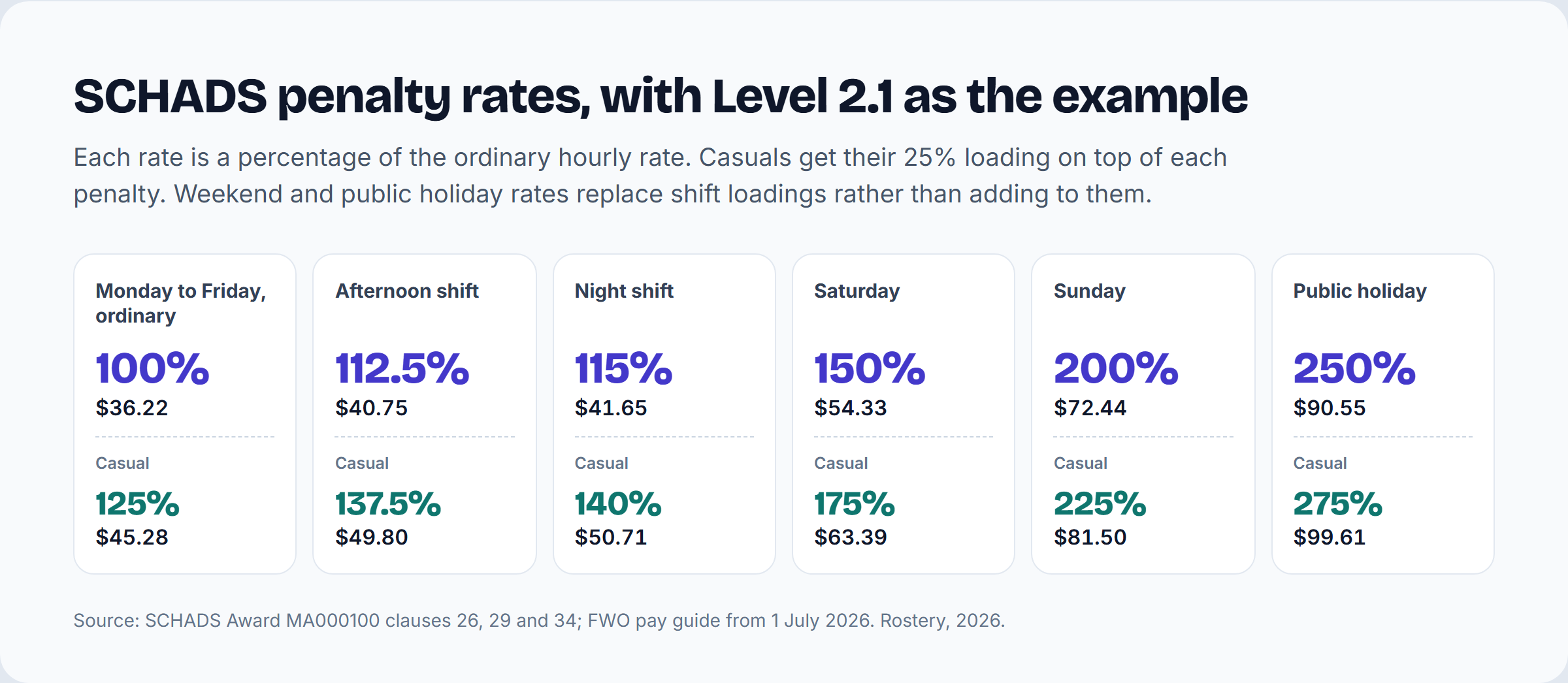
Penalty rates are percentages of the ordinary hourly rate. Weekend rates replace afternoon and night shift loadings, and the public holiday rate replaces both, so you never stack two of them on the same hour.
| When | Full-time and part-time | Casual | Level 2.1 example |
|---|---|---|---|
| Ordinary hours, Monday to Friday | 100% | 125% | $36.22 / $45.28 |
| Afternoon shift | 112.5% | 137.5% | $40.75 / $49.80 |
| Night shift | 115% | 140% | $41.65 / $50.71 |
| Saturday | 150% | 175% | $54.33 / $63.39 |
| Sunday | 200% | 225% | $72.44 / $81.50 |
| Public holiday | 250% | 275% | $90.55 / $99.61 |
An afternoon shift is one that finishes after 8 pm and at or before midnight, Monday to Friday. A night shift finishes after midnight or starts before 6 am, Monday to Friday. The shift loading applies to the whole shift. The public holiday rate applies to the hours worked between midnight before the holiday and midnight at its end. For day workers, ordinary hours run from 6 am to 8 pm, Monday to Sunday.
Two examples at Level 2, pay point 1:
- A part-time worker does 4 hours on a Saturday morning: 4 × $54.33 = $217.32.
- A casual works 3 hours on a Sunday: 3 × $81.50 = $244.50.
For a deeper look at shift penalties, see SCHADS penalties, broken shifts and sleepovers.
Overtime
| Who | Monday to Saturday | Sunday | Public holiday |
|---|---|---|---|
| Full-time, disability services, home care and day care | 150% for the first 2 hours, then 200% | 200% | 250% |
| Full-time, other SACS and crisis work | 150% for the first 3 hours, then 200% | 200% | 250% |
| Part-time | 150% for the first 2 hours, then 200% | 200% | 250% |
| Casual | 175% for the first 2 hours, then 225% | Not set out in the pay guide; check the award | 275% |
Part-time and casual employees are paid overtime for hours over 38 a week or 76 a fortnight, over 10 hours in a day or shift (12 hours where an agreed shift spans a sleepover), and, for day workers, for hours outside 6 am to 8 pm. Overtime rates replace shift and weekend penalties. Other overtime rules:
- If an employee does not get a 10-hour break after overtime, they are paid at 200% until they are released (this does not apply to casuals).
- A recall to work is paid for at least 2 hours.
- Time off instead of overtime pay is allowed by written agreement, hour for hour, taken within 3 months.
- A meal allowance of $17.30 applies when overtime goes past 1 hour, and another $17.30 past 4 hours.
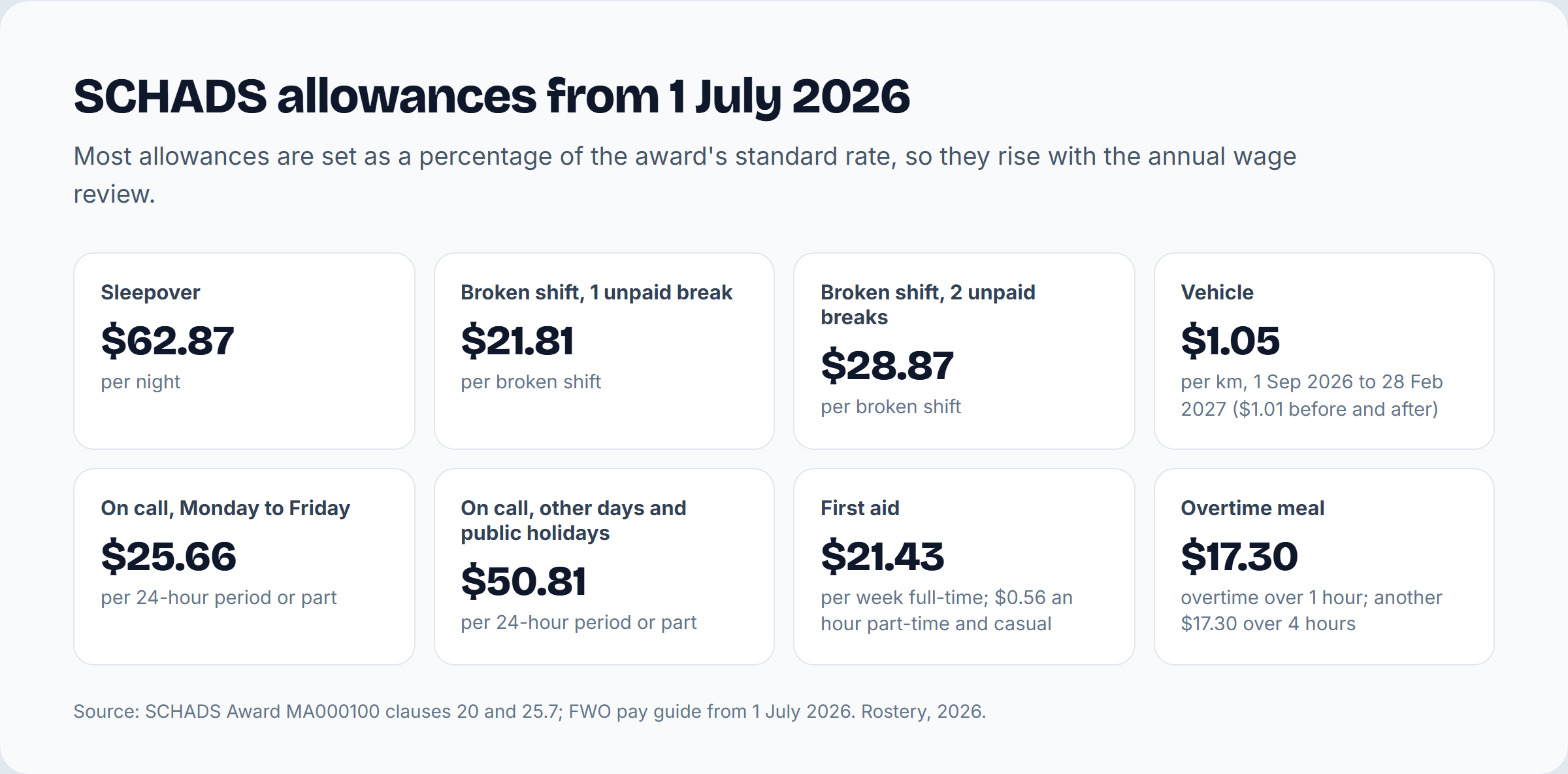
SCHADS allowances 2026
| Allowance | Amount | When it is paid |
|---|---|---|
| Sleepover | $62.87 a night | The employee sleeps overnight where the client is |
| Broken shift, one unpaid break | $21.81 | Each broken shift with one unpaid break |
| Broken shift, two unpaid breaks | $28.87 | Each broken shift with two unpaid breaks |
| On call, Monday to Friday | $25.66 | Each 24-hour period or part, from the end of ordinary duty Monday to the end of ordinary duty Friday |
| On call, other days and public holidays | $50.81 | Each other 24-hour period or part, or a public holiday or part |
| Vehicle | $1.05 a km (1 Sep 2026 to 28 Feb 2027); $1.01 otherwise | The employee uses their own car for work |
| First aid | $21.43 a week (full-time); $0.56 an hour up to $21.43 a week (part-time and casual) | The employee is the appointed first aider |
| Uniform | $1.26 a shift, up to $6.41 a week | By agreement, instead of the employer supplying uniforms |
| Overtime meal | $17.30, and another $17.30 | Overtime over 1 hour, and over 4 hours |
Shift rules: minimum engagement, broken shifts and sleepovers
Minimum engagement
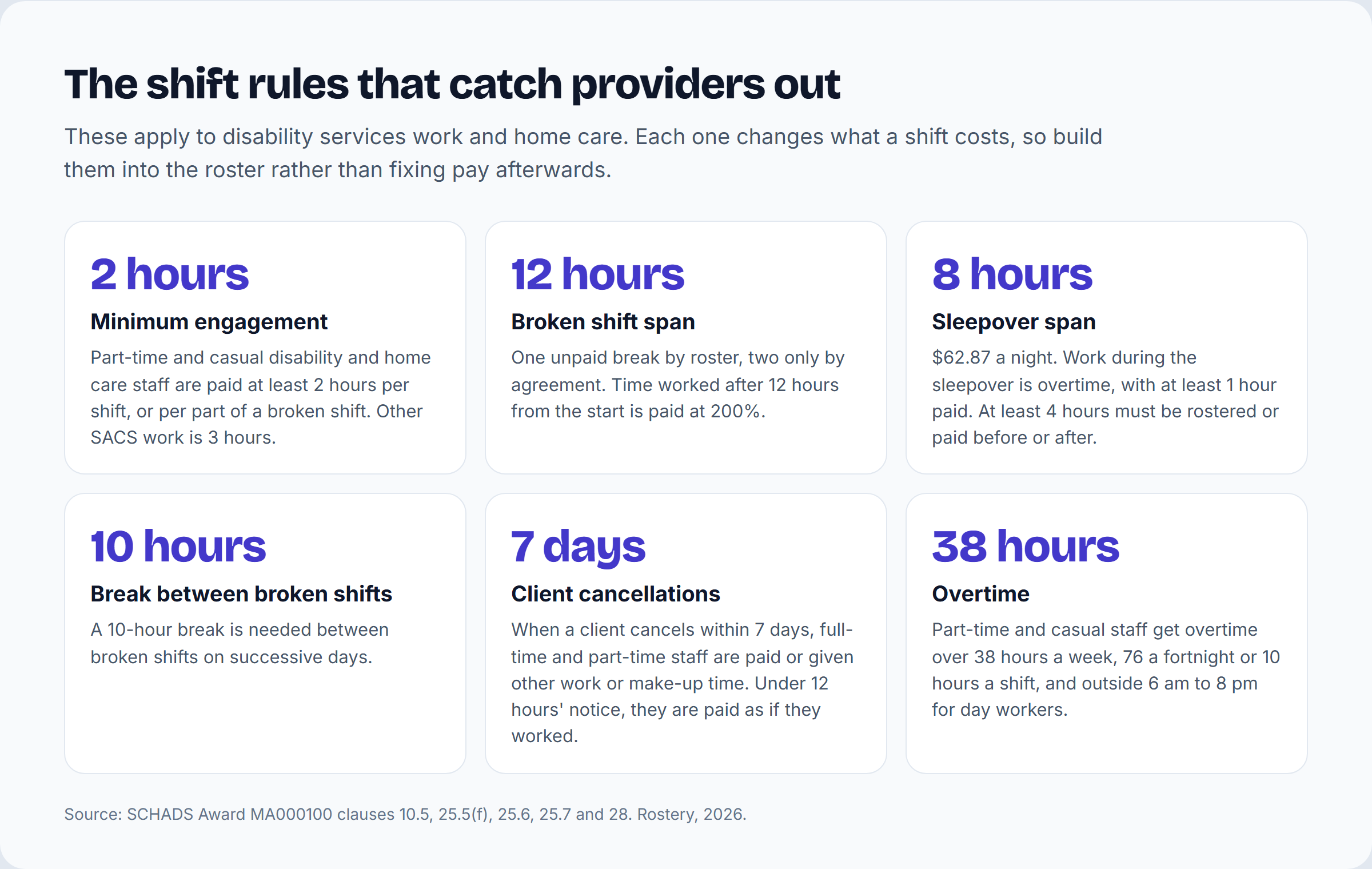
Part-time and casual employees doing disability services work or home care are paid for at least 2 hours each shift. For other SACS work the minimum is 3 hours. In a broken shift, the minimum applies to each period of work, and a break that falls inside a minimum payment period counts as time worked.
Broken shifts
A broken shift is a shift with an unpaid break in the middle. Broken shifts apply to SACS employees doing disability services work and to home care employees. The rules:
- One unpaid break can be rostered. Two need the employee's agreement before each occasion, or as part of an agreed part-time pattern.
- The whole shift must fit within 12 hours. Work after 12 hours from the start is paid at 200%.
- The employee gets the broken shift allowance: $21.81 with one break, $28.87 with two.
- There must be 10 hours between broken shifts on successive days.
- Afternoon and night loadings only apply to a period of work that itself meets the definition, and a period that starts before 6 am does not get the night loading.
Example: a casual at Level 2.1 works 7 am to 9 am and 4 pm to 7 pm on a Wednesday, with one unpaid break. That is 5 hours at $45.28 ($226.40) plus the $21.81 allowance, $248.21 in total. Both periods are at least 2 hours and the span is exactly 12 hours. Our broken shift glossary entry explains the terms.
Sleepovers
A sleepover is when the employer requires the employee to sleep overnight where the client is, including in respite care. The rules:
- The sleepover span is 8 hours, and the allowance is $62.87 a night.
- The employee must have a separate room, a bed, clean linen and facilities, with free board and lodging.
- If they are woken to work, that time is paid at the overtime rate, with at least 1 hour paid. If the work goes over an hour, the overtime rate applies for the whole time.
- Work can be rostered before and after the sleepover. At least 4 hours must be rostered or paid for one of those periods, and the allowance is paid on top.
- By agreement, a shift can be up to 12 ordinary hours spanning a sleepover, with up to 8 ordinary hours before or after it.
- Work before and after the sleepover is checked separately for afternoon, night and public holiday loadings.
Example: a permanent employee at Level 2.1 works 4 pm to 10 pm on a Tuesday, sleeps over from 10 pm to 6 am without being woken, then works 6 am to 8 am. The evening part finishes after 8 pm, so it is an afternoon shift: 6 × $40.75 = $244.50. Add the $62.87 allowance and 2 × $36.22 = $72.44 for the morning, and the total is $379.81.
A sleepover is different from an active night shift, where the employee stays awake and works. Our sleepover or active night tool compares what each costs, and SCHADS sleepover allowances in 2026 covers the details.
24-hour care (home care only)
Home care employees can work a 24-hour care shift. A full-time or part-time employee is paid 8 hours at 155% of their rate for each 24 hours. The pay guide sets the casual figure at 8 hours at 180%, which is $392.80 for disability home care Level 1. Work beyond 8 hours is paid as overtime.
Client cancellations
When a client cancels a home care or disability service within 7 days, full-time and part-time employees rostered on it are protected. The employer can direct them to other work in the rostered hours, or cancel the shift and either pay it or offer make-up time. Make-up time is only allowed with at least 12 hours' notice of the cancellation, must be worked within 6 weeks, and is paid at the higher of the cancelled and the actual shift. With less than 12 hours' notice, the employee is paid as if the shift went ahead. This clause covers full-time and part-time employees, not casuals.
Leave under the SCHADS Award
| Leave | Entitlement |
|---|---|
| Annual leave | 4 weeks a year (pro rata for part-time); casuals get the loading instead |
| Extra week for shiftworkers | A fifth week for employees who work more than 4 ordinary hours on 10 or more weekends in the year, or at least eight 24-hour care shifts |
| Annual leave loading | 17.5%, or for shiftworkers the weekend and shift penalties they would have received, if that is higher |
| Personal and carer's leave | 10 days a year (pro rata for part-time) |
| Excessive annual leave | More than 8 weeks (10 for shiftworkers) can be directed to be taken |
Use our SCHADS leave calculator to work out accruals, including the extra week for shiftworkers.
What changed in 2026, and what is coming
The Fair Work Commission's Annual Wage Review decision ([2026] FWCFB 3500, announced on 2 June 2026) raised modern award minimum rates by 4.75% from 1 July 2026. Allowances that are a percentage of the standard rate rose with it. The vehicle allowance has its own temporary increase to $1.05 a km from 1 September 2026 to 28 February 2027.
More change is coming for disability home care. In the same decision, the Commission said disability home care workers will receive a work value increase, with 23% for the Certificate III benchmark and a new classification structure to be in place by 1 October 2027. The amounts and dates for each step are not in the award yet, so keep an eye on it before you set budgets for 2027.
Superannuation is paid on top of these wages: the superannuation guarantee is 12% of ordinary time earnings.
How to stay compliant
- Classify each employee in the right stream and level, and record why.
- Track pay point anniversaries so reviews happen every 12 months.
- Apply new rates from the first full pay period on or after 1 July each year.
- Build minimum engagement, broken shift spans and sleepover rules into the roster before shifts are offered.
- Pay casuals the loading on top of every penalty.
- Keep time and pay records that show how each amount was worked out.
Rostery does this from the roster. Its SCHADS award interpretation applies the 2026 rates, penalties, loadings, allowances and overtime to every shift, and shows the clause behind each figure, so payroll matches the rules before it reaches your accountant. Read what award interpretation software does, or book a demo to see it with your own roster.
Frequently asked questions
What is the SCHADS Award?
It is the Social, Community, Home Care and Disability Services Industry Award 2010 (MA000100), the modern award that sets minimum pay and conditions for social and community services, disability services, home care, crisis accommodation and family day care workers in Australia.
How much did the SCHADS Award go up in 2026?
By 4.75%, from the first full pay period starting on or after 1 July 2026, under the Fair Work Commission's Annual Wage Review decision.
What is the SCHADS Level 2 pay rate in 2026?
SACS Level 2, pay point 1 is $36.22 an hour ($1,376.49 a week) for full-time and part-time employees, and $45.28 an hour for casuals.
What is the SCHADS sleepover allowance in 2026?
$62.87 a night, from 1 July 2026. Any work during the sleepover is paid separately at the overtime rate, with at least 1 hour paid.
Do casuals get penalty rates on top of the casual loading?
Yes. Under SCHADS the 25% casual loading is added to the weekend, public holiday and shift percentages, so a casual is paid 175% on Saturday, 225% on Sunday and 275% on a public holiday.
What is the minimum shift length under SCHADS?
2 hours for part-time and casual employees doing disability services work or home care, and 3 hours for other SACS work. In a broken shift, each period of work has its own minimum.
Is SCHADS the same as the Aged Care Award?
No. The Aged Care Award covers residential aged care. Home care, including home care for older people, is covered by SCHADS, which has its own aged care home care levels since 1 January 2025.
Sources
- Fair Work Ombudsman: pay guide, Social, Community, Home Care and Disability Services Industry Award (MA000100), from 1 July 2026
- Social, Community, Home Care and Disability Services Industry Award 2010 [MA000100], consolidated to 1 September 2026
- Fair Work Commission: Annual Wage Review 2025-26 decision, [2026] FWCFB 3500
Checked 13 October 2026. This guide explains minimum award entitlements and is not legal advice. For the full rate table, use the SCHADS Award pay rates table, and for the definition, see our SCHADS Award glossary entry.