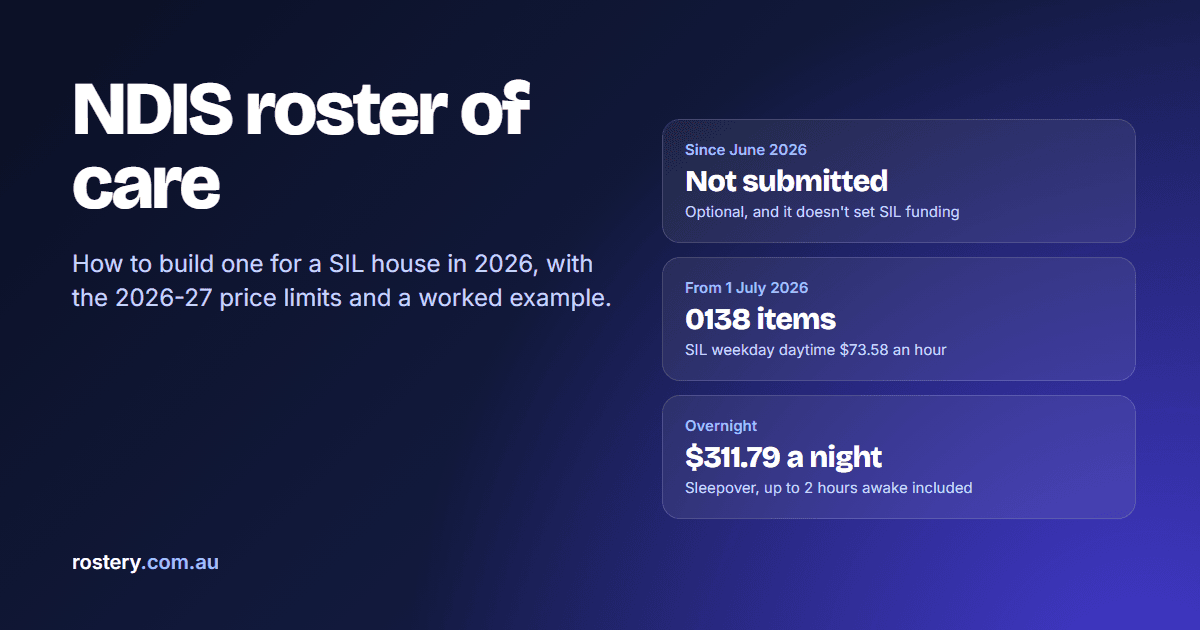
A roster of care is a plan of a typical week of supported independent living (SIL) for a shared house. It shows when each resident needs support, how many workers support how many residents, the overnight arrangement and the irregular support each person may need. Since June 2026 it is optional: the NDIA no longer asks providers to submit one, and it does not decide how much SIL a participant is funded for.
Providers still build them, because a roster of care is how you plan the staffing of a house, check that each resident's funding covers the cost, and agree a typical week with each participant. This guide explains what changed in 2026, every part of a roster of care, the 2026-27 price limits, how to fill in the NDIA's own tool, and a worked example of a three-person house. If you want to build one as you read, our free SIL Roster of Care Calculator loads the same example house and downloads it as a working Excel file.
| Question | Short answer (October 2026) |
|---|---|
| Is a roster of care required? | No. The NDIA's tool guide (version 4, June 2026) says it is no longer a requirement. |
| Do providers send it to the NDIA? | No. If the participant wants it considered, give it to them and their support coordinator for their home and living request or plan reassessment. |
| Does it decide SIL funding? | No. The NDIA works out SIL funding from evidence of the participant's needs and the Pricing Schedule. |
| Who prepares it? | The SIL provider, with the participant or their nominee. |
| Is there an official template? | Yes. The NDIA's SIL roster of care tool, an Excel workbook, version 4.0 (June 2026). |
| Which support items? | Registration group 0138 for supports delivered from 1 July 2026, for example 01_801_0138_1_1 for weekday daytime. |
| Which prices? | The NDIS Pricing Schedule 2026-27, effective 24 September 2026. Standard weekday daytime is $73.58 an hour and a sleepover $311.79 a night. |
What is a roster of care?
In the NDIA's words, a roster of care is a description of the supports a participant can get from their registered SIL provider. The SIL guideline (24 September 2026) lists five things it includes:
- the hours of support the participant needs for day-to-day activities at home in an ordinary week
- the ratio of support, meaning how many workers support how many residents
- the level of SIL: standard or high intensity
- the type of overnight support: a sleepover or active overnight
- the amount of irregular support, for unplanned days such as illness
The NDIA's tool guide adds that the roster "is not the exact schedule of supports that will be provided to the person, nor an agreement with the NDIA". It is a picture of a typical week. It also shows how all the residents of a shared house contribute to shared supports, which is something an individual plan can't show.
Participants can ask their SIL provider for their roster of care at any time, and the provider must work it out with the participant or their nominee. Several documents get mixed up with it, so here is how they differ.
| Document | What it is | Who it is for |
|---|---|---|
| Roster of care | A typical week of support for each resident: hours, ratios, intensity, overnight and irregular support | The provider and participant; optionally the participant's support coordinator and the NDIA |
| Staff roster | Which worker works which shift on which date | The provider and its workers |
| Typical schedule of supports | The week of support agreed for a weekly SIL claim, written into the service agreement | The participant and provider |
| Service agreement | The written agreement covering the supports, prices, claiming method and how vacancies are managed | The participant and provider |
What changed in 2026
If you search for roster of care help, most of what you find still describes the 2023 rules: build a roster for every new SIL participant, attach evidence for each ratio, and email it to the NDIA. That changed in June 2026.
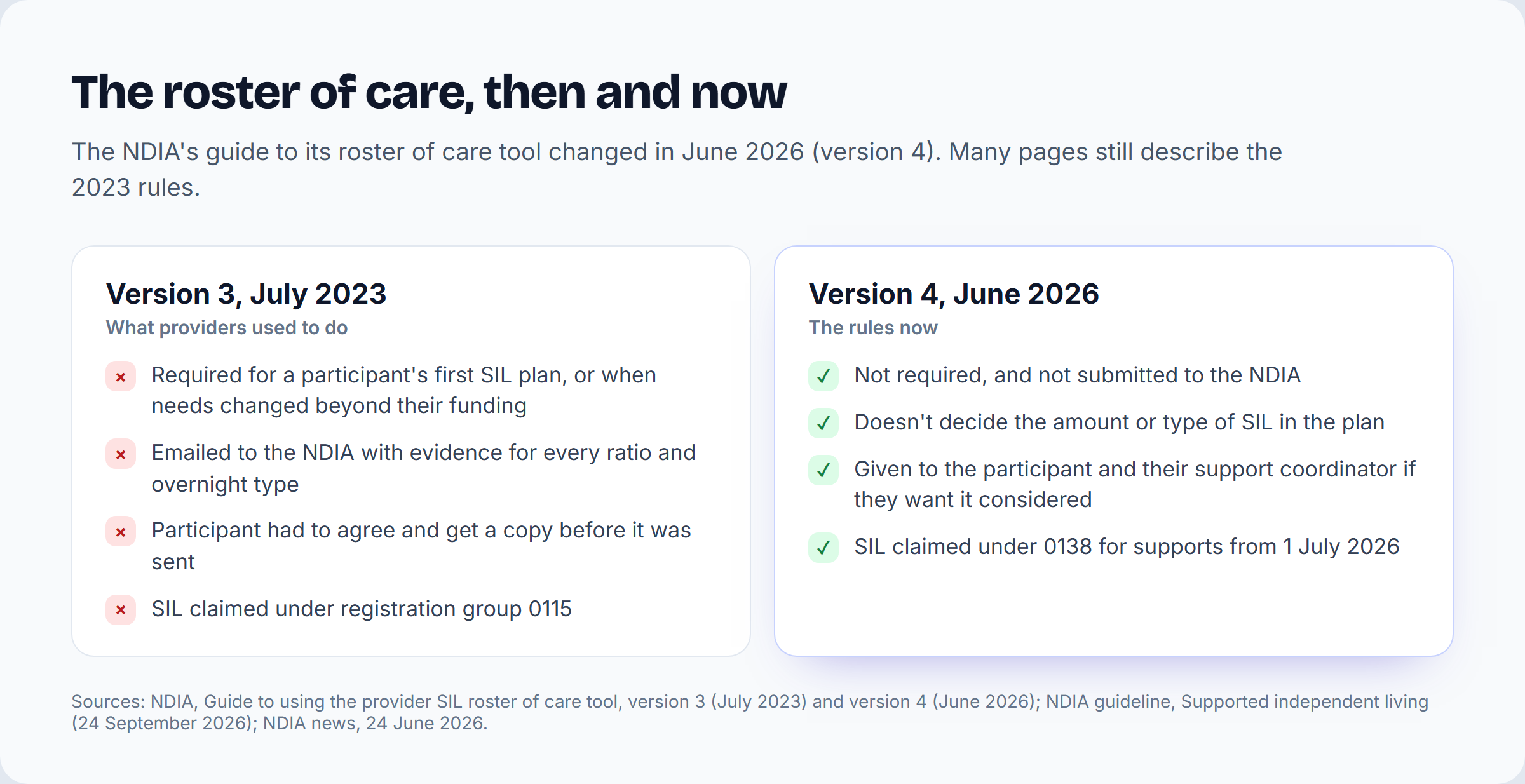
- Not required, not submitted. The tool guide (version 4) says "the roster of care is no longer a requirement. You do not need to submit this template." The NDIA's Guide to providing SIL says the same and calls the roster "a tool to help you and your participants know what supports are in the home each week".
- Doesn't decide funding. The SIL guideline says a roster of care "doesn't decide the amount or type of NDIS supports you will get in your plan". The NDIA may still read one alongside other evidence.
- New support items. From 1 July 2026 SIL is claimed under registration group 0138, Assistance with Supported Independent Living. Group 0115 is only for supports delivered before that date. The 2026-27 prices are the same under both.
- Registration. SIL providers must be registered with the NDIS Commission and meet the SIL Practice Standards. Providers that were not registered had to apply by 1 October 2026 to keep delivering SIL.
- Plan reassessments. Since 27 August 2026 only the participant, their plan nominee or child representative can ask for a plan reassessment, using a form and recent evidence. A provider cannot ask on a participant's behalf. The NDIA has 90 days to decide.
The NDIA's Excel tool was not withdrawn. Version 4.0 is dated 24 June 2026 and carries the 2026-27 prices and 0138 item numbers, so it is still the format the NDIA recognises if a participant chooses to share a roster.
Why providers still build a roster of care
An optional document can still be the most useful one in the house. Providers use a roster of care to:
- Staff the house. It turns each resident's needs into shifts, ratios and an overnight plan, which becomes the staff roster.
- Check the funding. Priced at the limits, it shows whether each resident's SIL budget covers the week you plan to deliver, before you deliver it.
- Claim weekly. Weekly SIL claiming needs an agreed typical schedule of supports in the service agreement. A roster of care is the natural source for it.
- Support the participant's request. When a participant asks for more SIL or a reassessment, a clear roster from the provider helps their support coordinator explain the week the evidence describes.
- Answer the participant. They can ask for it at any time, and the SIL Practice Standards expect support to be planned and agreed with them.
The building blocks of a roster of care
Hours of support in an ordinary week
Start with the hours each resident needs support at home in a typical week, and leave out the regular time they are not home: work, study, a day program, community participation funded elsewhere, or time with family. The NDIA's tool marks community participation as CP and supported employment as ADE so the gaps are explained.
SIL is for people who need active support for more than 8 hours a day and some level of support the rest of the time, around the clock. If a resident needs only a few hours a day, the NDIA is likely to fund other supports instead.
Ratios: how shared support is divided
A ratio is workers to residents. 1:3 is one worker supporting three residents; 2:4 is two workers supporting four. Under the Pricing Schedule, the amount claimed from each participant for a shared support is the maximum amount divided by the number of people sharing it. With more than one worker, each resident's share of a worker is workers divided by residents.
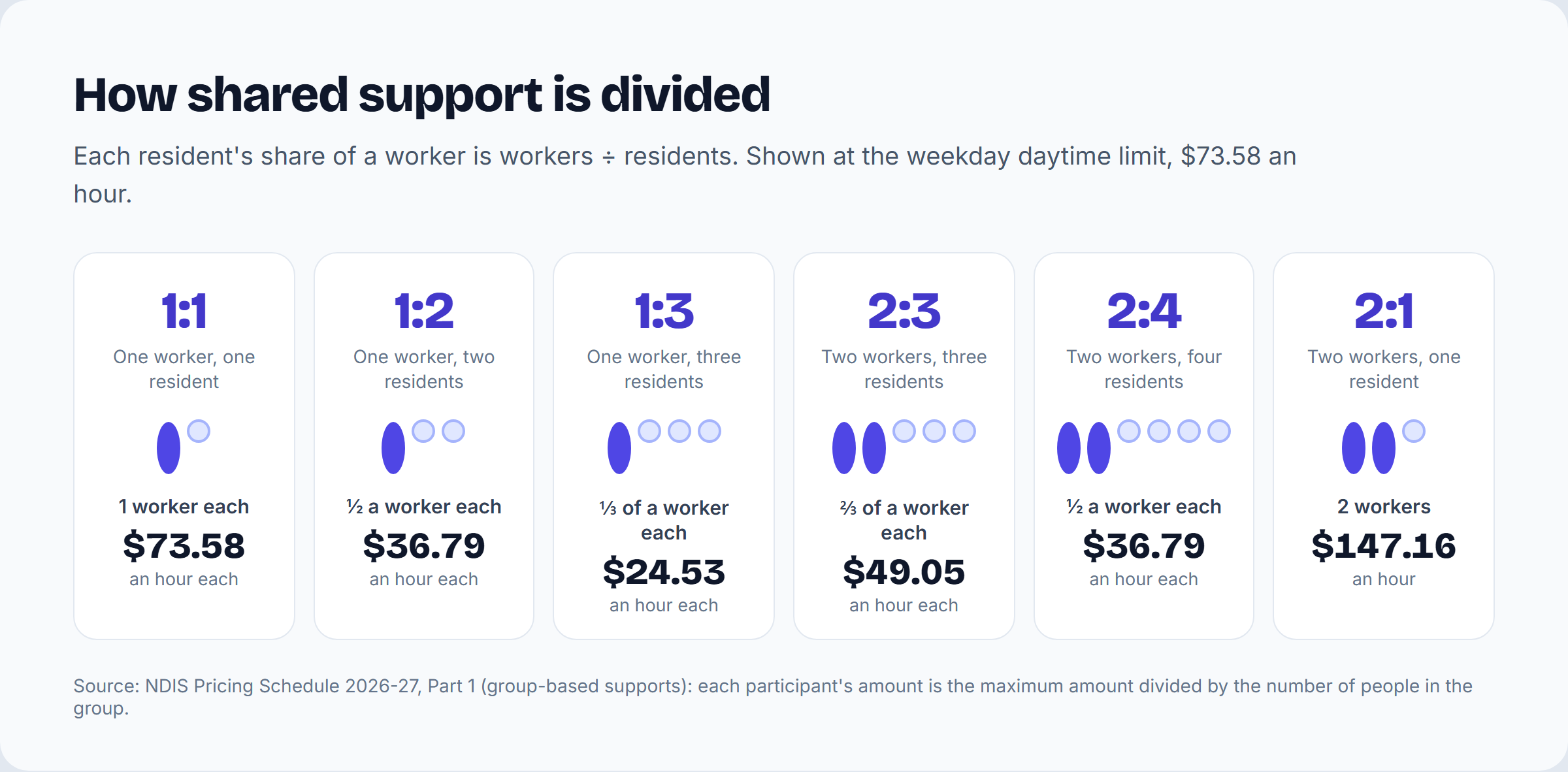
Most SIL residents share support for most of the week, with some 1:1 time for things only they need. The NDIA funds individual (1:1 or more) SIL around the clock only in limited cases, such as life-threatening health needs that need constant monitoring, frequent behaviours of concern that put people at risk, or a condition that is changing fast. If one resident has 1:1 hours while the others are out, enter those hours as that resident's own line.
Standard or high intensity
Most residents are standard intensity. High intensity applies when support needs a worker with one or more of the high intensity support skills in the NDIS Practice Standards, such as complex bowel care or enteral feeding, or frequent support for behaviours that need intensive positive behaviour support. High intensity has its own, higher limit in every time band. In a roster of care, each resident is priced at their own level, even when they share a worker with residents at the other level.
Overnight: sleepover or active overnight
The NDIA decides the overnight type from how much awake support a resident needs at night. A sleepover covers up to 2 hours of awake support. If more is needed now and again, the extra hours can be claimed, with the participant's agreement, at the Saturday rate on weeknights and at the day's own rate on weekends and public holidays. If a resident regularly needs more than 2 hours awake support at night, the NDIA funds active overnight support.
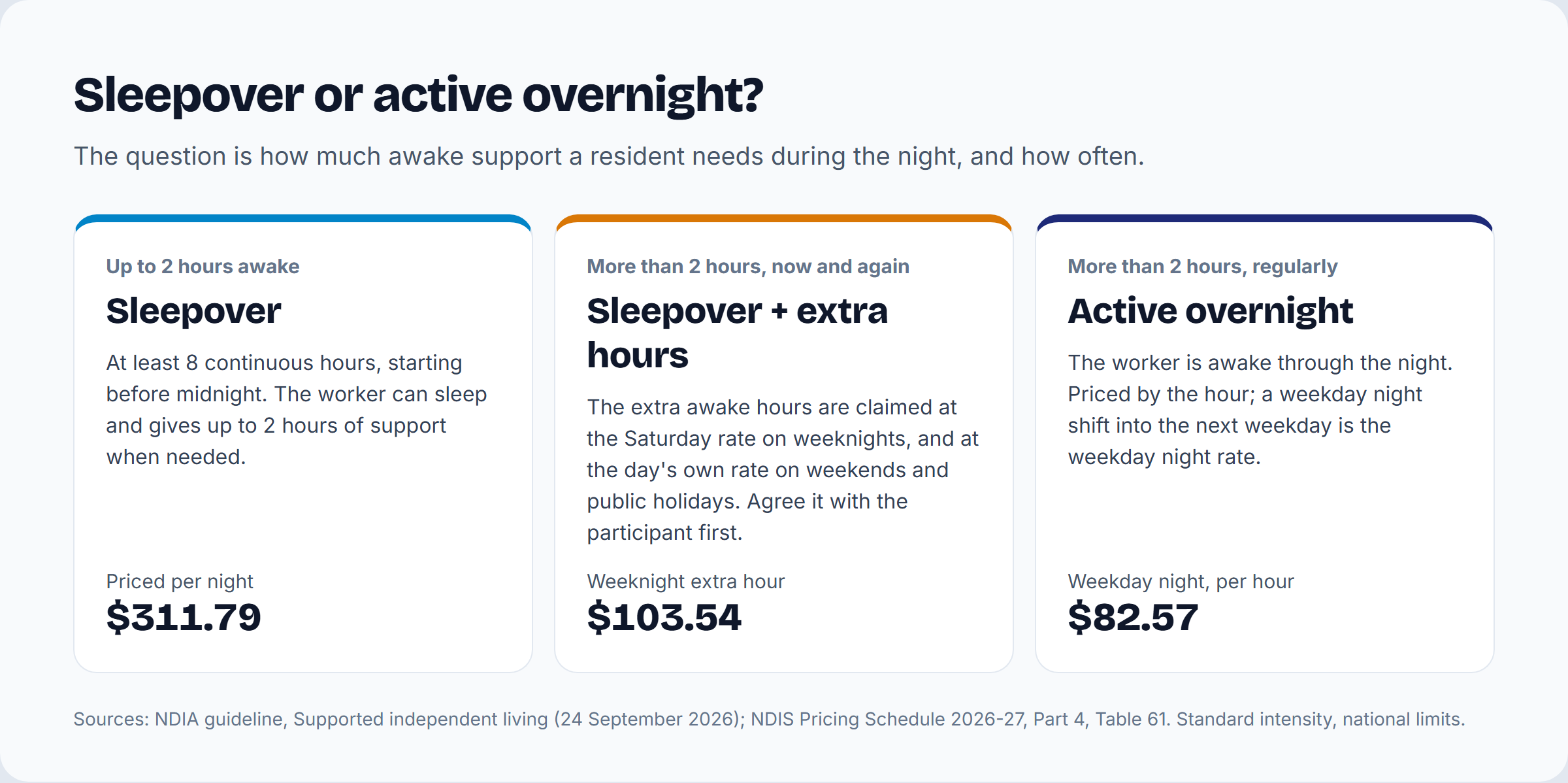
A night-time sleepover under the Pricing Schedule starts before midnight, finishes after it, runs for at least 8 continuous hours, and lets the worker sleep when not supporting anyone. It is priced per night, not per hour. Our Sleepover or Active Night tool walks through the decision under both the NDIS and the SCHADS Award.
Public holidays
SIL funding includes an average of 12 public holidays a year. The NDIA's tool asks for up to 12 and counts each as a 24-hour day; most residents need about the same support on a public holiday as on a Sunday. If you claim SIL weekly, there is no separate public holiday claim: the weekly amount already includes an annualised uplift.
Irregular support
Irregular support covers unplanned days that disrupt the usual week, such as a resident being unwell or a day program being cancelled. The NDIA generally funds up to 10 irregular support days a year for standard intensity and 15 for high intensity; its tool counts each as a 16-hour day. Irregular SIL can only be claimed when the service agreement allows it, the participant agrees, and the support was not part of the regular week. On the myplace portal, claim it against the relevant item with the irregular SIL support option.
SIL time bands and 2026-27 price limits
Every hour of a roster of care is priced at the SIL item for its time band. The bands come from Part 4 of the Pricing Schedule 2026-27: weekday daytime runs from 6 am to 8 pm, weekday evening from 8 pm to midnight, and weekday night covers support that starts before 6 am or runs past midnight into another weekday. Saturdays, Sundays and public holidays each have one rate for the whole day.
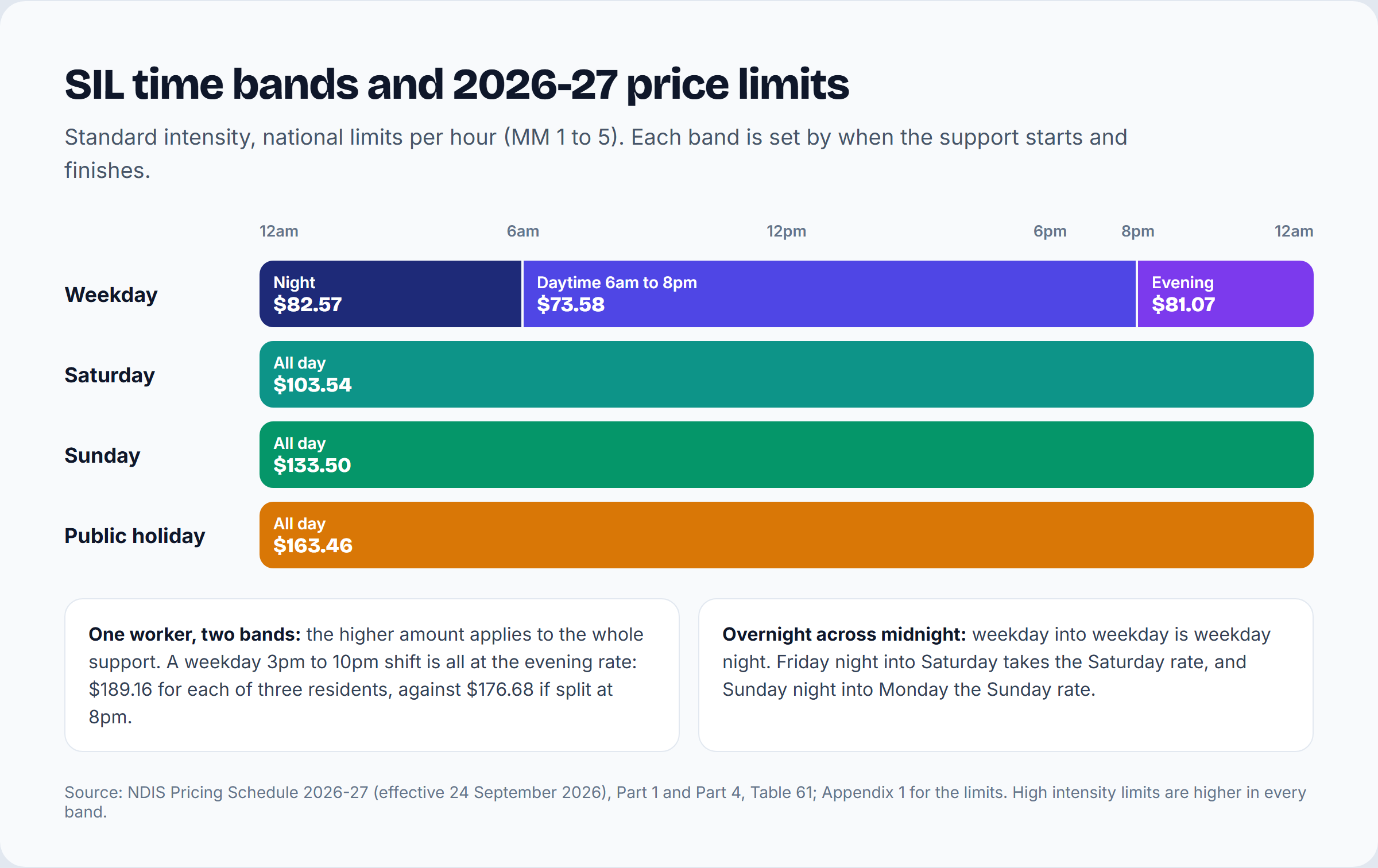
One rule changes how a roster should be priced. Part 1 of the Pricing Schedule says that where a support crosses times of day or days of the week and is delivered by a single worker, "the higher of the amounts applies to the whole support". So a weekday shift from 3 pm to 10 pm, worked by one person, is all at the evening rate. The NDIA's tool treats this crossover afternoon shift the same way. Split it at 8 pm and each of three residents is charged $176.68 instead of $189.16 for that shift, about $187 a week less across the house. A Friday night active shift into Saturday takes the Saturday rate, and a Sunday night shift into Monday takes the Sunday rate. If a different worker takes over at 8 pm, that is two supports, each priced on its own.
| Support (registration group 0138) | Item | National | Remote (MM 6) | Very remote (MM 7) |
|---|---|---|---|---|
| Standard, weekday daytime | 01_801_0138_1_1 | $73.58 | $103.01 | $110.37 |
| Standard, weekday evening | 01_802_0138_1_1 | $81.07 | $113.50 | $121.61 |
| Standard, weekday night | 01_803_0138_1_1 | $82.57 | $115.60 | $123.86 |
| Standard, Saturday | 01_804_0138_1_1 | $103.54 | $144.96 | $155.31 |
| Standard, Sunday | 01_805_0138_1_1 | $133.50 | $186.90 | $200.25 |
| Standard, public holiday | 01_806_0138_1_1 | $163.46 | $228.84 | $245.19 |
| High intensity, weekday daytime | 01_811_0138_1_1 | $79.60 | $111.44 | $119.40 |
| High intensity, weekday evening | 01_812_0138_1_1 | $87.70 | $122.78 | $131.55 |
| High intensity, weekday night | 01_813_0138_1_1 | $89.32 | $125.05 | $133.98 |
| High intensity, Saturday | 01_814_0138_1_1 | $112.01 | $156.81 | $168.02 |
| High intensity, Sunday | 01_815_0138_1_1 | $144.42 | $202.19 | $216.63 |
| High intensity, public holiday | 01_816_0138_1_1 | $176.84 | $247.58 | $265.26 |
| Night-time sleepover (per night) | 01_832_0138_1_1 | $311.79 | $436.51 | $467.69 |
These are maximums per hour (per night for a sleepover), and they bind NDIA-managed and plan-managed funding. You can agree lower prices. The region depends on where the support is delivered, using the Modified Monash Model: MM 1 to 5 is national, MM 6 remote and MM 7 very remote. The 0115 items with the same numbers carry the same prices for supports delivered before 1 July 2026. Weekly SIL is claimed with 01_821_0138_1_1, which has no price limit of its own: its amount is the participant's total regular SIL funding divided by the weeks in their plan.
How to fill in the NDIA's roster of care tool
The NDIA's SIL roster of care tool is an Excel workbook with a cover sheet, four steps and a sheet for each of up to 10 residents. Its guide (version 4) walks through each field; here is the short version.
- Overall information (step 1.1). Your provider name, ABN and registration number; the property address, state and postcode; and the most support workers on site at once. The tool sets the region from the postcode, but its own notes say the postcode list has not been updated since 2020, so check the MMM classification yourself and use the override if needed.
- Residents (step 1.2). One row for every resident, including anyone who is not an NDIS participant (enter them as "Non-NDIS A" and so on, to keep their privacy), so the staffing makes sense. For each NDIS participant enter their NDIS number, needs level and price level. The needs level and the price level are different fields: price level is standard or higher intensity.
- Your rates (step 1.3, optional). Enter your own hourly rates if they are below the limits. The tool will not accept rates above the price limits.
- Ratios (step 2.1). 1:1 and 2:1 are fixed. Choose up to 19 more from the list (staff to participants). A green tick means no ratio appears twice.
- The week (step 2.2). For each resident and day, choose a ratio for every half-hour block they receive SIL. Mark funded community participation as CP and supported employment as ADE; leave family and informal time blank.
- Crossover and overnight shifts (step 2.3). Say whether the afternoon shift starts before 8 pm and give its average start and finish times. Then choose Active overnight or Sleepover for each night, with the sleep start and finish times.
- Checks, staffing and notes (steps 2.4 to 2.6). Fix any check messages (see the table below), confirm the staff count is a whole number in every half hour, and add notes that explain the week: regular family time, appointments, transport, work or programs, handovers, and why you expect irregular support.
- Each resident's summary (step 3). Review the hours by shift type and ratio, adjust them with a written reason if the grid could not capture something, then enter public holidays (up to 12) and irregular support days. The sheet shows a weekly and yearly SIL estimate (52 weeks) and a separate irregular support amount.
| Check message in the tool | What to do |
|---|---|
| There are duplicate ratios in the legend | Change the repeated ratio so every ratio in the legend is unique. |
| Information provided is incomplete | Fill in the orange cells: the overnight support or the afternoon and evening shift details for that resident. |
| Start or finish time has not been completed | Choose the sleep start and finish, or the average shift start and finish, from the lists. |
| No overnight support: crossover shift should finish no later than 12am | Finish the crossover shift by midnight, or add the overnight support. |
Step 3 also limits the hours in each shift type per week: 70 hours Monday to Friday between 6 am and 8 pm, 20 hours between 8 pm and midnight (not counting crossover shifts), 24 hours each on Saturday and Sunday, 7 sleepover nights, and 168 hours in total.
A worked example: a three-person house
Here is a typical shared house, priced at the 2026-27 standard, national limits. It is the example our calculator opens with, so you can change any part of it and see the effect.
| Shift | Days | Time | Workers : residents | Priced at |
|---|---|---|---|---|
| Morning routine | Mon–Fri | 7 am to 9 am | 1:3 (A, B, C) | Weekday daytime |
| Work and day program | Mon–Fri | 9 am to 3 pm | A and B away | Not SIL |
| Day at home | Mon–Fri | 9 am to 3 pm | 1:1 (C) | Weekday daytime |
| Weekend day | Sat, Sun | 7 am to 3 pm | 1:3 | Saturday or Sunday |
| Afternoon and evening | Every day | 3 pm to 10 pm | 1:3 | Weekday evening for the whole shift on weekdays |
| Sleepover | Every night | 10 pm to 7 am | 1:3 | Sleepover, per night |
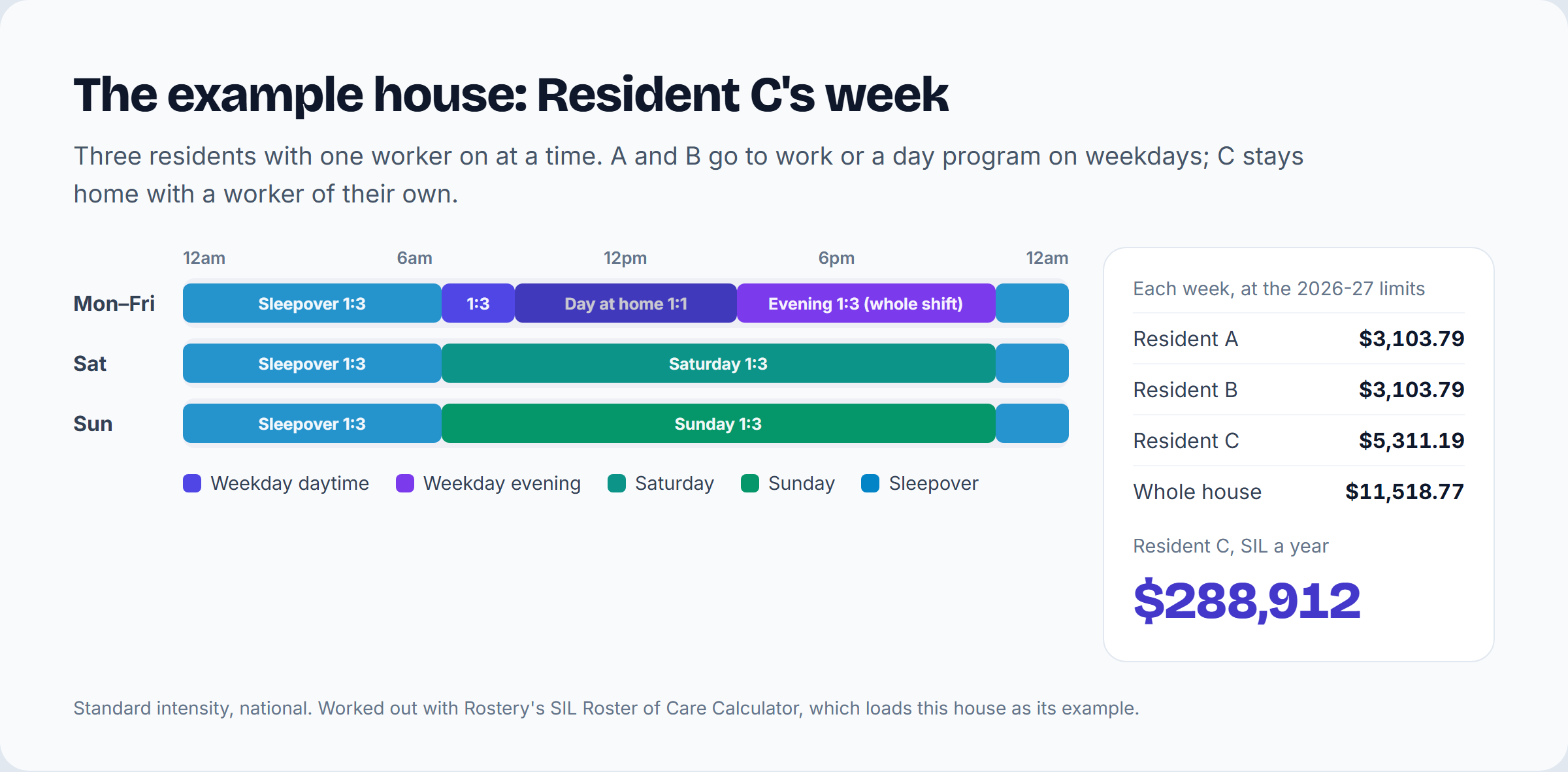
Resident A's week is 10 hours of weekday daytime and 35 hours of weekday evening at 1:3, 15 hours each of Saturday and Sunday at 1:3, and a third of seven sleepovers:
| Resident A | Resident B | Resident C | Whole house | |
|---|---|---|---|---|
| Per week | $3,103.79 | $3,103.79 | $5,311.19 | $11,518.77 |
| 52 weeks | $161,397.25 | $161,397.25 | $276,182.05 | $598,976.55 |
| Public holiday uplift (12 days) | $8,101.12 | $8,101.12 | $12,730.33 | $28,932.57 |
| SIL a year | $169,498.37 | $169,498.37 | $288,912.38 | $627,909.12 |
| Irregular support (10 days) | $12,372.00 | $12,372.00 | $12,372.00 | $37,116.00 |
Resident C costs more because of the 30 hours a week they spend at home with a worker of their own while the others are out. The house as a whole costs exactly what one person would cost with one worker on the same hours, because there is only ever one worker on duty: sharing is what divides that cost between three people.
The public holiday and irregular figures follow the method in the NDIA's tool. Each public holiday adds 24 hours at the public holiday rate less the average of the weekday daytime, evening and night rates, at the resident's average share of a worker. Each irregular day is 16 hours at 1:1, half at the daytime rate and half at the evening rate.
Some changes and what they do to the week:
- Resident C at high intensity: C's week rises to $5,686.16. A and B don't change, because each resident is priced at their own level.
- Active overnights instead of sleepovers: each resident's share of the nights goes from $727.51 to $2,102.46 a week, and the house from $11,518.77 to $15,643.62. That is why the overnight type matters so much.
- A remote house (MM 6): every limit is 1.4 times the national one, so Resident A's week is $4,345.36.
- Resident B moves out: the NDIA does not fund vacancies, and A's and C's prices must not go up to cover the empty room. Plan for vacancies in the service agreement, as the SIL Practice Standards require.
You can download this example as an Excel roster of care. Its rates, amounts and totals are live formulas, so change any hours, shares or the region and it recalculates. The calculator builds the same workbook for your own house.
From roster of care to staff roster
The roster of care says what support each resident needs. The staff roster says who delivers it. When you turn one into the other:
- keep the shift boundaries you priced: if the afternoon shift is priced as one crossover shift, roster one worker for it;
- make sure the number of workers on each shift matches the ratios, and that the sleepover worker's shift is at least 8 hours and starts before midnight;
- remember that SCHADS Award costs differ from the NDIS bands: sleepover allowances, minimum engagements, broken shifts and overtime all change what a shift costs you;
- build in handovers, and price them by dividing the time between the residents at the relevant ratio, as the NDIA's tool guide suggests.
Our free SIL and 24/7 house roster template and staff ratio planner help with this step, and the roster cost estimator compares a shift's SCHADS cost with what the NDIS pays for it.
Keeping the roster, claims and funding in step
Regular SIL is claimed either weekly or hourly, never both. Weekly claiming needs an agreed typical schedule of supports and an agreement to claim weekly in the service agreement. The weekly amount is the total regular SIL funding divided by the number of weeks in the plan, with no adjustment for weekends or public holidays. Hourly claiming prices each shift at its own band, which is exactly what a roster of care calculates.
The week will drift. Minor changes that fit within the funding don't need the NDIA: agree them with the participant, and you can write a new schedule to describe them. A significant change in support needs is a matter for a plan reassessment, which only the participant or their nominee can request, with evidence that is usually less than four months old. From December 2026, NDIS claims must be made within 90 days of the support.
In Rostery, a SIL house's roster of care becomes recurring shifts with their ratios and overnight type. Each resident's share of every shift is priced at the right 0138 item for its band, weekly SIL claims run from the funding line, and the funding is checked before a shift is confirmed. If you are comparing systems, see our guide to the best NDIS rostering software.
Common roster of care mistakes
- Sending the roster to the NDIA and waiting for an approval that no longer comes.
- Using 0115 item numbers for supports delivered from 1 July 2026.
- Splitting a single worker's crossover shift into two bands, which under-prices it.
- Rostering a sleepover for someone who regularly needs more than 2 hours awake support at night.
- Dividing shared support by the number of bedrooms instead of the residents being supported.
- Raising residents' prices to cover a vacancy.
- Leaving out time residents spend away, so the week adds up to more than 168 hours.
- Pricing at the 2025-26 limits, such as $70.23 an hour for standard weekday daytime, instead of the 2026-27 limit of $73.58.
- Charging high intensity rates for a resident whose support doesn't need high intensity skills.
- Leaving non-NDIS residents out of the ratios, which makes the staffing look wrong.
Roster of care checklist
- Built with the participant or their nominee, and they have a copy.
- Every resident in the house is listed, NDIS or not.
- Each resident's week adds up to 168 hours: support, sleepover, or time away.
- Ratios match the evidence of each resident's needs and the staff you will roster.
- Standard or high intensity is right for each resident.
- Overnight type is sleepover only where up to 2 hours of awake support is needed.
- Crossover shifts are priced at the higher band; handovers are explained.
- Public holidays (up to 12) and irregular days (10 or 15) are included.
- Prices are the 2026-27 limits or lower, with 0138 item numbers.
- The total fits each resident's SIL funding, and the service agreement covers the claiming method, irregular SIL and vacancies.
Free tools for SIL providers
- SIL Roster of Care Calculator: build the week shift by shift, price every resident, and download Excel.
- Sleepover or Active Night?: the overnight decision under the NDIS and SCHADS rules.
- Free roster templates: weekly, SIL and 24/7 house rosters to print or download.
- NDIS Price Guide 2026-27: every support item, with remote and very remote limits.
- NDIS public holidays 2026-27: the days that attract the public holiday rate in each state.
Frequently asked questions
What is a roster of care in the NDIS?
It is a plan of a typical week of supported independent living for a participant: the hours of support at home, the ratio of support, standard or high intensity, the overnight type and the irregular support they may need. The SIL provider prepares it with the participant.
Is a roster of care still required in 2026?
No. The NDIA's guide to its roster of care tool (version 4, June 2026) says it is no longer a requirement and you do not need to submit it.
Do I submit the roster of care to the NDIA?
No. If the participant would like planning to consider it, give it to them and their support coordinator to include with their home and living request or plan reassessment.
Does the roster of care decide how much SIL funding a participant gets?
No. The NDIA decides SIL funding from evidence of the participant's needs, using the Pricing Schedule. The roster describes the supports the participant can get from their provider.
Where do I download the NDIA roster of care tool?
From the NDIA's Guide to providing SIL page, as the SIL roster of care tool (an Excel file), with the guide to using it. The current version is 4.0, June 2026.
How is shared SIL support divided between residents?
Each resident pays their share of the worker-hours: the price limit times the hours, times workers divided by residents. One worker for three residents is a third each.
What is the difference between a sleepover and an active overnight?
A sleepover lets the worker sleep and covers up to 2 hours of awake support; it is priced per night, $311.79 nationally in 2026-27. An active overnight keeps the worker awake and is priced by the hour.
How many irregular support days does the NDIA fund?
Generally up to 10 a year at standard intensity and 15 at high intensity. The NDIA's tool pre-fills 10.3 and 15.2 days, counted as 16-hour days.
Which support items do I use from 1 July 2026?
Registration group 0138, for example 01_801_0138_1_1 for standard weekday daytime and 01_832_0138_1_1 for a sleepover. The 0115 items are for supports delivered before 1 July 2026.
Can I change the roster of care without telling the NDIA?
Yes, for minor changes that fit within the funding available. Agree them with the participant. A significant change in support needs may need a plan reassessment, which the participant asks for.
Can I charge a resident more when someone moves out?
No. The NDIA doesn't fund vacancies, and a SIL provider shouldn't increase the cost of SIL or claim extra from a participant's plan to cover one. Your service agreement should say how vacancies are managed. A separate unplanned exit claim of up to 28 days can apply when a resident dies or leaves because of an irretrievable breakdown.
Is there a roster of care template in Excel?
Yes. The NDIA's own tool is an Excel workbook. Our calculator also downloads any roster as an Excel file with working formulas, and you can start from the example house workbook.
Sources
- NDIA: Guide to using the provider SIL roster of care tool, version 4 (June 2026)
- NDIA: SIL roster of care tool, version 4.0 (Excel)
- NDIA guideline: Supported independent living (24 September 2026)
- NDIA: Guide to providing supported independent living
- NDIA: How to claim supported independent living supports
- NDIS Pricing Schedule 2026-27 (effective 24 September 2026)
- NDIA: SIL claims and payment changes from 1 July 2026
- NDIS Commission: Mandatory registration for SIL and the SIL Practice Standards
- NDIA: What is a plan reassessment
- NDIA: How to claim SIL payments after an unplanned exit
- NDIS Pricing Arrangements and Price Limits 2025-26, version 1.1 (claiming rules for irregular SIL and sleepovers)
Checked 15 October 2026. This guide is general information. The NDIA has said it will publish updated claiming guidance for 2026-27, so check the irregular SIL and sleepover claiming rules when it does. For the short definition, see our glossary entry on the roster of care.