Support at Home is the government program that pays for care and practical help at home for older Australians. It replaced Home Care Packages and the Short-Term Restorative Care Programme on 1 November 2025. When you are approved, you are given one of eight classifications, and each classification comes with a budget paid every three months. The more help your assessment says you need, the higher the classification and the bigger the budget.
This guide uses the amounts that took effect on 1 October 2026. It explains what each classification is worth, how yours is decided, what the money pays for, what you contribute, and what happens to money you don't spend. It is written for older people and their families, and for the providers who manage these budgets with them.
Support at Home funding levels at a glance
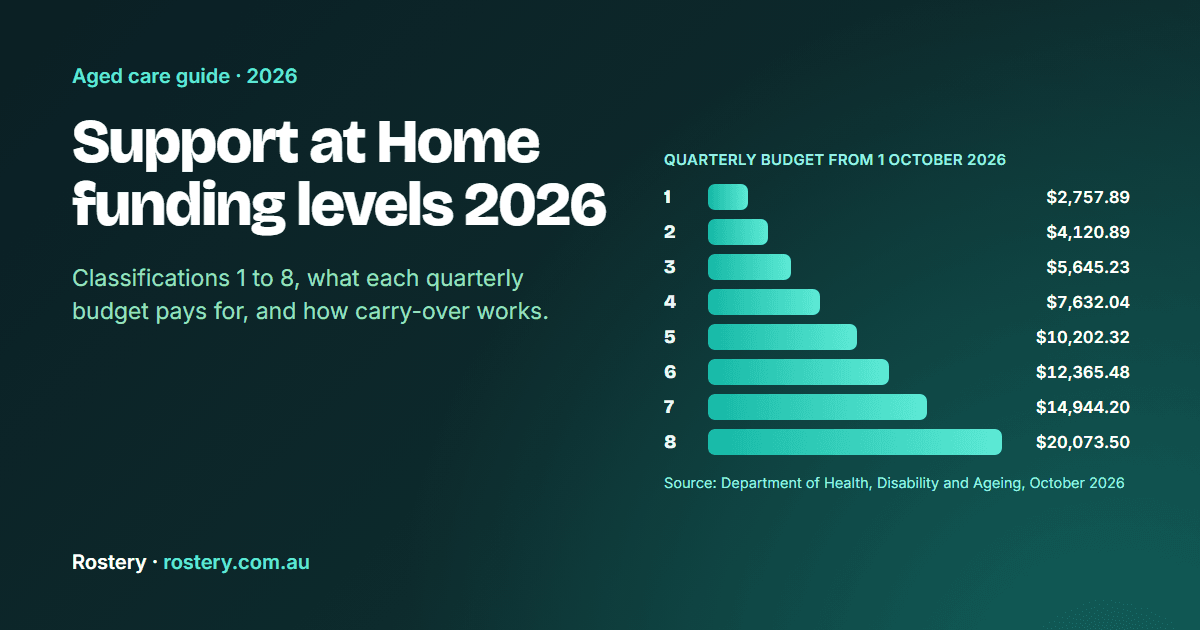
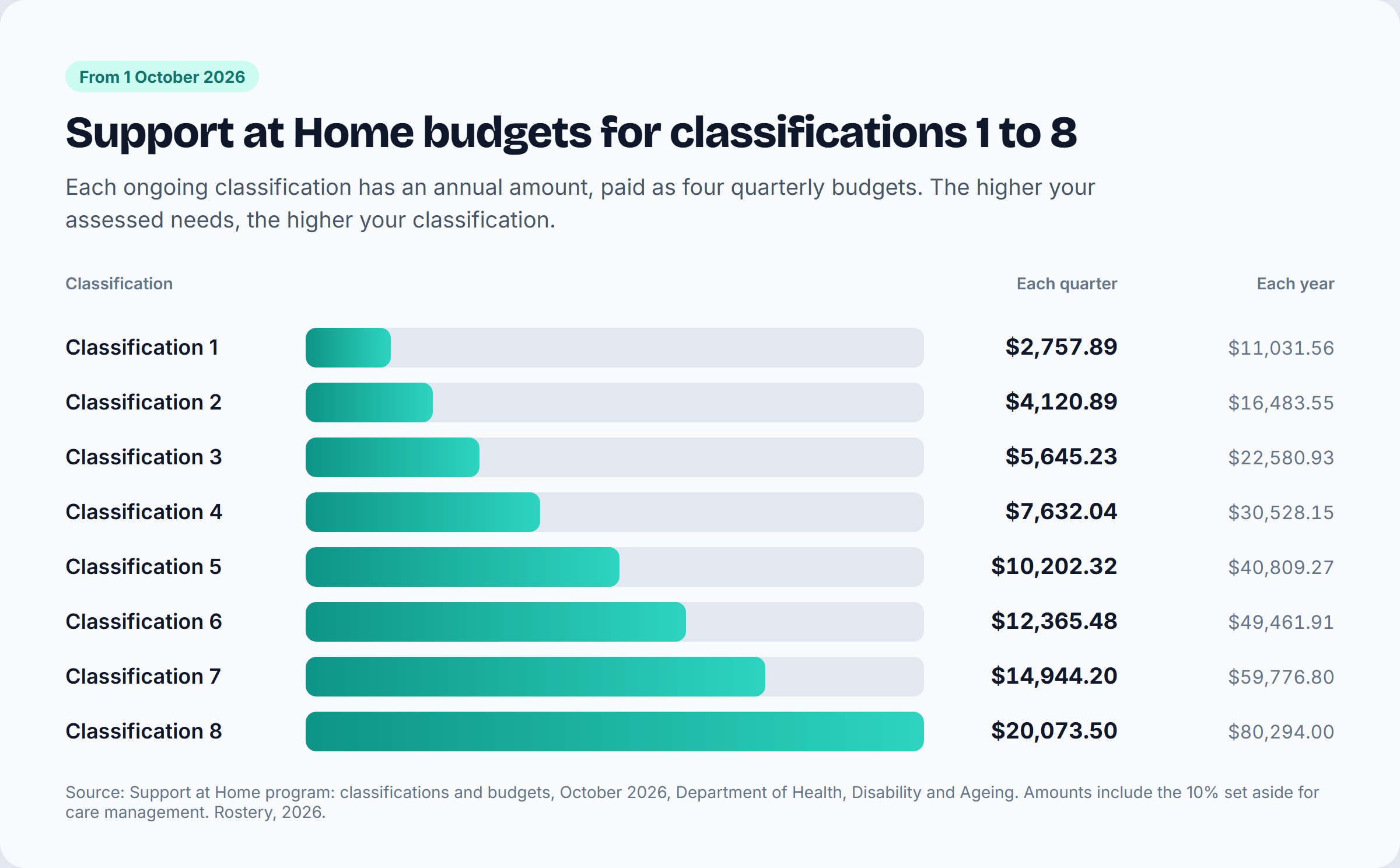
Classification 1 is about $212 a week. Classification 8 is about $1,544 a week. Each step up adds between about $1,360 and $5,130 a quarter.
| Classification | Quarterly budget | Annual amount | About per week |
|---|---|---|---|
| Classification 1 | $2,757.89 | $11,031.56 | $212 |
| Classification 2 | $4,120.89 | $16,483.55 | $317 |
| Classification 3 | $5,645.23 | $22,580.93 | $434 |
| Classification 4 | $7,632.04 | $30,528.15 | $587 |
| Classification 5 | $10,202.32 | $40,809.27 | $785 |
| Classification 6 | $12,365.48 | $49,461.91 | $951 |
| Classification 7 | $14,944.20 | $59,776.80 | $1,150 |
| Classification 8 | $20,073.50 | $80,294.00 | $1,544 |
Amounts from 1 October 2026, from the Department of Health, Disability and Ageing. The weekly figure is the annual amount divided by 52 and rounded. Every amount includes the 10% that is set aside for care management, which is explained further down.
Alongside the eight ongoing classifications there are three short-term ones: the Restorative Care Pathway, the End-of-Life Pathway, and the Assistive Technology and Home Modifications (AT-HM) scheme. They pay for a specific need on top of your quarterly budget, and they have their own section below.
The department does not publish a list of services that each classification buys. Your classification reflects how much help your assessment found you need, and your support plan lists the services you are approved for. How far the budget goes then depends on which services you choose and what your provider charges for them.
How your classification is decided
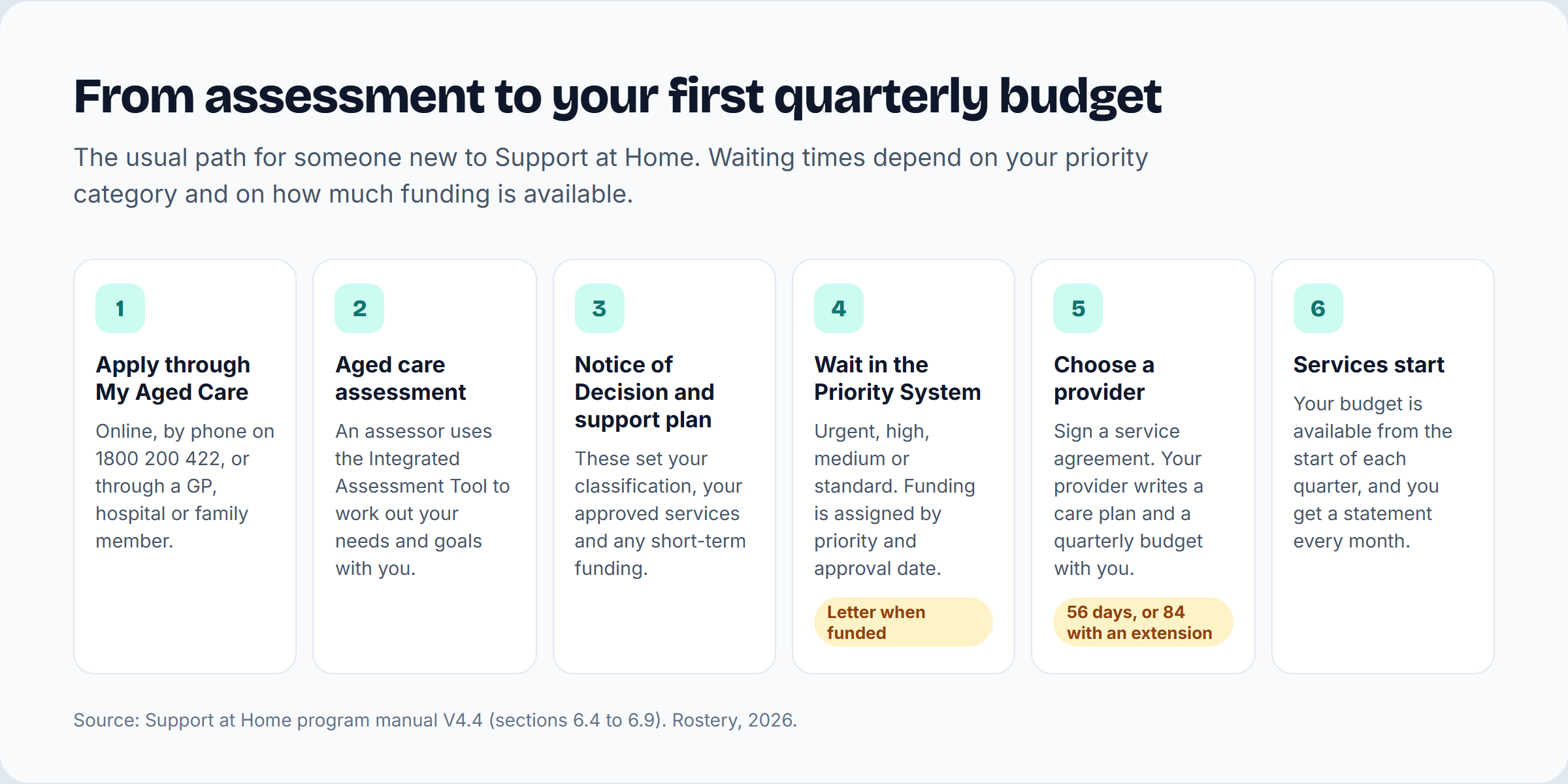
Everything starts with an aged care assessment, which you can arrange through My Aged Care online, by phone on 1800 200 422, or through a referral from your GP, a health professional or a hospital. An aged care needs assessor meets you and uses the Integrated Assessment Tool to look at your health, how you manage day to day, your goals and the support you already have. You work out your goals and the kinds of services that would help with the assessor.
The assessor sends their findings to an Assessment Delegate, who makes the decision. You then receive two documents:
- The Notice of Decision, called "Outcome of your application for government-funded aged care services". It states your classification, any AT-HM funding tier, any short-term pathway, the reasons for the decision and your right to ask for a review.
- Your support plan, which lists the services you are approved to receive from the Support at Home service list, your goals, your priority category and a date for a Support Plan Review.
Share both with your provider. Providers can also see them in the My Aged Care Service and Support Portal, and you can see them in your My Aged Care online account.
Your classification is not fixed for life. If your needs, goals or circumstances change, you or your provider (with your consent) can ask for a Support Plan Review through My Aged Care. The review may change nothing, update your support plan, or lead to a new assessment and a higher classification. If you move up part way through a quarter, your quarterly budget is adjusted from the date the new classification takes effect.
When your funding starts
Being approved and being funded are two separate steps. After approval you join the Support at Home Priority System in one of four categories: urgent, high, medium or standard. The assessor sets the category using standard criteria, and funding is assigned by priority and by the date you were approved. You receive a letter from the department when funding is assigned to you.
When demand is higher than expected, you may first receive interim funding, which is 60% of your classification. The letters call it the minimum service offer. You can start services with it, and the other 40% follows when funding becomes available. That second part is not backdated: it applies from the date it is allocated. People in the urgent category, and people approved for the Restorative Care Pathway or the End-of-Life Pathway, always receive full funding straight away.
Once funding is assigned you have 56 days to choose a provider, sign a service agreement and start services. If you need longer, My Aged Care can give you a 28-day extension, for 84 days in total.
How a quarterly budget works
Your annual amount is split into four quarterly budgets that follow the financial year: July to September, October to December, January to March and April to June. The whole quarterly budget is available from the first day of each quarter, so you can use more help early in a quarter if you need it.
You never handle the money. Services Australia holds your budget in an account on your behalf. Your provider delivers services, then claims for them afterwards, and each claim is paid from that account.
Two details change the exact amount you see:
- If you start part way through a quarter, your first budget is worked out pro rata from your entry date to the end of that quarter.
- The quarterly figures in the table are the annual amount divided by four, and the program manual says quarterly budgets depend on the number of days in the quarter. Worked out by days, Classification 4 comes to about $7,694.77 for October to December 2026 (92 days) and about $7,527.49 for January to March 2027 (90 days).
The amounts are indexed every July. In 2026 they also moved slightly on 1 October, so check that your provider is using the current figures.
Care management comes out first
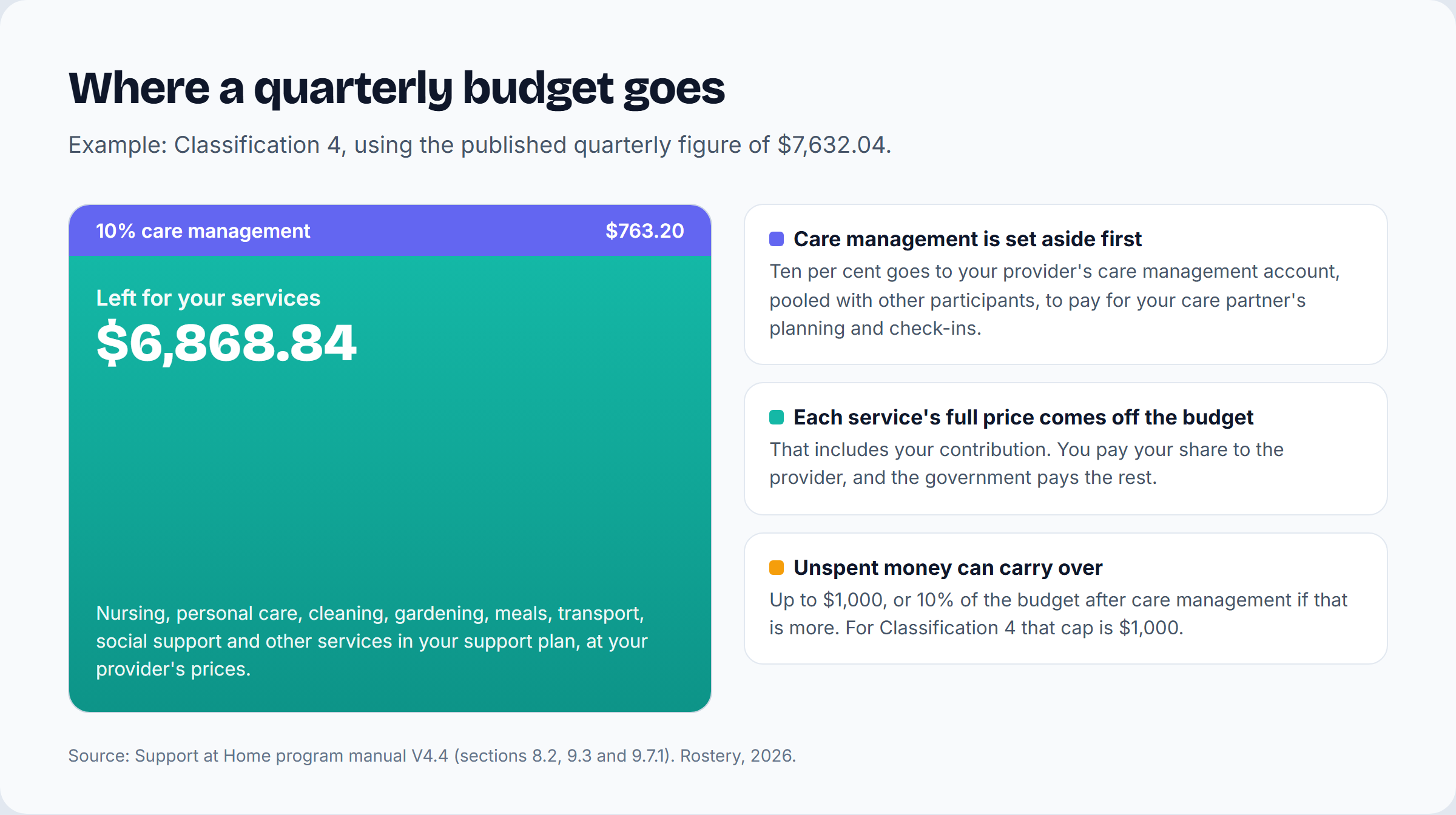
Before your quarterly budget is spent on services, 10% is taken out for care management. Services Australia pools that 10% with the same share from your provider's other participants in a care management account for each of the provider's service delivery branches. The provider uses that pool to pay for care management for all of those participants, so someone who needs more of it in a given month can have it.
Care management is the work your care partner does with you: setting up and reviewing your care plan and budget, arranging and checking your services, keeping in touch, and helping you connect with health services or request a Support Plan Review. Your provider must deliver a direct care management activity of at least 15 minutes every month. Scheduling, staff training, compliance, record-keeping and HR cannot be claimed as care management.
| Classification | Quarterly budget | 10% for care management | Left for services |
|---|---|---|---|
| 1 | $2,757.89 | $275.79 | $2,482.10 |
| 2 | $4,120.89 | $412.09 | $3,708.80 |
| 3 | $5,645.23 | $564.52 | $5,080.71 |
| 4 | $7,632.04 | $763.20 | $6,868.84 |
| 5 | $10,202.32 | $1,020.23 | $9,182.09 |
| 6 | $12,365.48 | $1,236.55 | $11,128.93 |
| 7 | $14,944.20 | $1,494.42 | $13,449.78 |
| 8 | $20,073.50 | $2,007.35 | $18,066.15 |
Some people bring extra care management with them. Providers receive a care management supplement of 12 extra hours a year (credited at $120 an hour) for participants who are Aboriginal or Torres Strait Islander, homeless or at risk of homelessness, care leavers, veterans approved for the Veterans' Supplement, or referred through the care finder program. Services Australia identifies who qualifies from the assessment.
What the budget pays for
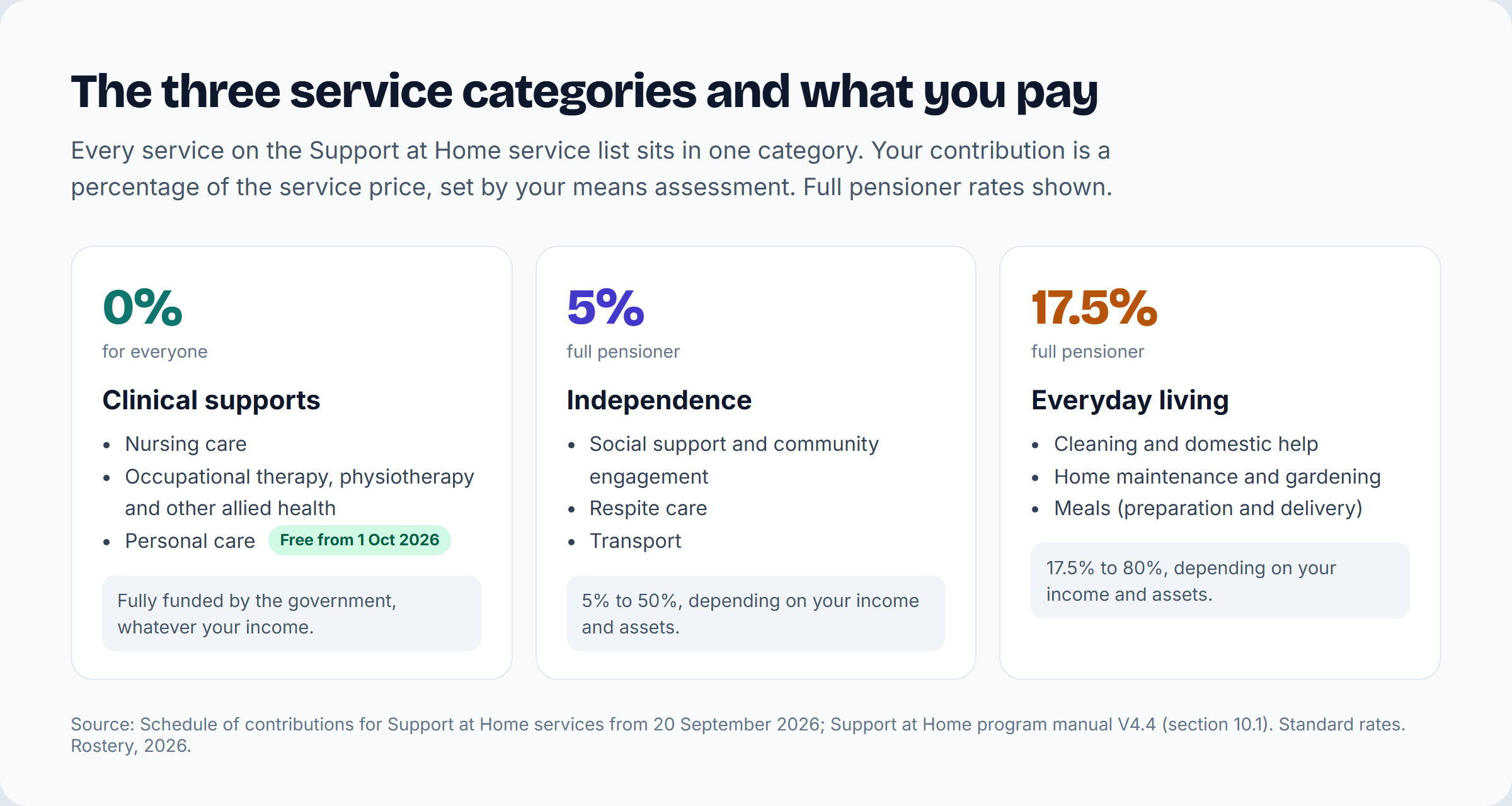
The budget pays for services on the Support at Home service list that are in your support plan. The list has three categories, and the category decides what you contribute:
| Category | Examples | Your contribution (standard rates) |
|---|---|---|
| Clinical supports | Nursing care, occupational therapy, physiotherapy and other allied health. Personal care from 1 October 2026. | 0% for everyone |
| Independence | Social support and community engagement, respite care, transport | 5% (full pensioner) to 50% (self-funded retiree) |
| Everyday living | Cleaning and domestic assistance, home maintenance and repairs, gardening, meals | 17.5% (full pensioner) to 80% (self-funded retiree) |
Personal care, such as help with showering, dressing and continence, moved from independence to clinical supports on 1 October 2026. If personal care is in your support plan and you have funding available, you now pay nothing towards it. You don't need a new assessment for this to apply.
Each provider sets its own prices and must agree them with you. When a service is claimed, Services Australia takes the full price of that service from your budget, including your contribution. You pay your share to the provider and the government pays the provider the rest. So your contribution does not make the budget last longer.
Here is how one hour of cleaning works if your provider charges $80 an hour. Cleaning is everyday living, so a full pensioner contributes 17.5%, which is $14. The government pays $66. The whole $80 comes off the quarterly budget. A self-funded retiree on the maximum rate would contribute $64 of the same $80.
The service list also says what is out of scope. With meals, for example, the budget pays for preparing, packaging and delivering meals, but not for the fresh food and raw ingredients. If you are unsure whether something is covered, ask your provider to check it against the service list before you book it.
What you contribute and the lifetime cap
Services Australia works out your contribution rates from an income and assets assessment. If you get a pension, Services Australia usually already has most of what it needs. You don't have to complete the assessment, but if you choose not to, you are asked to pay the maximum rates. Tell Services Australia within 28 days if your financial situation changes.
| Who | Clinical | Independence | Everyday living |
|---|---|---|---|
| Full pensioner | 0% | 5% | 17.5% |
| Part pensioner or Commonwealth Seniors Health Card holder | 0% | 5% to 50% | 17.5% to 80% |
| Self-funded retiree | 0% | 50% | 80% |
These are the standard rates from 20 September 2026. Your home is exempt from the assets test.
Contributions stop once you reach a lifetime cap. From 20 September 2026 the cap is $140,652.80. It is indexed on 20 March and 20 September each year.
A "no worse off" rule protects people who, on 12 September 2024, were receiving a Home Care Package, were on the National Priority System, or had been approved for a package. They pay lower rates (0% for full pensioners, 0% to 25% for part pensioners and card holders, 25% for self-funded retirees) and have a lower lifetime cap of $88,934.57. These rates continue even if they are later reassessed into a higher classification.
To estimate your own contributions, try our Support at Home contribution calculator.
Unspent money and carry-over
If you don't use your whole quarterly budget, some of it carries over to the next quarter. The most you can carry over is $1,000 or 10% of your quarterly budget, whichever is higher. The 10% is worked out after care management has been taken out. Anything above the limit goes back to the government.
| Classification | Left for services each quarter | Most you can carry over |
|---|---|---|
| 1 to 5 | $2,482.10 to $9,182.09 | $1,000 |
| 6 | $11,128.93 | $1,112.89 |
| 7 | $13,449.78 | $1,344.98 |
| 8 | $18,066.15 | $1,806.62 |
An example: Classification 2 has $3,708.80 for services each quarter. Say you spend $2,500, leaving $1,208.80. You can carry over $1,000, because that is more than 10% ($370.88). Next quarter you have $4,708.80 to spend, and the remaining $208.80 is gone.
Services Australia works out the carry-over 61 days after the quarter ends, or the day after your provider submits its last claim for that quarter if that comes first. Carry-over applies only to ongoing classifications. Short-term funding (AT-HM, the Restorative Care Pathway and the End-of-Life Pathway) does not carry over.
The department suggests using carried-over money for needs you didn't plan for, such as extra help while a family carer is away on holiday.
Pausing services, hospital stays and leave
Support at Home has no leave arrangements. If you go into hospital, go into residential respite, travel, or simply stop services for a while, your quarterly budget keeps arriving. The carry-over limit still applies, though, so money above the limit is lost each quarter you don't use it. Your provider should still do care management every month, unless you decline it.
There is also a time limit. If no service is delivered for four full quarters in a row (one year from the end of the quarter in which your last service was delivered), your funding is reduced to zero and given to someone else. To get it back, you contact My Aged Care. The department sends reminders before this happens if no claims are being made.
If you go over budget
Your account with Services Australia cannot go below zero, and Services Australia will not pay a provider for services once your budget has run out. Your provider is responsible for preventing overspending and should review your services with you before it happens. If it does happen, the provider must still claim for everything it delivered and cannot move the claim into the next quarter. The extra cost is either written off by the provider, or paid by you, but only if your service agreement already says you will pay in that situation.
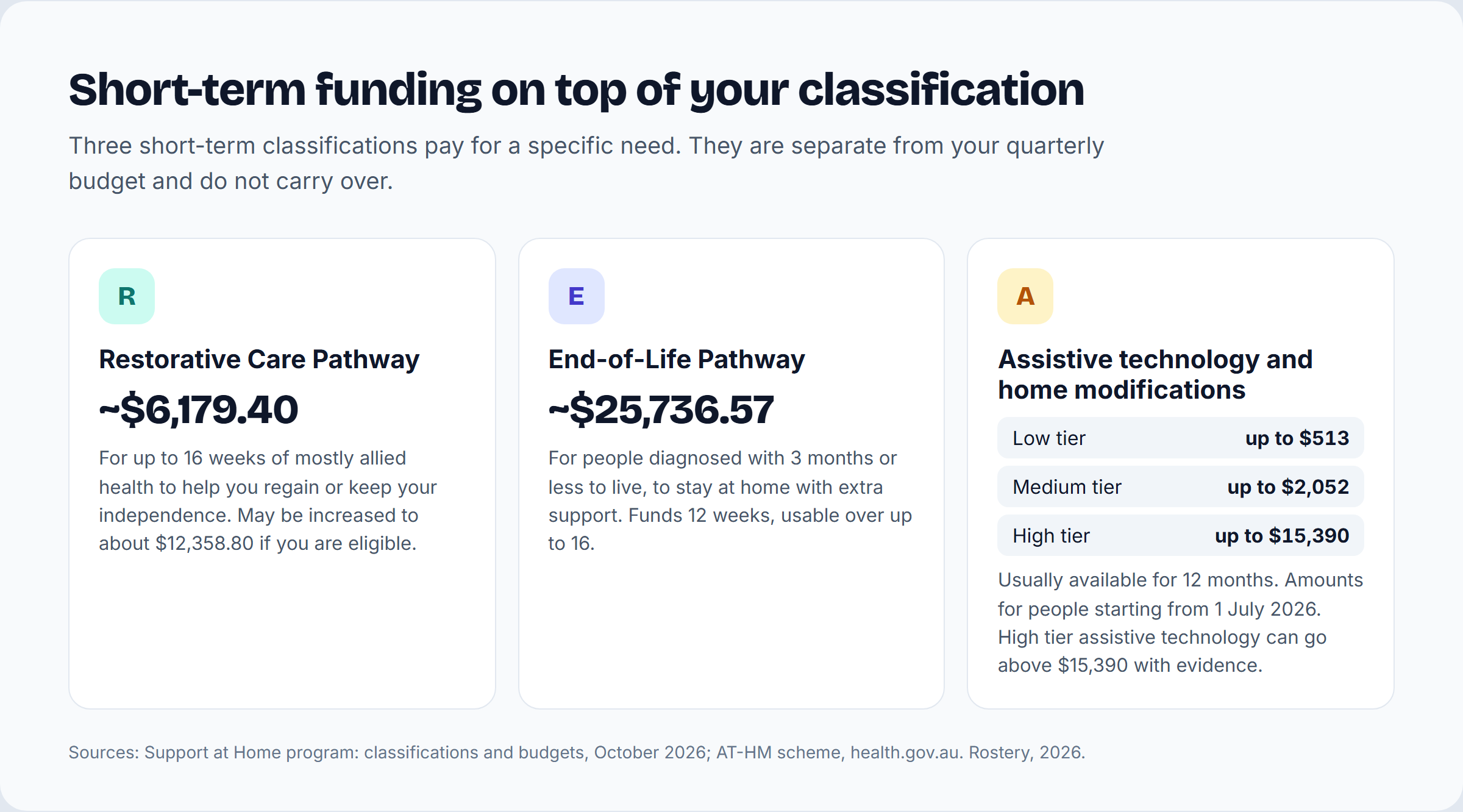
Short-term funding on top of your classification
| Short-term classification | Funding | What it is for |
|---|---|---|
| Restorative Care Pathway | About $6,179.40 for up to 16 weeks. Can be increased to about $12,358.80 if you are eligible. | Mostly allied health, to help you keep or regain your independence. |
| End-of-Life Pathway | About $25,736.57 over 12 weeks, which can be used over up to 16 weeks. | Extra support to stay at home for people diagnosed with 3 months or less to live. |
| Assistive technology | For people starting from 1 July 2026: low tier up to $513, medium tier up to $2,052, high tier up to $15,390 (more with evidence such as a prescription). | Equipment and products, a prescription from a health professional if needed, and related services. |
| Home modifications | For people starting from 1 July 2026: low tier up to $513, medium tier up to $2,052, high tier up to $15,390 (the high tier is a once-only lifetime amount). | Changes to your home, including trades, installation, approvals and council fees. |
AT-HM funding is usually available for 12 months, and high-tier home modifications can be extended to 24 months if your provider shows Services Australia that the work is progressing. The 10% care management deduction does not apply to the two pathways, though care management is still provided. People approved for either pathway receive their funding straight away rather than waiting in the Priority System. If you are already receiving services, getting onto the Restorative Care Pathway needs a new assessment, which you request through a Support Plan Review.
If you had a Home Care Package before
People who had a Home Care Package on 31 October 2025 moved across automatically. They were given a transitioned classification with the same funding as their old package, including any primary supplements, divided into four quarterly budgets.
| Former package | Support at Home classification | Quarterly budget | Annual amount |
|---|---|---|---|
| HCP Level 1 | Transitioned HCP Level 1 | $2,823.55 | $11,294.22 |
| HCP Level 2 | Transitioned HCP Level 2 | $4,965.14 | $19,860.56 |
| HCP Level 3 | Transitioned HCP Level 3 | $10,808.30 | $43,233.21 |
| HCP Level 4 | Transitioned HCP Level 4 | $16,385.99 | $65,543.98 |
If you had unspent Home Care Package funds, you kept them. You can use them for assistive technology and home modifications if approved, or for ongoing services once your quarterly budget for the quarter is fully used. There is no cap on how much of those unspent funds you can use. If you had a package, were on the National Priority System, or had been approved for a package on 12 September 2024, you pay the lower "no worse off" contribution rates described above. For a side-by-side comparison of the old and new programs, read our guide to Support at Home vs Home Care Packages, or use the HCP to Support at Home calculator.
Supplements that add to the budget
Some participants qualify for primary supplements, which are added to their budget on top of the classification amount. The oxygen supplement is for people with a medical need for continual oxygen, and the enteral feeding supplement is for people fed through a tube. From 1 October 2026 the Schedule of Subsidies and Supplements sets them at $15.06 a day for oxygen, and $23.90 a day (bolus) or $26.84 a day (non-bolus) for enteral feeding. Your provider applies to Services Australia with the supporting evidence. Once approved, the money becomes part of your budget and can be spent on any approved service on the service list.
Checking your budget each month
Your provider must give you a statement every month. It is itemised, and shows what was spent, how much budget you have left and the contributions you made. Read it the way you would read a bank statement. It is the easiest way to catch a service you didn't receive, a price you didn't agree to, or a budget that is running down faster than you expected.
Changing providers
You can change providers at any time, and your approval and budget move with you. Agree an exit date with your current provider and tell them who your new provider will be so your care continues. You have four quarters from the last quarter you received a service to sign up with a new provider. The outgoing provider has 60 days after your exit to finalise its claims, and must pass on any unspent Home Care Package funds it holds.
What this means for providers
For a provider, every participant has a different budget, carry-over limit and set of contribution rates, and all of them change during the year. Keeping those budgets accurate means four jobs that never stop:
- Track each participant's quarterly balance, including carry-over and any unspent Home Care Package funds, so services stop before the account would go below zero.
- Record at least one direct care management activity a month and claim it from the pooled care management account.
- Apply the right contribution rate for each service category, including the move of personal care to clinical supports on 1 October 2026.
- Send every participant an itemised statement each month and claim within the deadlines Services Australia sets.
Rostery's Support at Home software does this from the roster: classifications and budgets are drawn down as visits are delivered, contributions follow each participant's rates, the care management account is tracked as a pool, and monthly statements and claims are built from the same records. Book a demo to see it with your own participants.
Frequently asked questions
How much is Support at Home classification 1?
From 1 October 2026, Classification 1 is $2,757.89 a quarter, or $11,031.56 a year. That is about $212 a week, and 10% of it goes to care management.
What is the highest Support at Home funding level?
Classification 8, at $20,073.50 a quarter or $80,294.00 a year. Short-term funding, supplements and unspent Home Care Package funds can be added on top.
Can I move to a higher classification?
Yes. If your needs change, ask for a Support Plan Review through My Aged Care, or ask your provider to request one for you. It can lead to a new assessment and a higher classification.
Do I lose money I don't spend?
Partly. You can carry over up to $1,000 or 10% of your quarterly budget (after care management), whichever is higher. The rest is returned to the government at the end of the quarter.
Is personal care free under Support at Home?
Since 1 October 2026, yes, if personal care is in your support plan and you have funding available. It moved into the clinical supports category, where nobody pays a contribution.
Who holds my Support at Home budget?
Services Australia holds it in an account for you. Your provider claims for services after delivering them, and you see the result on your monthly statement.
Do the funding amounts change every year?
Yes. They are indexed each July. In 2026 they were also updated on 1 October. The lifetime contribution caps are indexed separately, on 20 March and 20 September.
Sources
- Department of Health, Disability and Ageing: Support at Home program, classifications and budgets (October 2026)
- Support at Home program manual: a guide for registered providers, V4.4 (September 2026)
- Schedule of contributions for Support at Home services from 20 September 2026
- Assistive Technology and Home Modifications (AT-HM) scheme
- Personal care to be fully funded under Support at Home from October
- Funding for Support at Home care management
Checked 13 October 2026. Government amounts change, so confirm the current figures with your provider or My Aged Care before making a decision. For the short definition of a classification, see our glossary entry on Support at Home classifications, and to explore each level, use the Support at Home classifications tool.