

If you run an NDIS or community services organisation, the hardest part of payday isn't paying people — it's working out exactly what each person is owed. The Social, Community, Home Care and Disability Services Industry Award (SCHADS Award, MA000100) governs how the overwhelming majority of disability support workers are paid, and it is one of the most intricate modern awards in the country. When that interpretation is done by hand in a spreadsheet, mistakes are not a possibility — they are a certainty over time.
This article explains why manual SCHADS interpretation fails, where the specific breakpoints are, what an underpayment can cost you, and how automated award interpretation inside your rostering software removes the guesswork before a single timesheet reaches payroll.
Why manual SCHADS interpretation fails
Manual interpretation fails for a simple structural reason: the SCHADS Award asks a payroll officer to hold dozens of interacting rules in their head, apply them consistently across every shift and every worker, and do it fortnight after fortnight without drift. Humans are excellent at judgement and terrible at flawless repetition. The award is built almost entirely on flawless repetition.
The award covers roughly eight classification levels, each with multiple pay points, split across separate streams — most notably Social and Community Services (SACS) and Home Care. A Level 2 worker in one stream is not paid the same as a Level 2 worker in another. Before you even reach penalties and allowances, a payroll officer has to correctly place each employee on the right level, pay point and stream. Get that wrong once and every downstream calculation inherits the error.
The clauses where spreadsheets break
Certain provisions are where manual calculation reliably comes undone. These are the "classic" SCHADS failure points:
- Broken shifts. A broken shift — a shift split by an unpaid gap — attracts a specific allowance, and the award limits how many breaks are permitted and how the interval is treated. Spreadsheets rarely detect a broken shift automatically; someone has to notice it and add the allowance by hand.
- Sleepovers. A sleepover attracts a flat allowance plus the requirement to pay for any work performed during the night at the applicable rate, and any hours worked can interact with minimum rest and overtime rules. This is two calculations stacked on one shift.
- Passenger and vehicle allowances. Transporting a participant, or using your own car for work travel, triggers separate allowances that are indexed differently from base rates — the kilometre allowance in particular moves outside the Annual Wage Review cycle.
- Overtime and penalty stacking. Weekend, evening, and public holiday penalties apply on top of base rates, overtime applies once thresholds are crossed, and casual loading interacts with — but does not simply add on top of — overtime. The order of operations matters and is easy to get wrong.
- 24-hour care and active vs passive time. Longer care arrangements distinguish between active work and passive availability, each paid on a different basis within a single engagement.
- Minimum engagement. Part-time and casual employees are entitled to a minimum number of paid hours per shift regardless of how short the actual booking is.
Every one of those is a rule a human has to remember to apply. Miss one across a fortnight of hundreds of shifts and the payslip is wrong.
Penalty-rate stacking is where the money leaks
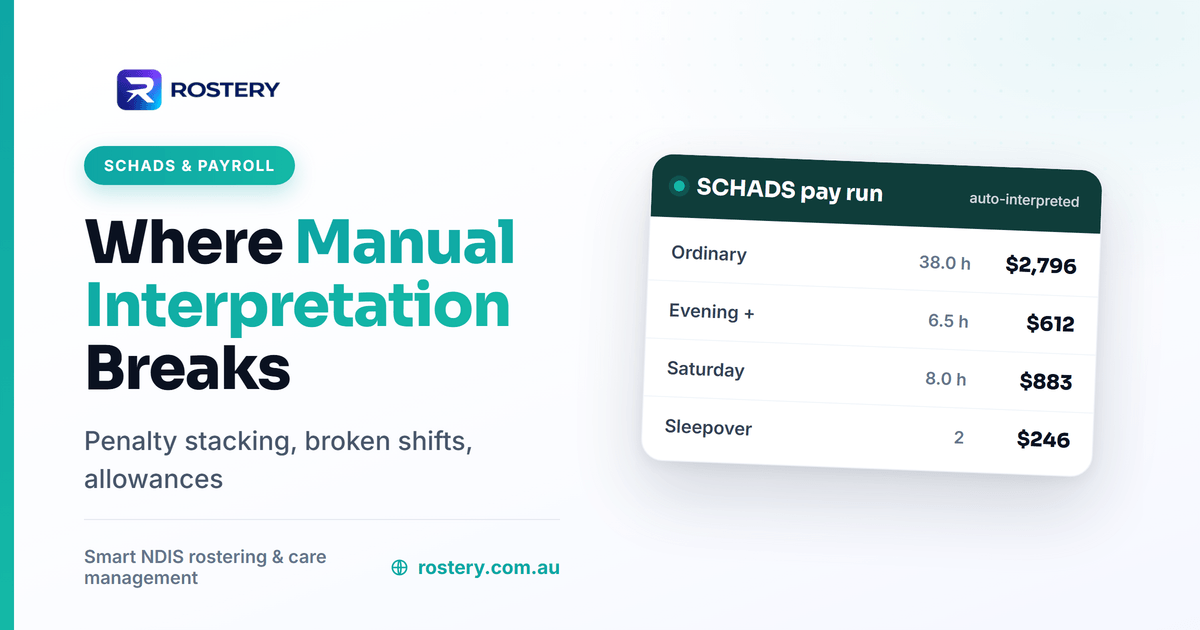
The single most error-prone area is penalty-rate stacking. A Saturday evening shift that tips into overtime, worked by a casual, is not one rate — it is a sequence of rules that have to be applied in the correct order. Casual loading does not simply pile on top of overtime; penalties and overtime are not always additive; and public holidays sit above weekend rates. A spreadsheet formula written once, by one person, tends to encode one interpretation of that order — and that interpretation is rarely revisited when the award or a Fair Work Ombudsman guidance note changes.
Because the errors are small per shift, they hide. A worker underpaid a few dollars on a penalty calculation won't always notice. But multiplied across a workforce and back-paid over years when an audit finds it, "small" becomes a material liability.
Rates change every year — and so does the risk
SCHADS rates are not static. Each year the Fair Work Commission's Annual Wage Review lifts modern award minimum rates, and the SCHADS Award moves with it. For the 2026–27 financial year, the Commission applied a 4.75% increase to modern award minimum rates, effective from the first full pay period starting on or after 1 July 2026. That timing detail matters: if your pay period doesn't begin exactly on 1 July, the new rates start from the next full pay period that opens after that date — not part-way through a period.
Manually, that means rebuilding every base rate, and every allowance and penalty derived from it, across every level and pay point — and applying the change on exactly the right pay run. Do it a period early or late and you have either underpaid or overpaid an entire workforce. This annual reset is precisely the kind of repetitive, high-stakes update that automation exists to handle.
What underpayment actually costs
Underpayment isn't just a correction; it's a compliance and reputational event. The consequences of getting SCHADS wrong include:
- Back-pay across years. Once an error in a formula or classification is found, it usually applies to every affected shift for as long as the error existed.
- Fair Work Ombudsman scrutiny. Systemic underpayment can attract investigation, enforceable undertakings and penalties.
- Staff trust and turnover. In a sector already fighting to retain workers, being paid incorrectly is a fast route to losing them — and to word spreading.
- Audit exposure. Payroll records that can't be reconciled against the award make every other compliance conversation harder.
The through-line is that manual interpretation converts a known, rules-based problem into an open-ended liability.
How automated award interpretation fixes it
Automated award interpretation moves the rules out of a person's memory and a fragile spreadsheet and into software that applies them the same way every time. Instead of a payroll officer deciding whether a shift was broken, whether a sleepover included work, or which penalty applies at 7pm on a Saturday, the rostering system reads the actual shift data and applies the award logic automatically. The best implementations do this at the point of rostering — so cost and compliance are visible before the shift is worked, not discovered weeks later at payroll.
In practice, award interpretation built into rostering software means:
- Classification, level and pay point are set once against the employee, not re-decided every pay run.
- Broken shifts, sleepovers, passenger and travel allowances are detected from the shift structure automatically.
- Penalties, overtime and casual loading are applied in a consistent, maintained order of operations.
- Annual Wage Review increases are applied on the correct pay period across every rate at once.
- Every calculation is traceable back to the rule that produced it — which is exactly what you need when an auditor asks "why was this paid this way?"
This is the core reason providers move from spreadsheets to purpose-built NDIS rostering software: the award stops being something a person has to remember and becomes something the system guarantees.
A practical checklist to reduce SCHADS risk
Whether or not you automate today, use this checklist to sanity-check your current process:
- Confirm every employee is on the correct stream, level and pay point.
- Check that broken-shift and sleepover allowances are applied automatically, not by memory.
- Verify your penalty and overtime order of operations against the current Fair Work Ombudsman pay guide.
- Confirm the 2026–27 (4.75%) increase was applied from the correct first full pay period on or after 1 July 2026.
- Ensure minimum-engagement rules are enforced for part-time and casual shifts.
- Make sure every pay calculation is auditable back to the award rule behind it.
If you can't answer "yes, automatically" to most of these, manual interpretation is quietly accumulating risk in your payroll. For a deeper look at the specific provisions, see our guide to SCHADS sleepover allowances.
Frequently Asked Questions
What is the SCHADS Award?
The SCHADS Award is the Social, Community, Home Care and Disability Services Industry Award (MA000100). It sets the minimum pay rates, penalties, allowances and conditions for most disability, aged care and community services workers in Australia, and is the award the majority of NDIS support workers are employed under.
Why is SCHADS so hard to calculate manually?
Because it combines multiple streams, eight classification levels with several pay points each, and layered penalties, overtime, casual loading and special allowances for broken shifts, sleepovers and travel. Applying all of those correctly and consistently across a whole workforce, every pay period, is beyond what a spreadsheet or a single payroll officer can reliably sustain.
How much did SCHADS rates increase in 2026?
The Fair Work Commission's 2026 Annual Wage Review applied a 4.75% increase to modern award minimum rates, including the SCHADS Award, effective from the first full pay period starting on or after 1 July 2026.
What is the biggest SCHADS underpayment risk?
Penalty-rate stacking — getting the order of operations wrong when penalties, overtime and casual loading interact, particularly on weekends, evenings and public holidays. Because per-shift errors are small, they often go unnoticed until an audit finds them applied across years of pay runs.
Can rostering software interpret the SCHADS Award automatically?
Yes. Purpose-built NDIS rostering software with award interpretation reads the actual shift data and applies SCHADS rules — classification, allowances, penalties, overtime and annual rate changes — automatically and consistently, with an audit trail back to each rule. This removes the manual interpretation step that causes most underpayment errors.


