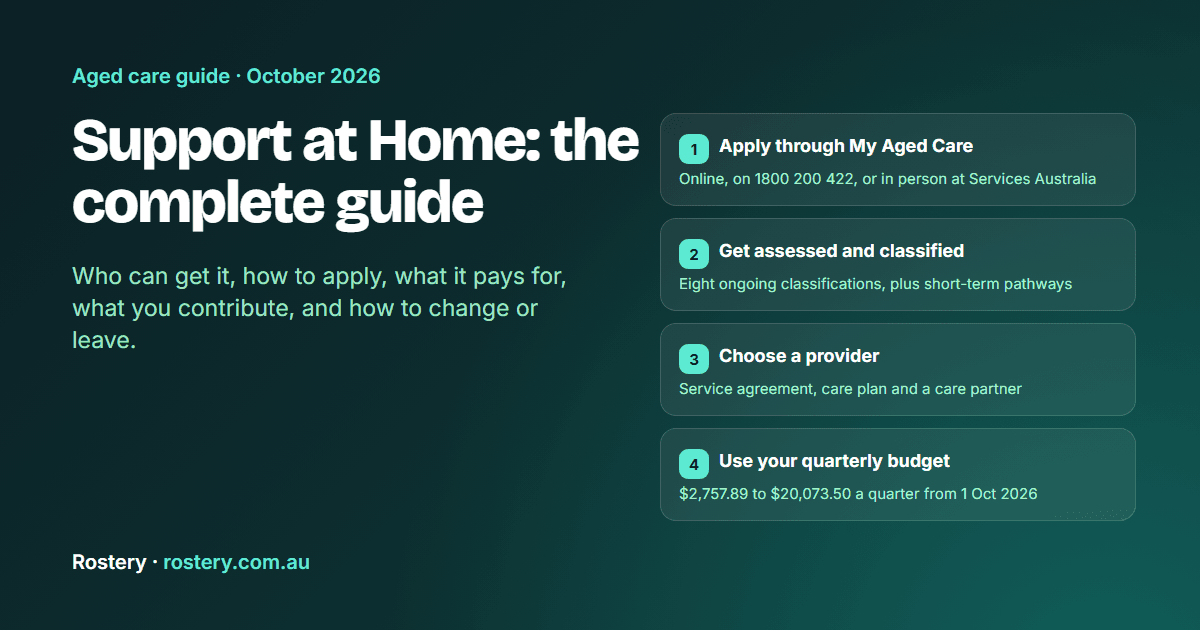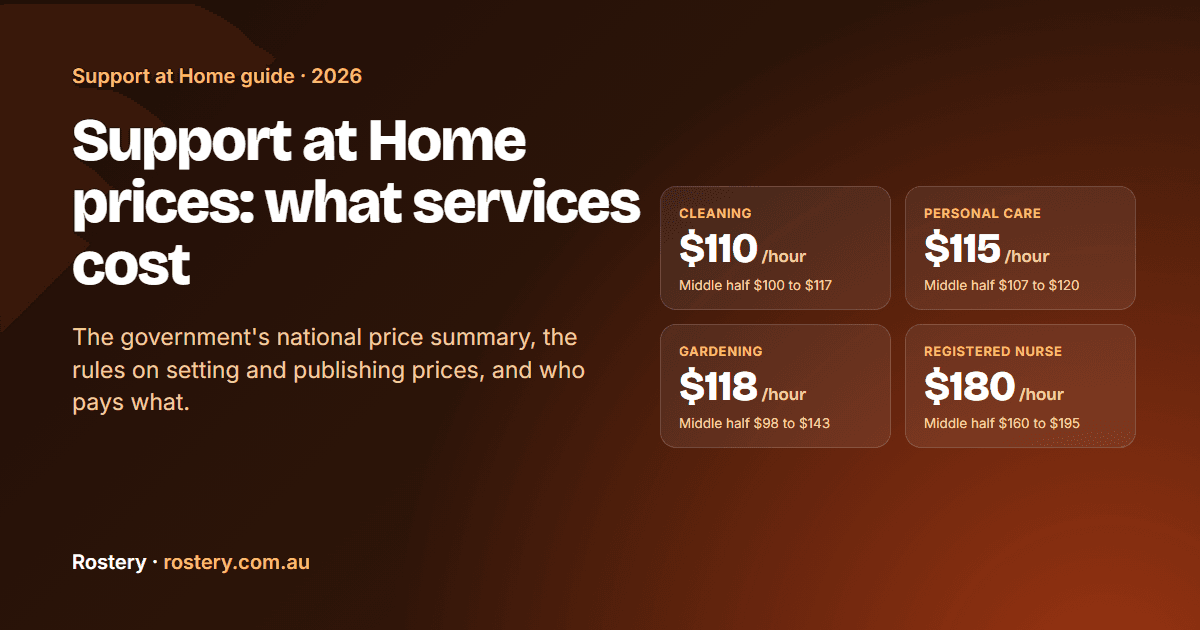
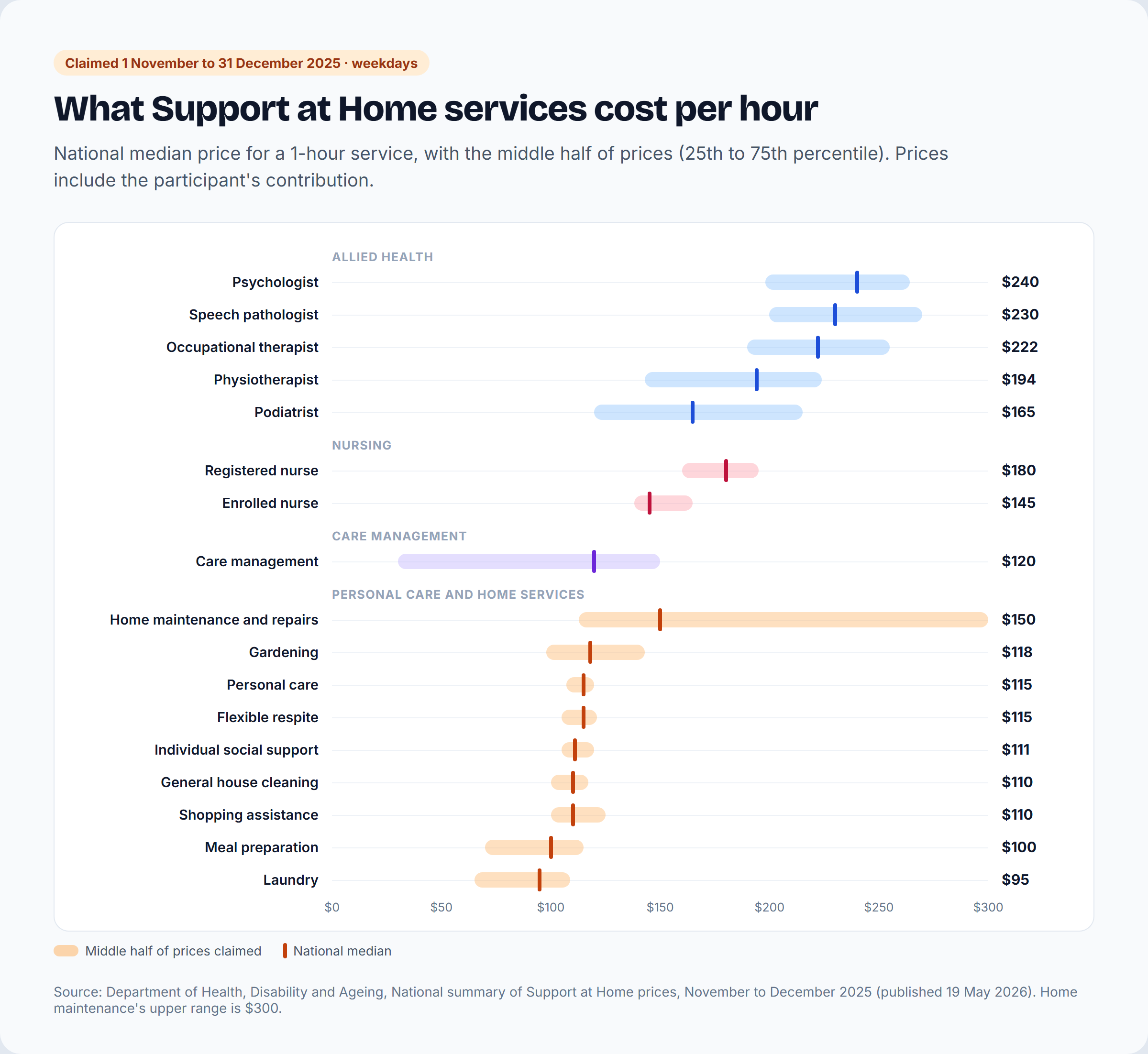
Support at Home has no set prices: each provider sets its own, and they must be reasonable. The government's National Summary of Support at Home Prices shows what providers actually charged. For weekday services from November to December 2025, the national median was $110 an hour for general house cleaning, $115 for personal care, $118 for gardening and $180 for a registered nurse. Price caps were planned for 1 July 2026 but were deferred in May 2026, and none apply now. This guide has the full national price list, what weekends cost, who pays which share, and the rules providers must follow to set, publish and change prices. It is written for providers and for the families comparing them.
The Support at Home price list: the national summary
The Department of Health, Disability and Ageing published the first National Summary of Support at Home Prices on 19 May 2026. It covers the prices claimed for services delivered from 1 November to 31 December 2025, the program's first two months, with data current as of 13 April 2026. A few things matter when you read it:
- These are prices actually charged to participants' budgets, and they include the participant's contribution.
- They are weekday prices only. Weekends and public holidays are left out and "may cost more".
- The range is the middle half of prices: a quarter of prices were below the lower figure and a quarter above the higher one.
- The figures are national, with no split by region or provider type, and the department says "These are not price caps and are not recommended prices."
The department said it would publish a summary every quarter, with the next due in July 2026 for January to March. When we checked on 21 October 2026, the November to December 2025 summary was still the only one on its pricing resources page.
Prices for 1-hour services
| Service type | Service | National median | Middle half of prices |
|---|---|---|---|
| Nursing care | Registered nurse | $180 | $160 to $195 |
| Nursing care | Enrolled nurse | $145 | $138 to $165 |
| Nursing care | Nursing assistant | Not published | |
| Allied health and other therapeutic services | Psychologist | $240 | $198 to $264 |
| Allied health and other therapeutic services | Speech pathologist | $230 | $200 to $270 |
| Allied health and other therapeutic services | Occupational therapist | $222 | $190 to $255 |
| Allied health and other therapeutic services | Dietitian or nutritionist | $220 | $165 to $264 |
| Allied health and other therapeutic services | Counsellor or psychotherapist | $215 | $175 to $248 |
| Allied health and other therapeutic services | Music therapy | $215 | $184 to $230 |
| Allied health and other therapeutic services | Social worker | $206 | $100 to $268 |
| Allied health and other therapeutic services | Physiotherapist | $194 | $143 to $224 |
| Allied health and other therapeutic services | Aboriginal and Torres Strait Islander health worker | $180 | $180 |
| Allied health and other therapeutic services | Podiatrist | $165 | $120 to $215 |
| Allied health and other therapeutic services | Exercise physiologist | $132 | $44 to $212 |
| Allied health and other therapeutic services | Allied health therapy assistant | $130 | $65 to $160 |
| Care management | Restorative care management | $173 | $170 to $173 |
| Care management | Care management | $120 | $30 to $150 |
| Personal care | Assistance with self-care and activities of daily living | $115 | $107 to $120 |
| Personal care | Assistance with the self-administration of medication | $110 | $63 to $119 |
| Personal care | Continence management (non-clinical) | $82 | $32 to $149 |
| Social support and community engagement | Cultural support | $129 | $95 to $173 |
| Social support and community engagement | Accompanied activities | $122 | $110 to $125 |
| Social support and community engagement | Group social support | $115 | $70 to $180 |
| Social support and community engagement | Individual social support | $111 | $105 to $120 |
| Social support and community engagement | Digital education and support | $110 | $61 to $133 |
| Social support and community engagement | Assistance to maintain personal affairs | $109 | $84 to $114 |
| Therapeutic services for independent living | Remedial masseuse | $160 | $130 to $191 |
| Therapeutic services for independent living | Osteopath | $154 | $119 to $195 |
| Therapeutic services for independent living | Acupuncturist | $150 | $110 to $182 |
| Therapeutic services for independent living | Diversional therapist | $150 | $50 to $200 |
| Therapeutic services for independent living | Art therapist | $120 | $81 to $249 |
| Therapeutic services for independent living | Chiropractor | $99 | $80 to $148 |
| Respite | Community and centre-based respite | $130 | $100 to $196 |
| Respite | Flexible respite | $115 | $105 to $121 |
| Domestic assistance | General house cleaning | $110 | $100 to $117 |
| Domestic assistance | Shopping assistance | $110 | $100 to $125 |
| Domestic assistance | Laundry services | $95 | $65 to $109 |
| Home maintenance and repairs | Assistance with home maintenance and repairs | $150 | $113 to $300 |
| Home maintenance and repairs | Gardening | $118 | $98 to $143 |
| Meals | Meal preparation | $100 | $70 to $115 |
The department marks two services as having too few claims to publish: nursing assistants and Aboriginal and Torres Strait Islander health practitioners.
Prices for 30-minute services
Short visits often cost more than half the hourly price. Cleaning is exactly half ($55 against $110), but personal care is 57% of the hourly price and physiotherapy 64%. Check the unit before you compare two quotes.
| Service | 30-minute median | Middle half | 1-hour median |
|---|---|---|---|
| Registered nurse | $99 | $89 to $112 | $180 |
| Enrolled nurse | $93 | $75 to $120 | $145 |
| Physiotherapist | $124 | $110 to $143 | $194 |
| Occupational therapist | $112 | $105 to $124 | $222 |
| Podiatrist | $118 | $102 to $140 | $165 |
| Psychologist | $128 | $119 to $138 | $240 |
| Care management | $70 | $63 to $75 | $120 |
| Personal care (self-care) | $65 | $56 to $80 | $115 |
| Medication assistance | $60 | $55 to $77 | $110 |
| Individual social support | $60 | $55 to $69 | $111 |
| Flexible respite | $68 | $55 to $70 | $115 |
| General house cleaning | $55 | $53 to $61 | $110 |
| Laundry | $53 | $39 to $56 | $95 |
| Shopping assistance | $55 | $53 to $61 | $110 |
| Gardening | $63 | $55 to $73 | $118 |
| Meal preparation | $55 | $53 to $63 | $100 |
Transport and meals
| Service | Unit | National median | Middle half |
|---|---|---|---|
| Direct transport (driver and car) | One-way trip | $40 | $25 to $78 |
| Indirect transport (taxi or rideshare vouchers) | One-way trip | $24 | $13 to $42 |
| Meal delivery | Meal | $18 | Not published |
Transport is priced per one-way trip, so taking someone to an appointment and back is two trips.
Three sets of figures, and which one to use
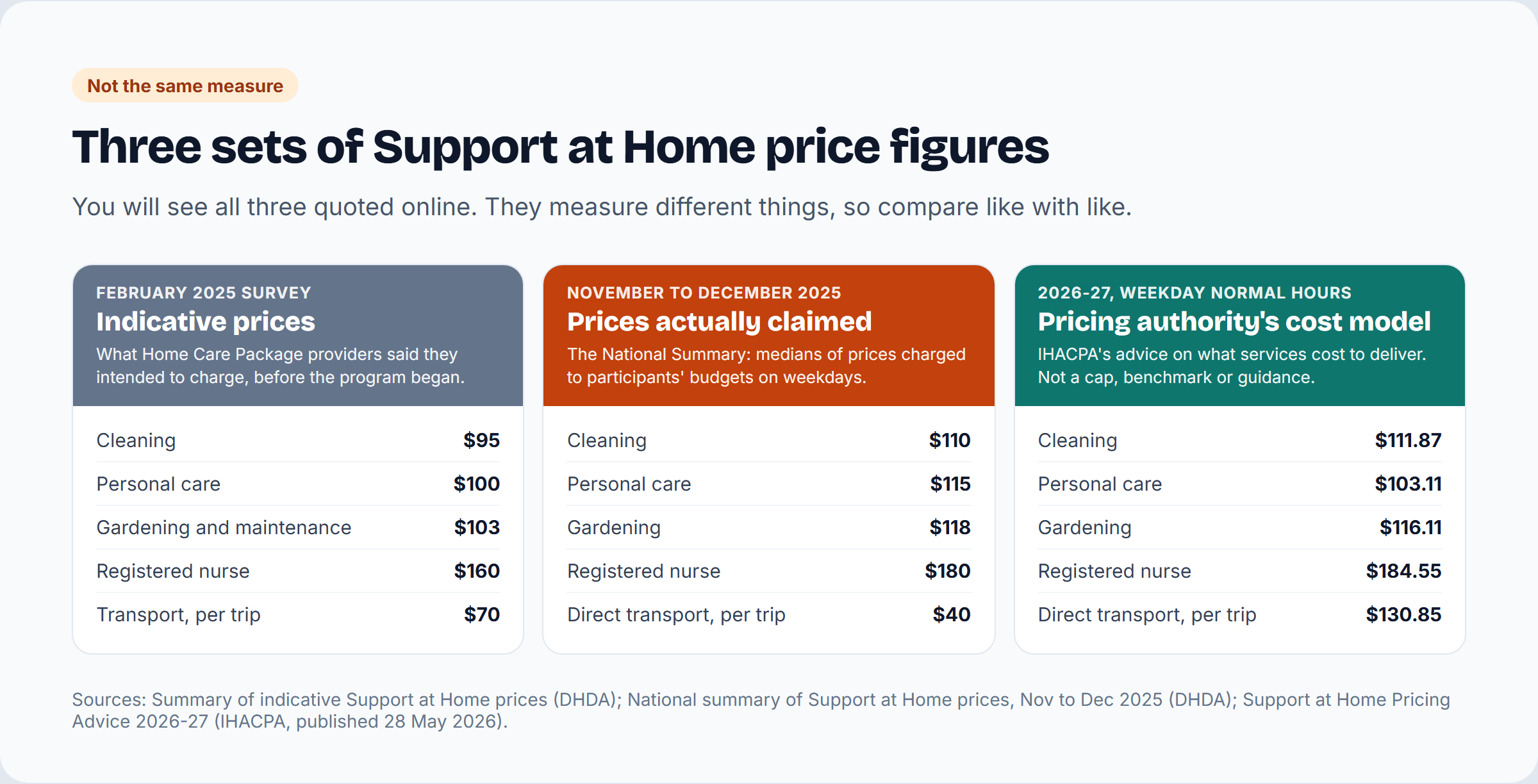
Search for Support at Home prices and you will find three different sets of numbers, often mixed up.
- Indicative prices come from a February 2025 survey of over 300 Home Care Package providers about what they intended to charge. They were published before the program began and have not changed since.
- The national summary shows what providers actually charged once it began. This is the one to compare against.
- The Independent Health and Aged Care Pricing Authority (IHACPA) modelled what each service costs to deliver in 2026-27, as advice for setting caps. It says the figures "do not represent a price cap, benchmark or guidance for aged care providers when setting their prices".
| Service (1 hour unless stated) | Indicative (February 2025 survey) | Claimed (November to December 2025) | IHACPA cost model 2026-27 |
|---|---|---|---|
| General house cleaning | $95 (domestic assistance) | $110 | $111.87 |
| Gardening | $103 (home maintenance) | $118 | $116.11 |
| Personal care | $100 | $115 | $103.11 |
| Individual social support | $99 (social support) | $111 | $101.41 |
| Meal preparation | $97 | $100 | $114.84 |
| Meal delivery, per meal | $15 | $18 | $18.18 |
| Direct transport, per trip | $70 (transport) | $40 | $130.85 |
| Registered nurse | $160 | $180 | $184.55 |
| Physiotherapist | $185 | $194 | $209.38 |
| Occupational therapist | $200 | $222 | $230.31 |
| Psychologist | $228 | $240 | $285.20 |
| Care management | $120 | $120 | $118.40 |
Most claimed medians came in above what providers indicated before launch: cleaning $110 against $95, personal care $115 against $100. The surveys measured different things, so treat that as a difference between two snapshots rather than a measured price rise. Transport is the exception, but the indicative survey had a single transport figure while the summary separates direct trips from vouchers, so the two cannot be compared.
Weekend, evening and public holiday prices
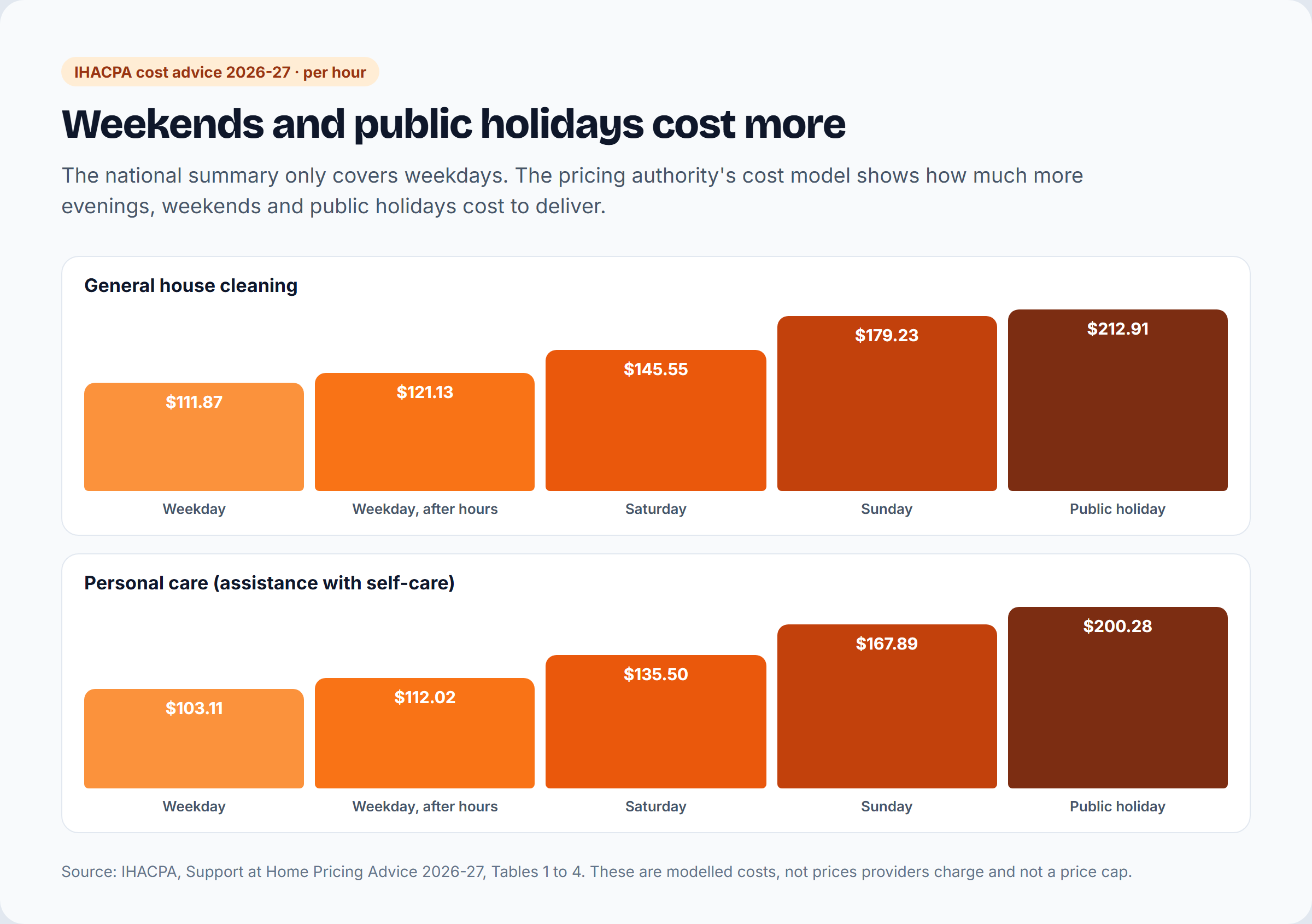
The national summary has no weekend figures, but providers must publish their most common price for five time bands on their own website: standard business hours, weekdays outside business hours, Saturdays, Sundays and public holidays. The department's template defines standard hours as "Monday to Friday 8am to 6pm", though the Rules do not. The only official figures by time band are IHACPA's modelled costs:
| Service (per hour) | Weekday | Weekday after hours | Saturday | Sunday | Public holiday |
|---|---|---|---|---|---|
| General house cleaning | $111.87 | $121.13 | $145.55 | $179.23 | $212.91 |
| Gardening | $116.11 | $127.92 | $159.05 | $201.98 | $244.91 |
| Personal care (self-care) | $103.11 | $112.02 | $135.50 | $167.89 | $200.28 |
| Individual social support | $101.41 | $110.78 | $135.48 | $169.55 | $203.62 |
| Respite care | $110.75 | $120.89 | $147.62 | $184.49 | $221.36 |
| Registered nurse | $184.55 | $200.76 | $243.49 | $272.96 | $302.42 |
| Meal delivery, per meal | $18.18 | $19.71 | $23.72 | $29.27 | $34.81 |
On those figures, cleaning on a Sunday costs about 60% more to deliver than on a weekday, and on a public holiday about 90% more. A provider's own weekend price can be higher or lower; check its website price list.
Are there price caps on Support at Home?
No. Caps were announced, then deferred, and no new date has been set.
| When | What happened |
|---|---|
| December 2024 | The government announces price caps from 1 July 2026, staged so the pricing authority can consult. "There will be no caps on gardening and cleaning services." |
| October 2025 | The provider fact sheet repeats: "From 1 July 2026, Australian Government set price caps will apply." |
| 1 November 2025 | Support at Home begins. Providers set their own prices and list them on My Aged Care. |
| 19 May 2026 | The Minister for Aged Care defers caps "until we have greater confidence in the stability of the market", and announces new consumer protections instead. |
| 28 May 2026 | The pricing authority, IHACPA, publishes its 2026-27 pricing advice, saying it is "not a price cap, benchmark or guidance". |
| June 2026 | Department FAQs: "there are no recommended prices for Support at Home services." |
| September 2026 | Program manual v4.4: "The implementation of capped pricing has been deferred." No new start date has been set. |
The minister said caps "can only work if they are set at the right level: high enough to keep the sector viable, low enough to genuinely protect older Australians." In their place the government announced:
- the national summary of prices each quarter, showing the median and range;
- stronger action on overcharging: the Aged Care Quality and Safety Commission can already require refunds of overcharged amounts through its compliance powers, and the government said it would give it power to order refunds;
- action against providers who do not issue monthly statements, and public reporting on enforcement;
- close monitoring of personal care prices as personal care became fully funded;
- encouraging providers to raise prices no more than twice a year. That is encouragement, not a legal limit.
Some pages still say caps start on 1 July 2026, including a May 2025 My Aged Care news item. They are out of date.
Who pays: contributions
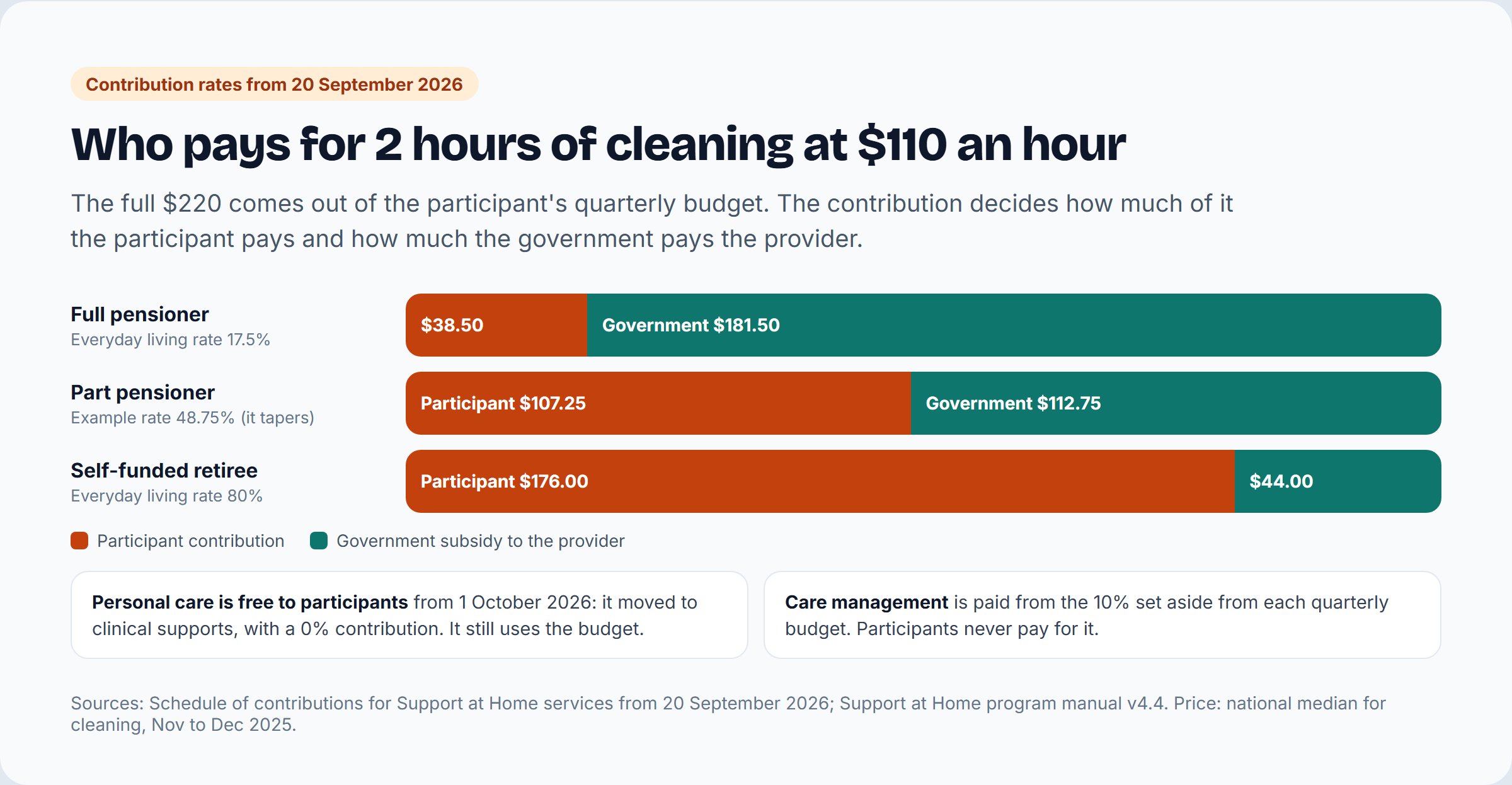
The whole price of a service comes out of the participant's quarterly budget. What the participant pays depends on the service's category and their means. The government pays the provider the rest as a subsidy, and providers can only collect a contribution after the service is delivered.
| Service type | Contribution category |
|---|---|
| Allied health and therapy | Clinical supports |
| Care management | Clinical supports |
| Nursing care | Clinical supports |
| Nutrition | Clinical supports |
| Personal care (from 1 October 2026) | Clinical supports |
| Restorative care management | Clinical supports |
| Home or community general respite | Independence |
| Social support and community engagement | Independence |
| Therapeutic services for independent living | Independence |
| Transport | Independence |
| Domestic assistance | Everyday living |
| Home maintenance and repairs | Everyday living |
| Meals | Everyday living |
| Contribution rates from 20 September 2026 | Clinical supports | Independence | Everyday living |
|---|---|---|---|
| Full pensioner | 0% | 5% | 17.5% |
| Part pensioner, or Commonwealth Seniors Health Card holder | 0% | 5% to 50% | 17.5% to 80% |
| Self-funded retiree without the card, or means not disclosed | 0% | 50% | 80% |
| "No worse off" group (receiving, waiting for or approved for a Home Care Package on 12 September 2024) | 0% | 0% to 25% | 0% to 25% |
Part pensioners and card holders pay a rate that tapers with their income and assets assessment, set by Services Australia. Someone who does not disclose their means pays the maximum rate. Worked examples at the national median prices:
| Example | Price (from the budget) | Rate | Participant pays | Government pays |
|---|---|---|---|---|
| 2 hours of cleaning, full pensioner | $220.00 | 17.5% | $38.50 | $181.50 |
| 2 hours of cleaning, part pensioner (example rate) | $220.00 | 48.75% | $107.25 | $112.75 |
| 2 hours of cleaning, self-funded retiree | $220.00 | 80% | $176.00 | $44.00 |
| 1 hour of personal care, full pensioner, before 1 Oct 2026 | $115.00 | 5% | $5.75 | $109.25 |
| 1 hour of personal care, anyone, from 1 Oct 2026 | $115.00 | 0% | $0.00 | $115.00 |
From 1 October 2026 personal care moved from the independence category to clinical supports, so it attracts no contribution. It is not backdated: personal care delivered before 1 October still carries a contribution, even if claimed later. It still uses the participant's budget.
There is also a lifetime cap on contributions, indexed each March and September. Once someone reaches it, they pay no more contributions.
| From | Lifetime cap | "No worse off" group cap |
|---|---|---|
| 1 November 2025 | $135,318.69 | $84,571.66 |
| 20 March 2026 | $137,917.01 | $86,185.23 |
| 20 September 2026 (current) | $140,652.80 | $88,934.57 |
Care management is not a price on your other services
Ten percent of each quarterly budget is set aside for care management and pooled by the provider across its participants. It is not a fee added to services. Providers set an hourly care management price (the national median was $120) and claim the time they deliver from that pool. Participants pay nothing for care management, and every participant must get at least one direct care management activity of 15 minutes or more each month.
Care management cannot be built into the prices of other services. In 2026 the Commission said it was investigating a provider that "included care management costs in their service delivery prices" and changed prices without its clients' agreement. Our free care management calculator works out the amount set aside for any classification.
The pricing rules providers must follow
| Rule | What it means | Where it comes from |
|---|---|---|
| Prices must not be unreasonable | A price the provider cannot justify from the cost of delivering the service, plus a reasonable margin, is unreasonable. | Rules s 273-15(b); RB 2026-1 |
| One all-inclusive unit price | Package management, travel and administration go into the unit price. No separate fees or surcharges. | RB 2026-1; department guidance |
| No entry or exit fees | Participants can change provider at no cost. | Department and minister statements |
| Prices in the service agreement | The price for each service, the reason for any price above the published one, and how indexation increases work. | Rules s 148-70(4) |
| Changing a price | By agreement after adequate consultation, or under an indexation clause already in the agreement. There is no set number of days' notice. | Rules s 148-65(5), s 148-70(4)(d) |
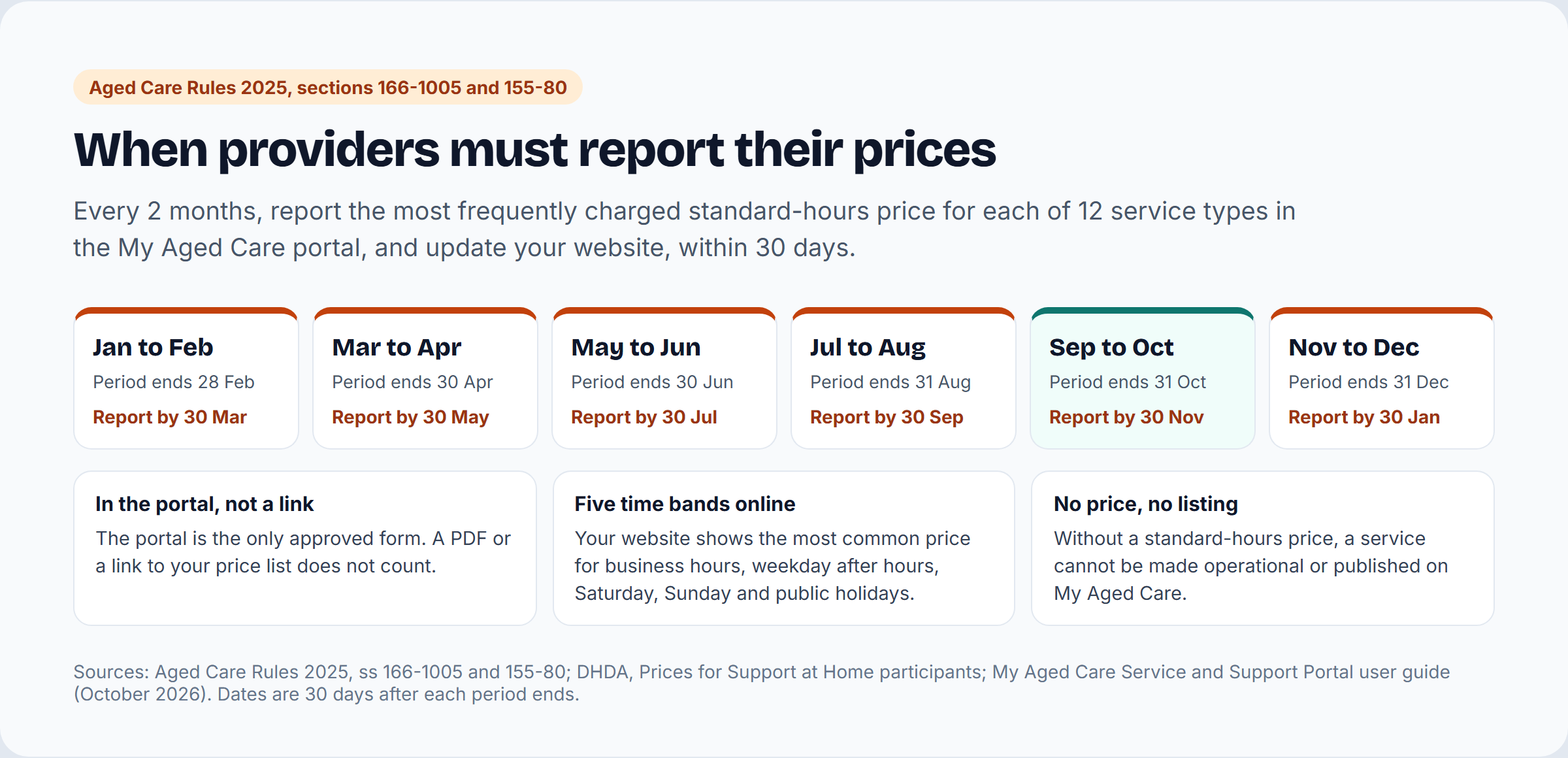
| Report prices every 2 months | The most frequently charged standard-hours price for each of 12 service types, in the My Aged Care portal, within 30 days of each period. | Rules s 166-1005 |
| Publish prices on your website | The most common price in five time bands: business hours, weekday after hours, Saturday, Sunday and public holidays. | Rules s 155-80 |
| Services the participant sources | When the participant sources a third party directly, the provider can add at most 10% to that price. | Rules s 273-15(a) |
| Charge only time delivered | No charging 1 hour for 45 minutes. Claims can be in 15-minute steps; there is no government minimum visit. | Department guidance; manual |
| Late cancellations | Less than 2 business days' notice can be charged in full. The cancellation policy should be in the service agreement. | Manual v4.4 s 10.8 |
| Transport and meals | Transport is priced per one-way trip (a range is allowed for direct transport only). Meals are priced per meal, and raw ingredients are not claimable. | Department FAQs and guidance |
| AT and home modifications | Admin is capped at 10% of the cost or $500 for assistive technology, and 15% or $1,500 for home modifications, whichever is lower. | Department guidance; manual |
| GST | Support at Home services are GST-free for participants. | Manual v4.4 |
What counts as a reasonable price
The Commission's Regulatory Bulletin RB 2026-1 says "An unreasonable price is a price that a provider cannot justify based on the cost of delivering the service (plus a reasonable margin)." A price can include labour (including subcontracting), administration, package management, travel, a margin for capital, and time-limited transition costs such as software upgrades and training. It cannot include costs the government already funds, such as a thin market grant. Being above the national range does not make a price unreasonable, and being inside it does not make it reasonable: the test is the provider's own costs, and the provider must keep the evidence.
The Commission watches for providers who have not reported their prices, charge differently from their published prices, charge more than similar providers, or do not explain their prices. It can ask for invoices, timesheets and rosters, payroll extracts, travel records and published price lists, and it can require prices to be corrected and overcharged amounts refunded.
The 12 service types you report
Prices must be reported and published for each of these service types you deliver: allied health and therapy, care management, domestic assistance, home maintenance and repairs, home or community general respite, meals, nursing care, personal care, restorative care management, social support and community engagement, therapeutic services for independent living, transport. A service you have not delivered in the last 12 months is exempt.
The My Aged Care portal is the only approved way to report. "Prices must be entered directly into the portal, pdf documents or links to webpages do not meet your reporting requirements." If you leave a price blank, the service cannot be made operational and My Aged Care will not publish it. The My Aged Care provider portal guide walks through the portal.
How to compare providers' prices
- Look up providers near you in the Find a provider tool on My Aged Care, and use the Support at Home fee estimator.
- Read each provider's full price list on its own website, including its weekend and public holiday prices.
- Compare against the national summary above, service by service, unit by unit.
- Ask what the price includes and, if it is higher than others, why. The provider must explain how it set its prices.
- Check the service agreement: every price, the reason for any price above the published one, and how prices will rise.
Changing provider costs nothing, since entry and exit fees are not allowed. The department's advice is to "have a start date with your new provider before agreeing to an end date with your current provider." For help, the Aged Care Advocacy Line is 1800 700 600, the Commission's complaints line is 1800 951 822 and My Aged Care is 1800 200 422.
How far a budget goes
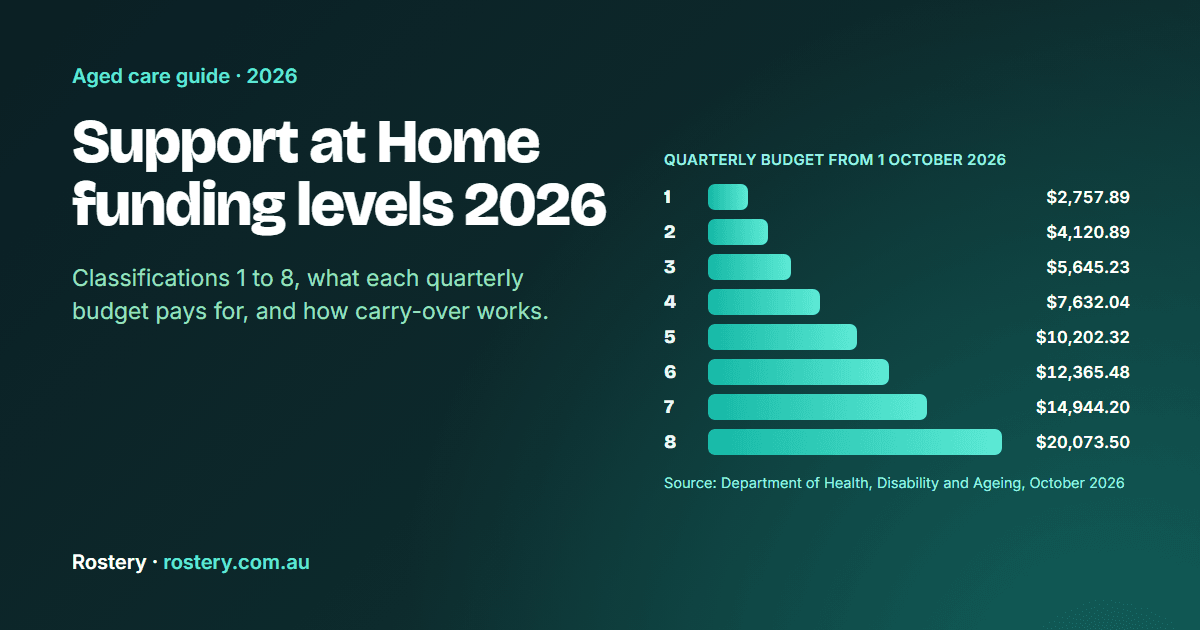
A participant at classification 3 has a quarterly budget of $5,645.23 from 1 October 2026. Ten percent ($564.52) is set aside for care management, leaving $5,080.71 for services. At the median cleaning price of $110 an hour, that is about 46 hours of cleaning in the quarter if spent on nothing else. Our Support at Home funding levels guide lists every classification, and the Support at Home budget and contribution calculator works out a budget and contributions for any combination of services. For how the program works overall, see our Support at Home program guide.
How Rostery helps providers manage prices
Rostery is our product, so here is what it does, plainly. For each service, it works out the price you charged most often in each 2-month reporting period, from the care actually delivered, and shows the date that period's report is due. Your price list can be published as a public page to link from your website, and exported with each service's unit, current price and any change ahead, ready to enter in the My Aged Care portal.
A price change becomes a new version of the service from its effective date, so every visit is priced at what applied on its own day. Rostery will not let an increase start before your notice period ends (28 days unless you set another), flags a third increase within 12 months, and drafts an updated agreement for each participant who uses the service, for them to agree to. Contributions are worked out by category, and monthly statements come from the services delivered. See participant contributions and statements and claims in Rostery.
Frequently asked questions
How much does Support at Home cleaning cost per hour?
The national median for general house cleaning on a weekday was $110 an hour, with the middle half of prices between $100 and $117, for services claimed in November and December 2025. A 30-minute clean had a median of $55.
Are there price caps on Support at Home services?
No. Caps were planned for 1 July 2026 but the government deferred them in May 2026 "until we have greater confidence in the stability of the market". No new start date has been announced. Prices must still be reasonable.
What are indicative Support at Home prices?
Prices Home Care Package providers said, in a February 2025 survey, that they intended to charge, published before the program started. They have been replaced by the national summary of prices actually charged.
Do I pay a contribution for personal care?
Not for personal care delivered from 1 October 2026, when it moved to the clinical supports category. Personal care delivered before then still attracts the contribution that applied at the time.
Can providers charge more on weekends?
Yes. Providers can set different prices by day and time, and must publish their most common price for weekdays, weekday after hours, Saturdays, Sundays and public holidays on their website. The prices must still be reasonable.
How often do providers have to update their prices?
Every 2 months. Providers report their most frequently charged standard-hours price for each service type in the My Aged Care portal within 30 days of each period ending, and update their website within the same 30 days.
Can a provider charge exit fees or separate admin fees?
No. Entry and exit fees are not allowed, and administration, package management and travel must be included in the unit price rather than charged separately.
Is Support at Home GST-free?
Yes. The program manual says Support at Home services are GST-free for participants.
Sources
- Department of Health, Disability and Ageing: National summary of Support at Home prices, November to December 2025 (19 May 2026)
- Department of Health, Disability and Ageing: Summary of indicative Support at Home prices
- IHACPA: Support at Home Pricing Advice 2026-27 (published 28 May 2026)
- Minister for Aged Care and Seniors: Strengthening consumer protections for older Australians (19 May 2026)
- Department of Health, Disability and Ageing: New consumer protections for Support at Home services (20 May 2026)
- Aged Care Quality and Safety Commission: Regulatory Bulletin RB 2026-1, Support at Home pricing requirements (version 2.0, 30 June 2026)
- Aged Care Rules 2025 (sections 148-65, 148-70, 155-80, 166-1005, 273-15, 8-105)
- Department of Health, Disability and Ageing: Guidance for setting Support at Home prices (June 2026)
- Department of Health, Disability and Ageing: Support at Home pricing FAQs (June 2026)
- Department of Health, Disability and Ageing: Consumer protections for Support at Home prices (May 2026)
- Department of Health, Disability and Ageing: Prices for Support at Home participants
- Department of Health, Disability and Ageing: Support at Home program manual, version 4.4 (September 2026)
- Department of Health, Disability and Ageing: Schedule of contributions for Support at Home services from 20 September 2026
- Department of Health, Disability and Ageing: Personal care contribution change
- My Aged Care: Support at Home costs and contributions
Checked 21 October 2026. Prices in the national summary are from November and December 2025 and may have changed since; check each provider's current price list. This guide explains published rules and figures and is not financial or legal advice.