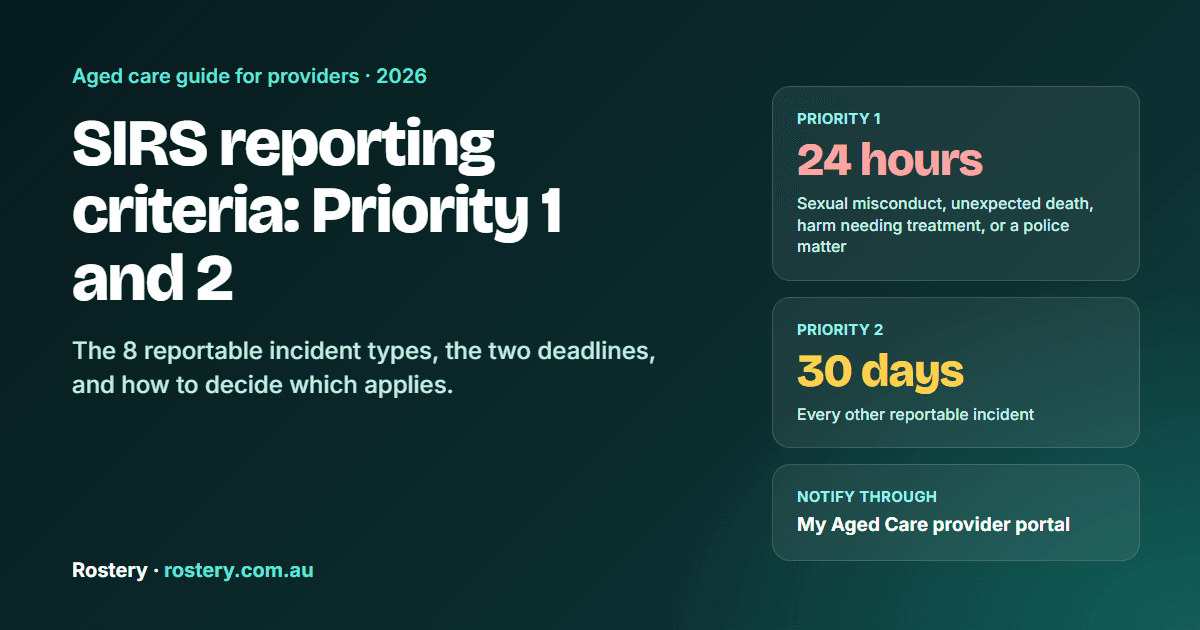
Under the Serious Incident Response Scheme (SIRS), an aged care provider must notify the Aged Care Quality and Safety Commission of every reportable incident: within 24 hours of becoming aware of a Priority 1 incident, and within 30 days for a Priority 2 incident. An incident is reportable when it is one of eight incident types and it happened, or is alleged or suspected to have happened, to a person receiving aged care. Notifications are lodged through the My Aged Care provider portal.
This guide sets out the eight reportable incident types, how to tell Priority 1 from Priority 2, what to do in the first 24 hours, and the mistakes that lead to late or missed notifications. It follows the Commission's Provider Handbook (section 3G, last updated 29 June 2026) under the Aged Care Act 2024.
SIRS at a glance
| Question | Answer |
|---|---|
| Who must report | Registered providers of funded aged care services, in residential care and in home services |
| What is reportable | One of 8 incident types that occurred, or is alleged or suspected to have occurred, to a person receiving care |
| Priority 1 deadline | 24 hours from becoming aware |
| Priority 2 deadline | 30 days from becoming aware |
| Where to notify | The SIRS notification webform in the My Aged Care provider portal |
| Police | Within 24 hours of being alerted, where there are reasonable grounds to contact police |
| Consent needed? | No. You do not need permission from the people involved to notify |
What counts as a reportable incident?
Every incident connected to the care you deliver must be managed through your incident management system. Only some must also be notified to the Commission. An incident is reportable if both of these are true:
- it is one of the 8 reportable incident types below, and
- it has occurred, or is alleged or suspected to have occurred, to a person receiving aged care.
The word "suspected" matters. You notify incidents you cannot yet confirm, incidents under internal or police investigation, incidents the older person does not want reported, and incidents involving people with cognitive impairment.
The 8 reportable incident types
| Incident type | In plain terms |
|---|---|
| Unreasonable use of force | Force against a person receiving care that is not reasonable in the circumstances, such as hitting, pushing or rough handling. |
| Unlawful sexual contact or inappropriate sexual conduct | Any sexual contact or conduct the person has not consented to, or that is otherwise unlawful or inappropriate. Always Priority 1. |
| Psychological or emotional abuse | Conduct that causes, or could reasonably cause, psychological or emotional distress, such as threats, intimidation or humiliation. |
| Unexpected death | A death where reasonable steps were not taken to prevent it, or that resulted from the care provided or a failure to provide care. Always Priority 1. |
| Stealing or financial coercion by a staff member | A staff member taking, or pressuring the person to hand over, money or property. |
| Neglect | A failure to provide the care, supervision or support the person needs. |
| Inappropriate use of restrictive practices | A restrictive practice used without meeting the legal requirements for its use. |
| Unexplained absence during delivery of care | The person is missing while care and services are being delivered, and their absence cannot be explained. |
The plain-terms column is a summary, not the legal definition. The Commission's SIRS guidelines give the full definitions and worked examples for each type, and they are the authority when an incident is borderline.
Priority 1 or Priority 2: the reporting criteria
Once you know an incident is reportable, you decide its priority. The priority sets the deadline.
| Priority 1 | Priority 2 | |
|---|---|---|
| Deadline | 24 hours from becoming aware | 30 days from becoming aware |
| Always this priority | Unlawful sexual contact or inappropriate sexual conduct; unexpected death | None |
| Other incident types | When the incident caused physical or psychological injury or discomfort that needs medical or psychological treatment, or when it is reasonable to report it to police | Every other reportable incident that is not Priority 1 |
Put simply: two incident types are always Priority 1. For the other six, ask two questions. Did the person need, or should they have had, medical or psychological treatment? Is it reasonable to report this to police? A yes to either makes it Priority 1. Otherwise it is Priority 2.
When you are unsure, the Commission's SIRS decision support tool walks you through each incident type. If doubt remains, treat it as Priority 1: notifying early is never a breach, while notifying late is.
When does the clock start?
Both deadlines run from when the provider becomes aware of the incident, not from when it happened and not from when an investigation finishes. If a worker learns of an allegation on a Friday night, a Priority 1 notification is due by Saturday night, so your process has to work outside office hours.
If you do not yet know the names of everyone involved, you still notify within the deadline and add the names as soon as you have them.
What to do when an incident happens
- Make the person safe. Your first duty is the safety, health and wellbeing of the people affected, including medical help.
- Contact police if there are reasonable grounds, within 24 hours of being alerted.
- Decide whether it is reportable and its priority. Use the 8 types and the criteria above, and the Commission's decision support tool if needed.
- Record it in your incident management system, with what happened, who was involved and the immediate actions taken.
- Notify the Commission through the SIRS webform in the My Aged Care provider portal, within 24 hours or 30 days.
- Involve the right people and use open disclosure. That includes the person affected and, where appropriate, their family, carer or representative.
- Investigate, resolve and learn. Record what you changed so it does not happen again, and review your incident data for patterns.
Your incident management system
SIRS sits inside a wider duty: registered providers must manage all incidents, reportable or not. The Commission expects you to assess each incident, respond so the people affected are safe, involve the relevant people, use open disclosure, and collect and review incident data to see how well you are managing risk. A register that only holds the incidents you notified will not meet that duty.
In practice, auditors look for a record that joins the whole story: the incident, the priority decision and why, the notification and when it was lodged, the follow-up, and what changed afterwards.
Common SIRS mistakes
- Waiting for proof. Alleged and suspected incidents are reportable. Investigate after you notify, not instead of notifying.
- Asking permission. You do not need consent from the people involved to notify the Commission.
- Starting the clock late. The deadline runs from when anyone in the organisation became aware, not from when a manager read the report.
- Leaving out cognitive impairment cases. Incidents involving people with cognitive impairment are still reportable.
- Treating the notification as the end. The incident still needs investigating, resolving and learning from in your incident management system.
How Rostery helps
Rostery's SIRS reporting software records each aged care incident with its SIRS type and priority, calculates the 24-hour or 30-day deadline from when you became aware, and keeps the notification, follow-up and resolution on one record. Overdue notifications show on the aged care dashboard. Rostery does not lodge the notification for you: that is still done in the My Aged Care provider portal, and Rostery records when it was done.
Frequently asked questions
What are the SIRS reporting timeframes?
Priority 1 incidents must be notified within 24 hours of becoming aware. Priority 2 incidents must be notified within 30 days of becoming aware.
Which incidents are always Priority 1?
Unlawful sexual contact or inappropriate sexual conduct, and the unexpected death of a person receiving aged care. Any other reportable incident is Priority 1 if it needs medical or psychological treatment, or if it is reasonable to report it to police.
Does SIRS apply to home care and Support at Home?
Yes. The Commission's requirements cover funded aged care services, and for home services you must tell the Commission about all reportable incidents to do with care.
Where do I lodge a SIRS notification?
Through the SIRS notification webform in the My Aged Care provider portal. The Commission's SIRS team can be reached at sirs@agedcarequality.gov.au or 1800 081 549 (9 am to 5 pm Monday to Friday AEST).
Is SIRS the same as NDIS reportable incidents?
No. SIRS is the aged care scheme run by the Aged Care Quality and Safety Commission. NDIS providers report incidents to the NDIS Quality and Safeguards Commission under different rules. A provider delivering both must follow both.
Sources
Checked on 7 October 2026. The Commission's pages are the authority and can change.
- Aged Care Quality and Safety Commission: Provider Handbook 3G, Incident management and the Serious Incident Response Scheme (last updated 29 June 2026)
- Aged Care Quality and Safety Commission: About reportable incidents
- Aged Care Quality and Safety Commission: SIRS guidelines for residential aged care providers