Restrictive practices are one of the most tightly regulated areas in disability support, and for good reason: they limit a person's rights and freedom of movement. If your service supports people whose behaviours of concern can place themselves or others at risk, you need to understand exactly what counts as a restrictive practice, when it can lawfully be used, and what you must report. This guide explains the five types of regulated restrictive practices in the NDIS, the behaviour support and authorisation rules that sit around them, and the reporting obligations every implementing provider must meet.
The short version: a regulated restrictive practice can only be used as a last resort, when it is included in a behaviour support plan, authorised in line with your state or territory's process, and reported to the NDIS Quality and Safeguards Commission. Get any one of those elements wrong and the practice becomes unauthorised — which is itself a reportable incident. Below we break down each requirement so your team knows where the lines are.
What Is a Restrictive Practice Under the NDIS?
A restrictive practice is any practice or intervention that has the effect of restricting the rights or freedom of movement of a person with disability. The intent behind the definition is deliberately broad — it captures anything that limits a person's choices to manage behaviour, not just obvious physical interventions. Under the NDIS (Restrictive Practices and Behaviour Support) Rules 2018, a subset of these are singled out as regulated restrictive practices, which carry the strictest controls.
The key distinction every provider needs to grasp is between a practice that is simply part of good support (for example, locking the front door of a home at night for everyone's safety as a general building-management measure) and a practice that is applied to a particular person to influence their behaviour. When it is targeted at an individual to manage behaviour, it is almost certainly regulated — and the full framework applies.
The Five Types of Regulated Restrictive Practices
The NDIS Commission regulates five categories of restrictive practice. Your team should be able to recognise each one on sight, because misclassifying a practice is the most common way providers slip into unauthorised use.
- Chemical restraint — the use of medication or a chemical substance for the primary purpose of influencing a person's behaviour, other than medication prescribed to treat a diagnosed physical or mental illness or physical condition.
- Environmental restraint — restricting a person's free access to parts of their environment, including items or activities (for example, locking a kitchen, fridge or bedroom).
- Mechanical restraint — the use of a device to prevent, restrict or subdue a person's movement for the primary purpose of influencing behaviour (not including devices used for therapeutic or non-behavioural purposes, such as a wheelchair seatbelt for safe transport).
- Physical restraint — the use of physical force to prevent, restrict or subdue the movement of a person's body or part of their body, to influence behaviour.
- Seclusion — the sole confinement of a person in a room or physical space at any hour of the day or night where voluntary exit is prevented, or not facilitated, or it is implied that they cannot leave.
Only medication prescribed to treat a diagnosed condition sits outside chemical restraint. The moment medication is used mainly to manage behaviour, it is a regulated restrictive practice and must go through the full process below.
Restrictive Practices Must Be a Last Resort
The framework is built on reduction and elimination. A regulated restrictive practice is only ever acceptable when less restrictive options have been genuinely tried and documented, the practice is the least restrictive response possible, it is used for the shortest time necessary, and it is proportionate to the potential negative consequence or risk of harm. Providers are expected to work actively towards reducing and ultimately eliminating the practice over time — not treating it as a permanent fixture of someone's support.
This is why strong, person-centred support planning matters so much. The best way to avoid restrictive practices is to understand the function of a behaviour and address its causes, which is the whole purpose of behaviour support planning.
Behaviour Support Plans: The Non-Negotiable Foundation
A regulated restrictive practice can only be used if it is contained in a behaviour support plan developed by an NDIS behaviour support practitioner considered suitable by the Commission. The sequencing matters:
- A specialist behaviour support provider develops an interim behaviour support plan within one month where a regulated restrictive practice is needed urgently.
- A comprehensive behaviour support plan that includes the regulated restrictive practice must be in place within six months.
- The comprehensive plan is reviewed when the person's circumstances change, or at least every 12 months while it is in force.
As the implementing provider — the organisation whose workers actually deliver the support — you must use the practice strictly in accordance with the plan. Using more than the plan allows, or applying a practice the plan doesn't contain, makes it unauthorised.
Authorisation: A State and Territory Responsibility
This is where many national providers trip up. Authorisation of regulated restrictive practices is governed by state and territory law, and the process differs in every jurisdiction. There is no single national authorisation pathway. Depending on where you operate, authorisation may involve a senior practitioner panel, a guardianship or consent process, or an approval body specific to that state or territory.
It is the implementing provider's responsibility to obtain the required authorisation before using the practice, and to upload evidence of that authorisation to the NDIS Commission portal. If you deliver supported independent living across multiple states, you need to map each jurisdiction's authorisation requirements separately — what is authorised in one state is not automatically lawful in another.
Monthly Reporting to the NDIS Commission
Registered providers who implement regulated restrictive practices must submit monthly reports on their use through the NDIS Commission portal. Two points trip providers up regularly:
- You must report even when no regulated restrictive practice was used in that month (a nil return) — silence is not compliance.
- Monthly reports should be submitted within five business days of the end of the month.
Accurate monthly reporting depends on capturing every instance at the point of care. Paper logs and memory are where data gets lost; recording each use digitally, as it happens, is what makes the monthly return defensible. A reliable record also feeds your reduction and elimination goals, because you can only reduce what you can measure.
When Use Becomes Unauthorised — and a Reportable Incident
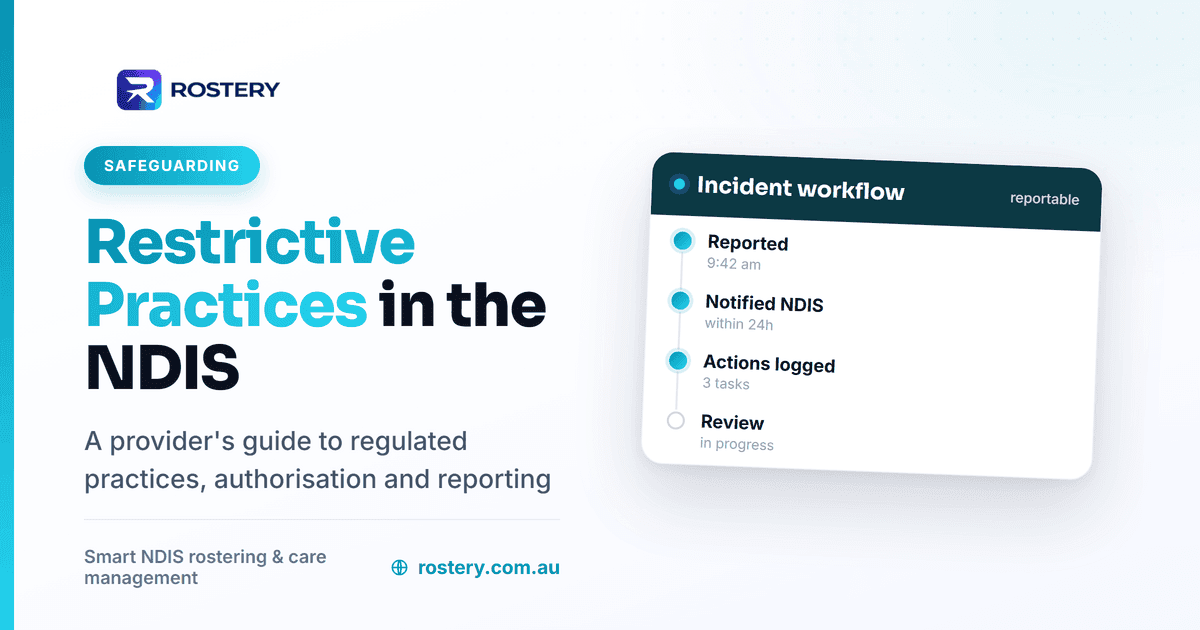
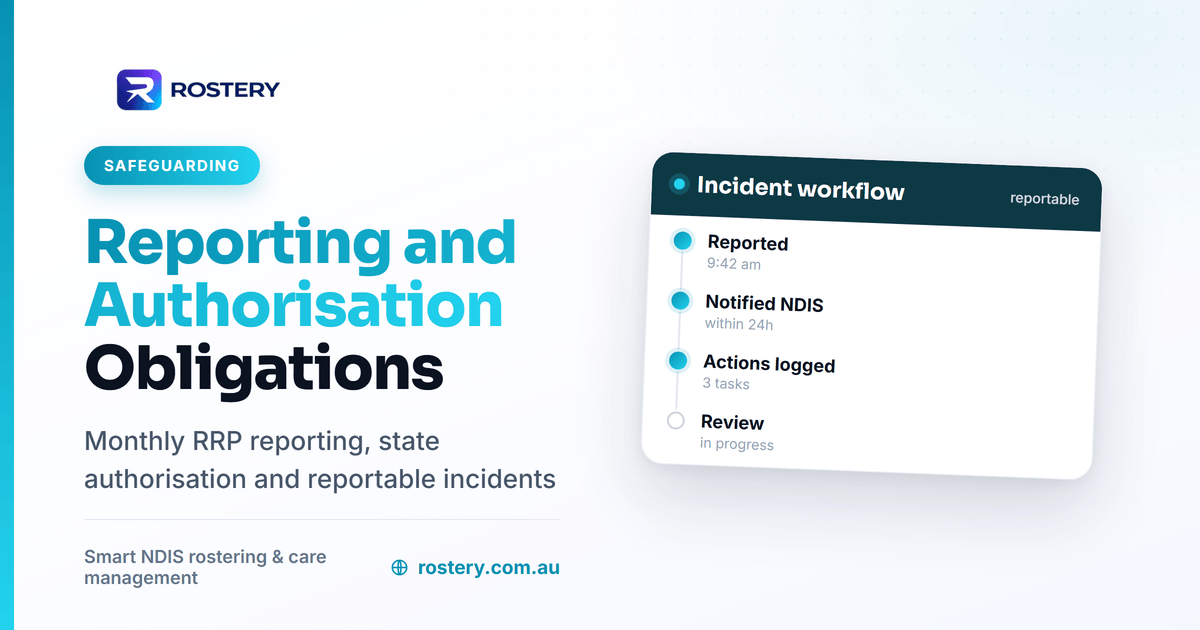
A regulated restrictive practice is unauthorised if it is not contained in a behaviour support plan, not authorised in accordance with the relevant state or territory process, or not used in accordance with the behaviour support plan. Unauthorised use is a reportable incident that must be notified to the NDIS Commission. The timeframes are:
- Within five business days of the provider becoming aware, for the unauthorised use of a restrictive practice.
- Within 24 hours if the incident also involves harm — for example, serious injury or abuse — which falls under the more urgent reportable incident categories.
Because the line between a late report and a breach is thin, your incident management process has to be fast and well understood by frontline staff. If you are building or tightening that process, our guide to NDIS verification vs certification audits explains how these obligations are tested at audit, and Rostery's incident reporting tools are designed to capture, categorise and escalate notifications within the required timeframes.
A Practical Compliance Checklist for Providers
Use this checklist to pressure-test your own practice before an auditor does:
- Every regulated restrictive practice in use is contained in a current behaviour support plan.
- State or territory authorisation has been obtained and evidence is uploaded to the Commission portal.
- Interim plans are in place within one month and comprehensive plans within six months.
- Plans are reviewed at least every 12 months, or sooner if circumstances change.
- Each use is recorded at the point of care, and monthly reports (including nil returns) are lodged within five business days of month end.
- Staff are trained to recognise all five practice types and know the unauthorised-use reporting timeframes.
- Reduction and elimination strategies are documented and actively worked on.
- You are registered and audited against the Specialist Behaviour Support and Implementing Behaviour Support Plans modules where applicable.
Frequently Asked Questions
What are the five regulated restrictive practices in the NDIS?
They are chemical restraint, environmental restraint, mechanical restraint, physical restraint and seclusion. Each is defined in the NDIS (Restrictive Practices and Behaviour Support) Rules 2018 and can only be used as a last resort, within a behaviour support plan and with the required authorisation.
Who authorises a regulated restrictive practice?
Authorisation is a state and territory responsibility, and the process differs across jurisdictions. There is no national authorisation pathway. The implementing provider must obtain authorisation through the relevant state or territory process and upload evidence to the NDIS Commission portal before using the practice.
How often do I have to report restrictive practices?
Implementing providers must submit monthly reports on the use of regulated restrictive practices through the NDIS Commission portal, within five business days of the end of the month. You must still submit a report when no regulated restrictive practice was used (a nil return).
What makes a restrictive practice unauthorised?
A practice is unauthorised if it is not in a behaviour support plan, not authorised under the relevant state or territory process, or not used in accordance with the plan. Unauthorised use is a reportable incident — notify the Commission within five business days, or within 24 hours if there is associated harm such as serious injury.
What is the difference between an interim and a comprehensive behaviour support plan?
An interim behaviour support plan can be developed within one month where a regulated restrictive practice is needed urgently, while a comprehensive plan must be in place within six months and reviewed at least every 12 months. Both must be developed by a suitable NDIS behaviour support practitioner.