Medication management compliance for NDIS providers means having the policies, trained workers, accurate records and safe storage in place to support participants with their medication safely — and being able to prove it to an approved quality auditor. Under the NDIS Practice Standards, medication is treated as a high-risk support: when it goes wrong, the harm can be serious, so the Quality and Safeguards Commission expects a documented, consistent and auditable approach from every registered provider that assists with medication.
This guide explains exactly what the rules require, where the line sits between assisting with medication and administering it, how the "rights" of medication translate into day-to-day practice, what your medication management policy must cover, and when a medication error becomes a reportable incident. It is written for NDIS provider owners, Supported Independent Living (SIL) managers and quality coordinators who want medication practice that holds up at audit and keeps participants safe.
What medication management compliance actually requires
Medication support appears in the NDIS Practice Standards under the Core Module — specifically within the Provision of Supports outcomes and, for complex supports, the High Intensity Support Skills Descriptors. An auditor assessing your medication practice is checking that you meet the quality indicators behind these standards, not just that you have a policy sitting in a folder. In practice, compliant medication management rests on six pillars:
- A documented medication management policy that reflects current legislation and the Practice Standards, and that your staff actually follow.
- Trained, competency-assessed workers whose training matches the risk and complexity of the support they deliver — with evidence kept on file.
- Accurate, contemporaneous records — a Medication Administration Record (MAR) completed at the time of support, not reconstructed afterwards.
- Safe, secure storage of medication that protects it from misuse, damage and unauthorised access.
- A clear error and incident pathway so mistakes are identified, responded to, documented and reported correctly.
- Respect for the participant's rights, including their right to self-manage medication where they have capacity, and their right to refuse.
Assistance with self-administration vs administration
The single most important distinction in medication compliance is the difference between assisting a participant to take their own medication and administering medication to them. Getting this wrong is a common source of audit findings and, more seriously, of harm.
Assistance with self-administration
This is support that helps a participant who directs their own medication — for example, prompting them to take a dose, reading a label aloud, opening packaging, or bringing a Webster pack to them. The participant retains control and decision-making. Most trained support workers can provide this level of support.
Administration
Administration is the act of giving the medication to the person — and some routes are out of scope for a general support worker. Tasks that typically require a registered nurse or appropriately qualified health practitioner, or a worker specifically trained and delegated under clinical oversight, include placing medication directly into a person's mouth, applying medication to the body, administering through enteral (PEG) feeding, injections and suppositories. These fall within complex or high-intensity supports, and your workforce competencies must match.
Your policy must state clearly which tasks your workers may and may not perform, and your rostering must ensure that only appropriately trained staff are scheduled to shifts where those supports are required. Mismatched rostering — sending an untrained worker to a shift that needs a medication-competent one — is both a safety risk and an audit red flag.
The "rights" of safe medication support
Safe administration practice is built on the "rights" of medication — a checklist workers run through every single time they provide medication support. Australian frameworks vary (some use five, six or seven rights), but the widely taught set for disability support is the seven rights plus the right to refuse:
- Right person — confirm the participant's identity against the chart.
- Right medication — match the medication to the MAR and the label.
- Right dose — the exact amount prescribed, no more, no less.
- Right time — the correct time and frequency.
- Right route — oral, topical or otherwise, as prescribed.
- Right reason — the medication matches the documented purpose.
- Right documentation — record the support at the time it happens.
- Plus the right to refuse — a participant with capacity can decline, and that refusal must be respected and recorded.
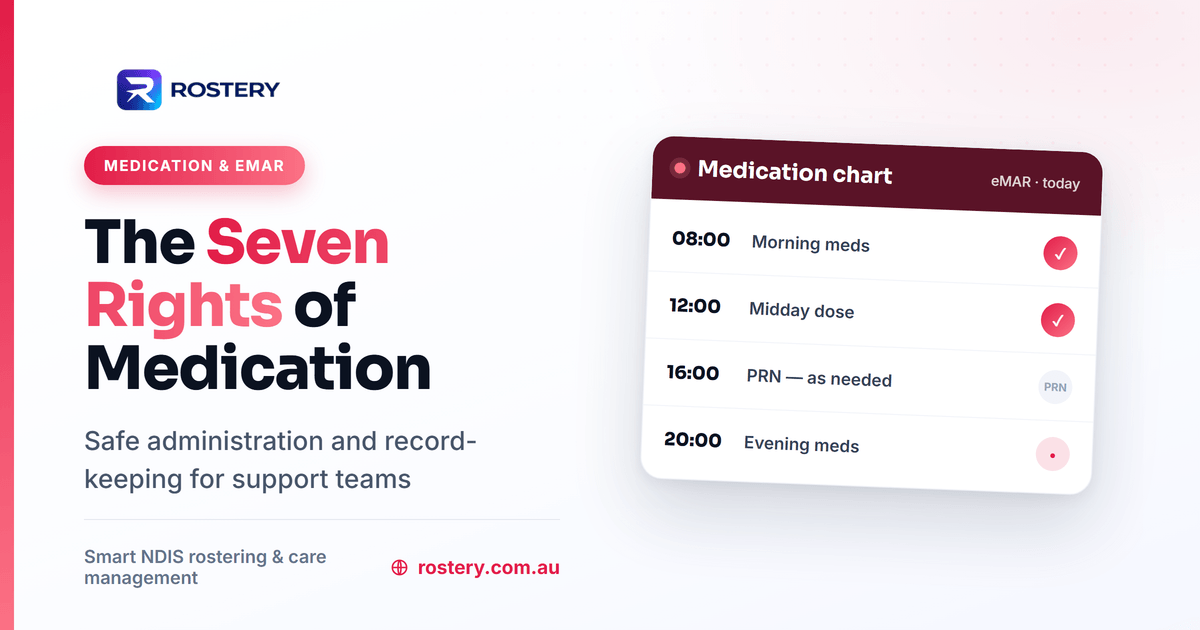
Embedding the rights into your MAR and your worker training turns an abstract principle into a repeatable safety routine. For related practice, see our guide on eMAR vs paper MAR charts, which explains how a digital record can enforce several of these rights automatically.
What your medication management policy must cover
A medication management policy is a Practice Standards expectation, and auditors will read it against what your staff actually do. A compliant policy for an NDIS provider — particularly a SIL provider — should address each of the following:
- The scope of medication support your service provides, and the clear boundary between assistance and administration.
- Worker training and competency requirements, including how competency is assessed, refreshed and evidenced.
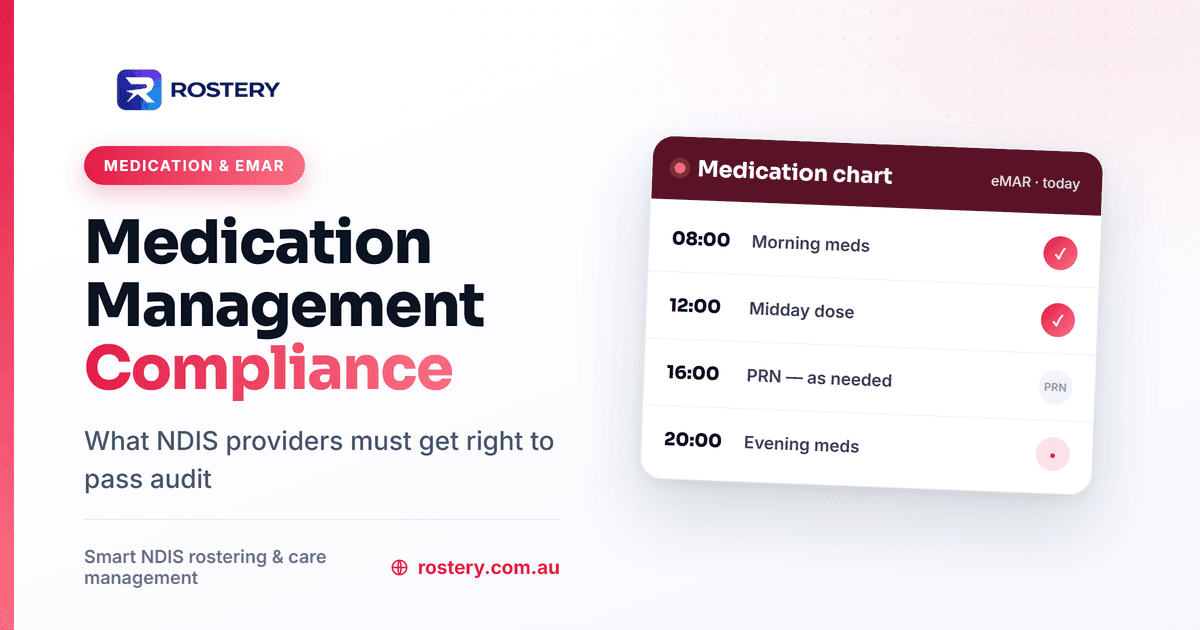
- MAR documentation standards — what is recorded, when, by whom, and how PRN (as-needed) medication is handled and justified.
- Safe storage requirements, including secure storage, temperature control where relevant, and controlled-drug handling.
- The process for medication errors and near misses — identify, respond, document, report, review.
- How participant choice, consent, dignity and the right to refuse are upheld.
- Roles and responsibilities, including clinical oversight for complex supports.
The policy is only half the picture. The other half is proof that it operates — training records, completed MARs, storage checks, error logs and the corrective actions that followed. Keeping that evidence organised is where many providers struggle, and it is exactly the kind of record-keeping that rostering and care-management software should make routine. See how Rostery supports compliant records on our features page.
When a medication error becomes a reportable incident
Not every medication error is a reportable incident — but some are, and the timeframes are strict. Under the NDIS (Incident Management and Reportable Incidents) Rules, a medication error that results in, or is likely to result in, serious harm to a participant is a reportable incident and must be notified to the NDIS Commission. Where the error has caused, or is likely to cause, a significant adverse outcome requiring emergency medical treatment, the immediate notification to the Commission is due within 24 hours, with a detailed follow-up report in the days that follow.
Regardless of whether an error meets the reportable threshold, every error and near miss should be captured in your internal incident system. When a medication error occurs, the immediate steps are:
- Assess the participant's current condition and act on any signs of harm.
- Contact the prescribing GP or an after-hours medical line for clinical advice — call emergency services if the participant is at risk.
- Notify the participant's nominated emergency contact.
- Document the error in full, including what happened, the response and the outcome.
- Assess whether it meets the reportable-incident threshold and, if so, notify the Commission within the required timeframe.
- Review the root cause and feed any corrective action into your continuous improvement register.
How to keep medication practice audit-ready every day
Audit readiness is not a scramble before the auditor arrives — it is the by-product of good daily practice. The providers who sail through medication assessment are the ones whose systems make the right action the easy action. A practical checklist to stay ready:
- Keep medication competency on every relevant worker's file current, and block rostering staff to medication shifts if their competency has lapsed.
- Use a MAR that prompts the rights of medication and timestamps each entry, so records are contemporaneous and complete.
- Run scheduled storage and stock checks and log them.
- Treat every near miss as a learning event, not just every error.
- Review medication incidents for trends and close the loop with documented corrective actions.
- Re-read your policy against your actual practice at least annually, and update it when the rules change.
Software does not make you compliant on its own — but it removes the manual gaps where compliance quietly slips. Matching only trained workers to medication shifts, enforcing contemporaneous records, and keeping evidence organised and retrievable turns medication compliance from a stressful audit event into business as usual.
Frequently Asked Questions
Do NDIS support workers need a qualification to give medication?
For assisting a participant to self-administer — prompting, reading labels, opening packaging — workers need appropriate training and a competency assessment, but not necessarily a clinical qualification. For actual administration, especially complex routes like enteral feeding, injections or suppositories, the task usually requires a registered nurse, a qualified health practitioner, or a worker specifically trained and delegated under clinical oversight in line with the High Intensity Support Skills Descriptors.
Is a medication management policy mandatory for NDIS providers?
If your service assists participants with medication, a documented medication management policy is a clear expectation under the NDIS Practice Standards, and auditors will assess both the policy and whether your staff follow it in practice. The policy should cover training, documentation, safe storage, error and incident handling, and participant rights.
When must a medication error be reported to the NDIS Commission?
A medication error that results in, or is likely to result in, serious harm to a participant is a reportable incident under the NDIS (Incident Management and Reportable Incidents) Rules. Where the error causes, or is likely to cause, a significant adverse outcome requiring emergency medical treatment, the immediate notification is due within 24 hours, followed by a detailed report. All errors and near misses, reportable or not, should be logged internally.
What is the difference between assistance with and administration of medication?
Assistance with self-administration supports a participant who directs their own medication — prompting, reminding or helping with packaging — while the participant stays in control. Administration is physically giving the medication to the person, and some routes are out of scope for a general support worker and require a qualified health practitioner or specifically trained, delegated staff.
What must a Medication Administration Record (MAR) include?
A MAR should record the participant, the medication, dose, route, time and frequency, the person who provided the support and when, and any refusal, PRN use or variation. It must be completed at the time of support rather than reconstructed later, so entries are accurate and contemporaneous — one of the key reasons many providers move from paper charts to an eMAR.