

An electronic medication administration record (eMAR) is the digital replacement for the paper MAR chart your support workers sign each time they give or prompt a medication. Instead of a printed grid filled in by hand, staff record every dose on a phone or tablet in a system that already knows what is due, for whom, and when. Across Australian disability services, NDIS providers are switching from paper to eMAR because it closes the exact gaps that cause medication errors, missed doses and audit findings — and because medication is one of the highest-risk supports a provider delivers.
This guide is for NDIS provider owners, SIL managers and support coordinators weighing up whether to move off paper MAR charts. We explain what each system actually does, where paper quietly fails, how eMAR maps to the NDIS Practice Standards and the Quality and Safeguards Commission’s expectations, what it means for reportable incidents, and a practical checklist for making the switch without disrupting care.
What is a MAR chart, and what is an eMAR?
A Medication Administration Record (MAR) is the primary record that a medication was administered, prompted or withheld. On paper, it is a printed chart — often supplied by the dispensing pharmacy — with a grid of medications down one side and dates and times across the top. A worker initials the box when a dose is given, and uses agreed codes for a refusal, a withheld dose or a PRN (as-needed) medication.
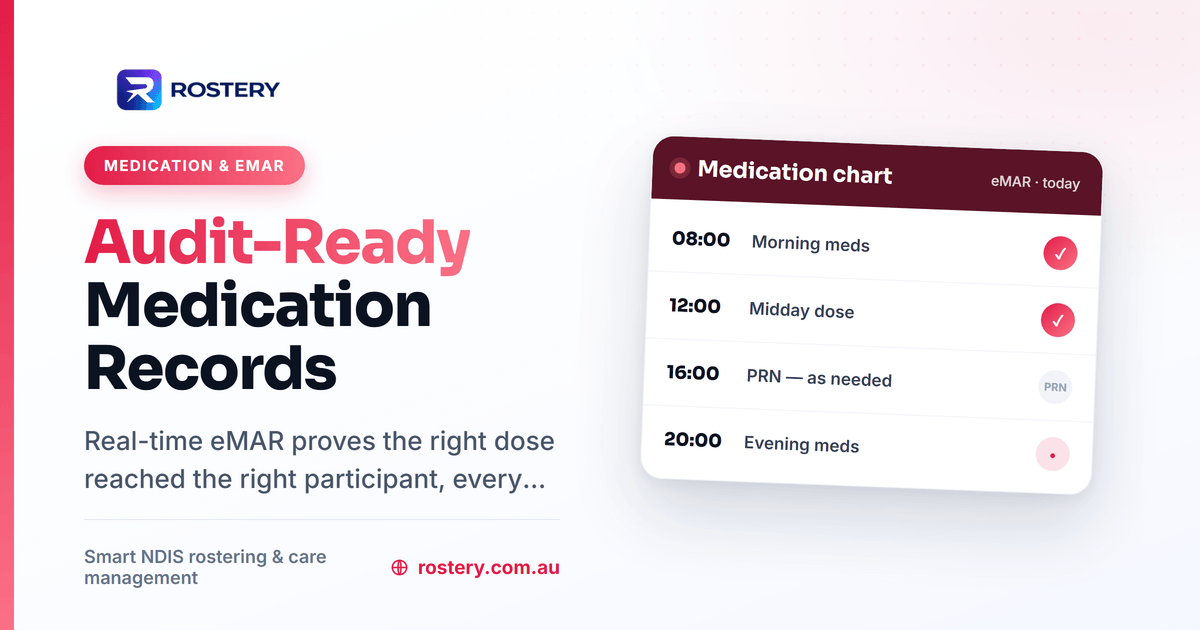
An eMAR is the same record delivered digitally. The medication list, doses, times and administration routes are set up once; the system then prompts the worker when a dose is due, records exactly who administered what and when, and flags anything that has been missed. The shift from paper to eMAR is not just a format change — it changes when a gap becomes visible, from a retrospective audit weeks later to the moment a dose is due.
Why NDIS providers are moving off paper MAR charts
Paper MAR charts fail in well-documented, predictable ways. None of these are exotic edge cases — every provider who has run paper charts at scale will recognise them:
- Illegible entries. Handwriting and hurried initials make it hard to tell who administered a dose, or whether it was given at all.
- Transcription errors. Every time a medication is copied from a script to a pharmacy chart to a worker’s notes, there is a fresh chance to introduce a wrong dose, wrong time or wrong participant.
- Silent gaps. A blank box on paper is ambiguous — was the dose missed, refused, or simply not signed? You usually find out weeks later during a chart review, not when it matters.
- No real-time oversight. A coordinator cannot see from the office whether the evening medications in an SIL house have been given without physically checking the chart.
- Lost or damaged charts. Paper gets coffee-stained, filed in the wrong folder, or left in a house the worker has finished at.
eMAR is designed to remove each of these failure modes. It prompts staff when medication is due, requires an active response for every dose (given, refused, or withheld with a reason), makes missed doses visible immediately rather than at a later audit, and produces a legible, time-stamped, attributable record for every administration. That last point matters enormously in a regulated setting: an auditor or investigator can reconstruct exactly what happened, in order, without deciphering handwriting.
How eMAR reduces medication errors
Medication support in disability services runs on a simple discipline often called the rights of medication administration — the right participant, the right medication, the right dose, the right route, the right time, and the right documentation. Paper relies on the worker holding all of that in their head and recording it accurately after the fact. eMAR builds the checks into the workflow itself.
- The right participant and medication are pre-loaded and displayed, rather than recalled or copied by hand.
- The right time is enforced with due-dose prompts and time stamps, so a late or early administration is captured rather than back-filled.
- The right documentation is automatic — the record is created at the point of care, legibly, with the worker’s identity attached.
- Missed and refused doses require an explicit reason, turning an ambiguous blank box into a clear, actionable record.
The effect is not that workers stop making judgements — they still do — but that the system catches the ordinary human slips that paper lets through unnoticed. Reputable research reviewed by the National Library of Medicine and guidance from bodies such as the UK’s Care Quality Commission consistently associate manual, paper-based medication processes with higher rates of documentation and administration error, and digital records with better legibility, completeness and timeliness. We have deliberately not quoted a single “error reduction” percentage here, because the figures vary widely by setting and study; the direction of the evidence, however, is not seriously in dispute.
eMAR and the NDIS Practice Standards
Medication management is not optional under the NDIS. The NDIS Practice Standards, published by the Quality and Safeguards Commission, include a specific Management of Medication outcome: each participant who requires medication must be confident their provider administers, stores, monitors and records it safely. An approved quality auditor tests this at your certification or verification audit, and the evidence they look for is precisely what an eMAR generates as a by-product of normal practice.
Providers delivering high-intensity medication tasks — for example subcutaneous injections or medication via an enteral (PEG) feeding tube — face an extra layer. Under the NDIS high intensity support skills descriptors, updated by the Commission in September 2024, workers must have competency-based training delivered by an appropriately qualified health practitioner before they provide that support, and the Commission recommends ongoing competency assessments and refreshers — including when a person’s needs change or when a worker has not provided the support for three months or more. eMAR does not replace that training, but it does give you the audit trail to show which trained worker administered which high-intensity medication, and when. If you are building or reviewing your policy, our guide to the new SIL registration group 0138 explains how medication management fits the wider compliance picture for supported independent living.
Medication errors are a safeguarding issue, not just a paperwork one
It is easy to think of MAR charts as administration. In the NDIS they are a safeguarding control. A medication error — a wrong dose, a missed dose, or medication given to the wrong participant — can cause serious harm and can meet the threshold of a reportable incident that must be notified to the NDIS Quality and Safeguards Commission within the required timeframes. When that happens, the first thing anyone asks for is the record: what was supposed to be given, what was actually given, by whom, and when.
With paper, answering that question can mean hunting through folders and interpreting initials, sometimes with critical detail missing. With eMAR, the timeline is already assembled — every administration attributed and time-stamped — so you can respond to an incident quickly, take corrective action, and demonstrate to the Commission that your medication system is working as intended. That speed and completeness is the difference between a controlled response and a scramble.
What switching from paper to eMAR involves
Moving off paper does not have to be disruptive if you sequence it properly. A practical rollout for an NDIS provider looks like this:
- Map your current medication list per participant. Confirm each medication, dose, route, time and any PRN protocols against the current script and pharmacy chart before anything is entered digitally.
- Set up the eMAR with the same clinical detail. Enter medications, schedules, PRN rules and withhold/refusal codes so the digital record mirrors the participant’s real regimen.
- Run parallel for a short window. Keep paper alongside eMAR for a defined handover period so staff build confidence and you can reconcile the two.
- Train and check competency. Make sure every worker can record an administration, a refusal and a PRN dose on the device, and that high-intensity tasks are covered by the required health-practitioner-led training.
- Switch off paper and monitor. Once parallel running is clean, retire the paper chart and use the eMAR’s missed-dose and compliance reporting to supervise administration in real time.
The right software makes this easier because eMAR is not a standalone tool — it should sit alongside your rostering, progress notes and incident logging so the worker on shift records the medication in the same app they use for everything else. You can see how Rostery approaches this on the eMAR medication management feature page, and how it connects to the rest of your operations on the features overview.
Paper MAR vs eMAR: a side-by-side summary
If you strip it back to what matters for an NDIS provider, the comparison is stark:
- Legibility: paper depends on handwriting; eMAR is always clear and attributable.
- Missed doses: paper shows an ambiguous blank; eMAR flags the gap in real time and demands a reason.
- Oversight: paper must be physically checked in the house; eMAR gives coordinators live visibility across every site.
- Audit evidence: paper must be assembled and interpreted; eMAR produces a complete, time-stamped record on demand.
- Incident response: paper slows reconstruction; eMAR delivers the timeline immediately.
Paper still “works” in the sense that a diligent team can run it — but it puts the burden of accuracy entirely on people, at the exact point where an error causes the most harm. eMAR moves that burden into the system.
Frequently Asked Questions
What is the difference between a MAR chart and an eMAR?
A MAR chart is the record that a medication was administered, prompted or withheld. On paper it is a printed grid a worker initials by hand; an eMAR is the same record kept digitally, where the system knows what is due and when, prompts the worker, requires a response for every dose, and produces a legible, time-stamped, attributable record. The information captured is the same — eMAR just makes it more reliable and easier to audit.
Is eMAR required under the NDIS?
No specific technology is mandated. The NDIS Practice Standards require registered providers to administer, store, monitor and record medication safely under the Management of Medication outcome, but they do not prescribe paper or electronic. eMAR is popular because it makes meeting that outcome — and producing the evidence at audit — far easier and more consistent than paper.
Does eMAR help with NDIS audits?
Yes. An approved quality auditor assessing your medication management wants to see accurate, complete, attributable records of administration. eMAR generates exactly that as a by-product of daily practice, so instead of assembling and deciphering paper charts before an audit, you can produce a clean, time-stamped record for any participant and period on demand.
What happens if a medication error occurs under eMAR?
A medication error can be a reportable incident that must be notified to the NDIS Quality and Safeguards Commission within the required timeframes. eMAR does not prevent every error, but it makes them visible sooner and gives you an immediate, complete timeline — what was due, what was given, by whom and when — so you can respond, take corrective action and evidence your response to the Commission quickly.
How hard is it to switch from paper MAR charts to eMAR?
Manageable if you sequence it: verify each participant’s medication list, set up the eMAR to mirror it, run paper and digital in parallel for a short window, train staff and confirm competency, then retire paper. Choosing eMAR that is built into your rostering and notes software rather than a standalone tool reduces the change for support workers, because they record medication in the same app they already use.


