Running a Supported Independent Living (SIL) house is one of the most operationally demanding things an NDIS provider can do. You are coordinating 24/7 staffing, blending the needs of several participants under one roof, documenting every support, and doing it all against the NDIS Practice Standards and the SCHADS Award. This guide walks through SIL provider operations end to end — from the roster of care and staffing ratios to shared supports, participant agreements, and the daily systems that keep the home compliant and sustainable.
If you are new to SIL or tightening up an existing house, the short answer is this: strong SIL operations come down to getting the roster of care right, matching staffing to each participant's funded support needs, running clean documentation, and treating compliance as a daily habit rather than an audit-week scramble. We will cover each of those below.
What Supported Independent Living Actually Covers
Supported Independent Living is funding for a support worker to help or supervise a participant with daily tasks so they can live as independently as possible — often up to 24 hours a day, seven days a week. SIL is usually delivered where participants live with housemates who also have NDIS funding and share some supports, although it can also be delivered to a person living on their own.
SIL funding sits in the Core Supports budget and is quoted individually for each participant based on their assessed support needs and goals. Critically, SIL pays for the support — the active and supervisory assistance — not the rent or the property. Housing is funded separately (for example through Specialist Disability Accommodation or the participant's own income), and keeping those two things cleanly separated in your records is an operational must.
From a registration standpoint, SIL is a registered support: providers must be registered, or have applied to register, before 1 October 2026 to continue delivering it. That makes your operational systems and evidence directly relevant to keeping (or gaining) registration.
The Roster of Care: Your Operational Backbone
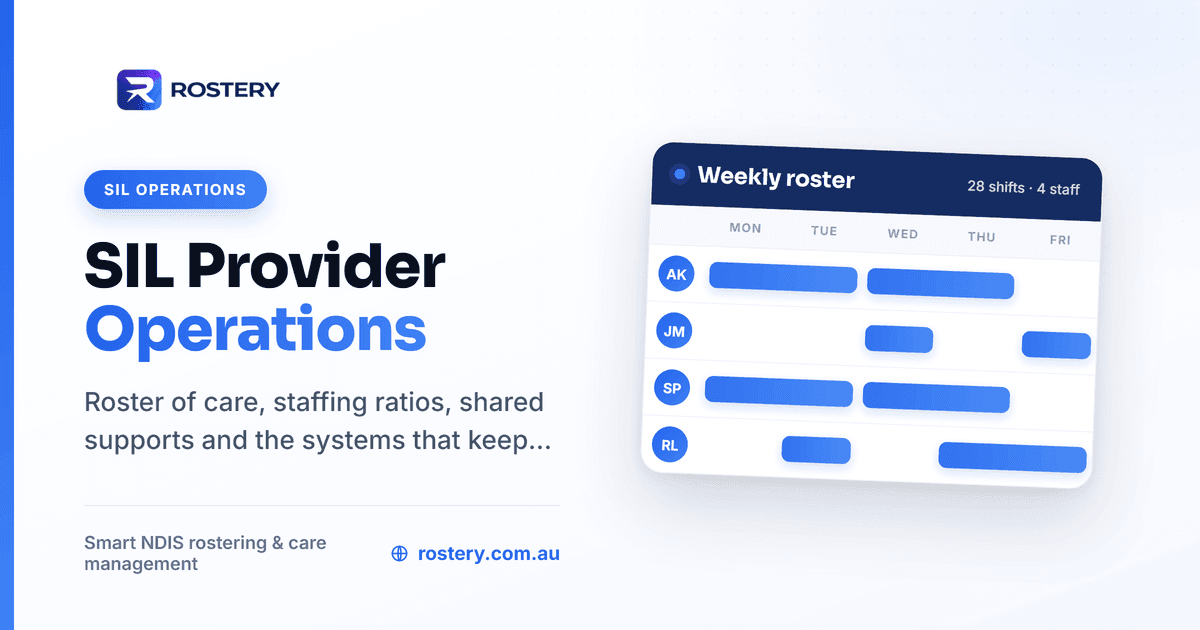
The roster of care (ROC) is the single most important operational document in a shared SIL home. It describes how all residents in a shared living arrangement contribute to and receive supports — what is delivered, when, and by how many staff at each point in the day.
A common misconception is that the ROC is a mandatory submission. It is not. According to NDIS guidance, a roster of care is not a requirement and you do not need to submit it to the agency. It is a tool to help you and your participants understand what supports are in the home each week and how they will be delivered. That said, the NDIA may use a participant's roster of care, alongside other supporting information, to help determine the reasonable and necessary supports in that participant's plan — so an accurate, well-built ROC protects both the participant's funding and your margin.
A workable roster of care should:
- Break the week into time blocks and specify the staffing ratio at every point in the day (for example 1:3 during the day, 1:2 in the evening, and overnight active or sleepover support).
- Separate shared supports (delivered to the house as a group) from one-to-one supports funded for an individual participant.
- Reflect each participant's actual assessed needs, not an averaged assumption across the house.
- Account for high intensity and irregular supports where relevant, rather than burying them in a general ratio.
Staffing Ratios and Shared Supports
Getting staffing ratios right is where SIL operations live or die financially. In a shared arrangement, some supports are genuinely shared — a single worker supervising three participants during a quiet afternoon — while others are individual, such as personal care that only one participant needs. Your roster of care must make that split explicit so claims are accurate and defensible.
Matching ratios to funded need
Each participant's SIL funding is built around their own support level, commonly described as lower, standard, or higher need. When you combine participants in a house, the ratio at any given time should reflect who is actually present and what support they require at that hour — not a blanket figure. Over-rostering erodes your margin; under-rostering risks participant safety and non-conformance at audit.
Overnight supports
Overnight support in SIL is typically delivered as either active overnight (the worker is awake and available throughout the night) or a sleepover (the worker sleeps on site but is available if needed). The distinction matters for both participant safety and payroll: sleepovers attract a SCHADS sleepover allowance plus payment for any hours actually worked during the night, whereas active overnight is paid as ordinary or penalty hours. Mapping which model applies to each night in your roster of care prevents both underpayment claims and over-claiming.
Practice Standards and Governance for SIL
SIL providers must comply with the NDIS Practice Standards Core Module and the supplementary module for Supported Independent Living, assessed by an approved quality auditor and overseen by the NDIS Quality and Safeguards Commission. The SIL module strengthens expectations around participant choice and control, supported decision-making, safeguarding, practice governance, and the agreements that cover tenancy, housing, and support arrangements.
Operationally, that means your house needs documented evidence for things like:
- Clear, signed service agreements that separate support from accommodation and set out what each participant can expect.
- Individualised support plans that connect each person's goals to the supports on the roster.
- Safeguarding processes — incident management, complaints handling, and restrictive practice authorisation and reporting where relevant.
- Practice governance: who is accountable for quality, how risks are reviewed, and how continuous improvement is recorded.
Where a participant relies on high intensity daily personal activities — such as complex bowel care, enteral feeding, severe dysphagia management, or seizure management — your workers must meet the Commission's high intensity support skills descriptors. The revised descriptors came into effect on 1 February 2026 and are actively applied at audit, so staff competency records should be current and matched to each participant's needs.
Daily Operations: Documentation and Handover
The difference between a well-run SIL house and a stressful one usually shows up in the daily detail. Participants in SIL often have complex needs and several workers across a 24-hour cycle, so information has to move cleanly between shifts.
A reliable daily operating rhythm includes:
- Structured handovers at every shift change, so no medication, appointment, or behaviour-of-concern falls through the cracks.
- Progress notes written against each participant's goals, not generic shift summaries.
- Medication administration records — increasingly electronic — that log every dose, refusal, and PRN decision.
- Incident recording that captures reportable incidents within the Commission's timeframes.
- Timesheets and shift records that tie back to the roster of care and your SCHADS pay rules.
When these are run on paper and spreadsheets, errors compound: missed claims, unpaid allowances, and gaps that surface at audit. This is exactly where purpose-built software earns its place — connecting the roster of care, worker records, medication charts, and payroll in one system. Rostery's care and workforce management platform is designed around this SIL workflow, linking rosters, SCHADS-aware pay interpretation, and compliant records so the daily grind does not become a compliance liability.
Common SIL Operational Mistakes to Avoid
Across SIL houses, the same operational problems recur. Watch for these:
- Averaging ratios instead of rostering to who is present and what they need at each hour.
- Blurring support and accommodation in agreements or invoices, which invites both claiming errors and audit findings.
- Treating the roster of care as a set-and-forget document rather than updating it when a participant's needs or plan changes.
- Under-recording overnight support, so sleepover allowances and disturbed-sleep hours go unclaimed and workers are underpaid.
- Thin competency evidence for high intensity supports, which is one of the fastest routes to a non-conformance.
For a deeper look at the registration side of running SIL — including the new SIL registration group and what the Commission expects — see our guide on the new SIL registration (Group 0138).
Building SIL Operations That Scale
As you add houses, manual coordination stops scaling. The providers who grow sustainably standardise their operations: a consistent roster-of-care template, defined ratio bands, documented handover and medication processes, and a single source of truth for who worked when and against which support. That consistency is what lets you open a second or third house without multiplying your administrative risk.
In practice, that means investing early in:
- A roster of care that is maintained, not rebuilt from scratch each plan cycle.
- Rostering that enforces ratios and flags understaffed blocks before the shift, not after.
- Payroll that interprets SCHADS automatically so sleepovers, broken shifts, and penalties are right the first time.
- Records — notes, incidents, medication — that are audit-ready on demand.
Get those four right and SIL operations shift from reactive firefighting to a predictable, compliant routine that is good for participants, fair for workers, and viable for your business.
Frequently Asked Questions
Is a roster of care mandatory for SIL providers?
No. NDIS guidance is clear that a roster of care is not a requirement and does not need to be submitted to the agency. It is a planning tool. However, the NDIA may use a participant's roster of care alongside other information to help determine reasonable and necessary supports, and it is extremely useful operationally — so most providers build and maintain one.
Does SIL funding pay for rent or accommodation?
No. SIL funds the support — the active and supervisory assistance a participant needs to live independently. Rent and accommodation are funded separately, for example through Specialist Disability Accommodation or the participant's own income. Keeping support and accommodation cleanly separated in agreements and invoices is an operational requirement.
Do SIL providers need to be registered?
Yes. Supported Independent Living is a registered support. Providers must be registered, or have applied to register, before 1 October 2026 to keep delivering SIL. Registration involves meeting the NDIS Practice Standards Core Module and the SIL supplementary module, assessed by an approved quality auditor.
How are staffing ratios set in a shared SIL home?
Ratios are set against each participant's assessed support needs and the mix of participants present at each point in the day, then documented in the roster of care. The ROC specifies the staffing ratio at every time block and separates shared supports from one-to-one supports, so the arrangement is both safe and accurately claimable.
What is the difference between active overnight and sleepover support?
Active overnight means the worker stays awake and available throughout the night and is paid for those hours. A sleepover means the worker sleeps on site but is available if needed; under SCHADS this attracts a sleepover allowance plus payment for any time actually worked during the night. Which model applies should be mapped per night in your roster of care.