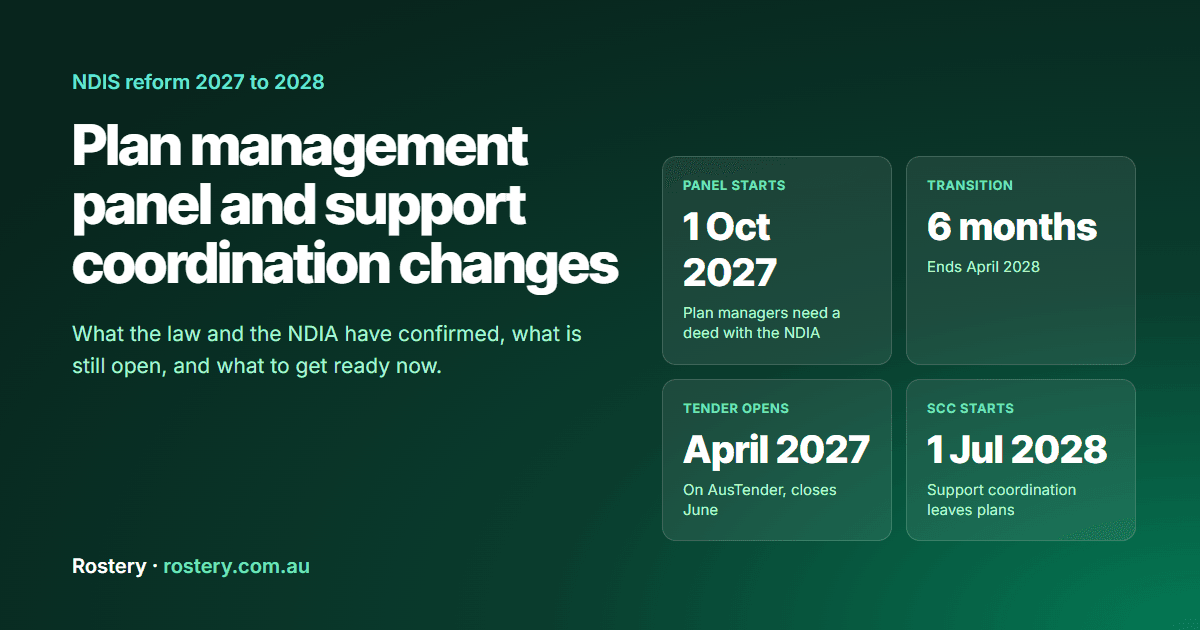
From 1 October 2027 the NDIA will run a panel of plan management providers, and only plan managers on that panel will be allowed to deliver plan management once a 6-month transition ends in April 2028. The NDIA will open the tender on AusTender from April 2027 and close it in June. Support coordination changes nine months later: from 1 July 2028 the NDIA will contract providers directly to deliver a new Support Coordination and Connection (SCC) service, and support coordination will no longer be funded in participants' plans. Checked against the Act, the NDIA and the department on 13 November 2026.
In short
- Plan management: an NDIA panel from 1 October 2027. Plan managers have to win a place through an approach to market on AusTender (April to June 2027).
- The law is already passed. A plan manager must have a deed of arrangement with the NDIA to stay registered, and a registered plan manager cannot provide any other NDIS supports.
- Plan managers not on the panel can keep their existing participants for 6 months, then must stop.
- Support coordination: the NDIA commissions a new SCC service from 1 July 2028. The department's early preference is one lead organisation per region. Eligibility, regions and the payment model are not decided.
- Now: get your claiming accuracy, invoice turnaround, verification, conflicts and records into a state you could show the NDIA.
What is the NDIS plan management panel?
It is a closed list of plan managers chosen by the NDIA. Today any provider registered with the NDIS Commission for plan management (registration group 0127) can take on plan-managed participants. The amended NDIS Act replaces that open market: a person can only be registered to manage the funding in participants' plans if a deed of arrangement with the NDIA is in force, and the NDIA must keep a public register of registered plan management providers.
The revised explanatory memorandum for the Act says there were 1,455 active plan management providers in the second quarter of 2025-26, many with 20 participants or fewer, and that around 60 per cent of NDIS funding is paid through plan managers. It describes the market as having widespread integrity problems: claims not properly verified, conflicts of interest, plan managers paying their own invoices for other services such as support coordination, and payments made without the participant confirming the service was received.
The NDIA says it is also changing how plan management services are priced, although no new fees are published.
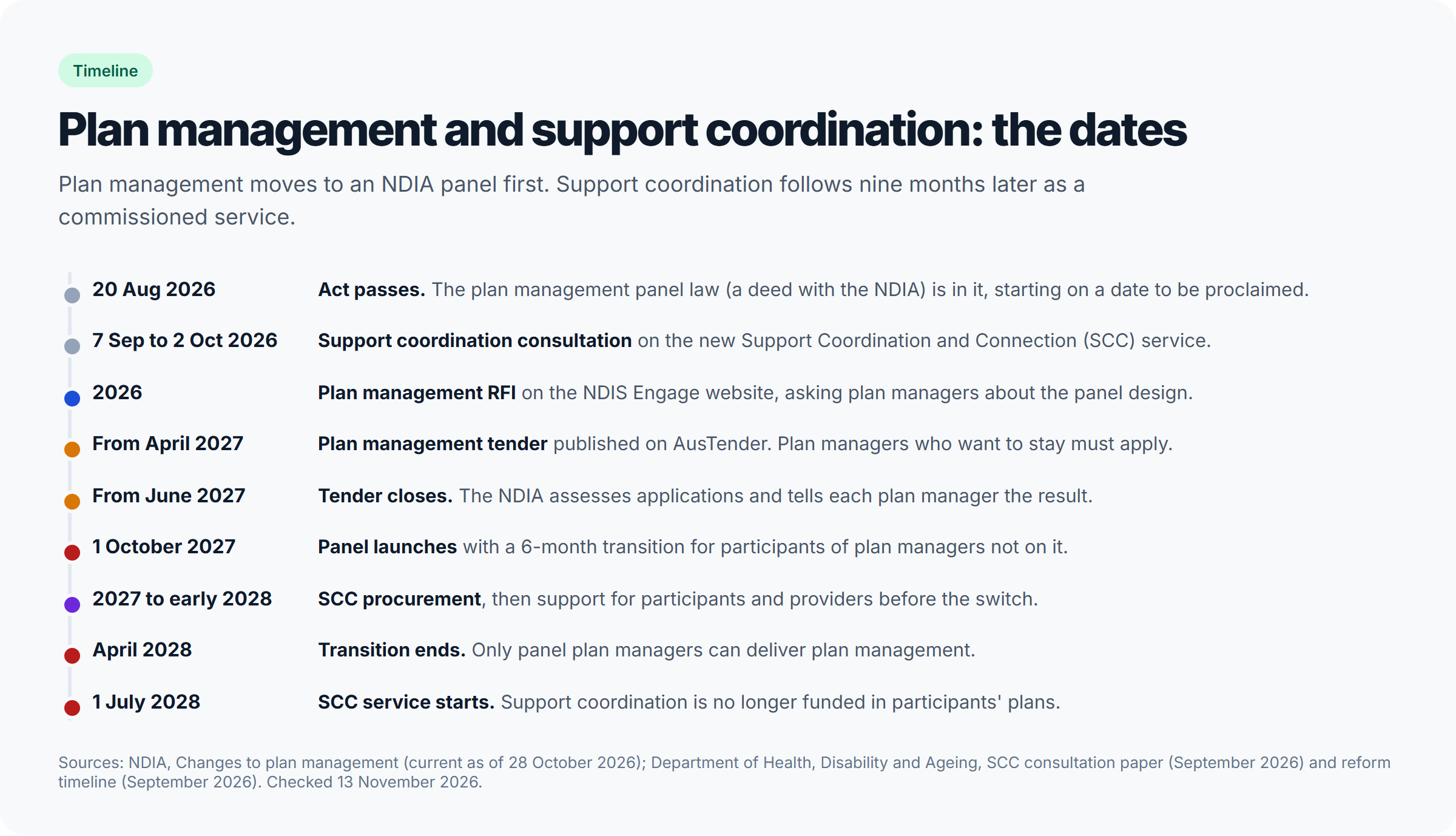
Plan management panel timeline
These dates come from the NDIA's Changes to plan management page (current as of 28 October 2026) and the department's reform timeline.
| When | What happens | What it means for a plan manager |
|---|---|---|
| 20 August 2026 | The Securing the NDIS for Future Generations Act receives Royal Assent. Schedule 2, Part 6 sets up the deed requirement. | The legal frame is fixed. The start date is set by Proclamation. |
| 2026 | The NDIA asks plan managers for feedback through a request for information (RFI) on the NDIS Engage website. | Your chance to comment on the panel design before the rules are written. |
| From April 2027 | The approach to market opens on AusTender, with the requirements to be selected. | Apply here if you want to keep delivering plan management. |
| From June 2027 | Applications close. The NDIA assesses them and tells each provider the result. | You learn whether you are on the panel. |
| 1 October 2027 | The panel launches. A 6-month transition starts. | Not selected: you can keep serving your existing participants until they move. |
| April 2028 | The transition ends. | Only panel members can deliver plan management. |
One detail in the Act matters for anyone planning around these dates. Schedule 2, Part 6 starts on a day fixed by Proclamation, and if that has not happened within 24 months of Royal Assent it starts automatically on 1 September 2028. The government's stated date is 1 October 2027, so treat that as the working date and watch for the Proclamation.
What the law requires of a panel plan manager
The new section 73EA lists what every deed of arrangement must include. The deed itself is not published yet, but the headings are law.
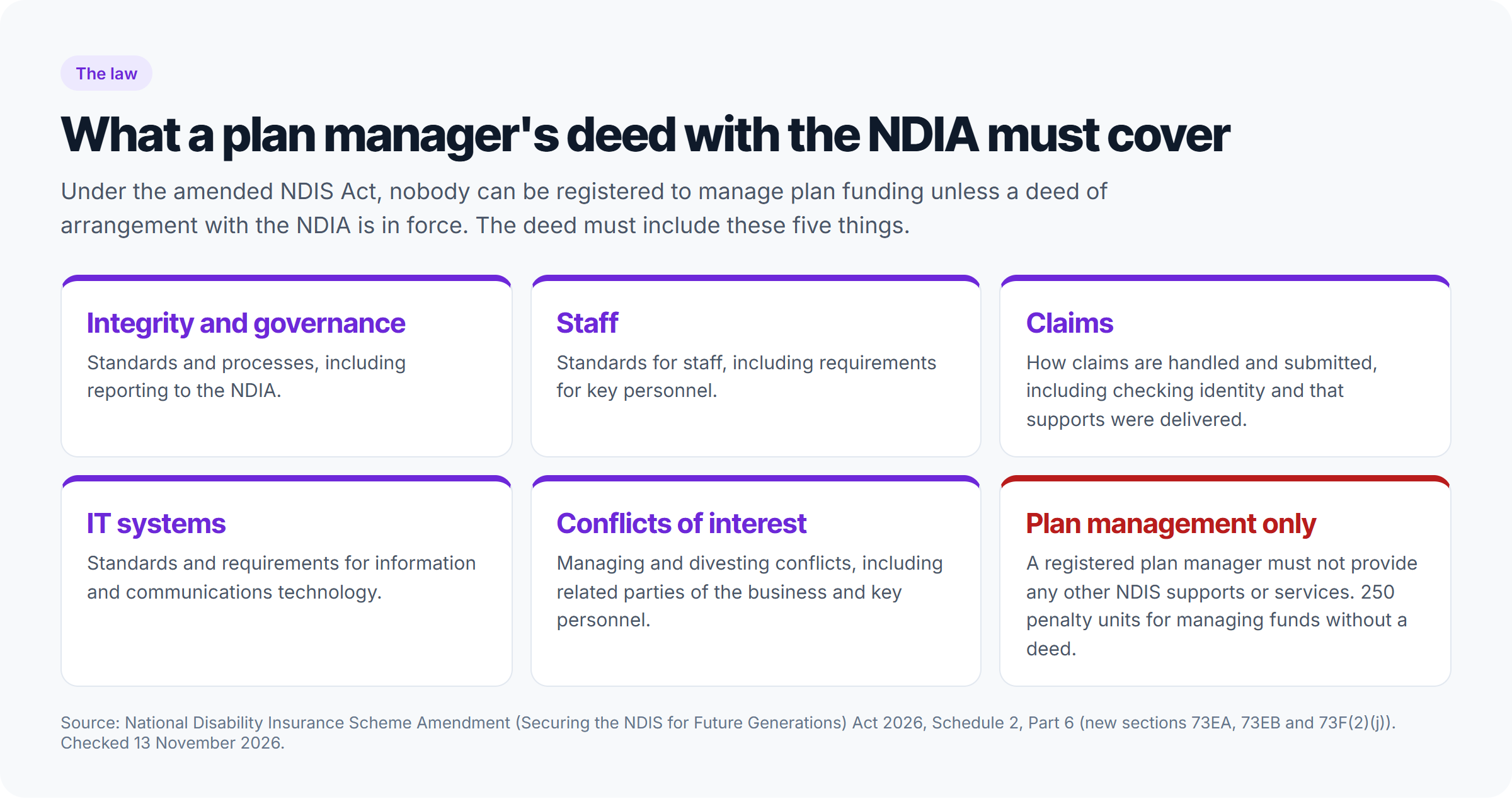
The explanatory memorandum gives examples of what the deed "might" include: board oversight and risk policies, regular suitability checks on key personnel covering criminal history and bankruptcy, auditable processes that pick up risky claiming, systems that meet NDIA technical specifications, and a ban on direct referrals between related parties. They show the likely direction; the final terms are not published.
Plan managers can only do plan management
The Act adds a condition to every plan manager's registration: a registered plan management provider must not provide any supports or services other than plan management under the NDIS. The Commissioner also cannot register someone for plan management while they are registered, or applying, for other supports, and the reverse. If your business runs plan management alongside support coordination, support work or therapy, those can no longer sit in the same registered entity.
The conflict rule does not bite during the 6-month transition, which gives panel members time to divest related businesses. Managing plan funding without a deed in force carries a civil penalty of 250 penalty units, also switched off for existing participants during the transition.
What happens to participants and plan managers not on the panel
Participants keep the right to be plan-managed. They choose a plan manager from the panel instead of from the open market. If their current plan manager is selected, nothing changes for them. If it is not, the NDIA says it will support them to move to a panel member during the 6 months.
A plan manager that misses out can keep serving the participants it already had at the start of the transition, as long as they have not already switched, and must stop when the transition ends. The department's talking points, released under freedom of information, add two points: the number of panel members will depend on an open competitive process, and plan management funding in plans will be updated at each participant's next reassessment to reflect any new fees.
Support coordination: the new SCC service from 1 July 2028
The department's consultation paper, open from 7 September to 2 October 2026, sets out early ideas for the Support Coordination and Connection service. The final design is a decision for the government, so everything below is a proposal.
- The NDIA would contract organisations to deliver SCC within defined geographic areas. The paper says the preferred model, on early thinking, is one lead organisation per region that delivers or subcontracts all SCC in that region. A multi-provider model is still under consideration.
- There would be two levels: SCC, and SCC+ for a small group with very complex circumstances. Today there are three levels of support coordination plus psychosocial recovery coaching.
- The NDIA would decide who is eligible, using criteria the government agrees. The paper lists decision-making capacity, safety risk, stability of supports and needs, understanding of the system, involvement with several systems and risk of disengagement.
- The hourly fee-for-service model would be replaced by a payment model still to be designed.
- SCC organisations and workers could not provide other NDIS supports.
- Procurement would run in 2027, with early 2028 set aside to prepare participants and providers.
The paper puts the current market at about 11,000 support coordinators. Some organisations may become SCC providers and others will stop delivering support coordination from 1 July 2028, with staff possibly moving into SCC roles. Until then, support coordination continues as it is.
| Today | Proposed SCC service |
|---|---|
| Participants pay for support coordination from their plan | No support coordination funding in plans. The NDIA funds SCC directly |
| Thousands of providers in an open market | The NDIA contracts an organisation for each area, so fewer providers |
| Three levels plus psychosocial recovery coaching | Two levels: SCC and SCC+ |
| Paid by the hour | A new payment model, not yet designed |
| Support coordinators can also deliver other NDIS supports | SCC organisations and workers cannot |
| No consistent standards for support coordination | The same standards for all SCC services, with performance reporting through contracts |
Registration is a separate thread. The NDIS Commission had looked at mandatory registration for support coordination alongside SIL, but its reform hub says that work is paused while the wider reform is considered. The paper lists registration or accreditation as one possible quality element for SCC.
What is decided and what is not
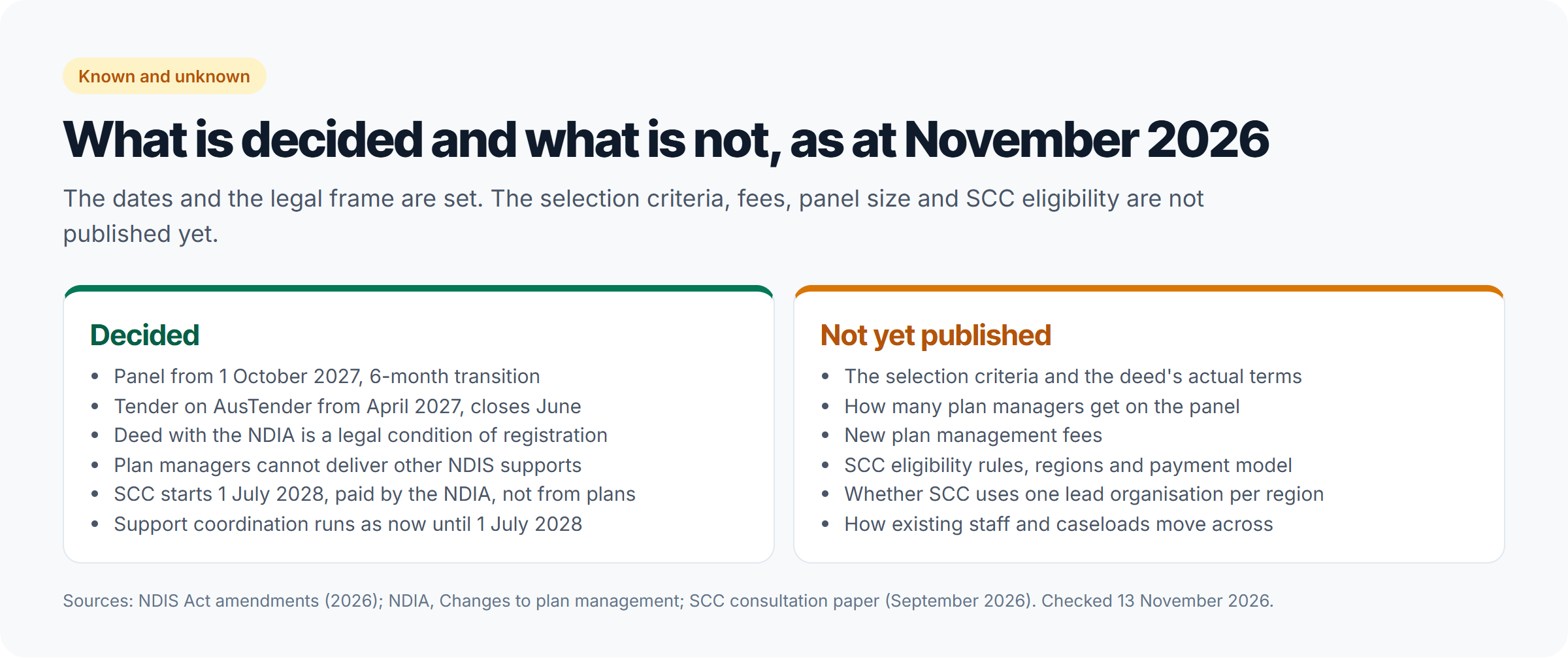
| Question | Status at 13 November 2026 |
|---|---|
| Will the plan management panel start on 1 October 2027? | That is the government and NDIA date. Legally it starts on Proclamation, and by 1 September 2028 at the latest. |
| What are the selection criteria? | Not published. They will be in the approach to market from April 2027. |
| What will the deed say? | Only the headings are known, from section 73EA. |
| How many plan managers will be on the panel? | Not decided. It depends on the tender. |
| What will plan managers be paid? | Not published. The NDIA says pricing is changing. |
| Who will be eligible for SCC? | Not decided. The government will agree the criteria. |
| One lead organisation per region, or several providers? | Not decided. Lead organisation is the early preference. |
| Will support coordinators need to be registered? | The NDIS Commission has paused mandatory registration for support coordination. SCC quality requirements are still being designed. |
What plan managers should do now
The deed headings show where the tender will want evidence, and most of it comes from records you already keep.
- Check your NDIS Commission registration for plan management is current, with audit results and any conditions on file.
- Measure claiming accuracy: how many lines the NDIA rejects, why, and how quickly they are fixed and reclaimed. A month-by-month figure is more convincing than an average.
- Measure invoice processing time from the day an invoice arrives to the day the provider is paid, in business days, and break it into stages so you can see where invoices wait.
- Write down how you confirm a support was delivered before you pay, and how you check a provider's bank details when they change. Invoice redirection is a known fraud, and the deed will cover claims verification.
- List every related party and every other NDIS service your group or your key people run. Decide early what you would divest if you win a place, because a panel plan manager can only do plan management.
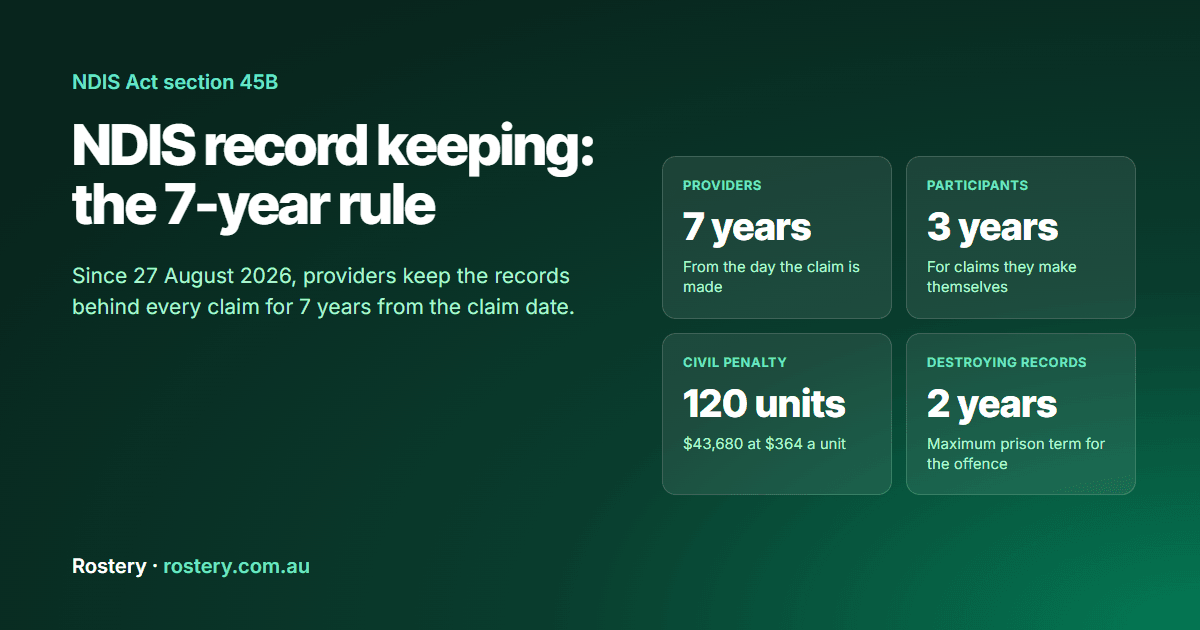
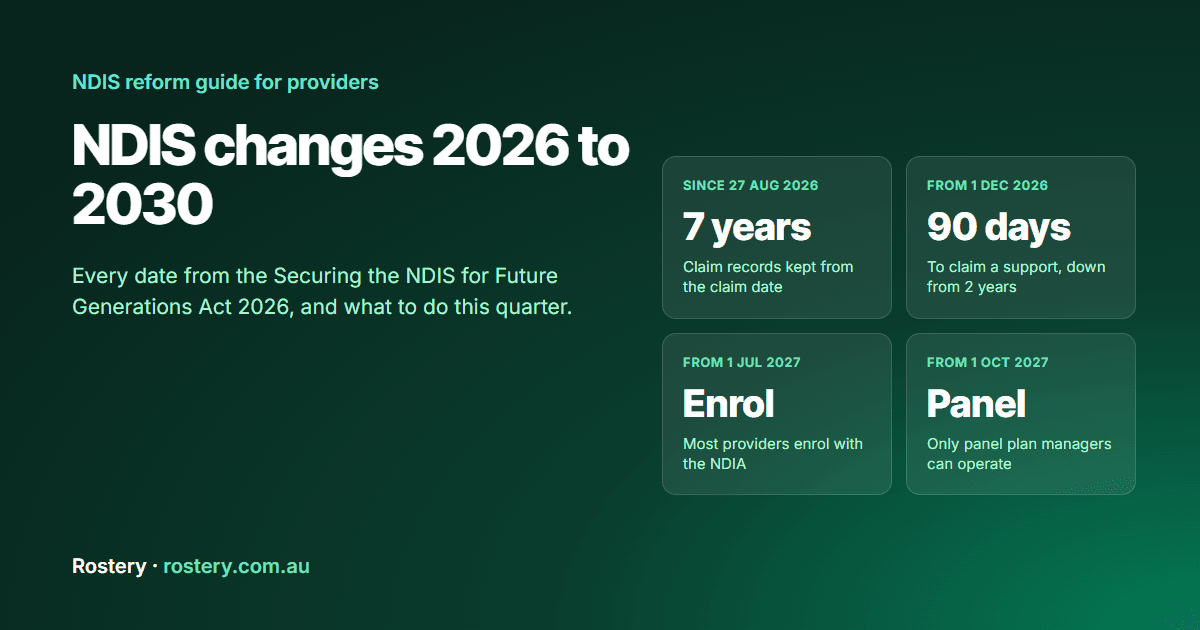
- Get records in order. Claim records have had to be kept since 27 August 2026. The government's timeline says 3 years for plan managers and 7 for providers, while the Act's default for an NDIS provider is 7 years unless NDIS rules set a shorter period. Our record keeping guide covers the detail.
- Claim on time. From 1 December 2026 claims must be made within 90 days of the support, so a slow invoice queue now costs money. See the 90-day claim rule.
- Build monthly reporting you could hand the NDIA: volumes, turnaround, rejections and complaints.
- Watch the NDIS Engage website for the plan management RFI and AusTender for the approach to market from April 2027. We could not confirm the RFI's open date at the time of writing.
What support coordinators should do now
SCC providers will be chosen on merit. The criteria are not published, so these steps build evidence you will want under any model.
- Record outcomes against each participant's goals: where they started, what you measured and what changed. "Evidence of outcomes" is hard to produce later from case notes alone.
- Keep progress reports, mid-plan and end-of-plan reports on file with dates, so you can show what you reported and when.
- Check that time entries, case notes and claims match. Over and under servicing under hourly billing is one of the problems the paper names.
- Write down your referral pathways and local links (health, housing, justice, community). The paper says SCC organisations will need strong local links and established referral pathways.
- If you also deliver other NDIS supports, plan for a future where SCC is a separate business. The proposal is that SCC organisations and workers cannot provide other NDIS supports.
- Talk to other providers in your area. Under a lead organisation model, smaller coordinators may deliver as subcontractors or partners.
Readiness checklist
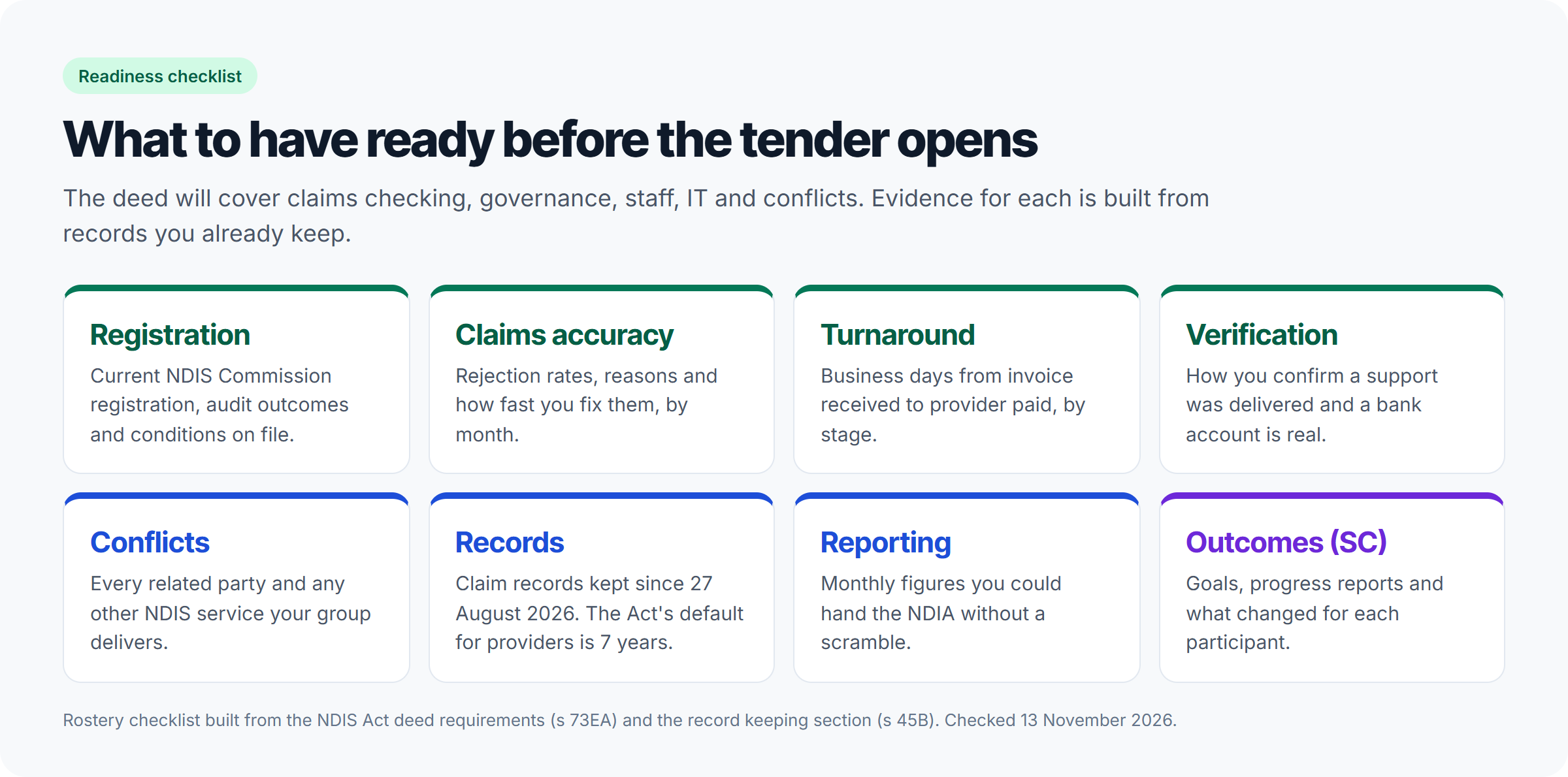
| Area | Plan managers | Support coordinators | Evidence to keep |
|---|---|---|---|
| Registration | Current 0127 registration, audit results, conditions | Registration if you hold it (not mandatory for support coordination) | Certificates, audit reports |
| Claiming accuracy | Rejection rate and reasons by month | Claims that match time and case notes | NDIA results files, error logs |
| Processing time | Business days from invoice received to provider paid | Time from referral to first contact | Dated workflow records |
| Verification | How delivery is confirmed and bank changes are checked | Who approved each claim line | Audit trail with names and dates |
| Conflicts | Related parties, other NDIS services in the group | Other NDIS supports your organisation delivers | Conflict register |
| Records | Invoices behind every claim | Case notes, reports, agreements | Retention policy and storage |
| Reporting | Monthly operational figures | Caseload, contact hours, outcomes | Saved monthly reports |
| Outcomes | Participant complaints and resolution | Goals, measures, progress and end-of-plan results | Goal records, progress reports |
How Rostery helps plan managers and support coordinators get ready
Rostery is our software, so here is plainly what its Plan Management and Support Coordination modules do today. Nobody knows the deed's terms yet, and no software can promise a panel place.
- Every provider invoice goes through checks before it can be claimed: price within the limit, funding available, service dates, the claim time limit, a duplicate check, a document attached, the provider's ABN and the totals.
- The Turnaround report measures business days for each stage, from received to entered, approved, claimed, reconciled and provider paid, against your payment commitment. The Aged work report lists invoices approved but not claimed and claims with no NDIA result.
- The Claim errors report groups NDIA rejections by reason and by provider, so a repeated fault shows up. The Missing evidence report lists invoices with no document behind them.
- When a provider's bank details are entered or changed, the provider goes back on hold. A second person has to confirm the account with the provider on a phone number that did not come from the invoice before payments are released.
- For support coordinators, time and case notes are one record, so pay and claims read the same minutes. Time locks once the claim file or invoice holding it is downloaded or its pay is marked paid, and case note edits after that keep every version.
- Goals carry a baseline, a measure, progress and an outcome, and 8-week, mid-plan, end-of-plan and crisis reports are stored and versioned in a report register.
Rostery builds the NDIA bulk claim file and reads the results file back; it does not lodge claims with the NDIA for you. Book a demo to see the reports with your own data.
The rest of the reform timetable, from the kickbacks and inducements ban to provider enrolment in 2027 and the end of carried-over funds, is in our NDIS changes hub.
Frequently asked questions
When does the NDIS plan management panel start?
The NDIA says the panel launches on 1 October 2027, followed by a 6-month transition that ends in April 2028. After that only plan managers on the panel can deliver plan management. The legal provisions start on a day fixed by Proclamation, and no later than 1 September 2028.
How do plan managers get on the panel?
By applying through the NDIA's approach to market on AusTender, which opens from April 2027 and closes from June 2027. It will include the requirements to be selected. Successful plan managers sign a deed of arrangement with the NDIA, which the Act now makes a condition of registration.
What happens if my plan manager is not on the panel?
You can stay plan-managed. If your plan manager is not selected, you can keep using it during the 6-month transition, and the NDIA says it will help you move to a plan manager on the panel. If your plan manager is selected, you do not need to change.
Can a plan manager also provide support coordination?
No, once the new rules start. The amended Act makes it a condition of registration that a registered plan management provider must not provide any other supports or services under the NDIS. The condition does not apply during the 6-month transition, to give providers time to divest.
Is support coordination being removed from NDIS plans?
Yes, from 1 July 2028. Participants will no longer get support coordination funding in their plans. The NDIA will fund the Support Coordination and Connection service directly for participants who are eligible, delivered by providers it selects through a merit-based process. Until then support coordination continues as it is now.
Sources
- National Disability Insurance Scheme Amendment (Securing the NDIS for Future Generations) Act 2026, Schedule 2 Part 6 and section 2 commencement table
- Revised explanatory memorandum to the Securing the NDIS for Future Generations Bill 2026 (August 2026)
- NDIA: Changes to plan management (current as of 28 October 2026)
- Department of Health, Disability and Ageing: NDIS Support Coordination and Connection Reform consultation paper (September 2026) and the consultation page
- Securing the NDIS for future generations: timeline (September 2026)
- Securing the NDIS for future generations: provider FAQs (July 2026)
- Department of Health, Disability and Ageing: Securing the NDIS for future generations (last updated 27 August 2026)
- Department talking points on NDIS reforms, released under FOI 26-3298 (September 2026)
- NDIS Quality and Safeguards Commission: Mandatory registration
Checked 13 November 2026. The approach to market, the deed and the SCC design are still to be published, so check the NDIA and department pages before acting. This guide explains published government information and is not legal advice.