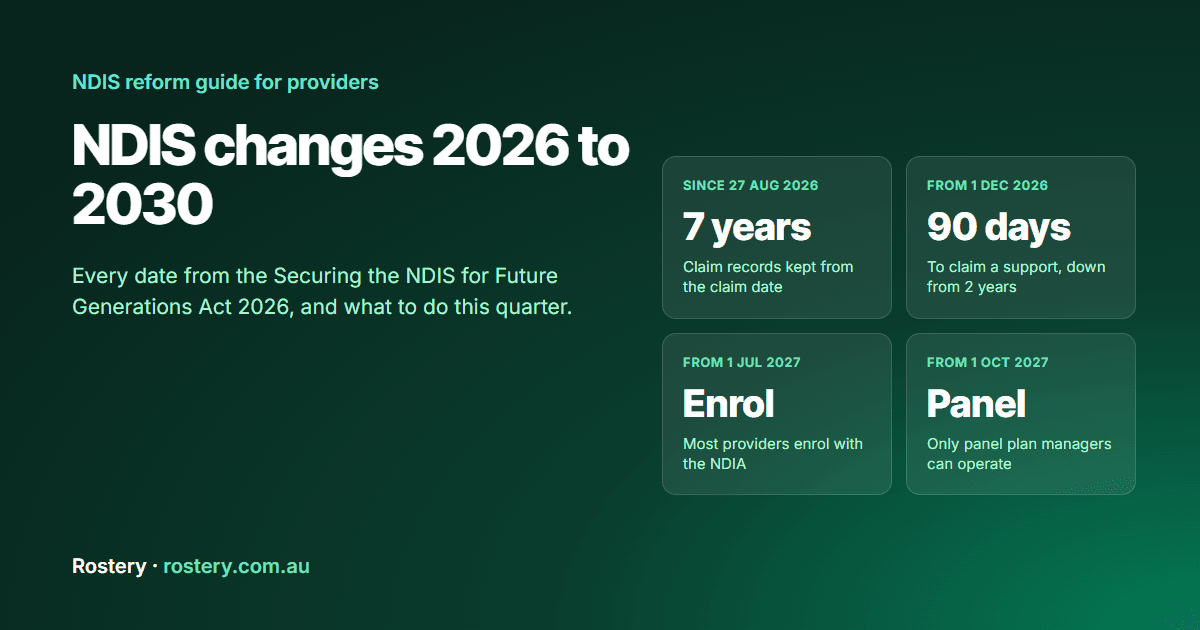
The biggest NDIS changes in 2026 come from the National Disability Insurance Scheme Amendment (Securing the NDIS for Future Generations) Act 2026, which became law on 20 August 2026. For providers, the dates that matter most are: claim records kept for 7 years (since 27 August 2026), a ban on kickbacks and inducements (November 2026), a 90-day claim window (1 December 2026), no carry-over of unspent plan funds (1 February 2027), NDIA enrolment and wider mandatory registration (from 1 July 2027), a plan management panel (1 October 2027) and commissioned support coordination (1 July 2028). The changes roll out until the end of 2030. This page lists every date and links to a full guide for each one.
In short
- Already in force: 7-year claim records, new fraud offences, stronger powers for the NDIA and the NDIS Commission, and the Minister setting NDIS price limits.
- Next 3 months: the inducements ban, the 90-day claim window and a price rise for four domestic support items on 1 December 2026.
- 2027: no plan rollovers, new debt notices, new framework planning, provider enrolment, wider mandatory registration, whistleblower protections and the plan management panel.
- 2028 to 2030: new access rules, Thriving Kids, commissioned support coordination, and the end of the transition on 31 December 2030.
What is the Securing the NDIS for Future Generations Act?
It is an amending Act. It changes the NDIS Act 2013 in five schedules: access and planning, fraud measures, governance (including pricing, whistleblowers and debts), new framework planning, and transitional rules. Parliament passed the Bill on 19 August 2026 and it received Royal Assent on 20 August 2026. Several parts started 7 days later, on 27 August 2026, and the rest are staged out to 2030.
The Department of Health, Disability and Ageing groups the reform into four aims: fighting fraud, slowing cost growth, clearer eligibility, and better quality services. Much of what providers will feel comes from the fraud and pricing parts, which is how this page is organised. The Department says it will update its timeline as more dates are confirmed, and the Act leaves many details to NDIS rules that have not been made yet. Where something is still at consultation or waiting on rules, we say so.
NDIS reform timeline 2026 to 2030
Every date below comes from the Act's commencement table or the Department's September 2026 timeline. Where the two differ, both are shown.
| Date | What starts | Who it affects most | Full guide |
|---|---|---|---|
| 1 Jul 2026 | Mandatory registration rollout begins for Supported Independent Living (SIL) and platform providers | SIL and platform providers | SIL registration |
| 20 Aug 2026 | The Securing the NDIS for Future Generations Act 2026 receives Royal Assent | Everyone | This page |
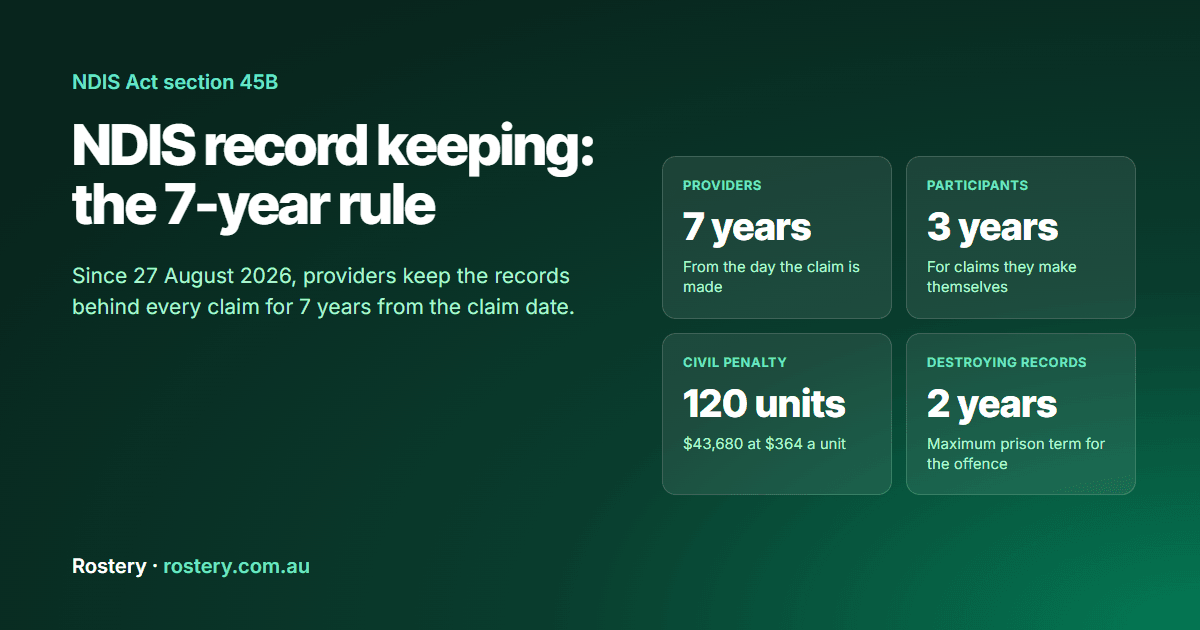
| 27 Aug 2026 | Providers must keep claim records for 7 years (participants 3 years) | All providers | Record keeping |
| 27 Aug 2026 | Stronger NDIA and NDIS Commission powers; new offences, including destroying records | All providers | This page |
| 27 Aug 2026 | The Minister becomes the decision maker on NDIS price limits | All providers | Price guide 2026-27 |
| 27 Aug 2026 | Tighter rules for unscheduled plan reassessments | Participants, support coordinators | This page |
| 24 Sep 2026 | First pricing determination made by the Minister (2026-27 price limits) | All providers | Core supports 2026 |
| 1 Oct 2026 | Budgets for social, civic and community participation and CB daily activities reset as plans are reassessed | Community participation providers | Plan rollover |
| 1 Oct 2026 | Thriving Kids phased rollout begins | Early childhood providers | This page |
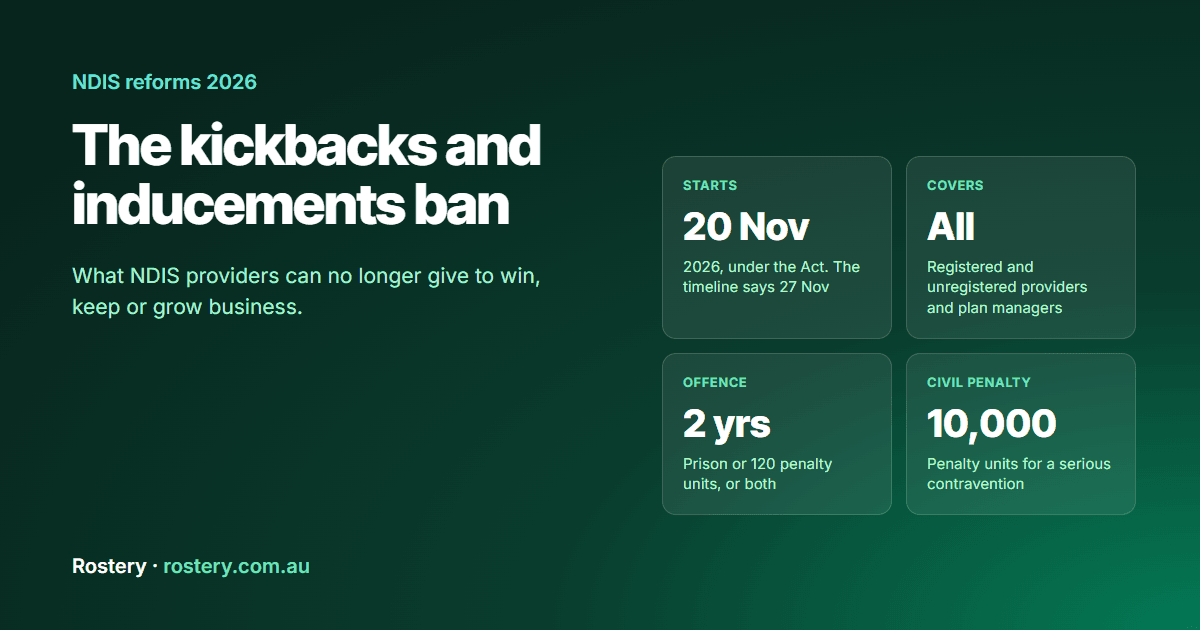
| 20 or 27 Nov 2026 | Ban on kickbacks and inducements (Act: 20 November; timeline: 27 November) | All providers | Inducements ban |
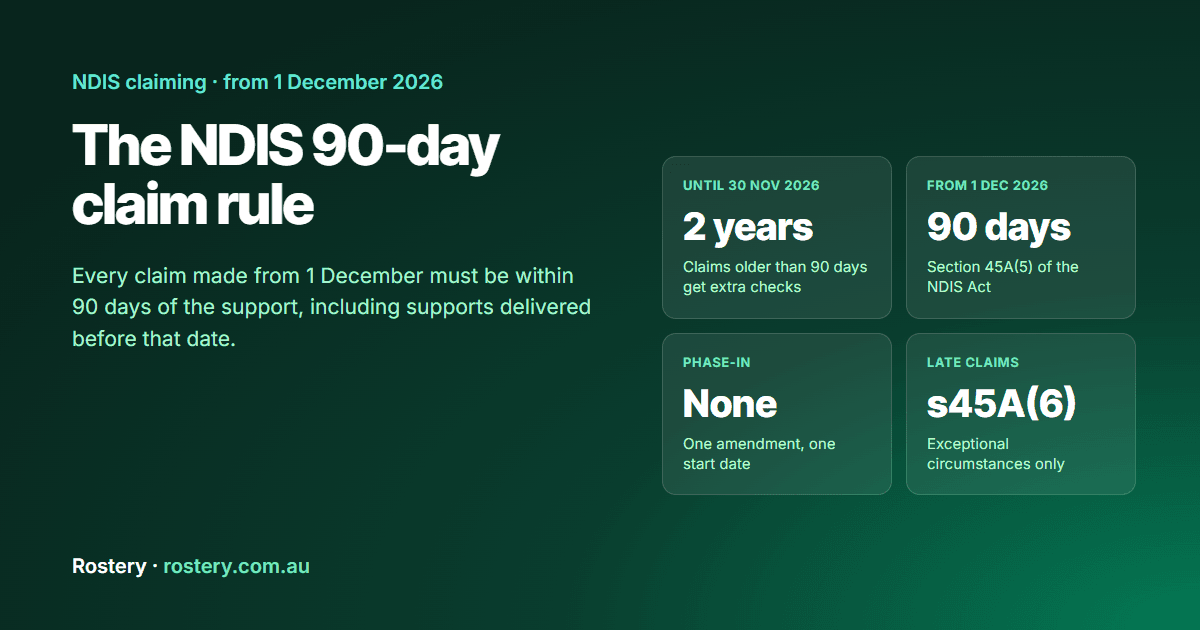
| 1 Dec 2026 | Claim window cut from 2 years to 90 days | All providers, plan managers | 90-day rule |
| 1 Dec 2026 | Price limits rise for four support items; SCHADS Schedule E changes start | Domestic and home support providers | SCHADS 2026 |
| 1 Jan 2027 | Recommended start for differentiated pricing (not yet decided) | Unregistered providers | This page |
| 1 Feb 2027 | Unspent funds no longer carried over when a plan is renewed; tighter reasonable and necessary test for new entrants | All providers | Plan rollover |
| 20 or 27 Feb 2027 | New debt notice rules (Act: 20 February; timeline: 27 February) | All providers | This page |
| 1 Apr 2027 | Participants start moving to new framework planning | All providers | This page |
| 1 Jul 2027 | Expanded mandatory registration rollout begins (all in scope by December 2030) | Personal care, daily living, closed settings | Enrolment and registration |
| 1 Jul 2027 | Provider enrolment with the NDIA begins (all in scope by December 2027) | Most providers | Enrolment and registration |
| 1 Jul 2027 | New whistleblower protections | All providers and workers | This page |
| 1 Oct 2027 | Plan management panel begins, with a 6-month transition | Plan managers | PM panel |
| 1 Jan 2028 | New access rules for new applicants; Thriving Kids fully operational | Early childhood and therapy providers | This page |
| 1 Jul 2028 | Commissioned support coordination and connection function begins | Support coordinators | PM panel and SC |
| 31 Dec 2030 | New framework planning transition ends; registration rollout complete | Everyone | This page |
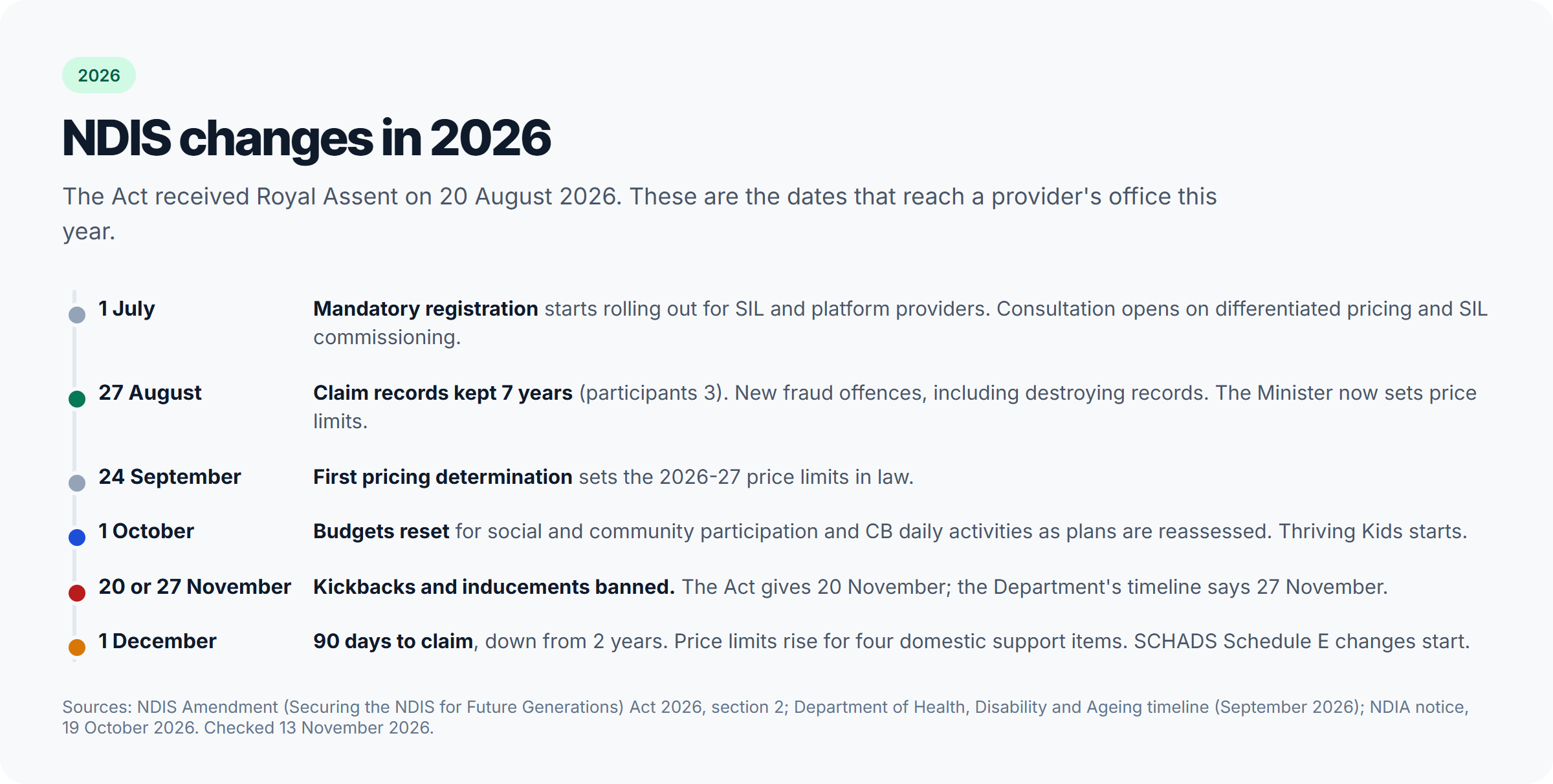
Two dates that do not match
The Act's commencement table says the inducements ban starts on 20 November 2026 (the day after 3 months from Royal Assent) and the new debt notice rules on 20 February 2027 (the day after 6 months). The Department's timeline gives 27 November 2026 and 27 February 2027. The Act is the law, so plan for the earlier dates. If the Department corrects either date, we will update this page.
Claiming and payments
From 1 December 2026 the time to claim a support is cut from 2 years to 90 days. The Act makes this change by amending section 45A of the NDIS Act. A provider who batches claims monthly will cope; one who leaves rejected lines sitting for a quarter will lose money. Our NDIS 90-day claim rule guide covers how it works and how to set up a weekly claim run.
The Department's provider FAQs also say that claims over a certain threshold will need supporting documentation, and that the NDIA will increase the evidence it asks for, including for payments at point of service. The threshold has not been published. The Department expects the uplift to claims and payments systems to run from July 2026 to the end of 2030. If you build claims with the NDIS bulk upload, the file format itself is not changing.
Record keeping and new offences
Since 27 August 2026, new section 45B of the NDIS Act requires NDIS providers to keep records relating to a claim, and to the support it pays for, for 7 years from the day the claim is made. Participants who claim keep them for 3 years, and other people who claim for 5 years. Failing to keep them is a civil penalty of 120 penalty units, and if a provider cannot otherwise show it was entitled to a payment, the amount becomes a debt to the NDIA. The kinds of records are to be set by NDIS rules, which had not been registered when we checked on 13 November 2026. Our NDIS record keeping guide explains what to keep and for how long.
The same day, a set of new offences started. They cover giving false or misleading information, obtaining NDIS funds by deception, abuse of position as a participant's nominee, and concealing, disposing of or falsifying records that must be kept. The NDIA, the NDIS Commission and other authorities also got stronger compliance, enforcement and information-gathering powers.
| Conduct | Maximum penalty under the Act | Starts |
|---|---|---|
| Not keeping claim records (s 45B) | Civil penalty, 120 penalty units | From 27 Aug 2026 |
| Concealing, disposing of or falsifying required records to defraud or obstruct (s 59AE) | Offence, up to 2 years prison or 240 penalty units, or both | From 27 Aug 2026 |
| Giving an inducement to be engaged (s 73VA) | Offence, up to 2 years prison or 120 penalty units; civil penalty 250 penalty units, or 10,000 for a serious contravention by a provider | From 20 Nov 2026 (Act) |
A Commonwealth penalty unit has been $364 since 1 July 2026, so 120 penalty units is $43,680.
Kickbacks and inducements ban
From November 2026 an NDIS provider must not give or offer a gift, benefit or other thing that is reasonably likely to induce a person to engage it, keep it, add a support, increase a support, or have it manage a participant's funding. It does not matter whether the person is the participant. The Act allows legitimate pricing practices and the provider's own merchandise, and NDIS rules may permit other conduct, but rules can never permit alcohol, illegal drugs, tobacco or vaping products, cash or cash-like products (gift cards, vouchers, digital currency) or electronic devices. Our NDIS inducements ban guide goes through what is and is not allowed.
Registration and enrolment
Mandatory registration for SIL providers and platform providers started rolling out on 1 July 2026. If you deliver SIL, read our SIL registration group 0138 guide, which covers what that means for audits and claiming.
From 1 July 2027, mandatory registration expands to providers of higher-risk supports, such as personal care, daily living supports and supports in closed settings. The Department will publish the list of supports in scope, and every provider in scope must be registered with the NDIS Commission by December 2030. Separately, most providers will have to enrol with the NDIA from 1 July 2027, giving a basic level of identifying information and a validated bank account that payments go into. Enrolment is not registration, and all providers in scope must be enrolled by December 2027. Mainstream retailers who may not know they have served participants will not need to enrol. Our NDIS provider enrolment 2027 guide covers both, and how to become a registered NDIS provider covers the registration process as it stands.
NDIS pricing changes
Since 27 August 2026 the Minister for Disability and the NDIS, not the NDIA, decides NDIS price limits, with the NDIA giving advice. On 24 September 2026 the Department announced the first pricing determination under the new law. It set the 2026-27 price limits, which the Department says match the NDIA's earlier pricing guidance, and they took effect straight away. Price limits are now set by a legislative instrument, which our NDIS price guide 2026-27 explains.
Price increase on 1 December 2026
On 11 September 2026 the Fair Work Commission decided on Schedule E of the SCHADS Award, part of its gender-based undervaluation review, with award changes starting on 1 December 2026. The NDIA announced on 19 October 2026 that the price limits for four support items rise for supports delivered on or after 1 December 2026. The item numbers and the claiming process do not change. These are the national limits per hour:
| Support item | Item number | Limit to 30 Nov 2026 | Limit from 1 Dec 2026 |
|---|---|---|---|
| House or Yard Maintenance | 01_019_0120_1_1 | $59.01 | $63.42 |
| House Cleaning and Other Household Activities | 01_020_0120_1_1 | $60.10 | $64.59 |
| Assistance with Personal Domestic Activities | 01_004_0107_1_1 | $61.16 | $65.73 |
| Specialised Home-Based Assistance for a Child | 01_016_0104_1_1 | $61.16 | $65.73 |
The NDIA said it will publish an updated Pricing Schedule and claiming guidance on 1 December 2026. Check it, including the remote and very remote limits, before you invoice. Our free NDIS price guide tool shows the current limit for every item, and our SCHADS Award 2026 guide covers the pay side.
Differentiated pricing for unregistered providers
The government consulted from 1 July to 30 September 2026 on differentiated pricing, which would set a different price limit for the same support depending on whether the provider is registered. The Department names three areas: social, civic and community participation, capacity building daily activities, and assisted daily living. The NDIA's Annual Pricing Review for 2026-27 recommended it start on 1 January 2027. As at 13 November 2026 the Department had not announced a decision. A recommendation is not a price limit, so do not cut prices yet, but if you are unregistered and most of your income is in those three areas, work out what a lower limit would do to your margin.
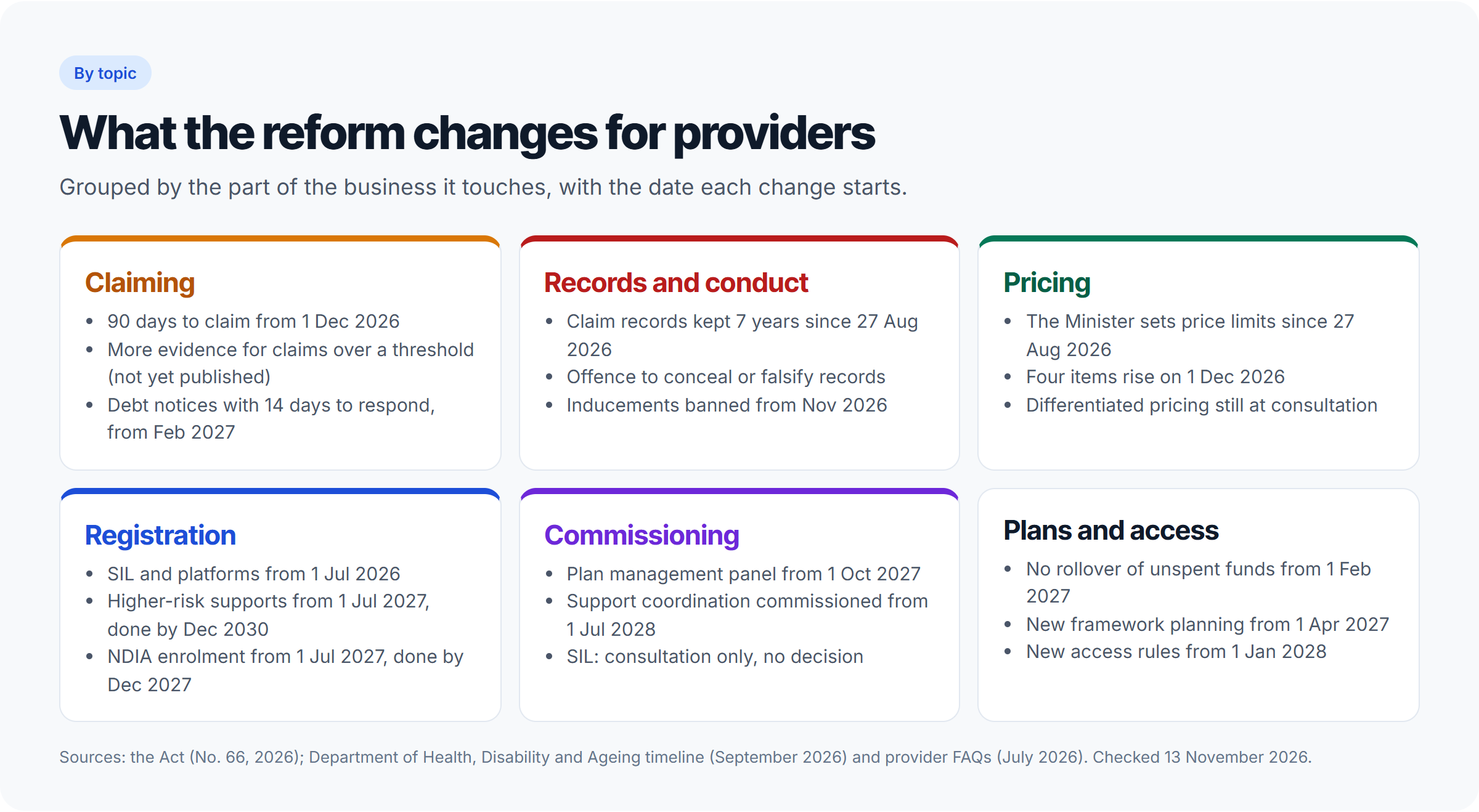
Budgets and plans
From 1 October 2026, participants' budgets for social, civic and community participation supports and capacity building daily activities are being reset progressively as plans are reassessed or renewed. The Department says supports essential to critical care and daily living needs are not affected. Alongside it, a $200 million Inclusive Communities Fund is meant to rebuild community organisations that host participation activities.
From 1 February 2027, when a plan reaches its scheduled reassessment date, a renewed plan is created and unspent funds from the old plan are not carried over. New entrants also face a tighter test of what is reasonable and necessary, which then applies to current participants as they are reassessed. Both changes are covered in our unspent funds and plan rollover guide.
New framework planning starts on 1 April 2027 (it was pushed back after consultation) and every participant is meant to be on a new framework plan by 31 December 2030. The planning rules were open for consultation until 14 October 2026 and are not final. Since 27 August 2026, only participants, plan nominees or guardians can request an unscheduled plan reassessment, and only for significant and ongoing changes in support needs. Since 1 October 2026 there is also a new plan variation pathway for high support needs participants who need continuous 24-hour care.
Commissioning: plan management, support coordination and SIL
For three kinds of support the NDIA is moving from an open market to contracting a smaller number of providers. From 1 October 2027 only plan managers on an NDIA panel may deliver plan management, with an initial 6-month transition. The Act also requires a registered plan manager to have a deed of arrangement with the NDIA, and stops a plan manager from also being registered to provide other supports (that part starts on a date to be fixed by Proclamation, and no later than 1 September 2028).
From 1 July 2028 the NDIA will appoint providers to a new support coordination and connection function through a merit-based process, and support coordination will no longer be funded in individual plans. Consultation ran from 7 September to 2 October 2026. Both changes are in our plan management panel and support coordination guide. If you coordinate supports today, our guide to software for support coordinators covers the day-to-day side.
For SIL, consultation on commissioning home and living supports for participants who need 24/7 support closed on 13 September 2026. The Department says the results will inform whether to commission a portion of the SIL market at all, so nothing has been decided. Our SIL provider operations guide covers running SIL under the current rules.
Access and Thriving Kids
There are no changes to who can get into the NDIS before 1 January 2028. From that date, eligibility for new applicants will be decided by a standardised assessment of functional capacity (a Technical Advisory Group set up in July 2026 is advising on it), with more consistent tests of permanence, of whether an impairment can be treated, and of access to other compensation schemes. Existing participants will be reassessed over 3 years.
Thriving Kids started a phased rollout on 1 October 2026 and is meant to be fully operational nationally from 1 January 2028. From then, new applicants aged 8 and under with developmental delay or autism and low to moderate support needs will be supported through Thriving Kids instead of the NDIS. Children with high support needs stay eligible. Early childhood and therapy providers should expect fewer new NDIS-funded children in that group from 2028.
Whistleblowers and debt recovery
From 1 July 2027, the NDIS Act's whistleblower protections widen. Disclosures made to a doctor or psychologist for care, to a lawyer for advice, to a registered organisation (such as a union) or professional association, to police (where the person suspects a provider has broken the Act) or to a Commonwealth-funded disability advocate will also qualify for protection. Providers should update their whistleblower and complaints policies before then and tell staff.
From February 2027, before recovering a debt the NDIA's CEO must send an initial notice explaining the debt and inviting a written response. A provider gets at least 14 days to respond (other people get 28), and the CEO must then send a debt determination notice. These rules apply to debts that arise after they start. Because a missing record can itself create a debt, the debt rules and the record-keeping rules work together.
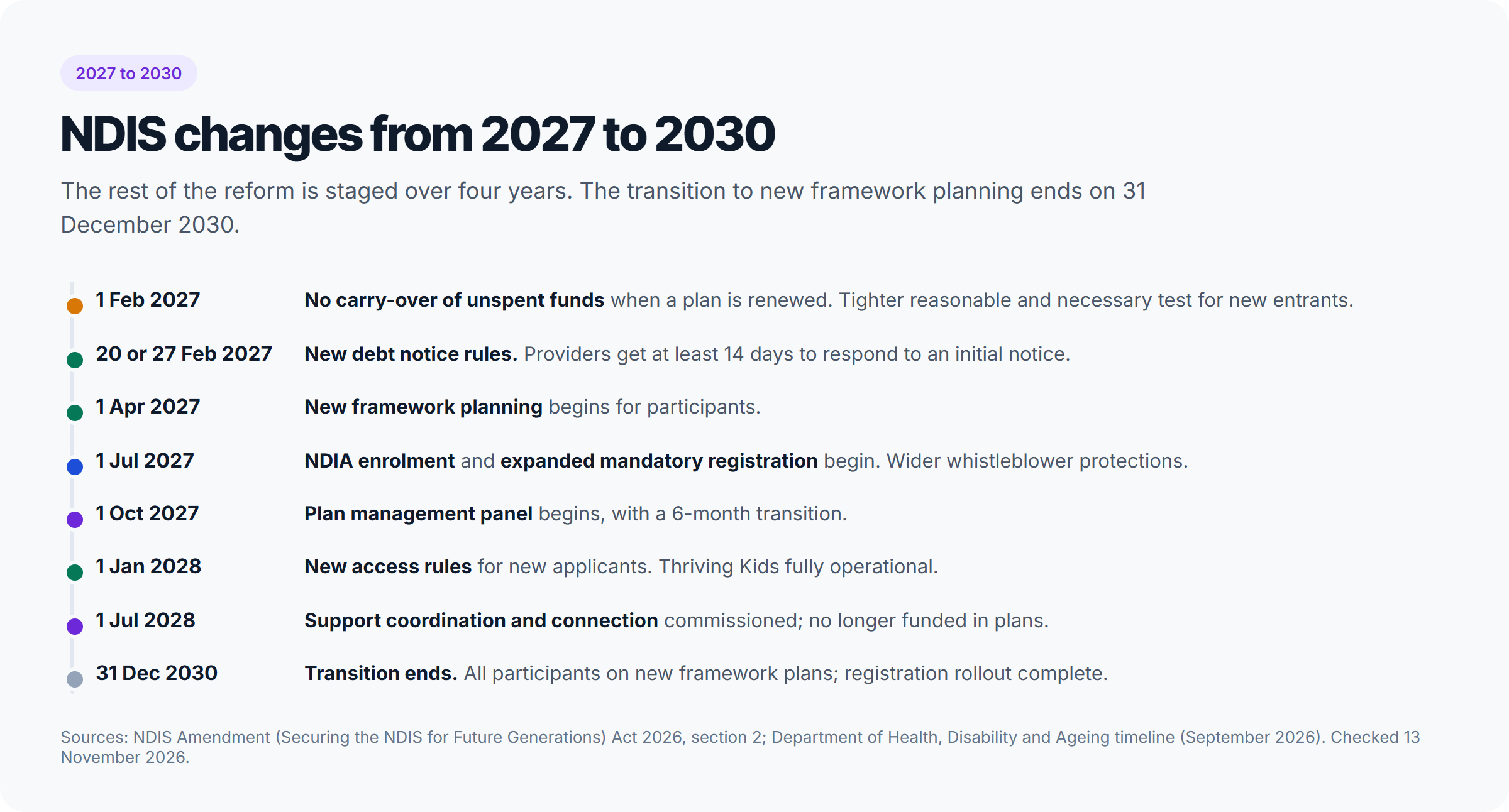
What should NDIS providers do this quarter?
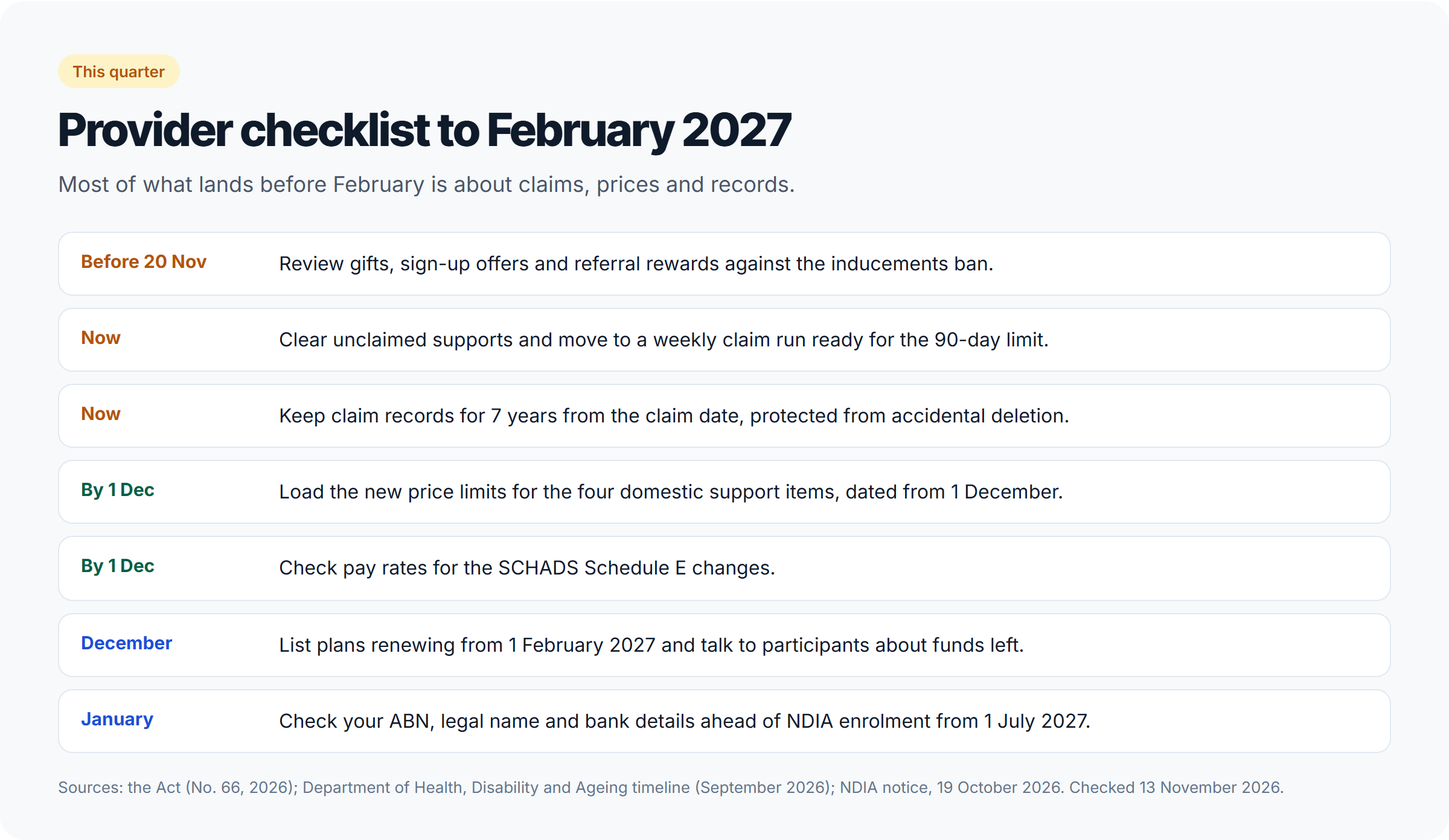
Most of what lands before February 2027 is about claims, prices and records. This is the list we would work through between now and the end of January.
| When | Action | Read more |
|---|---|---|
| Now, before 20 November | Review gifts, sign-up offers, referral rewards and "free" extras against the inducements ban | Inducements ban |
| Now | Clear any backlog of unclaimed supports and move to a weekly claim run | 90-day rule |
| Now | Set a retention rule: claim records kept 7 years from the claim date, and make sure deleting them is not possible by accident | Record keeping |
| By 1 December | Load the new price limits for the four domestic and home support items, dated from 1 December | Price guide tool |
| By 1 December | Check pay rates for the SCHADS Schedule E changes that start on 1 December | SCHADS 2026 |
| December | List participants with plans renewing from 1 February 2027 and talk to them about how much funding is left | Plan rollover |
| December | If you are unregistered and deliver community participation, CB daily activities or assisted daily living, model a lower price in case differentiated pricing goes ahead | This page |
| January | Check your ABN, legal name and bank account details are current, ready for NDIA enrolment from 1 July 2027 | Enrolment |
How Rostery fits
Rostery builds the NDIA bulk claim file straight from your invoices, using the 16-column layout of the NDIA template, so moving to a weekly claim run is a matter of running the export more often. You upload the file in the myplace provider portal yourself. Rostery's Activity log records who changed what and when, and admins can export it to CSV, which helps when an auditor or the NDIA asks how a record came to be. See our NDIS claiming software page, or book a demo to see it with your own participants.
Frequently asked questions
What are the main NDIS changes in 2026?
For providers: 7-year record keeping and new fraud offences (27 August 2026), the Minister setting price limits (27 August 2026), budget resets for community participation and CB daily activities (from 1 October 2026), the inducements ban (November 2026), the 90-day claim window and a price rise for four items (1 December 2026). Mandatory registration for SIL and platform providers began rolling out on 1 July 2026.
When does the NDIS 90-day claim rule start?
1 December 2026. The Act changes the time limit to claim from 2 years to 90 days. See our 90-day claim rule guide.
Is differentiated pricing for unregistered providers starting on 1 January 2027?
Not confirmed. The NDIA's Annual Pricing Review recommended 1 January 2027 and consultation closed on 30 September 2026, but as at 13 November 2026 no decision had been announced and no different price limits had been set.
Do I need to register with the NDIS Commission because of these changes?
If you deliver SIL or run a platform, registration has been rolling out since 1 July 2026. If you deliver higher-risk supports such as personal care, daily living supports or supports in closed settings, it rolls out from 1 July 2027 and must be done by December 2030. Most other providers will need to enrol with the NDIA from 1 July 2027, which is a separate and simpler step.
Will support coordination still be in participants' plans?
Until 1 July 2028. From then the NDIA will appoint providers to a commissioned support coordination and connection function, and it will no longer be funded in individual plans.
What happens to unspent NDIS funds from 2027?
From 1 February 2027, when a plan reaches its scheduled reassessment date a renewed plan is created and unspent funds are not carried over. See our plan rollover guide.
Who decides NDIS prices now?
The Minister for Disability and the NDIS, since 27 August 2026, on the NDIA's advice. The first determination, setting 2026-27 price limits, was announced on 24 September 2026.
Sources
- National Disability Insurance Scheme Amendment (Securing the NDIS for Future Generations) Act 2026 (No. 66, 2026), Federal Register of Legislation
- Department of Health, Disability and Ageing: Securing the NDIS for future generations timeline (September 2026)
- Department of Health, Disability and Ageing: Information for NDIS providers, FAQs (July 2026)
- Department of Health, Disability and Ageing: Securing the NDIS for future generations (updated 27 August 2026)
- Department of Health, Disability and Ageing: The Bill has passed Parliament (20 August 2026)
- Department of Health, Disability and Ageing: New price limits set for NDIS supports (24 September 2026)
- National Disability Insurance Scheme (Pricing Arrangements) Determination 2026, Federal Register of Legislation
- NDIA: NDIS price increase from 1 December 2026, gender-based undervaluation priority awards review (19 October 2026)
- NDIS Quality and Safeguards Commission: Parliament passed the Securing the NDIS for Future Generations Act 2026 (28 August 2026)
Checked 13 November 2026. Many details depend on NDIS rules and consultation outcomes that are not yet published, and the Department updates its timeline as dates are confirmed. This page explains the published law and guidance and is not legal advice.