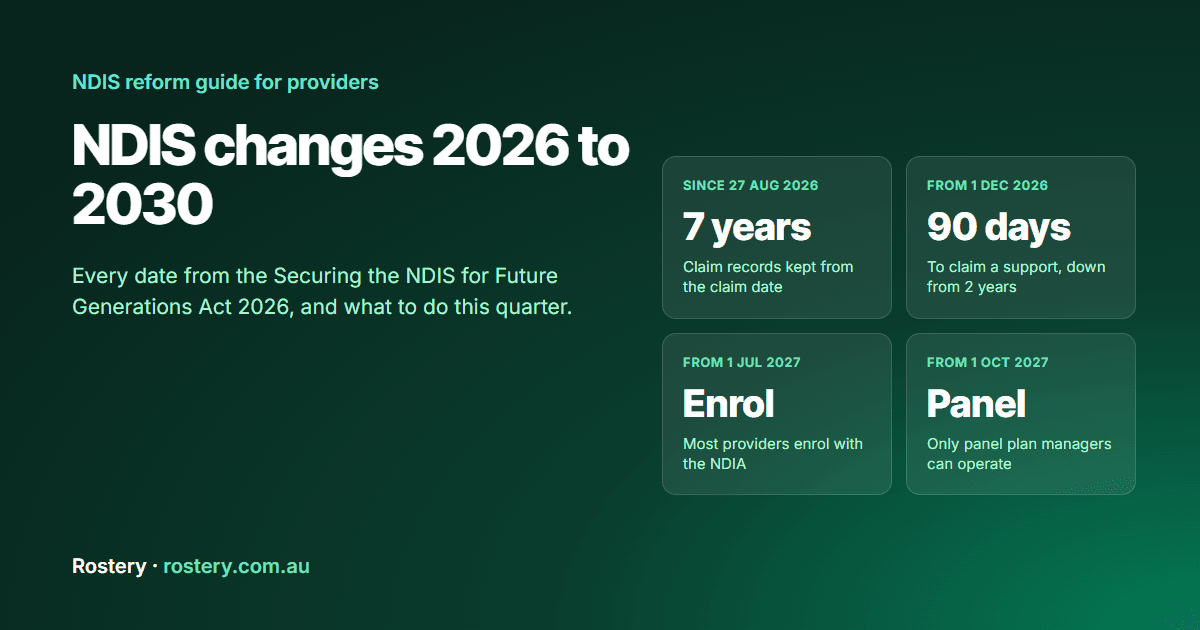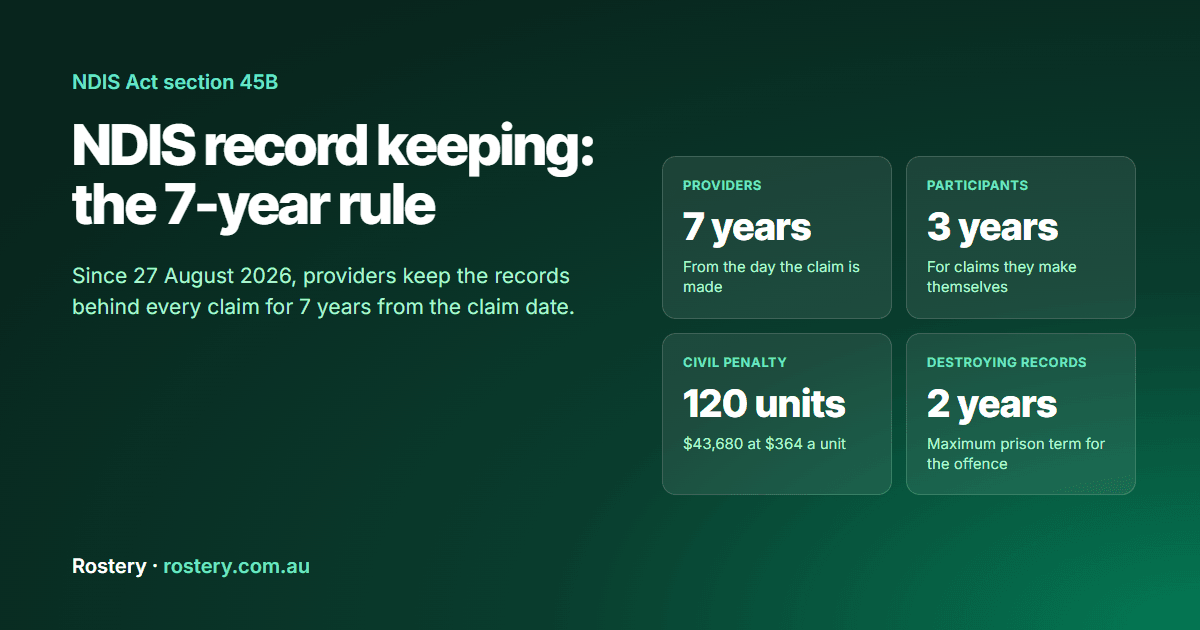
Since 27 August 2026, NDIS providers must keep records relating to every claim for 7 years from the day the claim is made. Participants who claim must keep theirs for 3 years. The rule is in new section 45B of the NDIS Act, added by the Securing the NDIS for Future Generations Act 2026. A provider who fails to keep the records faces a civil penalty of 120 penalty units ($43,680), and it is now a criminal offence to conceal, dispose of or falsify required records to defraud or obstruct an investigation. The rule applies to claims made on or after 27 August 2026. This guide covers what the Act says, which records to keep, how it fits with the NDIS Commission's existing 7-year rules, and how to store records so you can still produce them in 2033.
In short
- Providers: 7 years from the claim date. Participants: 3 years. Anyone else who claims: 5 years.
- Covers records relating to the claim and to the support it pays for, of a kind set by NDIS rules. Those rules had not been registered on 13 November 2026.
- Applies to claims made from 27 August 2026. Claims made before then are not caught by section 45B.
- Penalties: 120 penalty units civil penalty; the claim can become a debt; deliberately destroying records is an offence with up to 2 years in prison.
- Registered providers already keep incident, complaint, restrictive practice and worker screening records for 7 years under NDIS Commission rules.
What does the NDIS 7-year record keeping rule say?
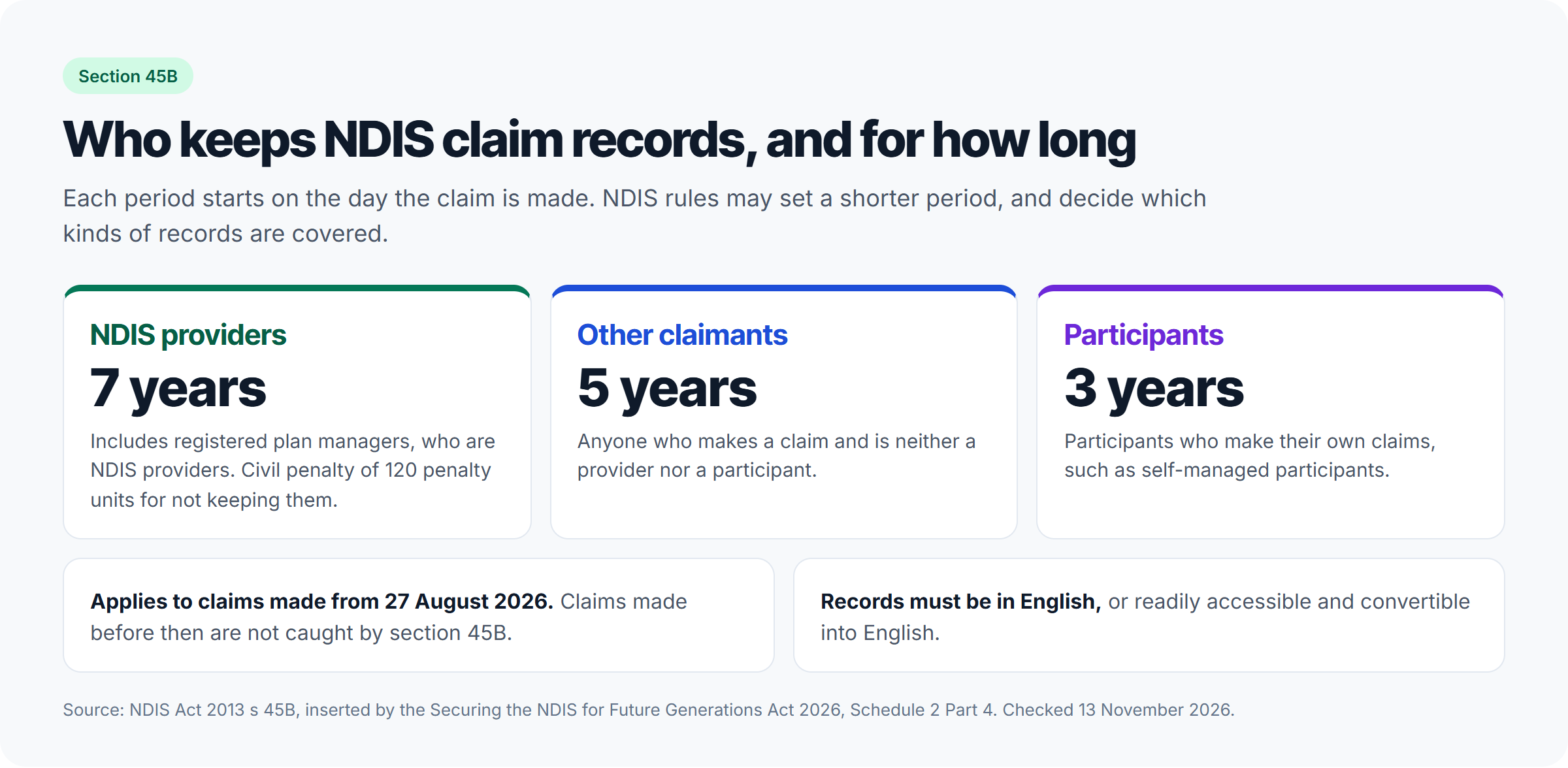
Section 45B(1) says an NDIS provider must keep and retain a record that relates to a claim for payment of an NDIS amount, or to the provision of an NDIS support that a claim relates to, if the record is of a kind prescribed by the NDIS rules. Section 45B(2) sets the period: 7 years beginning on the day the claim is made, unless the rules set a shorter period.
The same section sets shorter periods for others who claim. A participant who makes a claim keeps records for 3 years, and any other person who makes a claim (someone who is neither a provider nor a participant) keeps them for 5 years. The Department's timeline says plan managers keep records for 3 years, but the Act's text puts every NDIS provider on 7 years, and a registered plan manager is an NDIS provider. Unless rules say otherwise, plan managers should work to 7 years.
| Who | How long | Act | Penalty for not keeping |
|---|---|---|---|
| NDIS provider (including a plan manager) | 7 years from the day the claim is made | s 45B(1), (2) | Civil penalty, 120 penalty units |
| Participant who makes a claim (self-managed) | 3 years from the day the claim is made | s 45B(5), (6) | None stated in s 45B |
| Anyone else who makes a claim | 5 years from the day the claim is made | s 45B(7), (8) | None stated in s 45B |
Every record must be in English, or be readily accessible and convertible into English (section 45B(9)). Section 45B replaced the older record rule in subsections 46(2) and (3) of the NDIS Act, which the Act repealed.
Which records does section 45B cover?
The Act covers records "of a kind prescribed by the National Disability Insurance Scheme rules". The rules decide the list. When we searched the Federal Register of Legislation on 13 November 2026, no NDIS rules prescribing those kinds of records had been registered. The Department's provider FAQs (July 2026) describe the duty as keeping "records relating to payment and receipt of NDIS funds" and say there will be time for providers to develop filing and storage systems.
So the legal duty is in force for claims made since 27 August 2026, but the list it points to has not been published. Waiting is a poor bet. The 7 years run from the claim date, so a record you throw away this month cannot be recovered when the rules arrive. The safe course is to keep everything that shows a claimed support was agreed, delivered, priced and paid, and to tighten the list once the rules are made.
Does it apply to records from before 27 August 2026?
No. Item 88 of the amending Act says section 45B applies to a claim for payment made on or after the day it commenced, which was 27 August 2026. A claim made in July 2026 is not caught by section 45B.
The date that matters is when the claim was made, not when the support was delivered. A support delivered on 20 August 2026 and claimed on 3 September 2026 is caught. Older records may still have to be kept under other rules: registered providers' incident, complaint, restrictive practice and worker screening records, and employment records under the Fair Work Act, have their own periods (see the table below). If the NDIA opens a review into an older claim, you still need to be able to show you were entitled to the payment.
When does the 7-year period start and end?
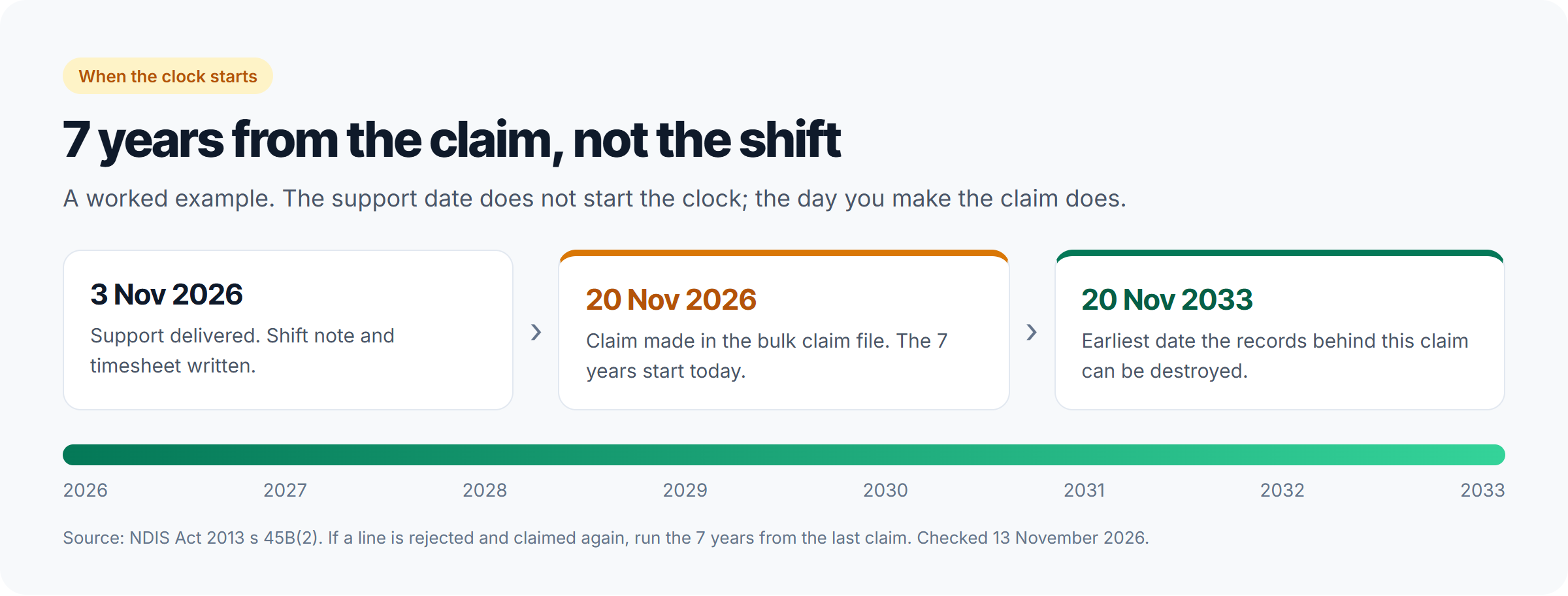
On the day the claim is made. If you deliver a support on 3 November 2026 and claim it on 20 November 2026, keep the records until at least 20 November 2033. Since the claim window drops to 90 days on 1 December 2026 (see our NDIS 90-day claim rule guide), a claim will usually be made within 3 months of the support.
The Act does not deal with claims made more than once. If a line is rejected and claimed again, our advice is to run the 7 years from the last claim. One record often backs many claims too. A service agreement can support a year of weekly claims, so keep it for 7 years after the last claim made under it.
What are the penalties for not keeping NDIS records?
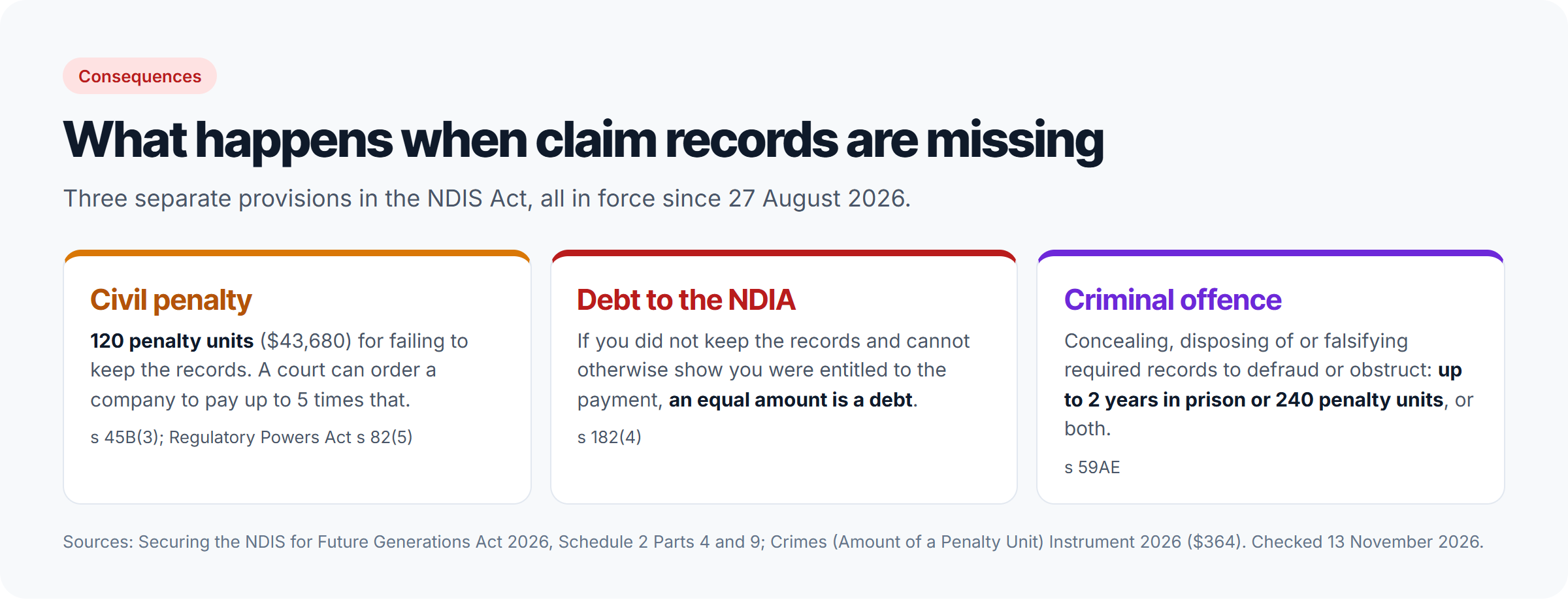
There are three separate consequences, and the second is the one most providers will meet first.
- A civil penalty of 120 penalty units for refusing or failing to keep the records (section 45B(3)). A penalty unit has been $364 since 1 July 2026, so that is $43,680. It is enforced under the Regulatory Powers Act, which lets a court order a company to pay up to 5 times the amount set for an individual. Rules may set circumstances where the penalty does not apply (section 45B(4)).
- A debt. New section 182(4) says that if you claimed and received an NDIS amount, did not keep the records you were required to keep, and cannot otherwise show you were entitled to the money, an equal amount is a debt due to the NDIA.
- An offence. New section 59AE makes it an offence to conceal, dispose of, mutilate, alter or falsify a record you are required to keep, or to direct someone else to, with intent to defraud or to prevent, delay or obstruct an audit, review, investigation or compliance activity. The maximum is 2 years in prison or 240 penalty units, or both.
The debt rule is why storage matters. If the NDIA reviews a claim and you cannot produce the shift notes and timesheet behind it, the money can be recovered even where no penalty is pursued. From February 2027 the NDIA must give a provider written notice of a debt and at least 14 days to respond, which is covered in our NDIS changes 2026 guide.
What records should NDIS providers keep?
Until the rules list the kinds of records, keep what an NDIA reviewer would ask for to check a claim: who the participant was, what was agreed, who delivered the support, when, for how long, what was done, and what was charged and paid. For most providers that is this list.
| Record | Why it matters for a claim | Keep for |
|---|---|---|
| Service agreement and any variations | Shows what was agreed, the price and the supports the claim relates to | 7 years from the last claim under it |
| Roster, timesheet and clock-in and clock-out times | Shows who delivered the support, when and for how long | 7 years from the claim |
| Shift notes and progress notes | Shows the support was actually delivered and what was done | 7 years from the claim |
| Invoices and credit notes | The amount claimed, line by line, with item numbers | 7 years from the claim |
| NDIA bulk claim file and the payment results file | Proves what was claimed and what the NDIA paid, rejected or capped | 7 years from the claim |
| Travel and kilometre logs | Backs up provider travel and activity-based transport claims | 7 years from the claim |
| Cancellation records | Backs up a short notice cancellation claim: when and how the participant cancelled | 7 years from the claim |
| Provider invoices received by a plan manager, plus remittances | The evidence behind every plan-managed claim | 7 years from the claim |
| Quotes, assessments and reports that a support relied on | Shows why a support or a quantity was claimed | 7 years from the claim |
The NDIA has also said that claims over a certain threshold will need supporting documentation when they are made. The threshold has not been published, but the records above are the ones you would attach. Our NDIS service agreement guide covers what the agreement itself should contain, and the travel and kilometre claiming guide covers the logs behind travel claims.
How does this fit with the NDIS Commission's record rules?
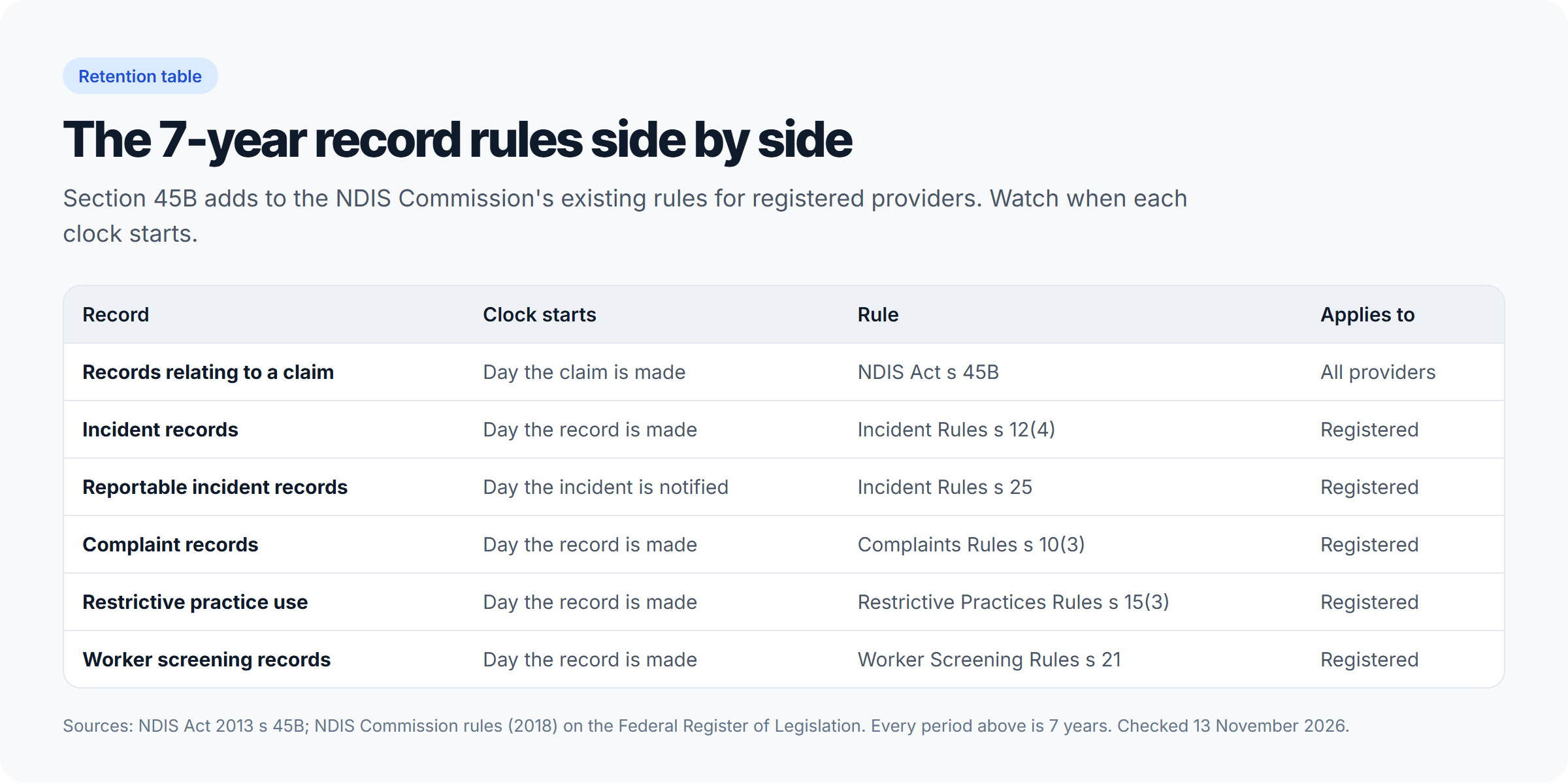
Registered providers already had several 7-year record rules under the NDIS Commission's rules, and section 45B sits beside them rather than replacing them. The difference is when the clock starts. Section 45B counts from the claim, while most Commission rules count from the day the record is made, and reportable incident records count from the day the incident was notified to the Commission.
| Record | How long | Where the rule is | Who it applies to |
|---|---|---|---|
| Records relating to an NDIS claim (providers) | 7 years from the day the claim is made | NDIS Act s 45B | All NDIS providers |
| Records of incidents in the incident management system | 7 years from the day the record is made | Incident Management and Reportable Incidents Rules s 12(4) | Registered providers |
| Records of reportable incidents | 7 years from the day the incident is notified to the Commission | Incident Management and Reportable Incidents Rules s 25 | Registered providers |
| Records of complaints, actions taken and outcomes | 7 years from the day the record is made | Complaints Management and Resolution Rules s 10(3) | Registered providers |
| Records of each use of a regulated restrictive practice | 7 years from the day the record is made | Restrictive Practices and Behaviour Support Rules s 15(3) | Registered providers |
| Worker screening records and the list of workers in risk assessed roles | 7 years from the date the record is made | Practice Standards (Worker Screening) Rules ss 18 to 21 | Registered providers |
| Employee time and wages records | 7 years | Fair Work Act (see the Fair Work Ombudsman) | Employers |
| Records relating to a self-managed claim | 3 years from the day the claim is made | NDIS Act s 45B | Participants |
For a registered provider, one shift can create records under three of these rules at once: the shift note supports the claim, an incident report sits under the incident rules, and a restrictive practice used during the shift has its own record. The simplest policy is to keep every participant and worker record for at least 7 years from the later of the day it was made or the last claim it supports. Our guides to restrictive practices, worker screening and audit evidence cover those records in detail.
How should you store NDIS records for 7 years?
A filing cabinet meets the rule until you need one shift from 2027 in 2032. These practices make 7 years workable.
- Link every record to the claim. Use one claim reference on the invoice line and the claim file row, so a reviewer's question about a claim leads straight to the shift, the note and the timesheet.
- Stop deletion by accident. Archive participants and workers who leave instead of deleting them, and switch off any automatic clean-up that removes old notes, timesheets or attachments.
- Keep the NDIA's side too. Save each bulk claim file you uploaded and the payment results file the NDIA returned, since together they show what was claimed and what was paid.
- Use formats that will still open. PDF and CSV will be readable in 2033. A file that only opens in a system you no longer pay for will not.
- Control access and keep a trail. Records with health information should only be open to the staff who need them, and you should be able to show who changed a record and when.
- Back up and test the restore. Keep at least one copy outside your main system, and check once a year that you can restore it.
- Write a retention rule. One page that says what is kept, where, for how long and who may destroy it after the period ends. It is the first thing an auditor will ask for.
What happens to your records if you change NDIS software?
The duty stays with you when you change vendor. If you move systems in 2028, you still have to produce 2026 records until 2033, so plan the exit before you sign up.
- Ask before you sign: can I export all my data, in what format, including notes, attachments and the history of changes? Is there a charge? How long do I keep access after the contract ends?
- Before you leave, export everything: participants, workers, rosters, timesheets, shift notes, incidents, invoices, claim files, payment results and uploaded documents. Check that the notes come out as readable text, not encrypted codes, and that attachments come with them.
- Keep a read-only copy somewhere you control, labelled with the date range it covers, and add it to your retention rule.
- Do not cancel the old system until you have opened the export and found a sample of records: one participant, one month of shifts and one claim.
How Rostery helps keep NDIS records
In Rostery, shifts, timesheets, progress notes, incidents, invoices and the NDIA bulk claim file sit in one place, and every row in the claim file carries a claim reference that matches the invoice. Participant documents can be uploaded to the participant's record with an expiry date, and worker documents to the worker's. In the Plan Management module, the NDIA payment results file is stored against each claim line as paid, short paid or rejected. The Activity log records who changed what and when, and admins can export it to CSV.
If you ever leave, Rostery can export your organisation's data to Excel or CSV, with each table on its own sheet and progress notes in readable text. The export is run by the Rostery team on request. See our NDIS claiming software and document tracking pages, or book a demo to see how records link to claims.
Frequently asked questions
How long do NDIS providers have to keep records?
7 years from the day the claim is made, for records relating to an NDIS claim and the support it pays for (NDIS Act section 45B). Registered providers also keep incident, complaint, restrictive practice and worker screening records for 7 years under NDIS Commission rules.
When did the 7-year NDIS record keeping rule start?
27 August 2026, seven days after the Securing the NDIS for Future Generations Act 2026 received Royal Assent. It applies to claims made on or after that day.
How long do plan managers keep NDIS records?
The Department's timeline says 3 years, but section 45B gives 7 years for every NDIS provider and 3 years only for participants who claim. A registered plan manager is an NDIS provider, so keep records for 7 years unless NDIS rules set a shorter period.
What is the penalty for not keeping NDIS records?
A civil penalty of 120 penalty units ($43,680 at $364 a unit). The amount claimed can also become a debt to the NDIA if you cannot otherwise show you were entitled to it. Concealing, destroying or falsifying required records to defraud or obstruct an investigation is an offence with up to 2 years in prison or 240 penalty units.
Which records do I have to keep?
The Act points to records of a kind prescribed by NDIS rules, and those rules had not been registered on 13 November 2026. Until they are, keep service agreements, timesheets, shift and progress notes, invoices, claim files, NDIA payment results, travel logs and cancellation records.
Can I keep NDIS records electronically?
Yes. Section 45B does not require paper. The records must be in English or readily convertible into English, and you must be able to produce them for the full period.
Sources
- National Disability Insurance Scheme Amendment (Securing the NDIS for Future Generations) Act 2026 (No. 66, 2026): Schedule 2 Parts 4 and 9, section 2
- Department of Health, Disability and Ageing: Securing the NDIS for future generations timeline (September 2026)
- Department of Health, Disability and Ageing: Information for NDIS providers, FAQs (July 2026)
- Crimes (Amount of a Penalty Unit) Instrument 2026
- Regulatory Powers (Standard Provisions) Act 2014, section 82
- NDIS (Incident Management and Reportable Incidents) Rules 2018
- NDIS (Complaints Management and Resolution) Rules 2018
- NDIS (Restrictive Practices and Behaviour Support) Rules 2018
- NDIS (Practice Standards: Worker Screening) Rules 2018
- Fair Work Ombudsman: Record-keeping and pay slips fact sheet
- NDIS Quality and Safeguards Commission: Parliament passed the Securing the NDIS for Future Generations Act 2026
Checked 13 November 2026. The NDIS rules that list the kinds of records under section 45B had not been made when we checked, and we will update this guide when they are. This guide explains the published law and is not legal advice.