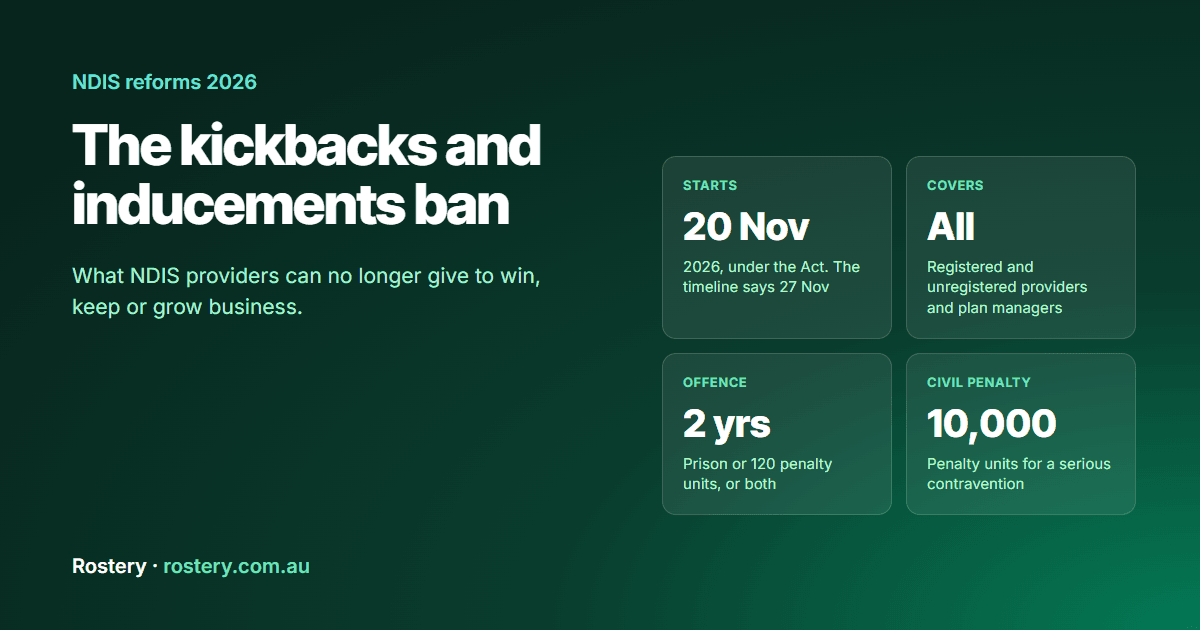
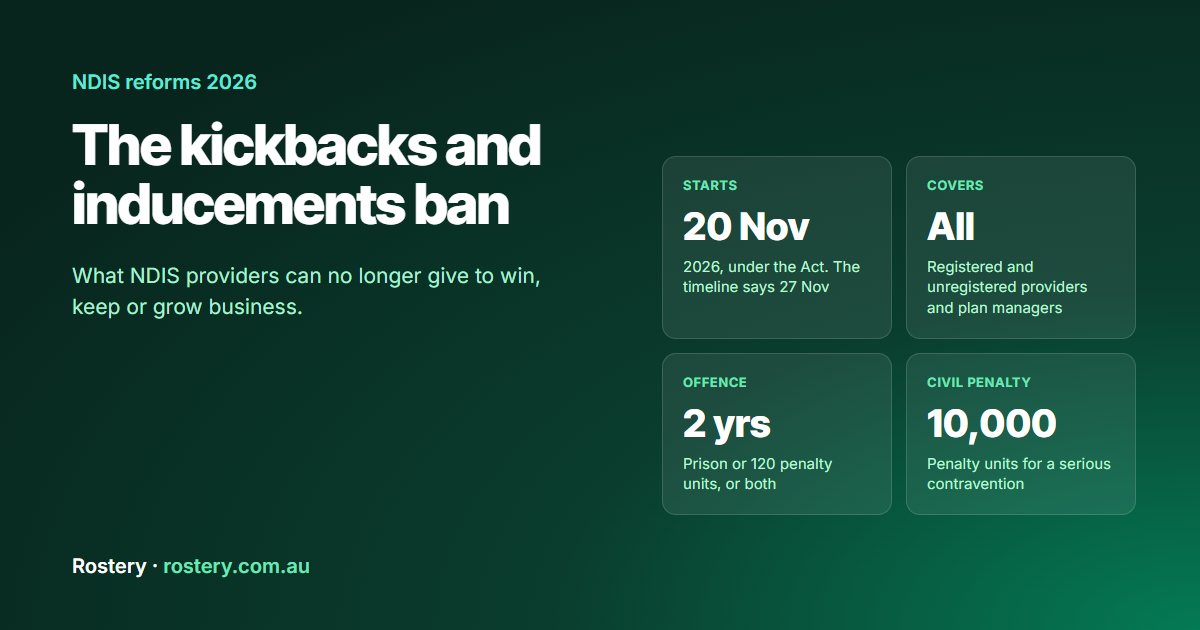
From 20 November 2026 it is against the law for an NDIS provider to give, offer or promise a gift, benefit or other thing that is reasonably likely to get someone to sign up with them, stay with them, take more supports from them or have them manage a participant's funding. The ban is the new section 73VA of the NDIS Act. It covers registered and unregistered providers and plan managers, and the person receiving the gift can be anyone, not only the participant. Cash, gift cards, vouchers, alcohol, tobacco and vapes, illegal drugs and electronic devices can never be given as an inducement. Branded merchandise such as a hat or tote bag, and genuine pricing practices, are allowed. Breaking the ban is a criminal offence (up to 2 years in prison, 120 penalty units, or both) and a civil penalty of up to 10,000 penalty units for a serious contravention.
In short
- The ban starts on 20 November 2026 under the Act. The department's reform timeline says 27 November, so get ready by 20 November.
- It applies to anyone paid NDIS money other than as a participant: registered providers, unregistered providers, sole traders and plan managers.
- Gifts to family, nominees, support coordinators or another business count as much as gifts to the participant.
- Delivering the support itself is never an inducement. Branded merchandise and legitimate pricing practices are exceptions.
- The NDIS Code of Conduct already told providers and workers not to give inducements. The difference now is a criminal offence and a civil penalty.
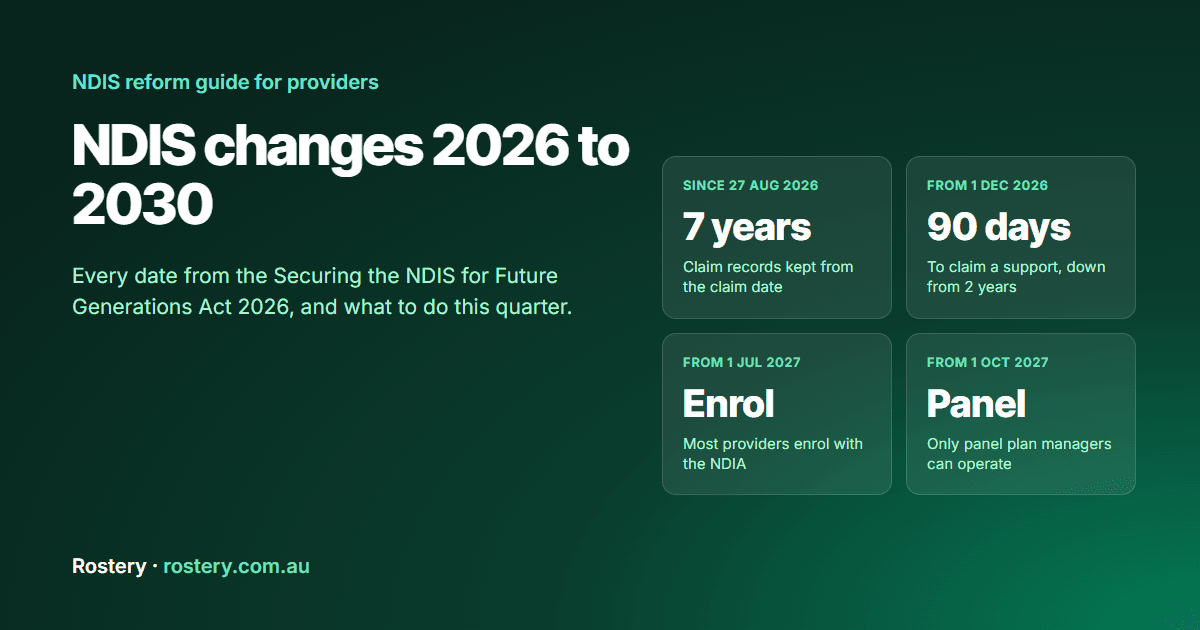
This guide works from the wording of the Act. It is general information, not legal advice. For the other reform dates see our NDIS changes 2026 hub.
When does the NDIS inducements ban start?
The ban is in Schedule 2, Part 8 of the NDIS Amendment (Securing the NDIS for Future Generations) Act 2026. The Act's commencement table says Part 8 starts "the day after the end of the period of 3 months beginning on the day this Act receives the Royal Assent". The Act received Royal Assent on 20 August 2026, so Part 8 starts on 20 November 2026. The Federal Register of Legislation lists the change to the NDIS Act on that date.
The Department of Health, Disability and Ageing's reform timeline (September 2026) lists 27 November 2026. The Act decides when a law starts, so plan for 20 November and treat the week in between as no grace period.
What the law bans
Section 73VA(1) is breached when an NDIS provider gives, or agrees or offers to give, a gift, benefit or other thing to a person, or causes one to be given or offered, and three things are true.
| Element | What section 73VA says | What it means in practice |
|---|---|---|
| Who gives | An NDIS provider gives, agrees or offers to give, or causes to be given or offered | Covers the business and anything handed over on its behalf, for example by staff or a marketing agency |
| What is given | A gift, benefit or other thing that is not the provision of a support or service to a participant | Delivering the support in the plan is never an inducement. Anything extra can be |
| The likely effect | Reasonably likely to induce the person to engage the provider | The test is the likely effect, judged objectively, not what you meant by it |
| To do what | Provide or keep providing a support, provide an additional support, increase the amount or intensity of a support, or manage or keep managing a plan's funding | Sign-ups, retention, upselling and plan management are all caught |
| Who receives | Any person. "It does not matter whether the person is the participant" (s 73VA(2)) | Family members, nominees, support coordinators, other providers and referrers are all covered |
The department's fact sheet puts the two ideas simply. An inducement is a reward, benefit or other offer meant to influence a person's decision or behaviour. A kickback is a payment, gift or other benefit given in exchange for favourable treatment or a business referral.
What is banned in every case
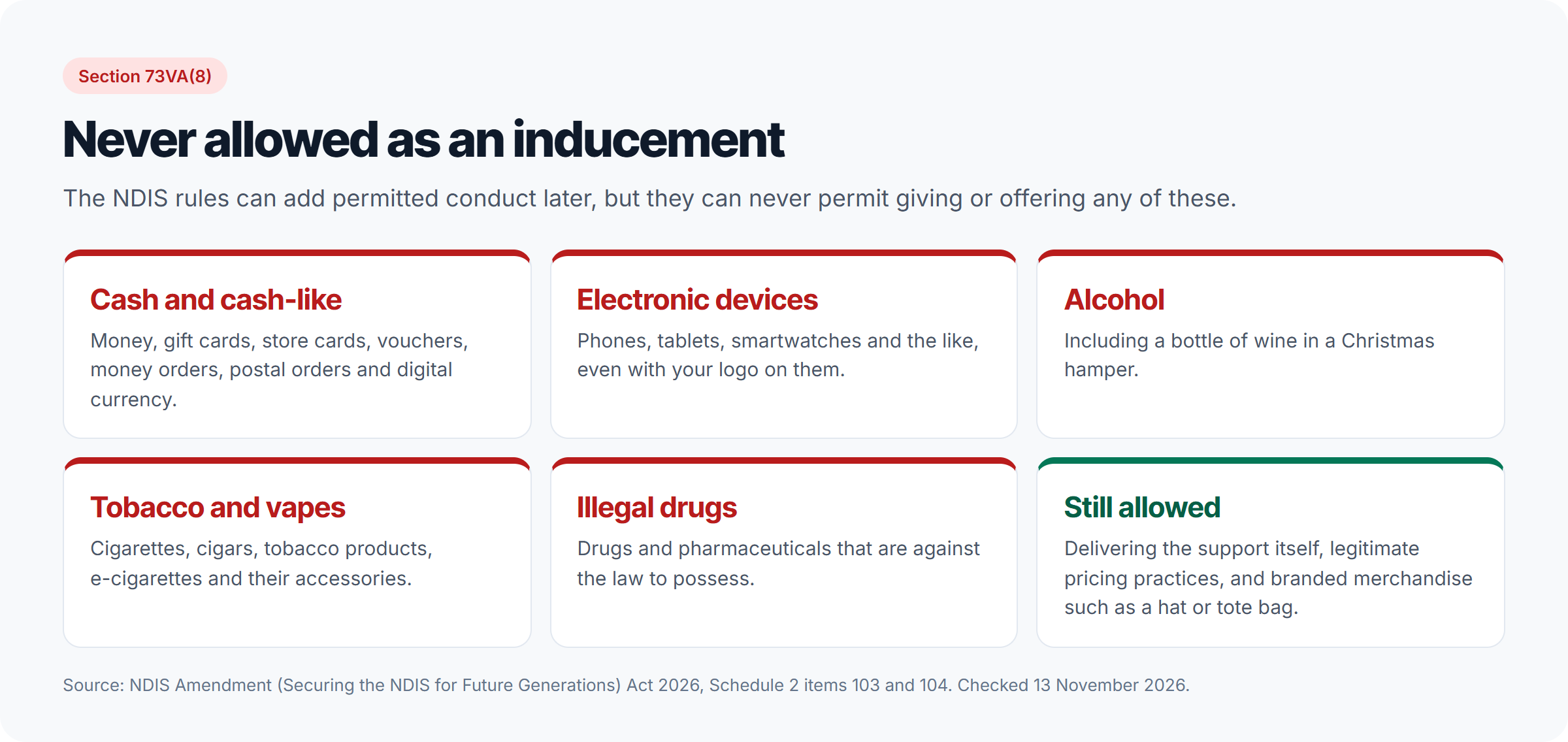
The Act lets the NDIS rules list "permitted conduct" later, but section 73VA(8) says the rules can never permit giving or offering any of these:
- alcohol
- drugs and pharmaceuticals that are illegal to possess under Commonwealth, state or territory law
- cigarettes, cigars, tobacco products and accessories, e-cigarettes and e-cigarette accessories
- cash or cash-like products
- electronic devices
"Cash-like products" is defined in the Act. It includes gift cards, store cards, vouchers and similar items (physical or electronic), money orders and postal orders, and digital currency. A $50 supermarket card for signing a service agreement is treated exactly like a $50 note.
In February 2026 the NDIS Commission and the NDIA said they were investigating providers in the Northern Territory who offered "cash, alcohol, cigarettes and other inducements to pressure participants into signing up". The NDIA said its investigations showed "a strong link between providers making 'incentive' or 'referral' payments and fraud".
Who the ban applies to
The ban applies to an "NDIS provider". Under section 10C of the NDIS Act that is any person, other than the NDIA, who receives NDIS amounts other than as a participant, plus anyone prescribed by the rules. Registration does not matter.
| Who | Covered? | Why |
|---|---|---|
| Registered NDIS providers | Yes | They receive NDIS amounts |
| Unregistered providers and sole traders | Yes | Being paid NDIS money is enough; registration is not the test |
| Plan managers | Yes | Section 73VA(1)(c)(iv) names managing a plan's funding as one of the things an inducement can be aimed at |
| Support coordinators | Yes | They are NDIS providers. They can also be the person a kickback is aimed at |
| Employees and contractors of a provider | Through the provider | The section is written about the provider, which breaches it if it "causes" a gift to be given. The Code of Conduct separately binds workers |
The Act does not say a worker who gives a gift on their own initiative commits the offence personally. A worker who hands out gift cards under the provider's "bring a friend" scheme puts the provider in breach.
Exceptions: what is still allowed
Section 73VA has four ways out, and two of them depend on NDIS rules that had not been made when we checked the Federal Register of Legislation on 13 November 2026.
| Exception | Where | Status on 13 November 2026 |
|---|---|---|
| Delivering a support or service to a participant | s 73VA(1)(b) | In force. The support itself is not an inducement |
| A discount, fee reduction or other benefit that is part of a legitimate pricing practice | s 73VA(3) and (4) | In force. The rules may later say which practices are or are not legitimate, and set conditions. None made yet |
| Merchandise of the provider | s 73VA(5) and (6) | In force. The fact sheet gives hats and tote bags as examples. Rules may list what is or is not merchandise. None made yet |
| Permitted conduct listed in the NDIS rules | s 73VA(7) and (8) | No rules made yet, so nothing is permitted under this heading. Alcohol, tobacco, drugs, cash and devices can never be added |
Until rules are made, read both exceptions narrowly. A published price every participant pays, within the price limits, is a pricing practice; "first month free if you sign today" is harder to defend. A cap with your logo is merchandise. A branded smartwatch is still an electronic device.
Penalties for NDIS kickbacks and inducements
Section 73VA creates both an offence and a civil penalty. The amounts are in penalty units, whose dollar value is set under the Crimes Act 1914 and changes from time to time.
| Type | Maximum | Source |
|---|---|---|
| Criminal offence (s 73VA(9)) | Imprisonment for 2 years or 120 penalty units, or both | Act No. 66, 2026, Sch 2 item 104 |
| Civil penalty, serious contravention by an NDIS provider (s 73VA(10)(a)) | 10,000 penalty units | Same |
| Civil penalty, any other case (s 73VA(10)(b)) | 250 penalty units | Same |
A contravention is "serious" under section 11B of the NDIS Act if it involves a significant failure (a significant departure from what is expected of an NDIS provider) or is part of a systematic pattern of conduct. A referral scheme that pays for every new client is, by design, a pattern.
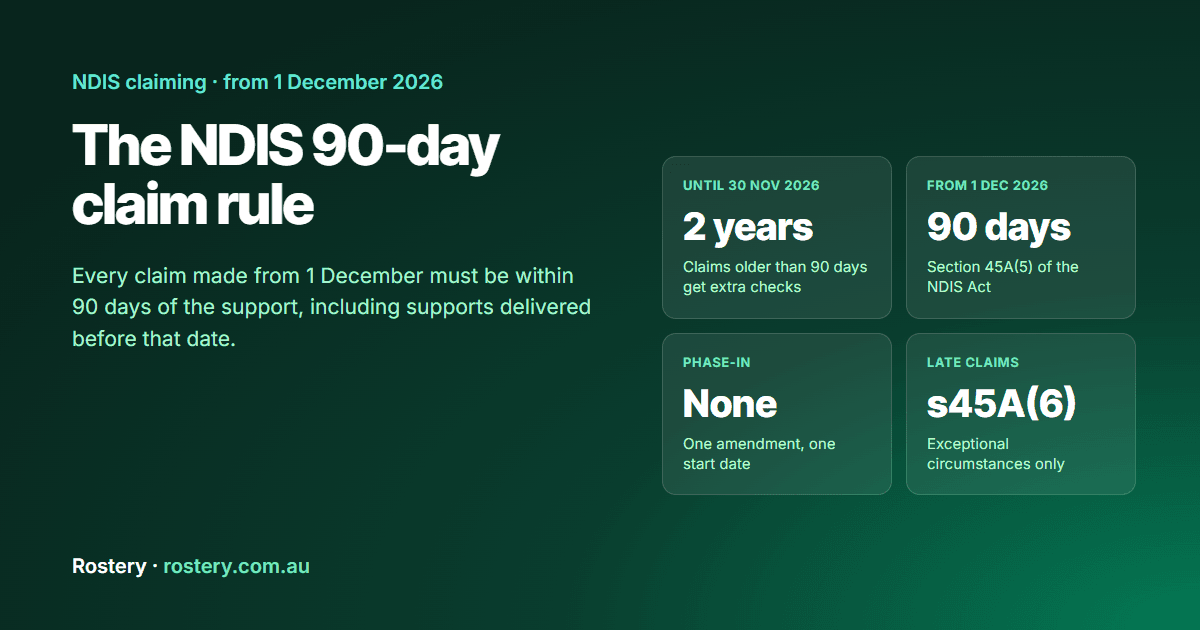
The same Act lets senior NDIS Commission staff make anti-promotion orders, which the fact sheet says "stop misleading, predatory, or unethical marketing". The claim window also drops to 90 days from 1 December 2026; see our NDIS 90-day claim rule guide.
How the ban relates to the NDIS Code of Conduct
None of this is new as a standard of behaviour. The Code of Conduct applies to all NDIS providers, registered or not, their key personnel and their workers. Element 4 is to act with integrity, honesty and transparency, and the NDIS Commission's Code of Conduct Guidance for NDIS Providers (April 2024) already says a provider should "not give, ask for, or accept any inducement or gift that impacts or may impact on the way it provides supports or services under the NDIS, including any referral arrangements with other providers".
| Code of Conduct (since 2018) | Section 73VA (from 20 November 2026) | |
|---|---|---|
| Who it binds | Providers, key personnel and workers | NDIS providers |
| What it covers | Giving, asking for or accepting inducements and gifts; declaring conflicts of interest; sharp practices | Giving or offering a gift, benefit or thing likely to win, keep or grow business |
| Accepting gifts | Workers should not accept gifts of more than minor value from participants, families, carers or advocates | Not covered; the section is about giving |
| Consequence | NDIS Commission compliance and enforcement action | Criminal offence and civil penalty, plus Commission action |
The guidance also lists "offering inducements or rewards that have no particular link to a person's NDIS plan" as a sharp practice, alongside high-pressure sales, and expects providers to have internal policies on conflicts of interest and on accepting and giving gifts.
Examples: likely fine or likely banned
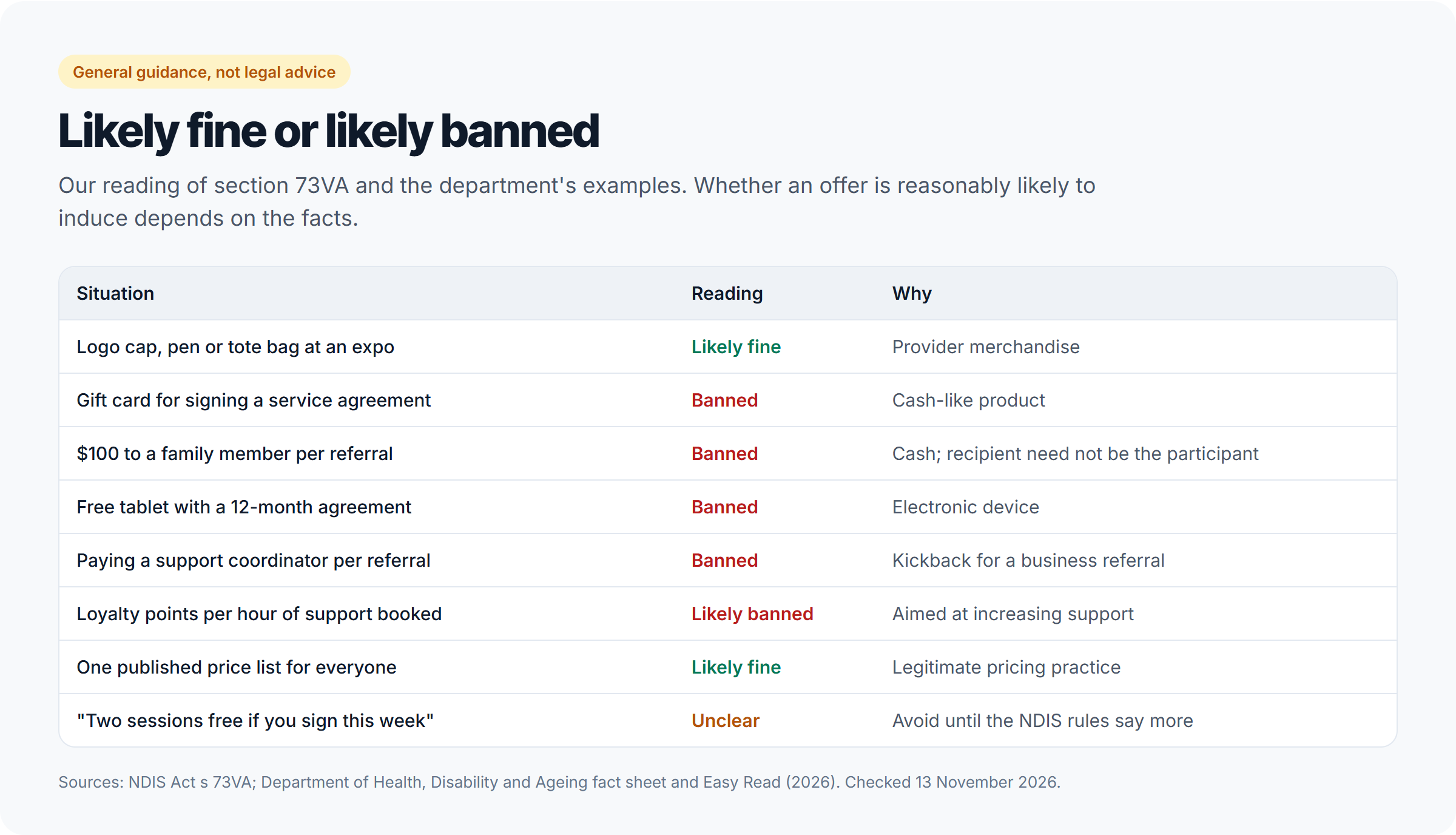
This table is general guidance, not legal advice. It applies the words of section 73VA and the official examples (cash, gifts, alcohol, tobacco, electronic devices, signing-up rewards, hats and tote bags). Whether a particular offer is "reasonably likely to induce" depends on the facts, and the NDIS rules may change the merchandise and pricing exceptions.
| Situation | Our reading | Why |
|---|---|---|
| A cap, pen or tote bag with your logo handed out at an expo | Likely fine | Merchandise of the provider; the fact sheet uses hats and tote bags as examples |
| A gift card or voucher for signing a service agreement | Banned | Cash-like product, can never be permitted |
| $100 to a family member for each friend they refer | Banned | Cash, and the person receiving it does not have to be the participant |
| A tablet or phone "free" with a 12-month agreement | Banned | Electronic device given to win business |
| Assistive technology the plan funds, delivered as the support | Likely fine | Providing a support to a participant is not an inducement |
| A Christmas hamper with wine for every participant | Banned | Alcohol can never be permitted, and a gift to all clients is aimed at keeping them |
| Cigarettes or vapes for attending a program | Banned | Tobacco and e-cigarettes can never be permitted |
| Loyalty points for every hour of support booked | Likely banned | A benefit aimed at increasing the amount of support |
| Paying a support coordinator or another provider per referral | Banned | A kickback: a payment in exchange for a business referral |
| One published price list, the same for everyone, within the price limits | Likely fine | Legitimate pricing practice exception |
| "First two sessions free if you sign up this week" | Unclear | Could be a pricing practice or a signing-up reward. Avoid until the rules say more |
| A birthday card from the team | Likely fine | Not reasonably likely to induce anyone to engage you |
What to change before 20 November
Marketing and sign-up offers
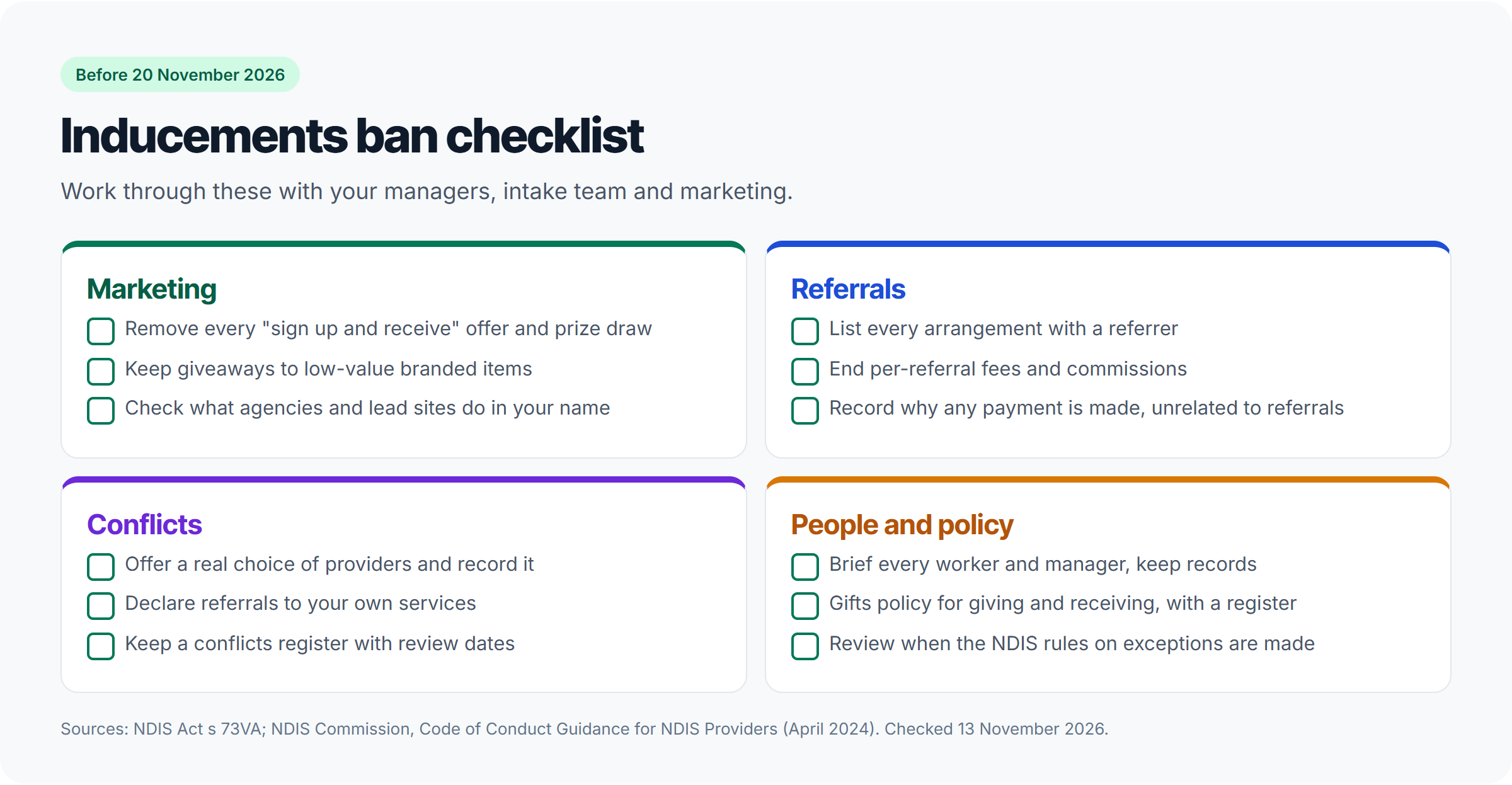
- Remove any "sign up and receive" offer from your website, social posts, flyers and intake scripts, including prize draws for new clients.
- Keep expo giveaways to low-value branded items. Drop anything electronic, even if it carries your logo.
- Check what agencies, lead-generation sites and partners do in your name. If you pay them and they hand out vouchers, you have caused the gift to be given.
Referral arrangements
- List every arrangement where money or a benefit moves between you and someone who sends you participants: other providers, support coordinators, plan managers, accommodation operators, community groups.
- End per-referral fees, commissions and "finder's fees". A referral fee is the standard example of a kickback.
- Where you share premises, staff or services with a referrer, write down what is paid for and why, at market rates, unrelated to referral numbers.
Support coordinator conflicts
Support coordinators sit closest to the choice of provider, so the risk is highest here. The Code guidance tells the story of a support coordinator who recommended an exercise program run by her own employer without saying so; the provider had to apologise and change its protocol. Under the new law, a gift to a support coordinator to steer clients your way is caught too, because the person receiving it does not have to be the participant.
- Give participants a genuine choice of at least two or three providers, and record the options offered.
- Declare in writing when your organisation also provides the support being recommended, tell the participant, and record how the conflict is managed.
- Do not accept gifts or hospitality from providers you refer to.
In Rostery, each support coordination file has a conflicts of interest register: what the conflict is, its type (including "Referral to our own service"), how it is managed, whether the participant has been told and a review date. Open conflicts appear in the compliance register report. For plan managers, a provider can be flagged as a related party, and a provider invoice from a related party or from your own ABN is flagged as a conflict of interest when it comes in. See software for support coordinators and NDIS plan management in Rostery.
Staff training
- Brief every worker, intake officer and manager before 20 November: what section 73VA bans, the five items that are never allowed, and who to ask.
- Explain that a gift to a participant's family "to keep them happy" can put the business in breach.
- Repeat the Code of Conduct rule on receiving gifts: nothing of more than minor value from participants, families, carers or advocates.
Policy checklist
- A gifts and benefits policy covering giving and receiving, with a value limit for gifts received and a register.
- A conflicts of interest policy with a register, covering ownership links, referrals to your own services, family relationships and financial interests.
- A marketing approval step: someone checks every offer against section 73VA before it goes out.
- A referral arrangements register showing every arrangement and confirming that no payment depends on referrals.
- A way for staff and participants to report concerns, and a note that whistleblower protections are being strengthened from 1 July 2027.
- Training records for every worker and manager.
- A review date, so the policy is updated when the NDIS rules on pricing practices and merchandise are made.
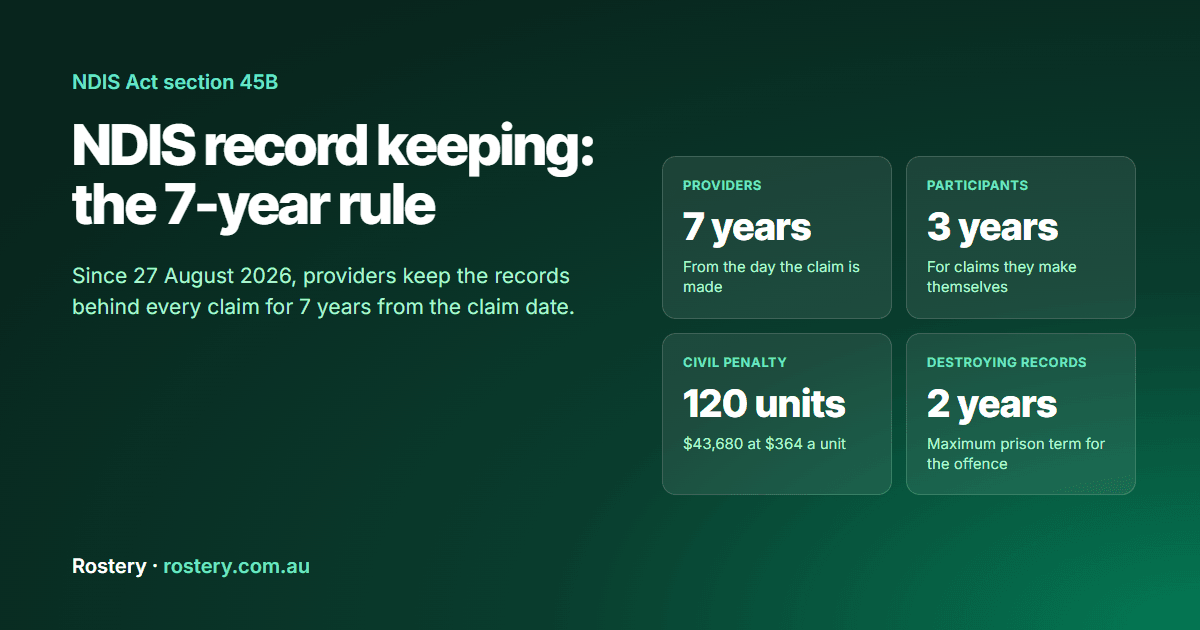
Keep the records: from 27 August 2026 providers must keep records relating to NDIS claims for 7 years. See our NDIS record keeping guide. Related changes coming for plan managers and support coordinators are in the plan management panel and support coordination commissioning, and enrolment is covered in NDIS provider enrolment 2027.
If you suspect a provider is offering inducements, the NDIA's Fraud Reporting and Scams Helpline is 1800 650 717 and the NDIS Commission is on 1800 035 544.
Rostery keeps support coordination conflicts, plan management related parties, service agreements and claim records in one place, so the evidence is there when the Commission asks. Book a demo to see it.
Frequently asked questions
When does the NDIS kickbacks and inducements ban start?
On 20 November 2026, under the commencement table of the Securing the NDIS for Future Generations Act 2026 (three months after Royal Assent on 20 August 2026). The department's reform timeline lists 27 November 2026, but the Act sets the start date.
Can NDIS providers still give gifts to participants?
Only gifts that are not reasonably likely to win, keep or grow business, or that fall within an exception such as branded merchandise. Cash, gift cards, vouchers, alcohol, tobacco, vapes, illegal drugs and electronic devices are never allowed as inducements.
Does the ban apply to unregistered NDIS providers?
Yes. It applies to every NDIS provider, which the NDIS Act defines as anyone who receives NDIS amounts other than as a participant. Registration does not matter, and plan managers are named directly.
Are referral fees between NDIS providers allowed?
No. A payment for a business referral is a kickback, and the person receiving it does not have to be the participant. That includes payments to support coordinators, other providers and family members.
Can I offer a discount to new NDIS participants?
A discount that is part of a legitimate pricing practice is an exception. The NDIS rules can say which practices count, and none had been made on 13 November 2026. A price everyone pays is safer than a time-limited deal to win new clients.
What is the penalty for offering an NDIS inducement?
The offence carries up to 2 years in prison or 120 penalty units, or both. The civil penalty is up to 10,000 penalty units for a serious contravention by an NDIS provider and 250 penalty units in other cases.
Sources
- National Disability Insurance Scheme Amendment (Securing the NDIS for Future Generations) Act 2026 (No. 66, 2026), section 2 and Schedule 2, Part 8
- National Disability Insurance Scheme Act 2013, sections 10C and 11B
- Department of Health, Disability and Ageing: Final changes to the NDIS Amendment (Securing the NDIS for Future Generations) Bill 2026 (August 2026)
- Department of Health, Disability and Ageing: Final changes, Easy Read (September 2026)
- Department of Health, Disability and Ageing: Securing the NDIS for future generations timeline (September 2026)
- NDIS Quality and Safeguards Commission: Code of Conduct Guidance for NDIS Providers (April 2024)
- NDIS Commission and NDIA: Crackdown on NDIS fraud and exploitation in Northern Territory (20 February 2026)
Checked 13 November 2026. NDIS rules on legitimate pricing practices, merchandise and permitted conduct may be made after this date and could change what is allowed. This article explains the law in general terms and is not legal advice.