Core Supports are the part of an NDIS plan that pays for everyday help: assistance with daily life, transport, consumables, and support to take part in the community. They are the largest and most flexible part of most plans. About 72% of the money committed in active NDIS plans sits in Core, and almost half of it is assistance with daily life.
This guide explains the four Core categories, how flexible the funding really is, the 2026–27 price limits that took effect on 24 September 2026, and the claiming rules that most often cost providers money. It is written for NDIS providers, plan managers and support coordinators. Participants will find it useful too.
Core Supports at a glance
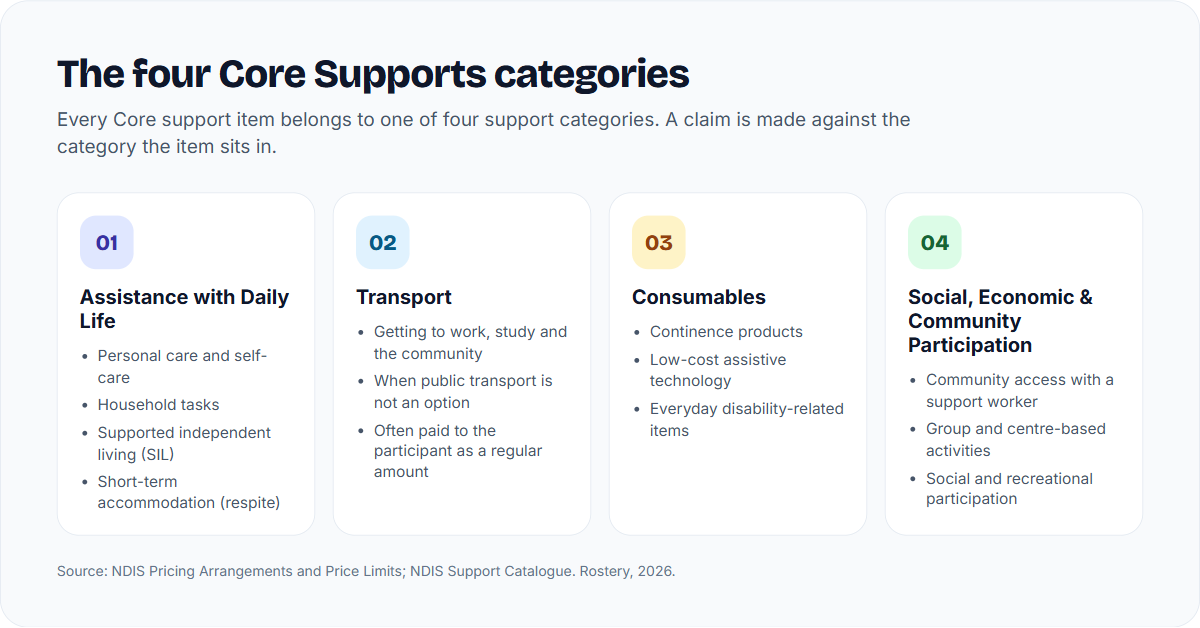
- Four support categories: 01 Assistance with Daily Life, 02 Transport, 03 Consumables, and 04 Assistance with Social, Economic and Community Participation.
- Flexible within Core: participants can usually choose supports across Core, but cannot move Core funding into Capacity Building or Capital.
- The biggest part of the Scheme: $47.9 billion of the $66.7 billion in annualised committed supports at 30 June 2026.
- New price limits: the 2026–27 NDIS Pricing Schedule took effect on 24 September 2026. A standard weekday daytime hour of self-care support is capped at $73.58 nationally.
- Funding periods: since 19 May 2025, new and reassessed plans usually release funding every three months rather than all at once.
The four Core Supports categories
Every support a provider delivers is a support item in the NDIS Support Catalogue, and every support item belongs to a support category. The first two digits of the item number tell you which one. For example, in 01_013_0107_1_1 (Assistance with Self-Care Activities, Standard, Saturday), 01 is the support category, 013 the sequence number, 0107 the registration group, the next 1 the outcome domain, and the last 1 the support purpose, which is Core.
01 Assistance with Daily Life
Help with personal care and everyday tasks: showering, dressing, meals, household tasks, and the overnight and around-the-clock support of supported independent living (SIL). Short-term accommodation (respite) and the home and living supports in this category also sit here. For most support-delivery providers, this category is where nearly all their revenue comes from.
02 Transport
Funding to help a participant get to work, study, appointments and the community when they cannot use public transport without substantial difficulty. In the NDIA’s PACE system, transport is often paid as recurring transport funding, category 18, rather than claimed by a provider per trip. The time a support worker spends driving a participant as part of a community participation support is claimed differently; see activity-based transport below.
03 Consumables
Everyday items a participant needs because of their disability: continence products, low-cost assistive technology, and similar products. Consumables are usually low-cost and bought regularly. Higher-cost assistive technology is Capital, not Core.
04 Assistance with Social, Economic and Community Participation
Support to take part in community, social, recreational and economic life: community access with a support worker, group and centre-based activities, and support in employment settings. At 30 June 2026 it was the second-largest support category in the Scheme, after daily activities.
How PACE shows the Core categories
Plans in PACE use some additional category numbers. Alongside 01 to 04, Core funding in PACE can include 16 Home and Living and 21 Young People in Residential Aged Care (cross-billing), and transport can appear as 18 Recurring Transport. If a claim is rejected for the wrong category, check which category the participant’s PACE plan actually funded.
How much of the NDIS is Core?
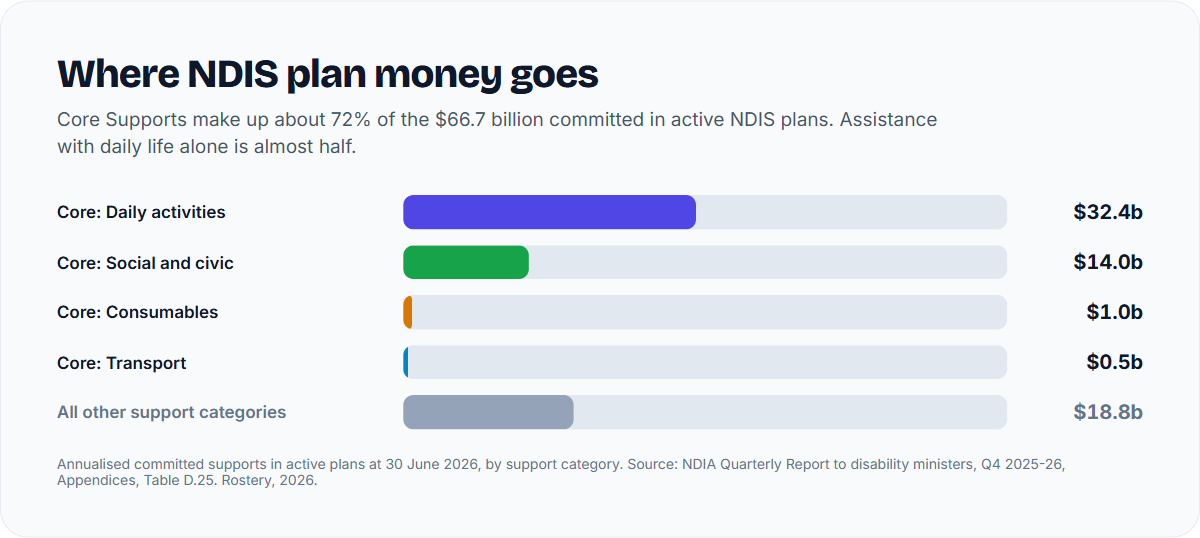
At 30 June 2026 there were 782,013 active NDIS participants. The NDIA’s quarterly report shows $66.7 billion in annualised committed supports across their plans, of which:
| Core support category | Annualised committed supports | Share of all supports |
|---|---|---|
| Core: Daily activities | $32,394 million | 48.5% |
| Core: Social and civic | $13,960 million | 20.9% |
| Core: Consumables | $1,003 million | 1.5% |
| Core: Transport | $546 million | 0.8% |
| All Core | $47,903 million | 71.8% |
Participants in supported independent living account for $18.0 billion of those committed supports, an average of about $488,000 each. With so much of the Scheme paid at support worker rates, a change to those price limits moves the whole Scheme.
How flexible is Core funding?
The NDIS Pricing Arrangements describe it plainly: participant budgets often have a lot of flexibility to choose specific supports with their Core budgets, but cannot reallocate Core funding to other support purposes, that is, to Capital or Capacity Building. In practice:
- Across Core categories: funding can usually be used across daily life, consumables and community participation to suit how the participant actually lives.
- Out of Core: no. Core cannot pay for therapy, support coordination or equipment funded under Capacity Building or Capital.
- Stated supports: some supports, such as SIL and items subject to quotation, are written into the plan as a stated item and can only be used for that support.
- Transport: often paid as a regular recurring amount rather than a flexible budget.
Funding periods: the change most providers notice
From 19 May 2025, the NDIA began giving new and reassessed plans shorter funding periods, usually three months. A funding period does not change the total amount in a plan, only when it becomes available. Funding periods were introduced by changes to the NDIS Act in October 2024, and plans made after that already had 12-month periods.
For a provider this matters more than it sounds. A participant can have money left in the plan for the year and still have nothing left in the current funding period, so a claim can fail even though the plan looks well funded. Check the funding period, not just the plan total, before you roster a large block of support.
What counts as an NDIS support
Since 3 October 2024, NDIS law lists what is, and is not, an NDIS support. Core funding can only be spent on supports that fit those lists, even when the participant’s Core budget has room.
Core, Capacity Building and Capital
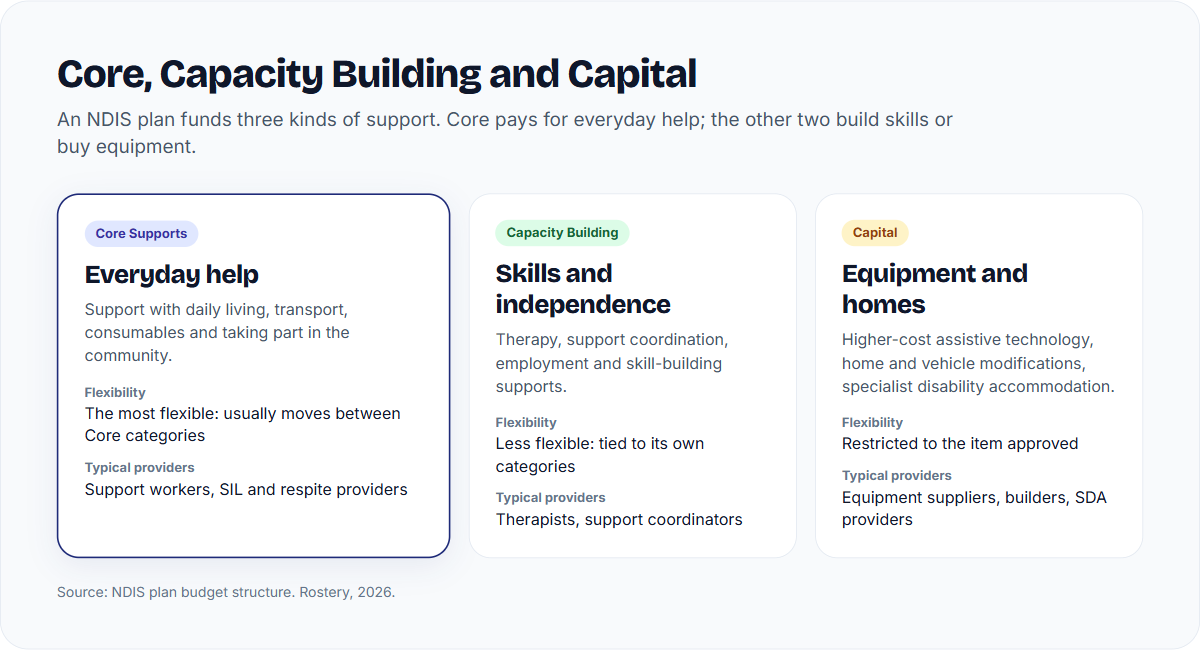
An NDIS plan has three support purposes. Core enables participants to complete activities of daily living. Capacity Building enables a participant to build their independence and skills, through supports such as therapy, support coordination, and finding and keeping a job. Capital is investment: assistive technology, home and vehicle modifications, and specialist disability accommodation, restricted to the specific items in the plan. The last digit of a support item number tells you the purpose: 1 for Core, 2 for Capital, 3 for Capacity Building.
What Core Supports cost in 2026–27
On 24 September 2026, the Minister for Disability and the NDIS made the first NDIS pricing determination under the National Disability Insurance Scheme Amendment (Securing the NDIS for Future Generations) Act 2026. The NDIS Pricing Schedule 2026–27, effective the same day, sets the maximum amounts. They match the price guidance the NDIA published in June 2026. For the most common Core item, assistance with self-care activities by a disability support worker at the standard intensity, the maximum amounts per hour are:
| Support item | When | National | Remote | Very remote |
|---|---|---|---|---|
| 01_011_0107_1_1 | Weekday daytime | $73.58 | $103.01 | $110.37 |
| 01_015_0107_1_1 | Weekday evening | $81.07 | $113.50 | $121.61 |
| 01_002_0107_1_1 | Weekday night | $82.57 | $115.60 | $123.86 |
| 01_013_0107_1_1 | Saturday | $103.54 | $144.96 | $155.31 |
| 01_014_0107_1_1 | Sunday | $133.50 | $186.90 | $200.25 |
| 01_012_0107_1_1 | Public holiday | $163.46 | $228.84 | $245.19 |
| 01_010_0107_1_1 | Night-time sleepover (each) | $311.79 | $436.51 | $467.69 |
The same weekday daytime maximum, $73.58, applies to SIL (01_801_0115_1_1) and to community access (04_104_0125_6_1). Four rules in the schedule decide which amount applies:
- The maximums include GST and apply to NDIA-managed and plan-managed funding. Self-managed participants are not bound by them.
- Location is where the support happens, not where the participant lives: Modified Monash Model areas MM 1–5 use the national amount, MM 6 the remote amount, and MM 7 the very remote amount, with some isolated towns reclassified.
- Crossing time bands: where one worker’s support crosses into a different time of day or day of the week, the higher amount applies to the whole support.
- Groups: for a group support, each participant is charged the maximum divided by the number of people in the group.
Changes still to come in 2026–27
- SCHADS Award: on 11 September 2026 the Fair Work Commission decided on Schedule E of the SCHADS Award as part of its gender-based undervaluation review. The award changes take effect on 1 December 2026, and the NDIA has said the pricing schedule will be updated later this year to reflect any required changes.
- Differentiated pricing: the government is consulting on different price limits for registered and unregistered providers. The NDIA’s 2026–27 Annual Pricing Review recommended it start on 1 January 2027.
- Updated guidance: the NDIA has said it will shortly publish updated pricing and claiming guidance. Until then, the 2025–26 Pricing Arrangements and Price Limits (version 1.1) is the latest guide to the claiming rules below.
Claiming Core Supports correctly
Service agreements and price limits
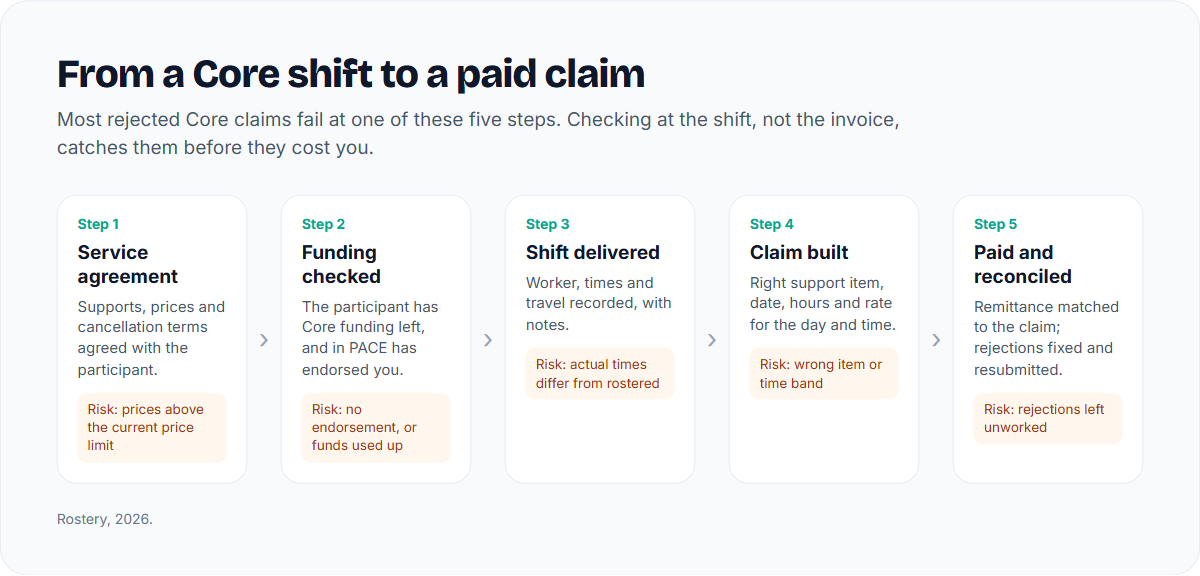
Agree the supports, prices and cancellation terms in writing before you start. You cannot charge more than the maximum amount for agency-managed or plan-managed funding, and the NDIA cannot pay a claim above it.
PACE: my providers and endorsement
Plans in PACE do not use service bookings. Instead, participants record the providers they work with regularly as “my providers”. According to the NDIA, claims from my providers are generally paid within two to three days. A participant can still use other providers, but a provider who is not recorded may see claims held or rejected, so confirm your status with each participant at the start.
Short notice cancellations
A provider can claim up to 100% of the agreed fee for a short notice cancellation or no-show, but only when every condition is met:
- Disability support worker supports: the participant gave less than seven days’ notice, or did not show up within a reasonable time.
- Most other supports, such as therapy: less than two clear business days’ notice.
- The provider could not find other billable work for the worker, and had to pay the worker for the time (unless a sole trader or partnership).
- The cancellation terms are in the service agreement, and the claim uses the same support item with the cancellation option.
There is no limit on the number of short notice cancellations a provider can claim, but the NDIA monitors cancellation claims and expects providers to find out why a participant is cancelling often. Providers may waive the fee at their discretion.
Provider travel and activity-based transport
Provider travel can only be claimed for items that allow it, when the support is delivered face to face, the participant agreed to the travel costs in advance, and the worker is paid for the travel time. Activity-based transport is different: when a worker transports a participant as part of a community participation support, the worker’s time is claimed at the support’s hourly rate against the Core budget. The 2025–26 guide sets non-labour vehicle contributions of up to $0.99 a kilometre for an unmodified vehicle and up to $2.76 a kilometre for a modified vehicle or bus, plus tolls, parking and fares at cost, all agreed with the participant in advance.
Common Core claiming mistakes
- Wrong time band. A shift that runs past 8pm or into Saturday is claimed at the lower rate, or at the higher rate for only part of it.
- Wrong location rate. Remote rates claimed for a participant whose support was delivered in a national-rate area.
- Funding period exhausted. The plan has money; the current three-month period does not.
- Not endorsed in PACE. The participant has not recorded the provider as one of their providers.
- Cancellation claimed without the conditions. No cancellation terms in the service agreement, or the worker was given other billable work.
- Rostered hours claimed instead of actual hours. The claim should match what was delivered.
How Rostery handles Core Supports
Rostery checks Core funding where it is cheapest to fix: at the shift. Each booking is checked against the participant’s funding before it is confirmed, so a shift that would overspend is held rather than discovered at claiming. The claim file is built from approved shifts and actual times, with the right support item and time band on every line, and checked against the current NDIS price limits before it is uploaded. Short notice cancellations follow the service agreement’s terms, and rejections come back against the shift they came from. Book a demo to see it on your own rosters.
Frequently Asked Questions
What are Core Supports in the NDIS?
Core Supports fund everyday help so a participant can complete activities of daily living: assistance with daily life, transport, consumables, and support to take part in the community. They are usually the largest and most flexible part of an NDIS plan.
What are the four Core Supports categories?
01 Assistance with Daily Life, 02 Transport, 03 Consumables, and 04 Assistance with Social, Economic and Community Participation. Plans in PACE can also show Core funding as 16 Home and Living and transport as 18 Recurring Transport.
Can I move Core funding to Capacity Building?
No. Core funding is flexible across Core categories, but it cannot be moved to Capacity Building or Capital supports.
What is the NDIS price limit for a support worker in 2026–27?
Under the NDIS Pricing Schedule 2026–27, effective 24 September 2026, the national maximum for standard weekday daytime assistance with self-care activities is $73.58 an hour, rising to $103.54 on Saturdays, $133.50 on Sundays and $163.46 on public holidays. Remote and very remote areas have higher limits.
Is SIL funded from Core Supports?
Yes. Supported independent living is funded under Assistance with Daily Life, category 01, and is usually a stated support in the plan.
How much notice is needed to cancel a Core support?
For supports delivered by a disability support worker, a provider can claim a short notice cancellation when the participant gave less than seven days’ notice, provided the service agreement allows it and the worker could not be given other billable work. For most other supports, the notice period is two clear business days.
Related reading
- Core Supports: the short definition
- Capacity Building
- PACE, the NDIA’s plan and payment system
- How to submit an NDIS bulk payment request without rejections
- NDIS Price Guide 2026–27: what changed
Sources
Checked on 1 October 2026. Prices and rules change; the agency sources below are the authority.
- NDIS pricing arrangements: NDIS Pricing Schedule 2026–27 (effective 24 September 2026)
- NDIS: New price limits set for NDIS supports (24 September 2026)
- NDIS Pricing Arrangements and Price Limits 2025–26, version 1.1 (published 14 October 2025)
- NDIA Quarterly Report to disability ministers, Q4 2025–26 (Appendices, Tables D.23 and D.25)
- NDIS: Changes to NDIS funding periods (19 May 2025)