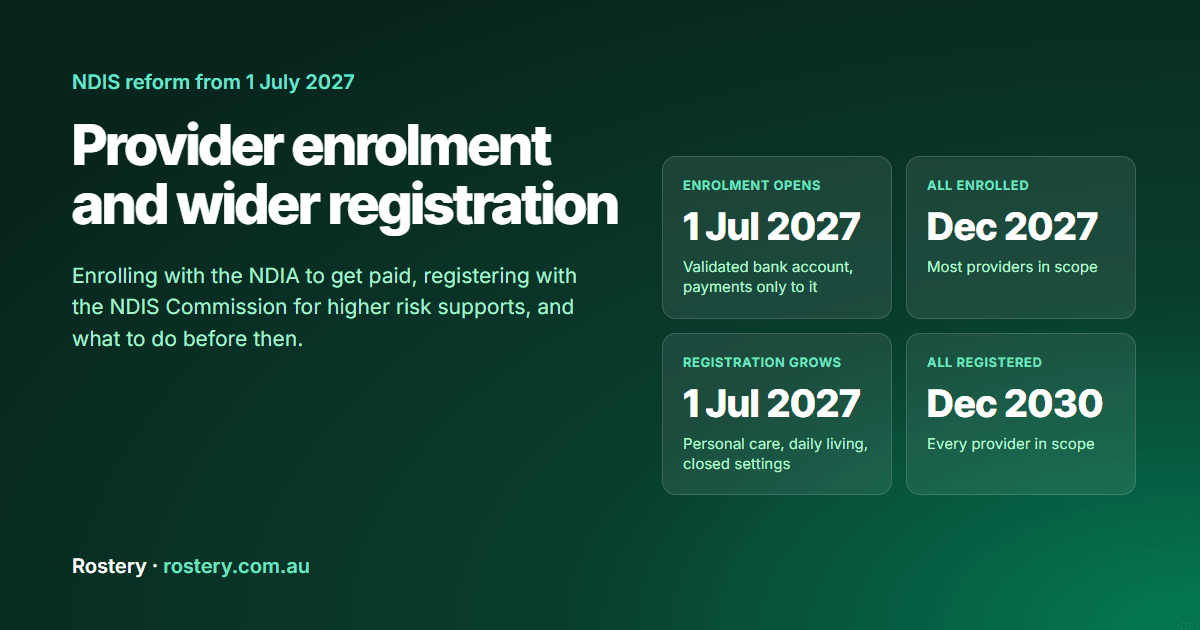
From 1 July 2027 most NDIS providers will have to enrol with the NDIA before they can be paid. Enrolment means giving the NDIA a minimum basic level of identifying information and a nominated, validated bank account, and NDIS payments will be made into that account. Every provider in scope must be enrolled by December 2027. Enrolment is separate from registration with the NDIS Quality and Safeguards Commission, and mainstream retailers will not need to enrol. On the same day, mandatory registration starts to expand to providers of higher risk supports such as personal care, daily living supports and supports in closed settings, with every provider in scope registered by December 2030. This guide explains the difference and what to do now. Checked against the department, the NDIS Act and the NDIS Commission on 13 November 2026.
In short
- Enrolment with the NDIA: from 1 July 2027, for most providers, registered or not. All in scope by December 2027.
- You give basic identifying details and a nominated, validated bank account. Payments go into that account.
- Claims above a threshold will need supporting documentation. The threshold is not published.
- Registration with the NDIS Commission becomes mandatory for higher risk supports from 1 July 2027, all in scope by December 2030. The list of supports is not published.
- The enrolment form, the threshold and the exact list are still to come. You can get your business details, bank account, invoices and records ready now.
What is NDIS provider enrolment?
Enrolment is a new NDIA system that records who is being paid NDIS money. The department's provider FAQs say most providers will need to enrol, show a minimum basic level of identifiable information and give a nominated and validated bank account, and that payments will be made into that account. The Minister's 30 June 2026 media release describes it as a new payment system that will require providers to enrol with the NDIA before receiving payments.
The stated reason is visibility. The FAQs say enrolment will let the NDIA track and monitor payments, check claims and see who the money is going to, which means less fraud. Today an unregistered provider can be paid NDIS funds through a plan manager or a self-managed participant without the NDIA knowing who they are.
The FAQs say enrolment is a separate process from being a registered NDIS provider. Registration is with the NDIS Commission and involves audits against the Practice Standards. Enrolment is with the NDIA and is about identity and payment.
Registered, enrolled and unregistered: the difference
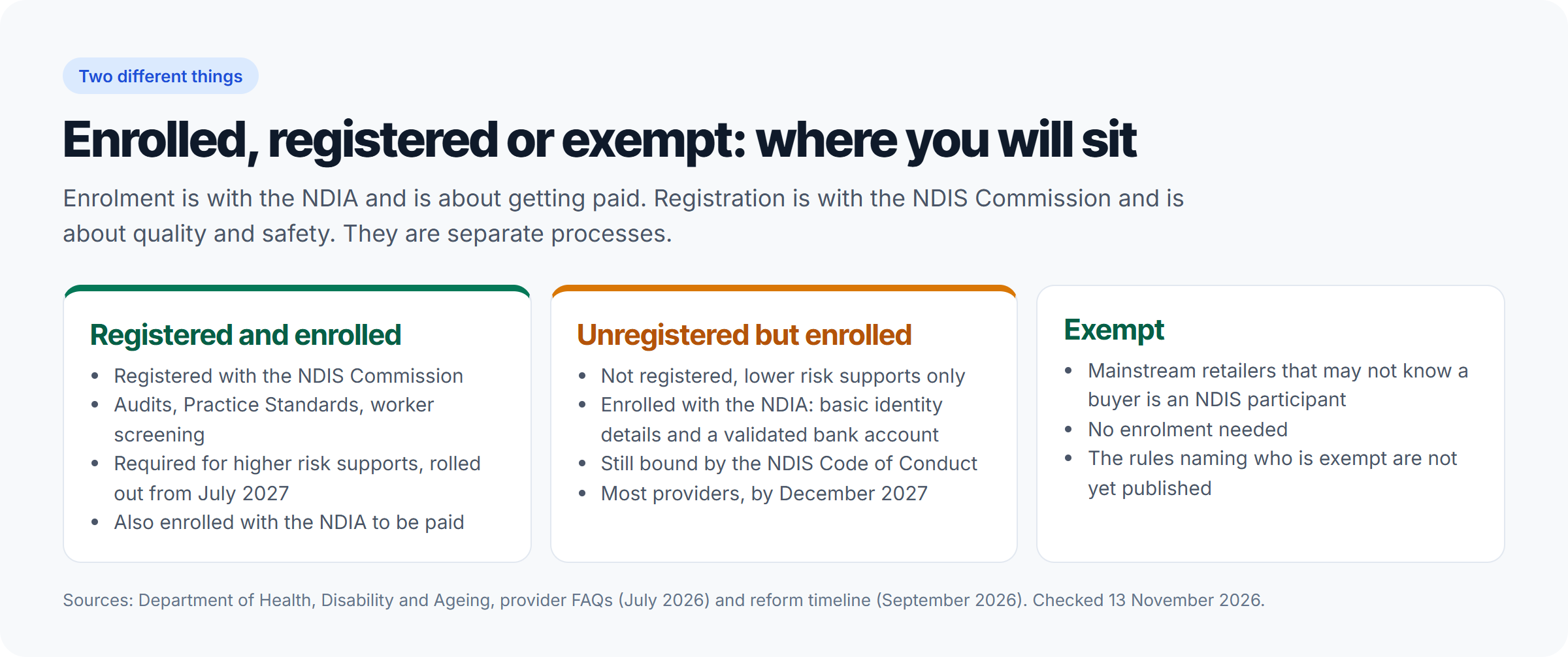
| Registered (and enrolled) | Unregistered but enrolled | Exempt from enrolment | |
|---|---|---|---|
| Who with | NDIS Commission for registration, NDIA for enrolment | NDIA only | Neither |
| What you provide | An application, audit against the NDIS Practice Standards, worker screening, plus enrolment details | Basic identifying information and a validated bank account | Nothing |
| Which supports | Required for higher risk supports as the expansion rolls out, and already for SIL, platforms, SDA, behaviour support and regulated restrictive practices | Supports not on the higher risk list | Ordinary retail purchases |
| Who can buy from you | NDIA-managed, plan-managed and self-managed participants | Plan-managed and self-managed participants | Anyone |
| Code of Conduct | Applies | Applies | The Act now lets NDIS rules take these businesses out of the NDIS provider definition |
| By when | Higher risk supports: rolled out from 1 July 2027, all by December 2030 | From 1 July 2027, all by December 2027 | Not applicable |
Two points sit behind the last column. The amended NDIS Act has a new definition of NDIS provider (section 10C), in force since 27 August 2026, which lets the NDIS rules exclude classes of persons or entities. The department's talking points say this is how mainstream retailers, such as supermarkets and hardware chains that may not know a customer is a participant, will be taken out of obligations like the Code of Conduct. We could not find the rules that name the excluded classes, so the exact boundary is not yet known.
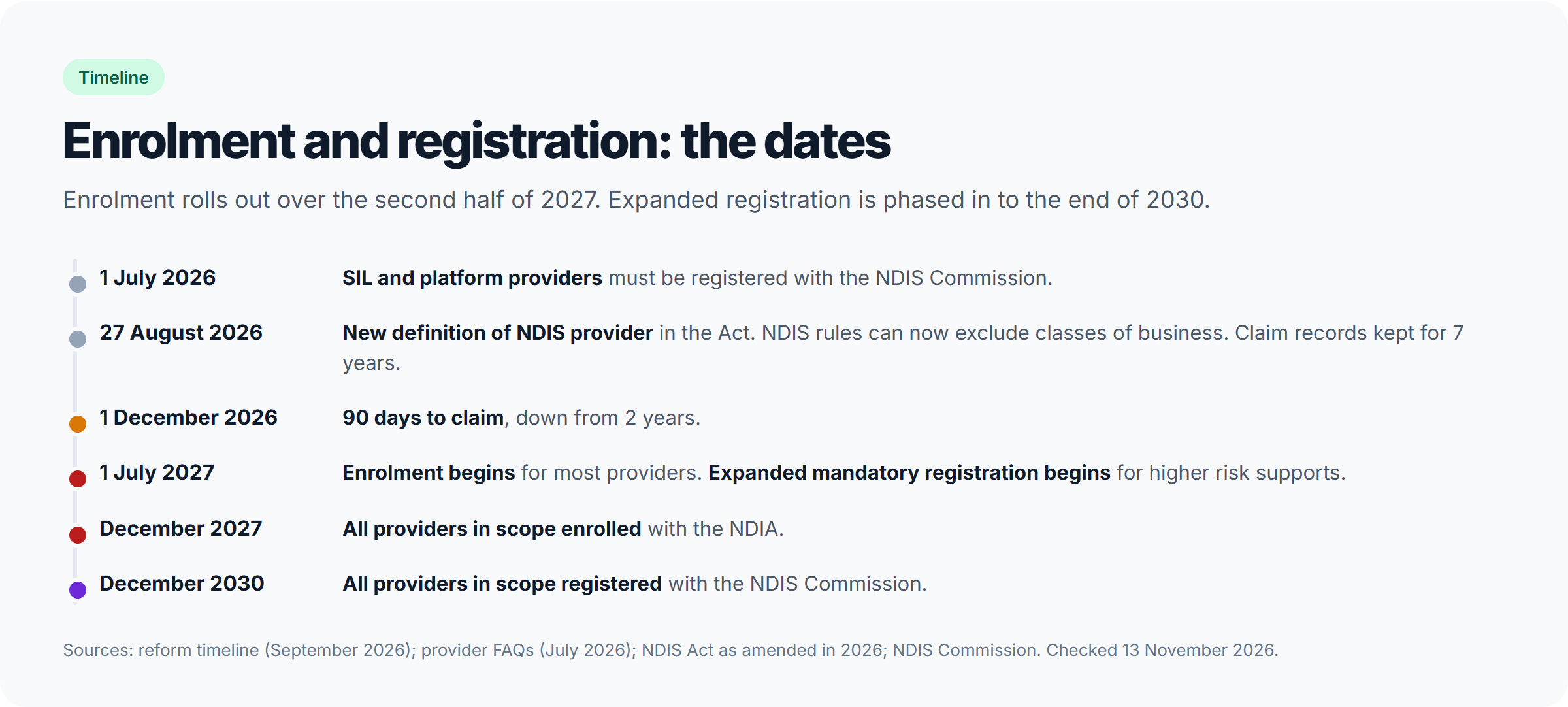
NDIS enrolment and registration timeline
| Date | What happens | Who it affects |
|---|---|---|
| 1 July 2026 | Mandatory registration for SIL and NDIS digital platform providers | SIL and platform providers (see our SIL registration group 0138 guide) |
| 27 August 2026 | New NDIS provider definition; claim records must be kept (7 years for providers) | All providers |
| 1 December 2026 | Claims must be made within 90 days of the support | Everyone who claims |
| 1 July 2027 | Enrolment with the NDIA begins; expanded mandatory registration begins | Most providers; providers of higher risk supports |
| December 2027 | All providers in scope enrolled | Most providers |
| December 2030 | All providers in scope registered | Providers of higher risk supports |
What we know about enrolment, and what we don't
| Question | Status at 13 November 2026 |
|---|---|
| When does enrolment start? | From 1 July 2027. All providers in scope enrolled by December 2027. |
| Who has to enrol? | Most providers, registered or not. Mainstream retailers will not. |
| What do I give the NDIA? | A minimum basic level of identifiable information and a nominated, validated bank account. The exact fields are not published. |
| Where will payments go? | Into the nominated bank account. |
| Will claims need evidence? | Yes, above a certain threshold. The threshold and the documents are not published. |
| How long must I keep records? | Records of NDIS claims and payments: 7 years for providers, under section 45B of the Act since 27 August 2026. |
| Is it in the law yet? | Not in the August 2026 amending Act. We found no enrolment provision in it, so the legal detail is still to come. |
| How will plan-managed payments work? | Not published. The FAQs say enrolled providers can be paid directly, but not how this fits with plan managers or self-managed participants. |
| Is there a consultation? | We could not find one on enrolment as at 13 November 2026. |
The department also lists "increase evidence required for payments for NDIS supports, including payments at point of service" among the measures. Point of service payments are not explained further in what has been published.
Expanded mandatory registration for higher risk supports
From 1 July 2027 the rollout of expanded mandatory registration begins for providers of higher risk supports. The FAQs give personal care, daily living supports and supports provided in closed settings as examples, and say the government will publish a list of the supports considered high risk. Providers will have time to work out whether the change applies to them and register before it starts. All providers in scope must be registered by December 2030. The 2026-27 Budget funded the expansion, and the Minister's release says the reform will see 90 per cent of all NDIS payments go to registered providers.
No list had been published by 13 November 2026. The department's impact analysis from May 2026 shows how the rollout was proposed, and the NDIS Commission says it will give providers more information before they need to register. Treat these points as proposals:
- A staged rollout over four years from July 2027, registering the highest risk providers who are currently unregistered first.
- New "advanced" and "general" registration categories, starting with the highest risk supports, with personal care and home and living supports given as examples.
- New market entrants, meaning currently unregistered providers, would have 12 months from the start date for their category to meet the obligations.
- Existing registered providers would move to their new category at their next audit.
- Cost recovery for registration applications.
Support coordination is a separate case. The NDIS Commission had consulted on mandatory registration for support coordination, but that work is paused while the wider reform is considered. Support coordination becomes a commissioned NDIA service from 1 July 2028, covered in our plan management panel and support coordination guide.
What unregistered providers should do now
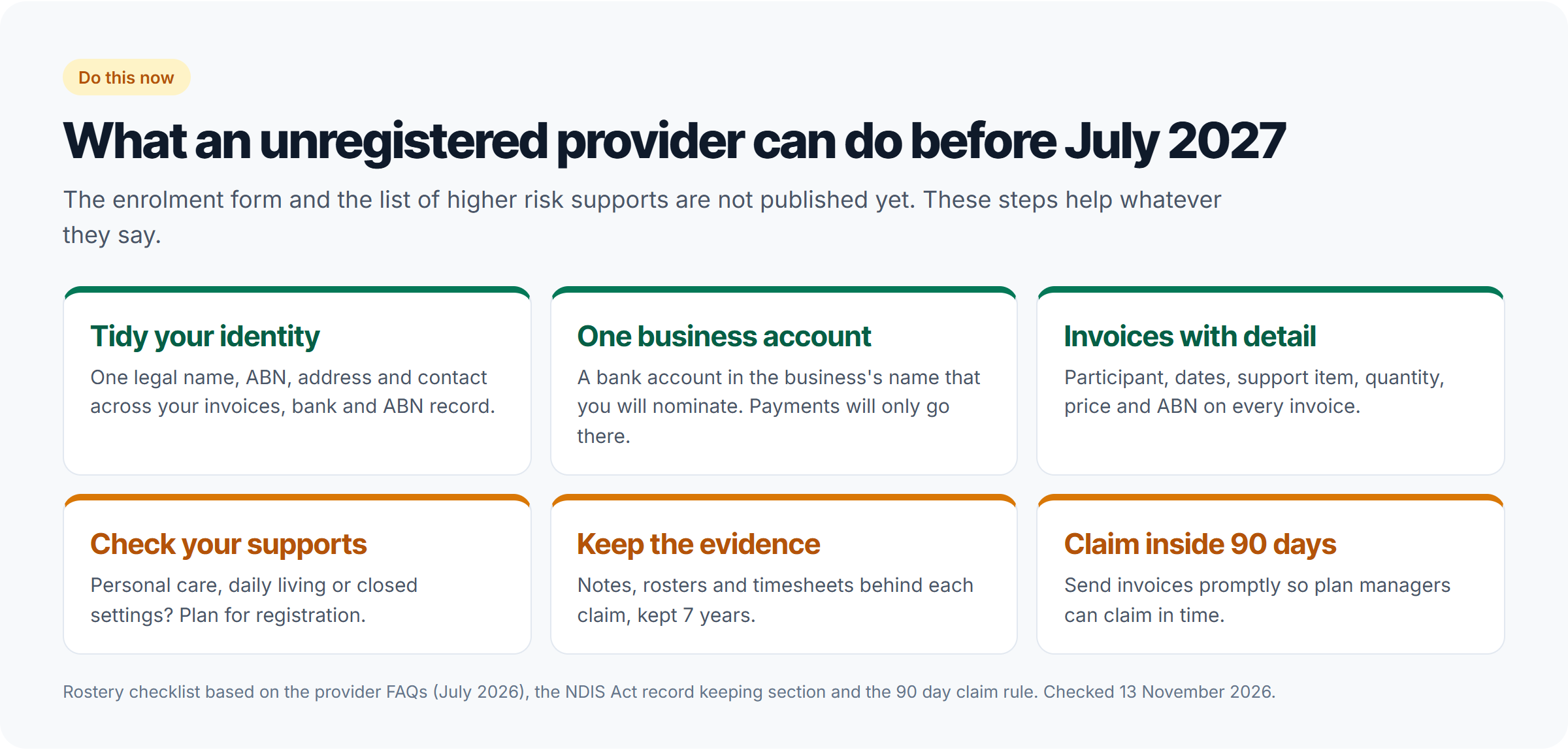
Nothing can be lodged yet. These steps get you ready for day one.
- Make your identity consistent. Your legal name, trading name, ABN, address and contact details should match on your ABN record, your bank account and your invoices. "Minimum identifiable information" will be checked against something.
- Pay into one business bank account in the business's name, and plan to nominate it. Payments will only go to the validated account, so a change later will be slower than getting it right first.
- Put full details on every invoice: participant name, dates of service, support item, quantity or hours, unit price and your ABN. That is what plan managers need to claim, and it is what supporting documentation for a claim is built from.
- Look at what you deliver. If it includes personal care, daily living supports or anything in a closed setting, assume registration is coming and start preparing. Our guide on how to become a registered NDIS provider covers the steps, and the audit evidence checklist covers what auditors look for.
- Keep the records behind each claim, such as notes, rosters, timesheets and service agreements, for 7 years. See our record keeping guide.
- Invoice promptly. From 1 December 2026 plan managers and the NDIA have 90 days from the support to claim, explained in our 90-day claim rule guide.
- Remember the Code of Conduct already applies to you, registered or not, and the ban on kickbacks and inducements applies to every provider.
What plan managers need from providers
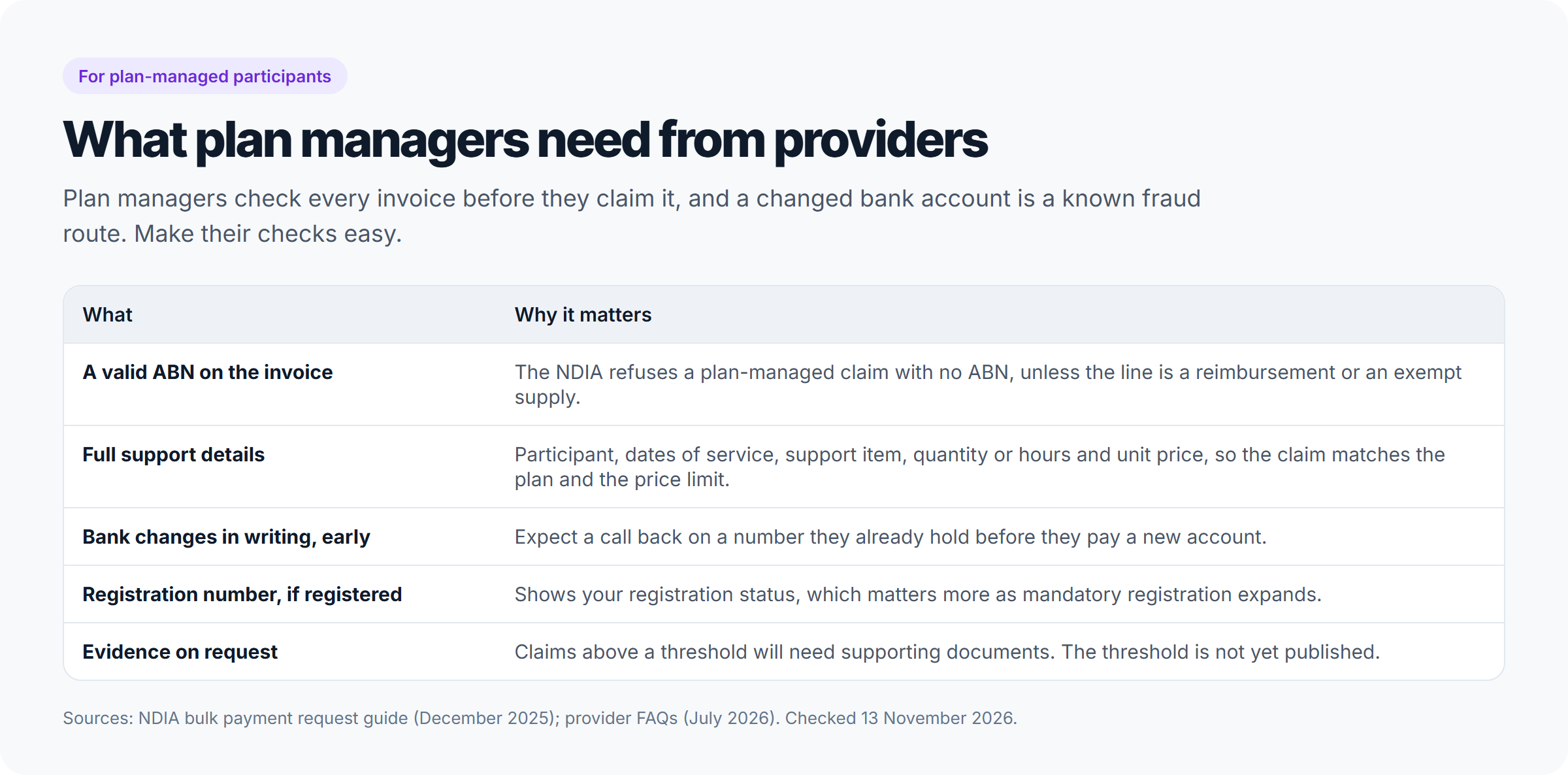
Plan managers carry more of the checking load as these reforms land. From 1 October 2027 they must hold a deed with the NDIA that covers verifying identity and that supports were provided. Providers who make those checks easy get paid faster.
- A valid ABN on every invoice. The NDIA's bulk claim guide says a plan-managed claim needs the ABN of the provider who delivered the support, and a blank is refused unless the line is a reimbursement (REIMB) or an exempt supply (EXCLS).
- Invoices that match the plan and the price limits: the right support item, dates, quantity and a price no higher than the limit in the NDIS price guide.
- Bank details changes sent early and through a known contact. Expect a plan manager to call you back on a number they already hold before paying a new account.
- Your registration number if you are registered, so the plan manager can see your status.
- Supporting documents when asked. Once the evidence threshold is set, plan managers will need them to claim.
What we do not know is how enrolment will change the flow of money for plan-managed participants. Whether plan managers will have to check that a provider is enrolled, or pay only to the enrolled account, is not published. Plan managers should watch for NDIA guidance in the first half of 2027.
How Rostery fits
Rostery is our software, so here is plainly what it does today. For providers, invoices carry your ABN, and the bulk claim file for NDIA-managed participants checks your Organisation ID and each line before it is written. Rostery builds the file; it does not lodge it with the NDIA. More on NDIS claiming in Rostery.
For plan managers, each provider record holds the ABN, with a checksum check, and the NDIS registration number, where blank means unregistered. When a provider's bank details are entered or changed the provider goes back on hold, and a second person has to confirm the account with the provider on a number that did not come from the invoice before payments are released. The Missing evidence report lists invoices with no document behind them. See Plan Management in Rostery or book a demo.
For every reform date from now to 2030, see our NDIS changes hub.
Frequently asked questions
When do NDIS providers have to enrol with the NDIA?
From 1 July 2027. Providers in scope will need to enrol from that date so they can be paid, and all providers in scope must be enrolled by December 2027.
Is NDIS enrolment the same as registration?
No. Enrolment is with the NDIA and covers basic identifying information and a validated bank account for payments. Registration is with the NDIS Commission and involves audits against the NDIS Practice Standards. The government says they are separate processes.
Do unregistered NDIS providers need to enrol?
Yes, most will. The government says the vast majority of providers will need to enrol, registered or not. Mainstream retailers that may not know they are serving NDIS participants will not.
Which supports will need registration from July 2027?
Higher risk supports. The government gives personal care, daily living supports and supports in closed settings as examples and says it will publish a list. That list was not published at 13 November 2026. Registration rolls out from 1 July 2027, with all providers in scope registered by December 2030.
What is the threshold for supporting documentation on claims?
It has not been published. The government says supporting documentation will be required where claims exceed a certain threshold, without giving the amount or the documents.
Will plan managers still be able to pay unregistered providers?
For supports that do not need registration, nothing published says otherwise. Plan managers can pay unregistered providers today. Once a support is on the higher risk list and its registration date has passed, the provider will need to be registered to deliver it.
What can I do about enrolment now?
Nothing can be lodged yet. You can make your business details consistent, set up the bank account you will nominate, put full details on every invoice and keep records for 7 years.
Sources
- Department of Health, Disability and Ageing: Securing the future of the NDIS for future generations, provider FAQs (July 2026)
- Securing the NDIS for future generations: timeline (September 2026)
- Department of Health, Disability and Ageing: Securing the NDIS for future generations (last updated 27 August 2026)
- Minister for the NDIS: Crackdown on sales of NDIS businesses as mandatory registration set to expand from 1 July (30 June 2026)
- National Disability Insurance Scheme Amendment (Securing the NDIS for Future Generations) Act 2026, sections 10C and 45B
- Department of Health, Disability and Ageing: Mandatory Registration of all NDIS Providers, impact analysis (May 2026)
- Department talking points on NDIS reforms, released under FOI 26-3298 (September 2026)
- NDIS Quality and Safeguards Commission: Mandatory registration
- NDIA: Bulk payment requests self-help guide for providers (December 2025)
Checked 13 November 2026. The enrolment process, the documentation threshold and the list of higher risk supports are still to be published, so check the NDIA, the department and the NDIS Commission before acting. This guide explains published government information and is not legal advice.