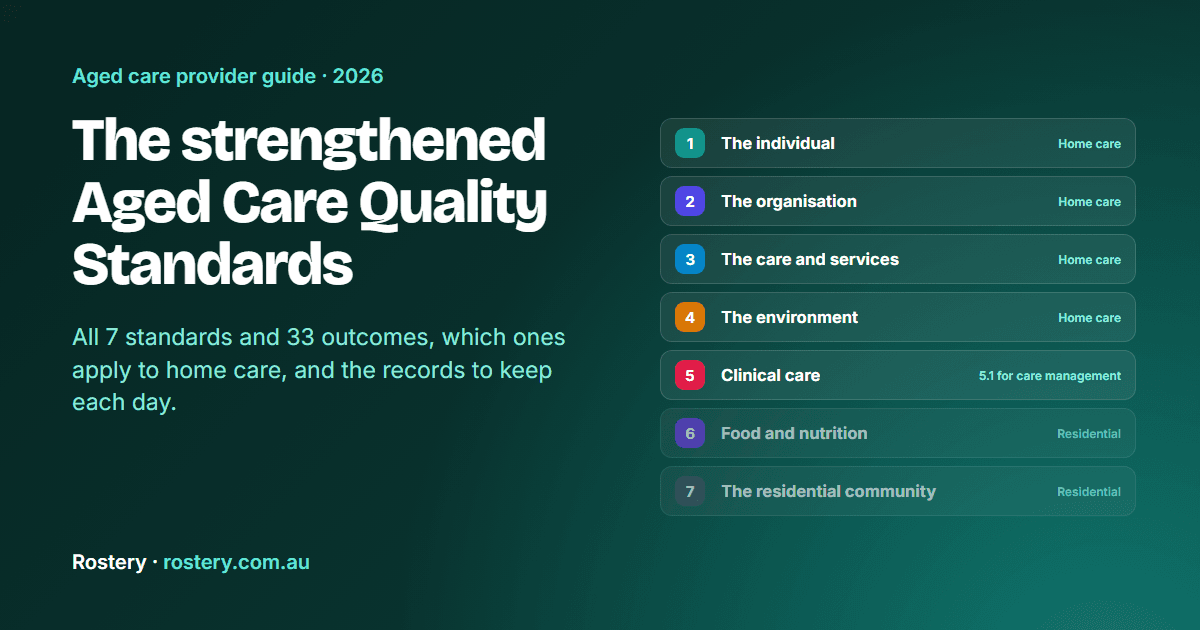
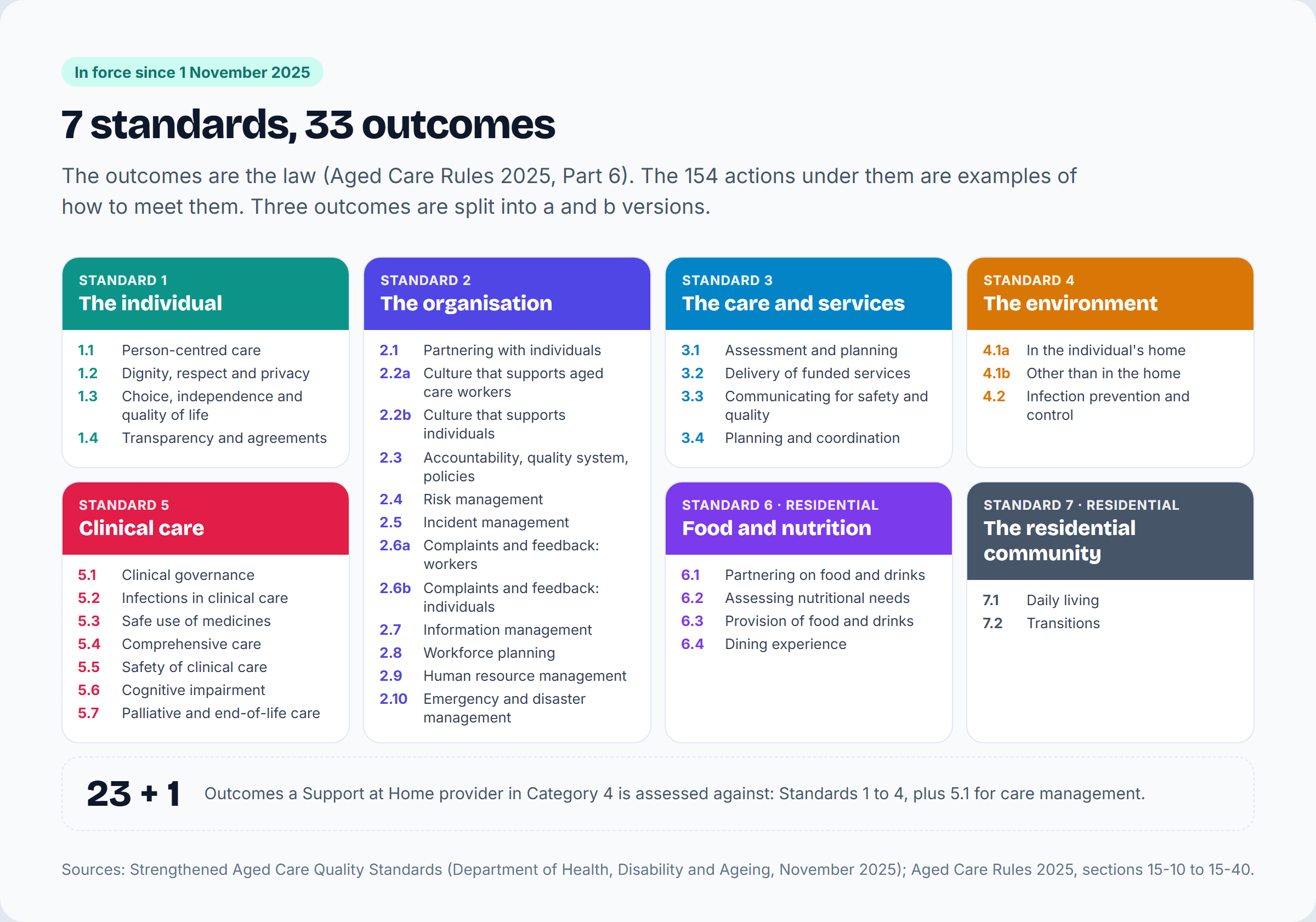
The strengthened Aged Care Quality Standards are the 7 standards that aged care providers in registration categories 4, 5 and 6 must meet. They have applied since 1 November 2025, when the Aged Care Act 2024 began, and they replaced the 8 standards in force since 2019. The standards sit in Part 6 of the Aged Care Rules 2025 and contain 33 outcomes, which are the legal duty, and 154 actions, which are examples of how to meet them. A Support at Home provider is registered in Category 4 with care management, so it is assessed against Standards 1 to 4 and Outcome 5.1: 24 outcome statements in all. This guide explains each standard, who must meet which, what changed, and what a home care provider does and keeps each day to meet them.
What the strengthened Quality Standards are
The standards are law. Section 146 of the Aged Care Act 2024 makes conforming with them a condition of registration for the providers the rules prescribe, and the standards themselves are in sections 15-10 to 15-40 of the Aged Care Rules 2025. The Department explains that "the Rules operationalise the strengthened Quality Standards by making the outcome statements legal obligations".
Each standard has four parts: an intent, an expectation statement written from the older person's point of view, the outcomes you are assessed against, and actions that describe what you can do to meet them. The Commission is clear that "providers don't need to meet each action but need to meet each outcome, depending on their registration category". The actions are examples, so you can meet an outcome in a way that suits your service.
| Standard | Name | Outcomes | Actions | Applies to home care? |
|---|---|---|---|---|
| 1 | The individual | 4 (1.1 to 1.4) | 21 | Yes |
| 2 | The organisation | 10, written as 12 (2.2 and 2.6 have a and b) | 51 | Yes |
| 3 | The care and services | 4 (3.1 to 3.4) | 22 | Yes |
| 4 | The environment | 2, written as 3 (4.1 has a and b) | 6 | Yes |
| 5 | Clinical care | 7 (5.1 to 5.7) | 35 | Outcome 5.1 with care management; all of it for nursing |
| 6 | Food and nutrition | 4 (6.1 to 6.4) | 10 | No, residential only |
| 7 | The residential community | 2 (7.1 and 7.2) | 9 | No, residential only |
| Total | 33 (36 outcome statements) | 154 |
The standards came out of the Royal Commission into Aged Care Quality and Safety, which in 2021 recommended an urgent review. The areas it named for improvement were dementia care, diversity, provider governance, food and nutrition and clinical care. The standards will be reviewed every 5 years.
The 7 standards in plain English
Standard 1: The individual
It "underpins the way that providers and aged care workers are expected to treat older people and is relevant to all standards". The expectation: "I have the right to be treated with dignity and respect and to live free from any form of discrimination. I make decisions about my funded aged care services, with support when I want or need it." Outcomes: 1.1 person-centred care, 1.2 dignity, respect and privacy, 1.3 choice, independence and quality of life, and 1.4 transparency and agreements.
Standard 2: The organisation
The largest standard sets out what the governing body must do. The expectation: "The organisation is well run. I can contribute to improvements to funded aged care services." Its outcomes cover partnering with individuals (2.1), a culture of quality, safety and inclusion for workers and individuals (2.2a and 2.2b), accountability and the quality system (2.3), risk (2.4), incidents (2.5), complaints from workers and individuals (2.6a and 2.6b), information (2.7), workforce planning (2.8), human resources (2.9) and emergencies and disasters (2.10).
Standard 3: The care and services
It "describes the way providers must deliver funded aged care services for all types of services being delivered". Older people can expect services that "are safe and effective ... are well planned and coordinated ... respect my right to take risks". Outcomes: 3.1 assessment and planning, 3.2 delivery of funded services, 3.3 communicating for safety and quality, and 3.4 planning and coordination.
Standard 4: The environment
Services are delivered "in a physical environment that is safe, supportive and meets their needs". Outcome 4.1a covers services in the person's own home, 4.1b services delivered elsewhere, such as centre-based respite, and 4.2 infection prevention and control. In the home, the rule is that the provider "must support the individuals to mitigate environmental risks relevant to the services".
Standard 5: Clinical care
It "describes the responsibilities of providers to deliver safe and quality clinical care services to older people". Its outcomes are clinical governance (5.1), infections in clinical care (5.2), medicines (5.3), comprehensive care (5.4), safety of clinical care (5.5, including falls, pressure injuries, swallowing, continence, nutrition, pain and oral health), cognitive impairment (5.6) and palliative and end-of-life care (5.7).
Standards 6 and 7: Food and nutrition, and the residential community
Both are "intended to apply only to residential care homes". Standard 6 covers food, drinks, nutrition and the dining experience; Standard 7 covers daily living and transitions in the residential community.
Which standards apply to your organisation
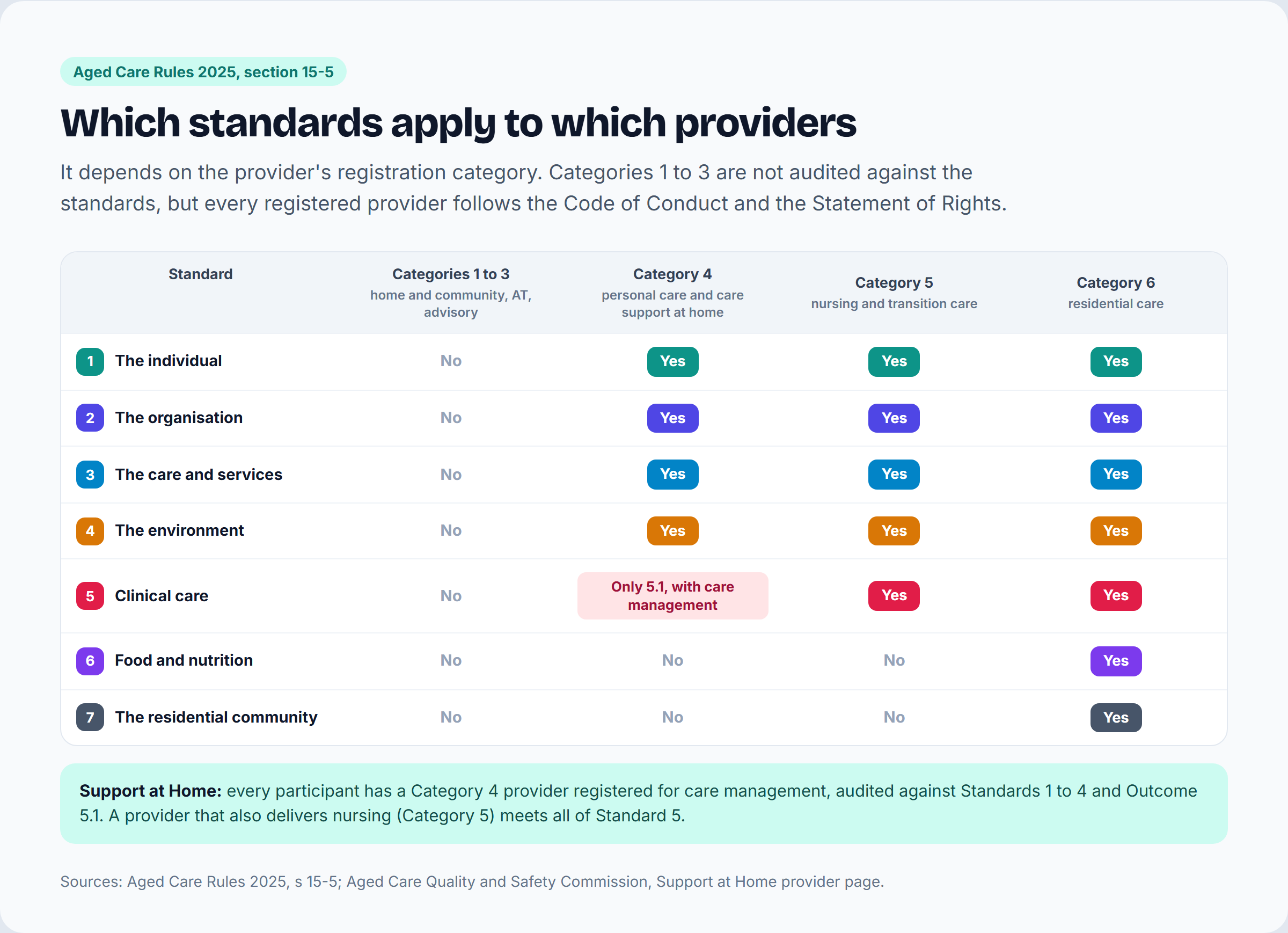
Section 15-5 of the Rules decides it by registration category. Standards 1 to 4 apply to categories 4, 5 and 6, Standard 5 to categories 5 and 6, and Standards 6 and 7 to category 6. One part of Standard 5 reaches further: Outcome 5.1, clinical governance, applies to a Category 4 provider "that delivers, or intends to deliver" care management or restorative care management.
| Category | Name | Example service types | Quality Standards |
|---|---|---|---|
| 1 | Home and community services | Domestic assistance, home maintenance and repairs, meals, transport | No |
| 2 | Assistive technology and home modifications | Equipment and products, home adjustments | No |
| 3 | Advisory and support services | Hoarding and squalor assistance, social support and community engagement | No |
| 4 | Personal care and care support in the home or community | Personal care, allied health and therapy, nutrition, respite, care management, restorative care management | Standards 1 to 4, plus Outcome 5.1 for care management |
| 5 | Nursing and transition care | Nursing care, assistance with transition care | Standards 1 to 5 |
| 6 | Residential care | Residential accommodation, everyday living, non-clinical and clinical care | All 7 |
Providers in categories 1 to 3 are not audited against the standards. They still follow the Code of Conduct and act compatibly with the Statement of Rights, like every registered provider. Providers in categories 1 and 4 that deliver meals have separate meal requirements as a condition of registration.
Support at Home providers
Support at Home works under a single provider model, and every participant must receive care management. The Commission says providers claiming for Support at Home must register in Category 4 with the service type "Care management", be audited under the strengthened standards and meet Outcome 5.1. "Each older person receiving Support at Home has a provider registered in Category 4." The Department says the single provider model will run until at least June 2027.
- If you also deliver nursing, you are in Category 5 as well and meet all of Standard 5, including medicines.
- The Assistive Technology and Home Modifications scheme needs Category 2. The Restorative Care Pathway needs Category 4 with restorative care management and allied health and therapy.
- If a person's needs grow beyond your registration, they would need to move to a provider registered for the full range of services they need.
For how the program itself works, see our Support at Home program guide, and for the budgets, the Support at Home funding levels.
What changed from the old 8 standards
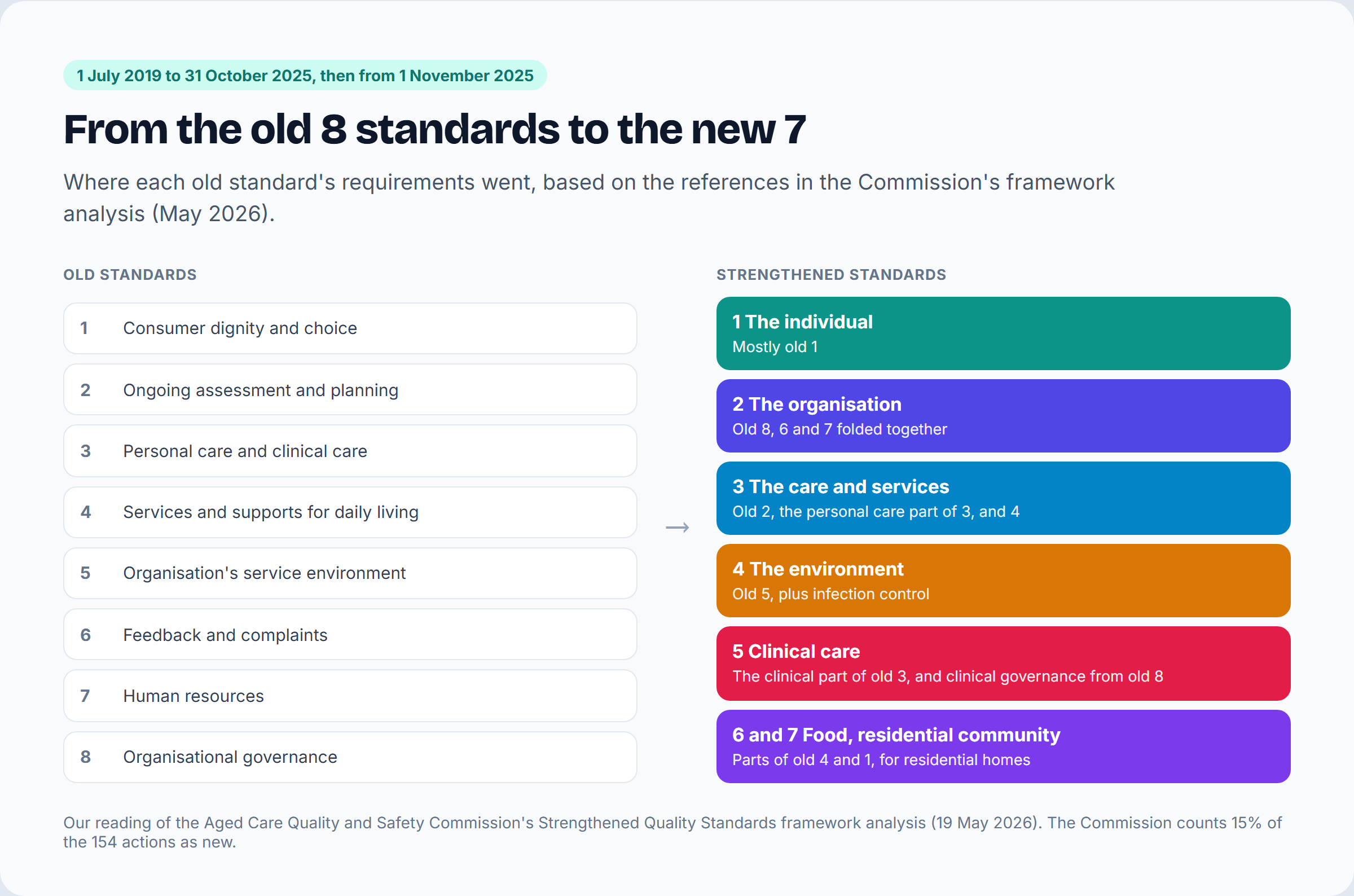
If you are looking for the 8 aged care quality standards, those were the previous standards, in force from 1 July 2019 to 31 October 2025: consumer dignity and choice; ongoing assessment and planning; personal care and clinical care; services and supports for daily living; the organisation's service environment; feedback and complaints; human resources; and organisational governance. The Commission describes the new set as "more streamlined, going from 8 down to 7 standards".
Most of the content is not new. The Commission's analysis of the 154 actions found 15% align with the old standards, 11% were already required by law, 59% clarify existing expectations and 15% are new or enhanced. The Department puts it at 13% new. These are the main additions:
| What is new | Where |
|---|---|
| A dedicated clinical care standard | Standard 5, developed by the Australian Commission on Safety and Quality in Health Care. |
| Food and nutrition | Standard 6, for residential homes. Home meal providers have separate meal requirements (Regulatory Bulletin RB 2026-2). |
| Graded assessment | Each outcome is rated: conformance, minor non-conformance or major non-conformance. |
| Dignity of risk | Outcome 1.3: supporting people to take the risks they choose, including positive risk-taking. |
| Culturally safe, trauma-aware care | Outcomes 1.1 and 3.2, and asking and recording whether a person is Aboriginal or Torres Strait Islander. |
| Invoices and refunds | Actions 1.4.6 and 1.4.7: invoices that are timely, accurate and clear, and prompt refunds for overcharging. |
| Workers inside the standards | Outcome 2.2a on a culture that supports aged care workers, and 2.6a so workers can complain without reprisal. |
| Emergency and disaster management | A dedicated outcome, 2.10, including what happens when you cannot reach someone at home. |
| Minimum core training | Action 2.9.6: person-centred and rights-based care, culturally safe care, dementia, medical emergencies, and the Code of Conduct, SIRS and the standards. |
| Digital clinical records | Action 5.1.5: providers work towards a digital clinical information system. |
What each standard means day to day in home care
This is what the outcomes ask of a Category 4 home care provider, drawn from the Rules, the Commission's guidance for home and community settings, and the evidence its auditors ask for. Outcome 4.1b only matters if you deliver services outside the person's home.
| Outcome | What to do | Records that show it |
|---|---|---|
| 1.1 Person-centred care | Know each person: their home, who lives with them, family support and their other services. Make sure every worker, including contractors, has current information. | Care and services plan, client profile |
| 1.2 Dignity, respect and privacy | Have a way to recognise and respond to abuse, neglect and discrimination, including signs workers see outside your services. Offer choice about intimate personal care. | Incident register, training records |
| 1.3 Choice, independence and quality of life | Get and record informed consent. Support people to take the risks they choose. Notice and act on changes in quality of life. | Consent and dignity of risk forms |
| 1.4 Transparency and agreements | Explain prices before services start, get consent before fees change, send itemised, accurate invoices and refund overcharging promptly. | Service agreements, monthly statements |
| 2.1 Partnering with individuals | Involve the people you support in improving services, even when they live in different places. | Minutes of meetings with older people and supporters |
| 2.3 Quality system | Watch feedback, complaints, incidents and risks for patterns, and practise open disclosure. | Continuous improvement plan, trend analysis |
| 2.4 Risk management | Record each person's risks in their plan and the organisation's risks in a register. | Risk register |
| 2.5 Incident management | Record incidents and near misses, including ones reported by others, and report to the regulator where required. | Incident register, SIRS notifications |
| 2.6b Complaints and feedback | Ask people at the end of a visit if they are happy, and offer another way to complain than the worker involved. | Complaints register |
| 2.7 Information management | Keep care information accurate and shared with the people who need it. A clinical section of your database is enough for home services. | Client records, consent to share |
| 2.9 Human resource management | Check workers before they start, supervise them, train them in the core topics and roster with enough travel time between homes. | Worker records, training matrix, rosters |
| 2.10 Emergency and disaster management | Plan for when you cannot reach someone at home, such as in a fire or flood. | Emergency and continuity plan |
| 3.1 Assessment and planning | Build the plan with the person and their supporters, and review it when needs, carers or risks change, after an incident and at transitions. Support advance care planning. | Care plan, assessments, review dates |
| 3.2 Delivery of services | Help workers spot deterioration and escalate it, keep the same workers where you can, and refer to My Aged Care for reassessment when needs change. | Progress notes, referrals |
| 3.3 Communicating for safety | Make sure information reaches the next worker, especially at handover, after an incident and when someone deteriorates. | Shift notes, handover records |
| 3.4 Planning and coordination | Record hospital and emergency visits, use discharge summaries and document who does what at a transition. | Transition plans, hospital records |
| 4.1a Environment in the home | Identify risks in the home (clutter, pets, poor lighting, heat), discuss ways to reduce them and keep any equipment you supply safe and clean. | Home safety assessments, equipment records |
| 4.2 Infection prevention and control | Have someone responsible for infection control, supply PPE and screen and immunise for vaccine-preventable disease based on risk. | Infection control plan, vaccination records |
| 5.1 Clinical governance (care management) | Have a clinical governance framework endorsed by the governing body, make sure workers act within their scope, and agree roles with health practitioners. | Clinical meeting minutes, practitioner agreements |
Some of the Commission's home care guidance is worth reading in its own words. On fees: "it is important to recognise that fees and charges are a frequent source of complaints", so "invoices need to be itemised" and "Don't rely on older people to make complaints about incorrect charges." On rostering, plan for the "logistics of travelling between older people's homes" and make sure "workers have adequate time to meet the assessed care needs of each older person within the worker's allocated shift". On records, home services do not need a dedicated clinical system: care information "can be stored in the clinical sections of your database".
How the Commission checks
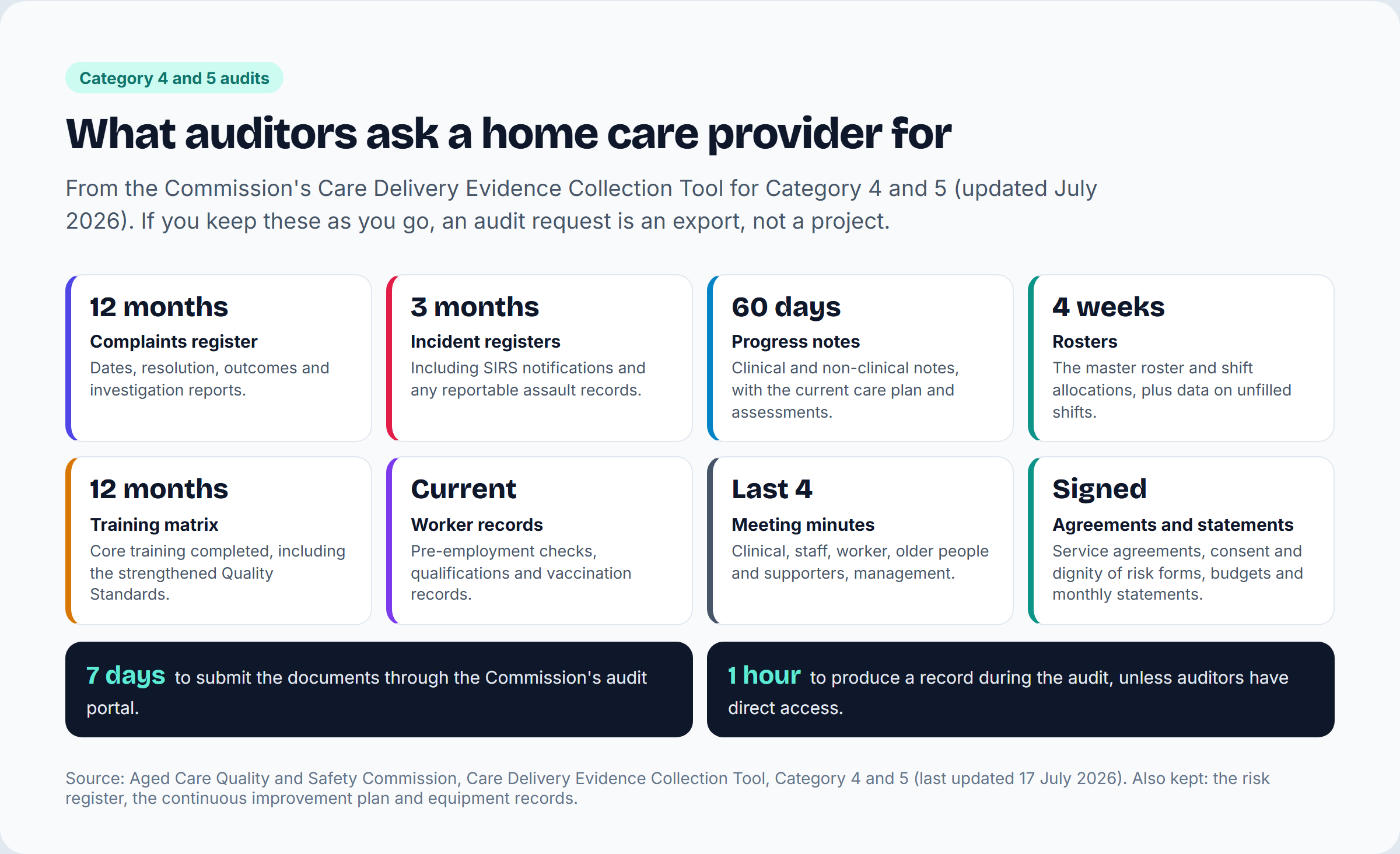
The Commission audits providers when they first register in categories 4, 5 or 6, when they renew (registration usually runs for 3 years, and the invitation to renew can come up to 18 months before it ends) and when they add one of those categories. A Category 4 or 5 provider has one provider audit that samples its locations. Audits are announced, and the Commission draws evidence from eight sources, including older people's experience, worker and management feedback, observations, documents and care outcomes.
Each outcome is rated conformance, minor non-conformance or major non-conformance; "exceeding" is only for residential homes. Audits restarted in January 2026 under the new Act, and the Commission had not yet published conformance results under the strengthened standards when we checked. The practical point for a home care provider is the evidence list above. Documents are due within 7 days, and during the audit a record has to be produced within an hour. Keeping them as part of the work is much easier than assembling them afterwards.
Home care in 2026: what the data shows
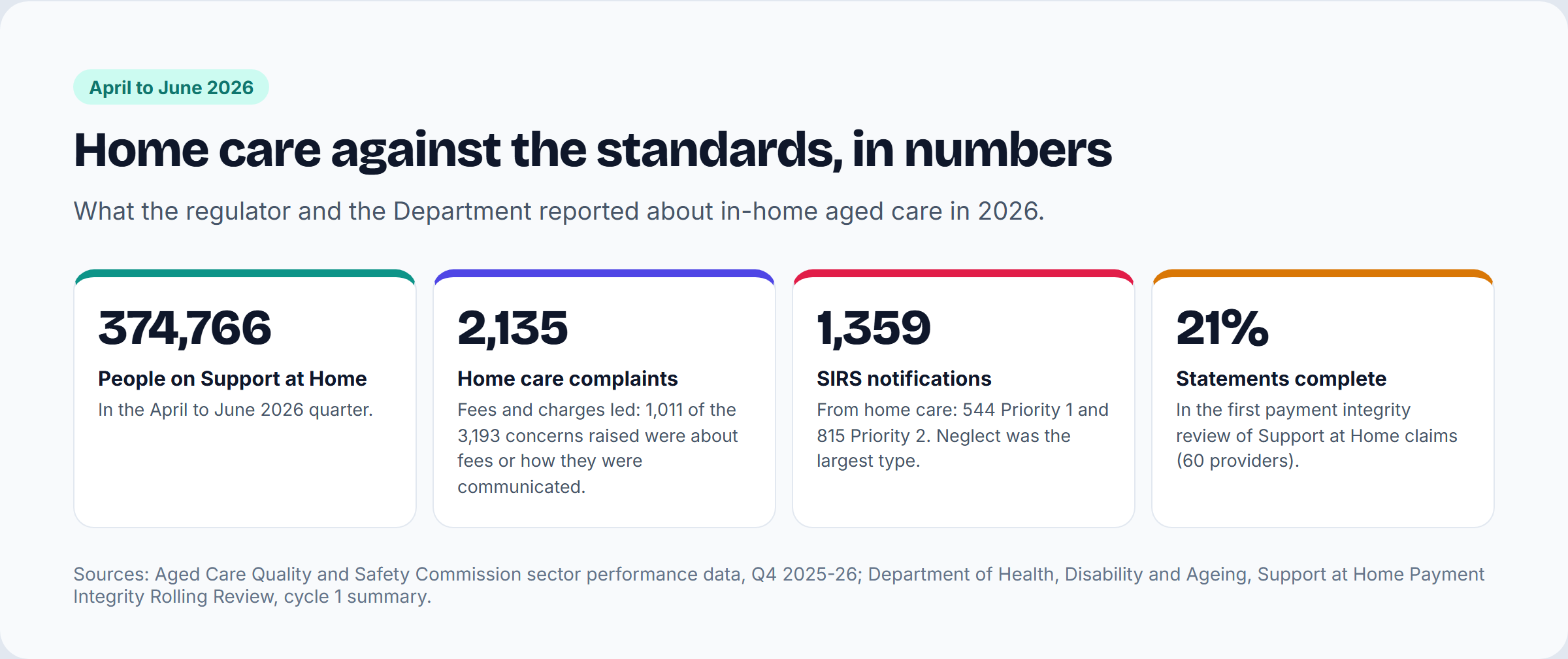
| Measure | Figure | Detail |
|---|---|---|
| People receiving Support at Home | 374,766 | April to June 2026 |
| Home care complaints to the Commission | 2,135 | 3,193 concerns: fees and charges, and how they were communicated, were 1,011 of them |
| Late, cancelled, unavailable or inadequate services | 409 concerns | The next largest group of home care concerns |
| Home care SIRS notifications | 1,359 | 544 Priority 1 and 815 Priority 2; neglect (684) was the largest type |
| Monthly statements with every required item | 21% | First payment integrity review, 60 providers, November and December 2025 claims |
| Providers with findings on monthly statements | 51 of 60 | Same review |
The pattern points at Standard 1, Outcome 1.4: fees, prices and statements. The Commission is investigating one Support at Home provider that "had included care management costs in their service delivery prices", which the Rules do not allow, and its prudential reviews have found issues with service agreements, pricing transparency and financial management. The Department's payment integrity review warns that its results "should not be interpreted as representative of all Support at Home providers". For 2026-27 the Commission's risk priorities are aged care rights in practice, sexual safety, de-escalating changed behaviours and culturally safe care for Aboriginal and Torres Strait Islander people.
The standards and the other rules providers mix them up with
| Obligation | Who it applies to | What it requires |
|---|---|---|
| Aged Care Code of Conduct | Every registered provider, responsible person and worker | Eight behaviours, such as acting promptly on concerns and delivering care free from violence, neglect and abuse. |
| Statement of Rights | Every registered provider | Act compatibly with the rights in section 23 of the Act, including to take risks, to be cared for by skilled workers and to complain without reprisal. |
| Serious Incident Response Scheme (SIRS) | Registered providers | Eight types of reportable incident. Priority 1 within 24 hours of becoming aware, Priority 2 within 30 days, through the My Aged Care provider portal. Home services report all reportable incidents to do with care. |
| Worker screening | Workers and responsible persons | Generally a police certificate no more than 3 years old or an NDIS worker screening clearance, and a check of the banning orders register. |
| Monthly statements | Support at Home providers | A plain language statement for each month by the last day of the next month, listing every service, including cancellations, with its price, subsidy and contribution. |
| Complaints and whistleblowing | Every registered provider | A complaints system, no reprisal for complaining, and a whistleblower system and policy. |
Our guide to SIRS reporting criteria covers the incident types and priorities, and the My Aged Care provider portal guide shows where incidents and prices are lodged.
A checklist for Support at Home providers
- You are registered in Category 4 with care management, and in Category 5 if you deliver nursing.
- Your governing body has endorsed a clinical governance framework (Outcome 5.1).
- Every participant has a service agreement, prices explained before services start, and a care and services plan they can see.
- Plans are reviewed when needs, carers or risks change, after an incident and at transitions.
- Consent and dignity of risk decisions are recorded.
- You keep an incident register, a complaints register and a risk register, and you look at them for patterns.
- Serious incidents reach the Commission within 24 hours (Priority 1) or 30 days (Priority 2).
- Workers are screened, trained in the core topics, supervised and rostered with enough time between homes.
- Monthly statements go out by the last day of the next month, with every service, cancellation and price.
- You have a continuous improvement plan and an emergency plan for when you cannot reach someone at home.
How Rostery helps
Rostery is our product, so here is what it does for a home care provider, plainly. Care plans hold each participant's goals, the services planned to meet them and the next review date, and the aged care dashboard shows care plan coverage, care management delivered this month, overdue SIRS notifications and open complaints. Workers' notes that may show a change in needs (a fall, confusion, a hospital visit) come to a care partner to review: no change, care plan updated or a reassessment asked for.
The SIRS register sets each incident's deadline from when you became aware of it, 24 hours for Priority 1 and 30 days for Priority 2; you lodge it in the My Aged Care portal and record it in Rostery. The complaints register tracks acknowledgement and resolution and links each complaint to the Quality Standard it touches, and the continuous improvement register turns incidents, complaints, feedback and audits into actions with an owner and a due date. Worker compliance shows whose mandatory checks are current and who has acknowledged the Code of Conduct, and it can stop a worker whose check has lapsed from being rostered. Monthly statements, prices and contributions are built in. See aged care and Support at Home in Rostery.
Frequently asked questions
What are the 7 aged care quality standards?
Standard 1 The individual, Standard 2 The organisation, Standard 3 The care and services, Standard 4 The environment, Standard 5 Clinical care, Standard 6 Food and nutrition, and Standard 7 The residential community. Standards 6 and 7 apply only to residential care homes.
When did the strengthened Quality Standards start?
On 1 November 2025, together with the Aged Care Act 2024. They replaced the previous 8 standards, which applied from 1 July 2019 to 31 October 2025.
Are there 8 or 7 aged care quality standards?
Seven, since 1 November 2025. Searches for the 8 standards usually mean the previous set, which no longer applies.
Which standards apply to Support at Home providers?
Standards 1 to 4 and Outcome 5.1 (clinical governance), because every Support at Home participant has a provider registered in Category 4 for care management. A provider that also delivers nursing is in Category 5 and meets all of Standard 5.
How many outcomes are there?
33 outcomes with 154 actions, according to the Department. In the Rules three outcomes are split into a and b versions, giving 36 outcome statements. A Category 4 Support at Home provider is assessed against 24 of them.
Do providers have to meet every action?
No. The outcomes are the legal requirement. The Commission says providers "don't need to meet each action but need to meet each outcome"; the actions show ways to meet them.
Do the standards apply to Category 1 to 3 providers?
They are not audited against the Quality Standards, but they must follow the Aged Care Code of Conduct and act compatibly with the Statement of Rights.
Sources
- Department of Health, Disability and Ageing: Strengthened Aged Care Quality Standards (November 2025)
- Aged Care Rules 2025, Part 6, sections 15-1 to 15-40
- Aged Care Act 2024 (sections 15, 23, 24, 146 and 147)
- Aged Care Quality and Safety Commission: Strengthened Aged Care Quality Standards
- Aged Care Quality and Safety Commission: Strengthened Quality Standards guidance
- Aged Care Quality and Safety Commission: Support at Home
- Aged Care Quality and Safety Commission: Strengthened Quality Standards framework analysis (19 May 2026)
- Department of Health, Disability and Ageing: What's different
- Aged Care Quality and Safety Commission: Care Delivery Evidence Collection Tool, categories 4 and 5 (updated 17 July 2026)
- Aged Care Quality and Safety Commission: Graded assessment and audit ratings
- Aged Care Quality and Safety Commission: About reportable incidents
- Aged Care Quality and Safety Commission: Sector performance data, April to June 2026
- Department of Health, Disability and Ageing: Support at Home Payment Integrity Rolling Review, cycle 1 summary
- Department of Health, Disability and Ageing: Monthly statements for Support at Home services
Checked 21 October 2026. The Commission notes that parts of its online guidance are still being updated, so this guide quotes the Rules for legal wording. It explains the standards and is not legal advice.