
If you run a registered NDIS provider and you're weighing up software, Rostery and SupportAbility will both land on your shortlist. They solve the same underlying problem — getting participants supported, staff paid correctly, and claims out the door — but they come at it from different angles. SupportAbility is a long-established NDIS client-and-billing platform; Rostery is a rostering-first platform that interprets the SCHADS Award before your pay run leaves the building.
This comparison is written for provider owners, service managers and SIL coordinators deciding which platform fits their operation in 2026. We'll look at where each tool is strongest, the one feature gap that matters most for payroll accuracy, pricing transparency, and how to choose based on how your business actually runs — not on a feature checklist.
Rostery vs SupportAbility at a glance
The short version: SupportAbility is a mature, compliance-focused client management and NDIS billing system. Rostery is built rostering-first, with SCHADS Award interpretation and pay validation wired into the schedule so the shift you build and the pay it generates stay in step.
- SupportAbility — strongest at participant records, case notes, goal tracking, budget warnings, NDIS Bulk Payment Requests, and audit-ready documentation against the NDIS Practice Standards.
- Rostery — strongest at building compliant rosters fast, flagging SCHADS triggers (broken shifts, sleepovers, minimum engagement, penalties) in real time, and validating pay before it reaches your payroll system.
Neither is "better" in the abstract. The right answer depends on whether your biggest pain is documentation and claiming or rostering and award-correct pay.
What SupportAbility does well
SupportAbility has earned its place with Australian providers because it treats NDIS compliance as the centre of gravity. Its core job is client management, service delivery and NDIS billing, with the NDIS Price Guide, Bulk Payment Request generation, budget tracking with overspend warnings, plan reviews, case notes and the NDIS Practice Standards built in so your records hold up at audit.
Its documented strengths include:
- End-to-end service management from client intake through to invoicing and claims tracking.
- Budget tracking with warnings to help prevent plan overspend.
- Reporting tools that turn your data into funding statements and goal-progress reports.
- Finance and payroll integrations at no extra licence cost — including Xero, MYOB AccountRight, QuickBooks/Reckon (via Zed Axis), plus payroll exports to MYOB AccountRight, HR3, Payroll Metrics and Sage MicrOpay.
If your pain is scattered participant records, inconsistent case notes, and claims that don't reconcile, SupportAbility's documentation depth is a genuine strength.
What Rostery does well
Rostery starts from the roster, not the invoice. It's built for providers who want rostering and SCHADS Award interpretation in one place, so you don't build a roster in one system and discover the pay problem in another a fortnight later.
- SCHADS Award interpretation built in — the platform calculates penalties, sleepovers, broken-shift allowances and minimum-engagement rules as you roster, not after the fact.
- Real-time award alerts — potential overtime, broken shifts and allowance triggers are flagged before you finalise the roster, so you can fix the cost before it's committed.
- Pay validation before the pay run — the shift you schedule and the pay it generates stay aligned, reducing the manual timesheet-to-award reconciliation that causes underpayment claims.
- Skills and availability matching — roster the right worker to the right participant while respecting availability, leave and clashes.
For a deeper look at why manual award interpretation fails, see our guide on automating SCHADS Award interpretation, and compare the broader market in the best NDIS rostering software for 2026.
The feature gap that matters: who interprets the SCHADS Award?
This is the single most important distinction, and it's easy to miss on a feature list. SupportAbility's own documentation is clear that the payroll system is responsible for award interpretation on the exported timesheet data — SupportAbility passes hours to MYOB, HR3, Payroll Metrics or MicrOpay, and those systems (or your payroll officer) apply the SCHADS Award rules.
That handoff is where underpayments and overpayments creep in. The SCHADS Award (the Social, Community, Home Care and Disability Services Industry Award 2010) is one of the more complex modern awards — broken shifts, sleepover allowances, 24-hour care, active vs passive overnight, minimum engagements and a stack of allowances all interact. If interpretation happens after the roster is built and outside the rostering tool, you only find mistakes when payroll runs or, worse, when the Fair Work Ombudsman or a back-pay claim finds them for you.
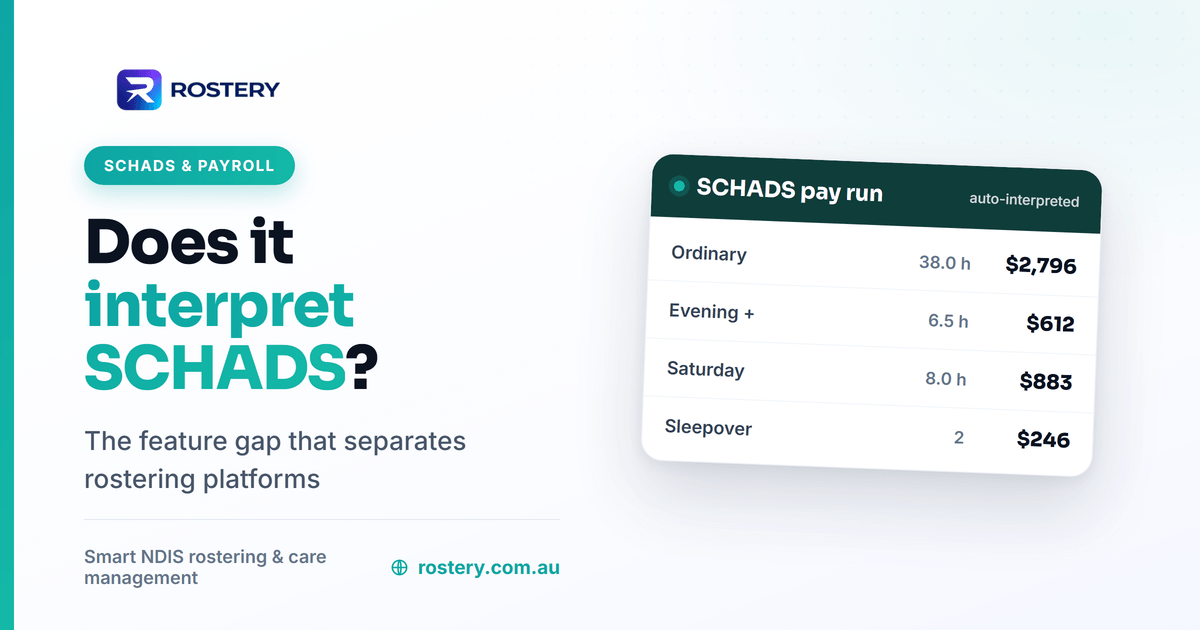
Rostery closes that gap by interpreting the award inside the roster. You see the award-correct cost of a shift before you publish it, which means fewer surprises at pay time and a cleaner audit trail linking the roster to the pay.
Pricing and transparency
Neither vendor publishes a full public price list, which is common in the NDIS software market. SupportAbility's pricing is quote-based — you contact the company for a demo and a tailored quote rather than seeing per-user pricing online. Rostery publishes its plans on the Rostery pricing page, so you can size the cost against your participant and staff numbers before you book a call.
When you compare quotes, look past the headline number:
- What's included vs add-on? Payroll exports, mobile app access and extra sites are sometimes bundled, sometimes charged.
- Implementation and migration cost. Moving participant data and historical notes takes time — ask who does it and what it costs.
- The cost of the award gap. If award interpretation lives in a separate payroll system, factor in the payroll officer hours (and underpayment risk) that a rostering-level interpreter would remove.
Which should you choose?
Use this quick decision guide:
- Choose SupportAbility if your primary need is deep participant documentation, case notes, goal tracking and NDIS claiming, and your payroll is already handled cleanly by MYOB, HR3 or MicrOpay with a payroll officer who knows SCHADS.
- Choose Rostery if rostering volume and award-correct pay are your biggest headaches — lots of shifts, broken shifts, sleepovers and SIL rosters where getting SCHADS right the first time saves real money and risk.
Many providers end up weighing a billing-first platform against a rostering-first one. If that's you, it's worth reading our Rostery vs Brevity Care comparison too, and taking a close look at Rostery's SCHADS payroll feature to see the interpretation engine in detail.
How to run a fair comparison
Before you commit, put both tools through the same real-world test:
- Build one of your messiest real rosters — a SIL week with sleepovers and a broken shift — in each tool.
- Check whether the award-correct pay is visible at roster time or only after a payroll export.
- Generate a Bulk Payment Request and confirm it reconciles against the plan budget.
- Ask each vendor, in writing, who is responsible for SCHADS interpretation and what happens when the award rates change.
- Price the migration and the ongoing cost per active participant, not just the sticker price.
Whichever way you lean, the goal is the same: participants supported properly, staff paid correctly under SCHADS, and claims that reconcile at audit.
Frequently Asked Questions
Is Rostery or SupportAbility better for NDIS providers?
It depends on your biggest pain. SupportAbility is stronger for participant documentation, case notes and NDIS claiming. Rostery is stronger for rostering volume and SCHADS Award interpretation, because it validates award-correct pay inside the roster rather than relying on a separate payroll system.
Does SupportAbility interpret the SCHADS Award?
SupportAbility's documentation states that the payroll system is responsible for award interpretation on the exported timesheet data. It integrates with MYOB AccountRight, HR3, Payroll Metrics and Sage MicrOpay, which (together with your payroll officer) apply the award rules. Rostery, by contrast, interprets SCHADS within the rostering tool itself.
How much does SupportAbility cost?
SupportAbility does not publish pricing publicly — you request a demo and a quote directly from the company. Rostery publishes its plans on its pricing page, so you can estimate cost against your participant and staff numbers up front.
What accounting and payroll systems does SupportAbility integrate with?
At no extra licence cost it integrates with finance systems including Xero, MYOB AccountRight and QuickBooks/Reckon (via Zed Axis), and payroll systems including MYOB AccountRight, HR3, Payroll Metrics and Sage MicrOpay. Custom enterprise integrations are available at additional cost.
Can I switch from SupportAbility to Rostery without disrupting services?
Yes, with planning. Export your participant and roster data, run both systems in parallel for one pay cycle, verify that award-correct pay and Bulk Payment Requests reconcile, then cut over. Ask your new vendor who manages the migration and how historical notes are preserved for audit continuity.


