
Support at Home Software for Aged Care Providers
- Aged care and NDIS on one roster
- Quarterly budgets from the classification
- Claims and statements built for you
- Aged Care add-on, $349 a month
What it does
Support at Home, run the way the program works
Support at Home has its own rules: a quarterly budget, contributions by service category, care management set aside and claims to Services Australia. Each part has its own screen.
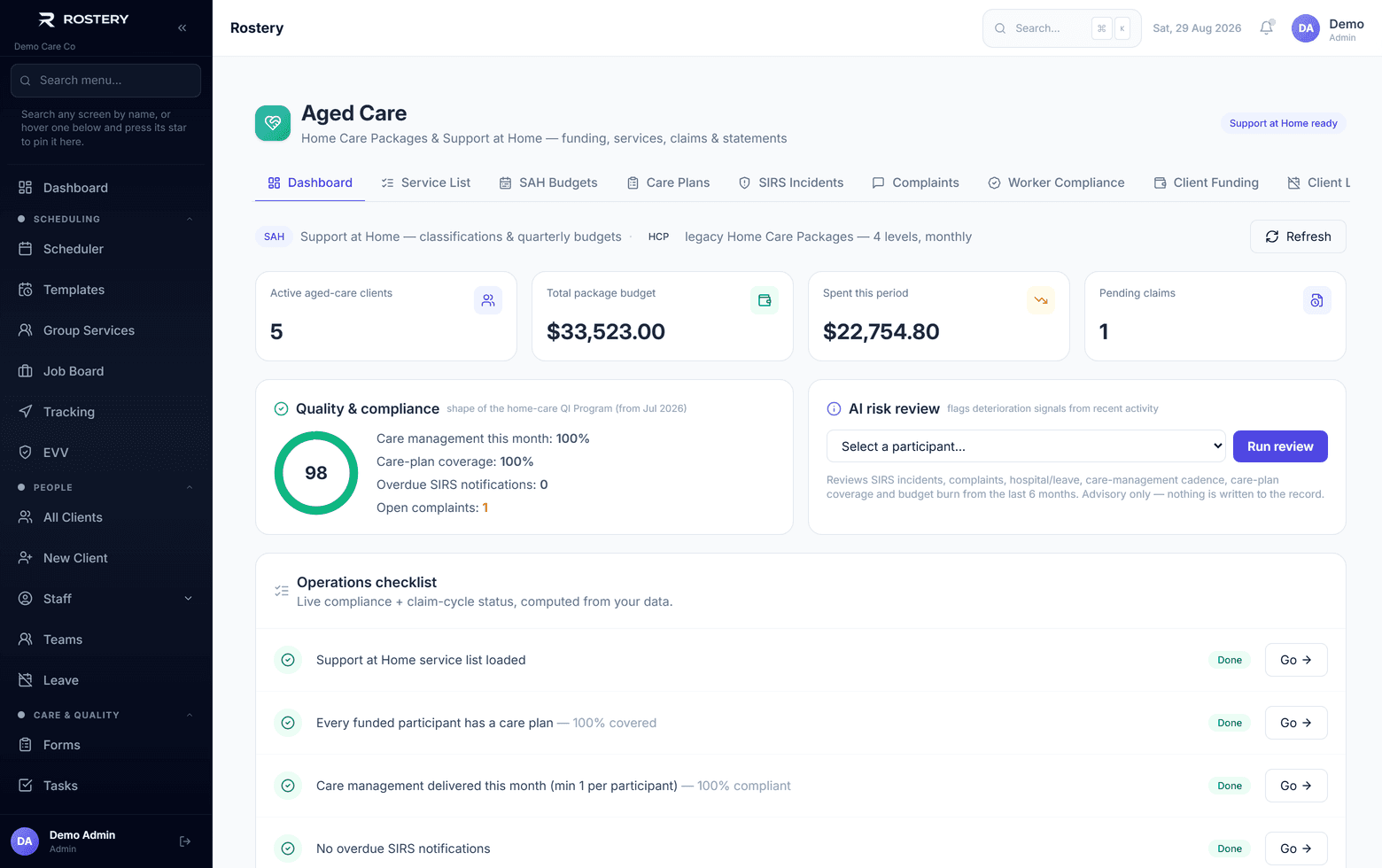
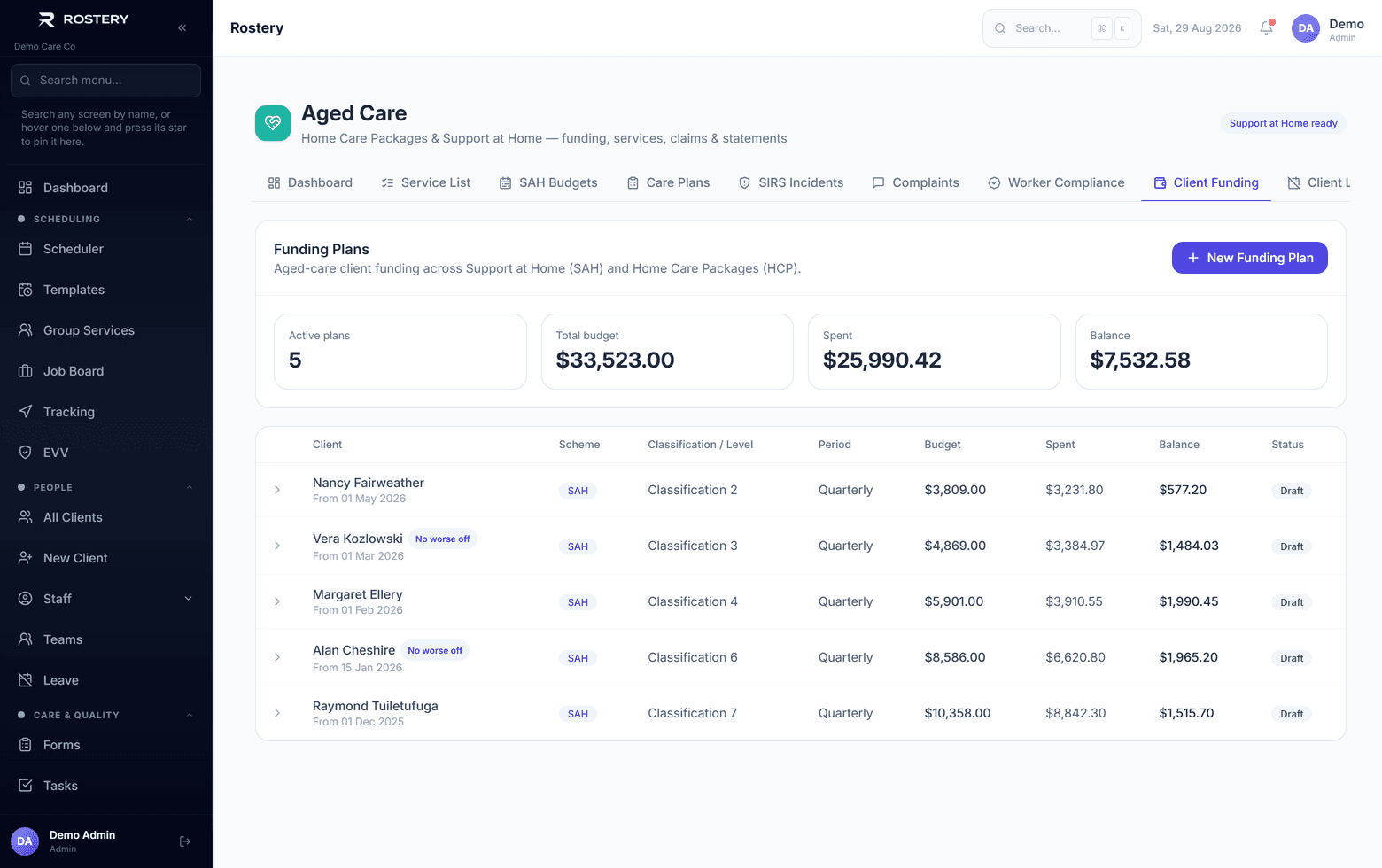
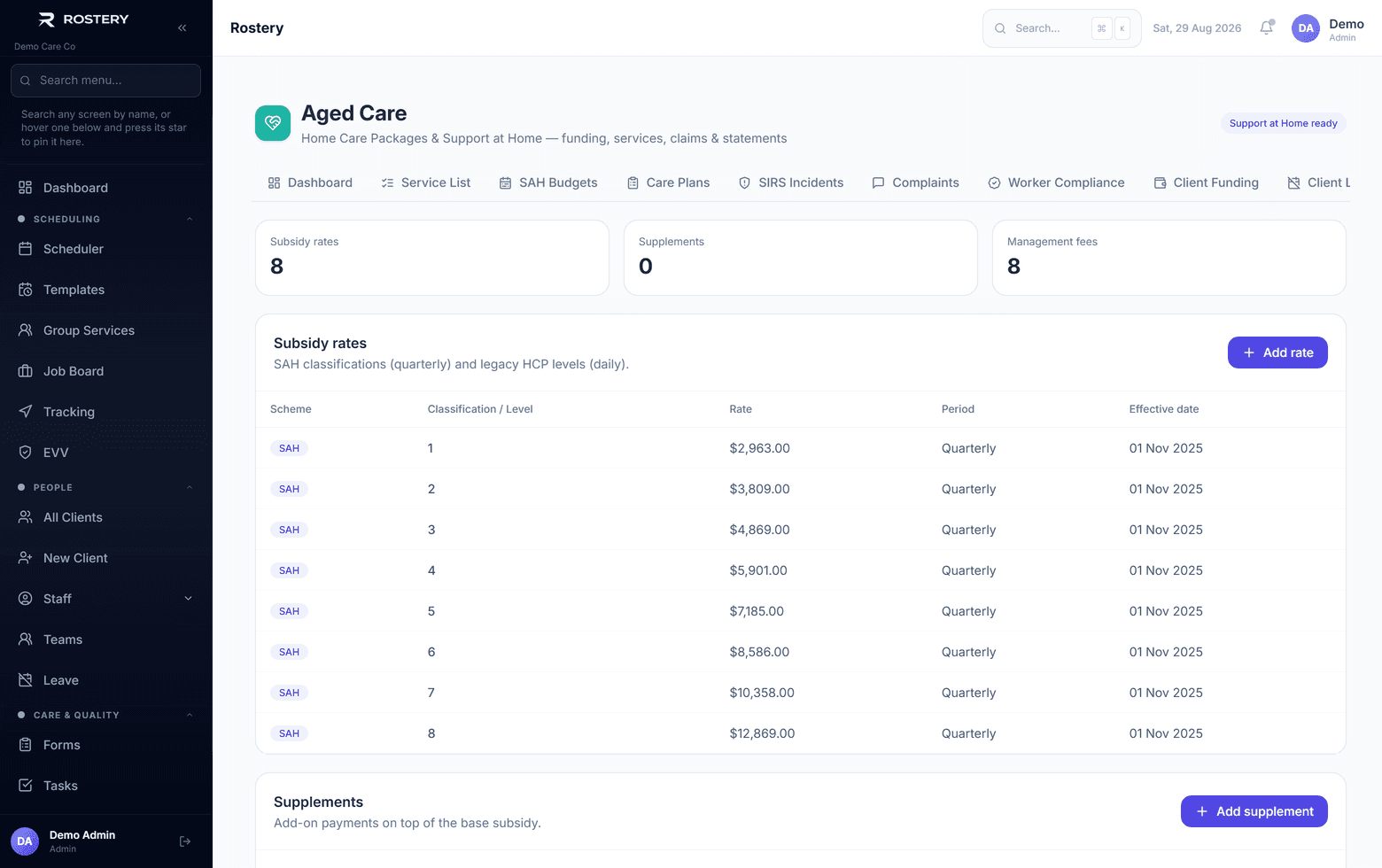
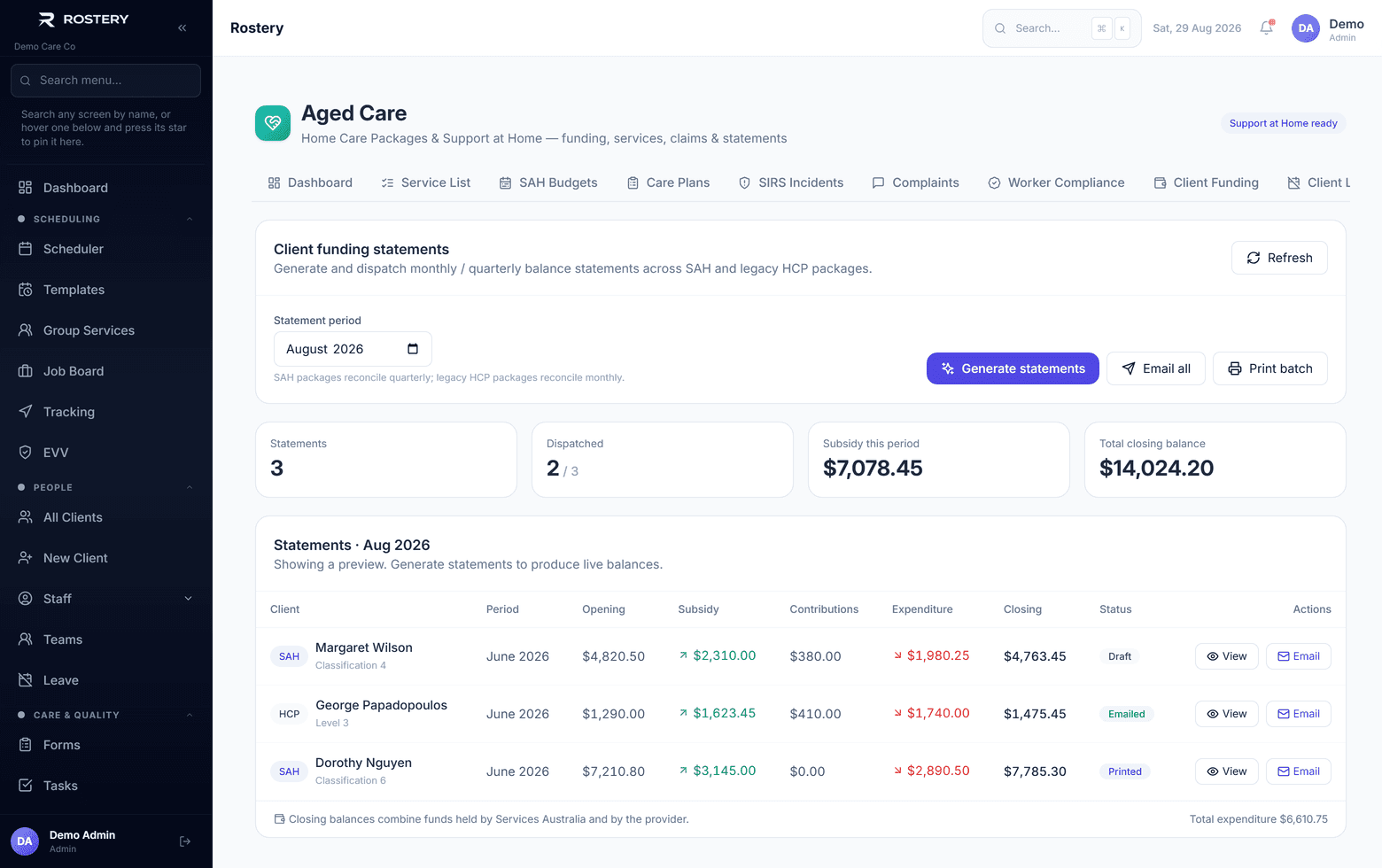
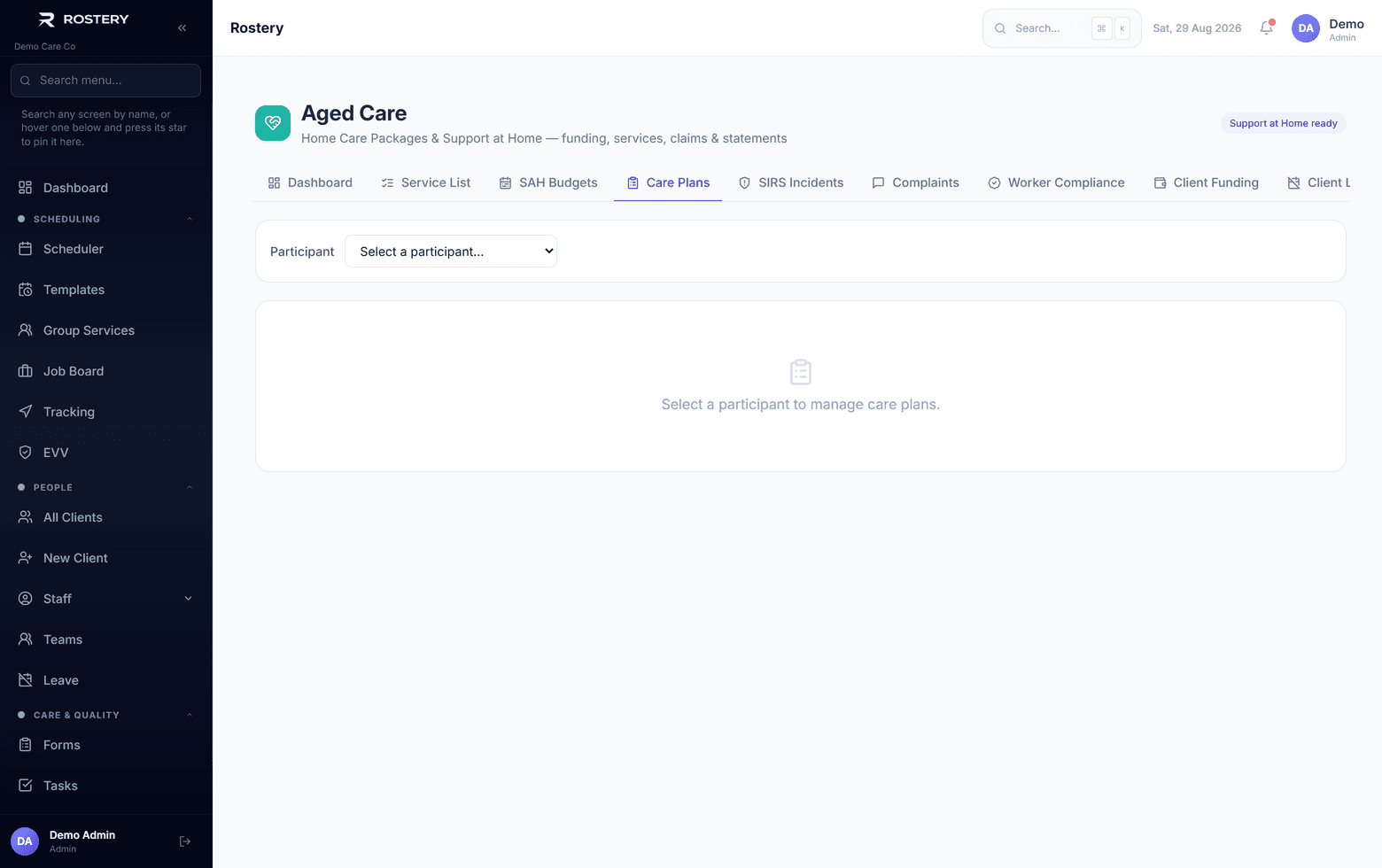
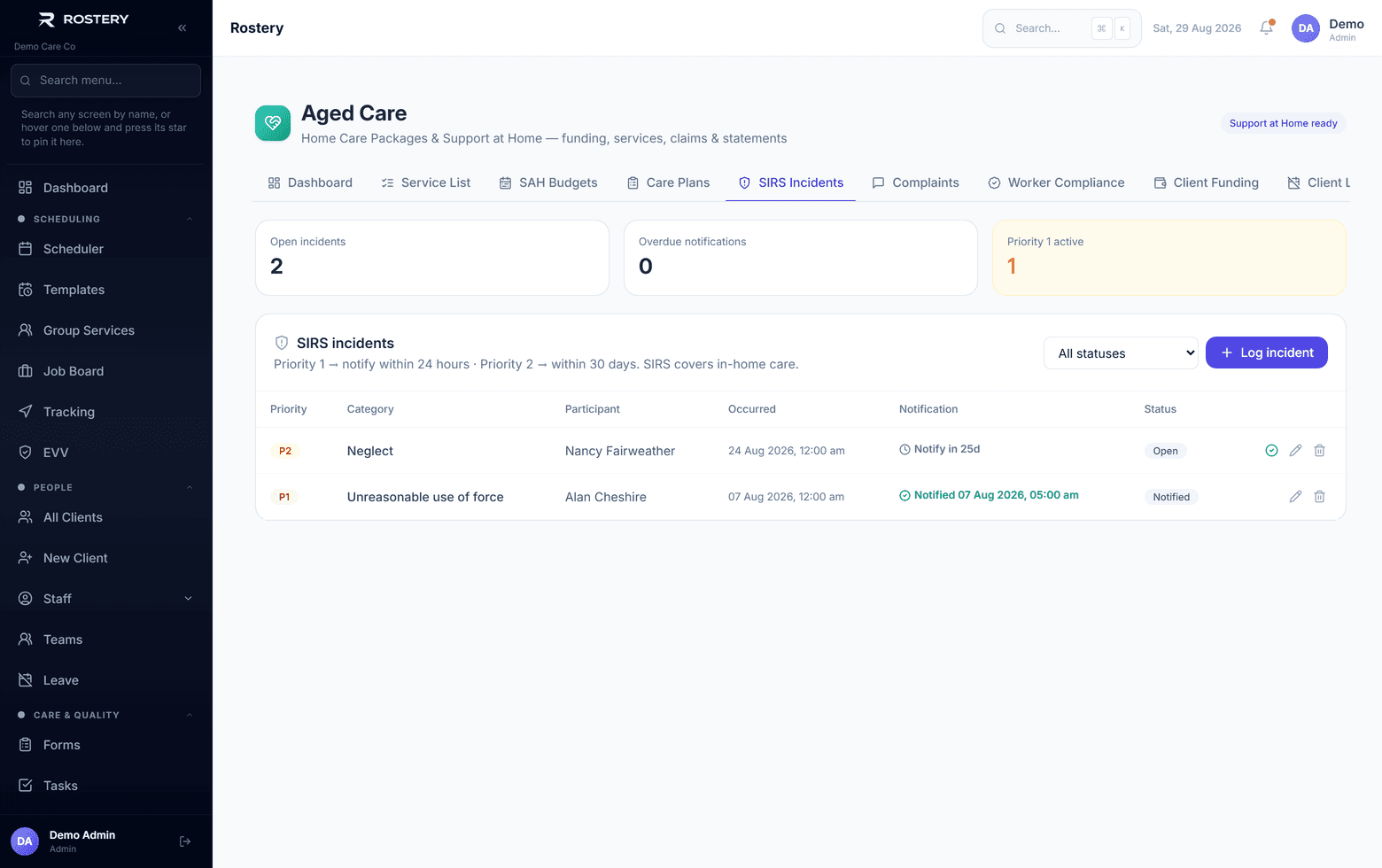
What Support at Home software has to handle
Since 1 November 2025, home care for older people has run under Support at Home. Each participant has an ongoing classification from 1 to 8, which sets their quarterly budget, and 10% of it is set aside for care management. Services must be in the person’s Notice of Decision, participants contribute by service category, and providers claim from Services Australia each month.
| Classification | Annual amount | Quarterly budget |
|---|---|---|
| Level 1 | $11,031.56 | $2,757.89 |
| Level 2 | $16,483.55 | $4,120.89 |
| Level 3 | $22,580.93 | $5,645.23 |
| Level 4 | $30,528.15 | $7,632.04 |
| Level 5 | $40,809.27 | $10,202.32 |
| Level 6 | $49,461.91 | $12,365.48 |
| Level 7 | $59,776.80 | $14,944.20 |
| Level 8 | $80,294.00 | $20,073.50 |
Amounts from 1 October 2026, from the Schedule of Subsidies and Supplements for Support at Home. Work out a participant’s budget and contribution in the free Support at Home calculator, check what each service covers in the Support at Home service list, and read the Support at Home funding levels guide.
Why aged care rostering needs its own checks
In NDIS work, a shift with no funding behind it is a billing problem. In Support at Home it can also be a compliance problem: a service outside the Notice of Decision, a visit with no signed agreement or care plan, or a worker whose screening has lapsed. Rostery checks those at the moment the visit is published, not after it has been delivered.
- No funding plan, signed agreement, care plan or quarterly budget, or not enough budget left.
- The service is not linked to a Support at Home item, or is not in the participant’s Notice of Decision.
- The worker’s screening has expired.
Workers see the care plan for the visits they are rostered on, without clinical notes, and participants and families can sign in to see their budget, statements and care management.
Support at Home and NDIS in one system
Many providers deliver both. Rostery keeps the two programs’ money apart (NDIS price limits and claims on one side, Support at Home budgets, contributions and claims on the other) while the roster, staff, timesheets and SCHADS pay are shared. See the rest in NDIS software for providers, and check incident priority with the free SIRS Priority Checker.
Pricing
Simple monthly plans, priced by size
Support at Home runs on the Aged Care add-on at $349 a month, excluding GST, on any plan. Plans are priced by the number of active participants.
For new and small providers finding their feet
$199 /month
AUD excl. GST · $166/month billed yearly
- ✓Up to 25 active participants
- ✓Up to 15 staff accounts
- ✓1 branch / location
- ✓NDIS price book (2026-27 official catalogue)
For established providers scaling their operation
$499 /month
AUD excl. GST · $416/month billed yearly
- ✓Up to 75 active participants
- ✓Unlimited staff accounts
- ✓Up to 3 branches
- ✓NDIS price book (2026-27 official catalogue)
For multi-site providers and larger teams
$999 /month
AUD excl. GST · $833/month billed yearly
- ✓Up to 200 active participants
- ✓Unlimited staff accounts
- ✓Up to 10 branches
- ✓NDIS price book (2026-27 official catalogue)
For groups, franchises and multi-entity providers
$0 /month
AUD excl. GST · $0/month billed yearly
- ✓Unlimited participants
- ✓Unlimited staff accounts
- ✓Unlimited branches
- ✓NDIS price book (2026-27 official catalogue)
Prices in AUD, excluding GST. Compare every plan in full.
Questions people ask
What is Support at Home software?
Software that runs a Support at Home provider: rostering visits, tracking each participant’s quarterly budget from their classification, working out contributions, setting aside care management, sending monthly statements and claiming from Services Australia. Good software also stops a visit going ahead when the funding or paperwork behind it is missing.
Is Rostery aged care rostering software?
Yes. Aged care visits are booked in the same scheduler and with the same staff as NDIS work. A visit is held back from being published when the participant has no funding plan, signed agreement, care plan or quarterly budget, when the budget will not cover it, when the service is not in their Notice of Decision, or when the worker’s screening has expired.
Does Rostery lodge Support at Home claims with Services Australia?
No. Rostery builds the bulk claim file and you import it in the Aged Care Provider Portal. When the payment statement comes back, Rostery reconciles it line by line.
Can Rostery run NDIS and aged care together?
Yes. The Aged Care add-on runs alongside NDIS service delivery in the same system, on the same roster and staff, rather than as a separate product.
Are CHSP and home care packages supported?
Yes. CHSP is supported with DEX reporting, by bulk file or web services, and legacy home care packages are supported alongside Support at Home.
How much does Rostery cost for Support at Home?
Support at Home runs on the Aged Care add-on at $349 a month, excluding GST, on any plan. Plans start at $199 a month for up to 25 active participants. There are no lock-in contracts.
See a Support at Home quarter in Rostery
Book a demo and we’ll show you a quarter’s budget, a held visit, a monthly statement and the claim file on your own participants.